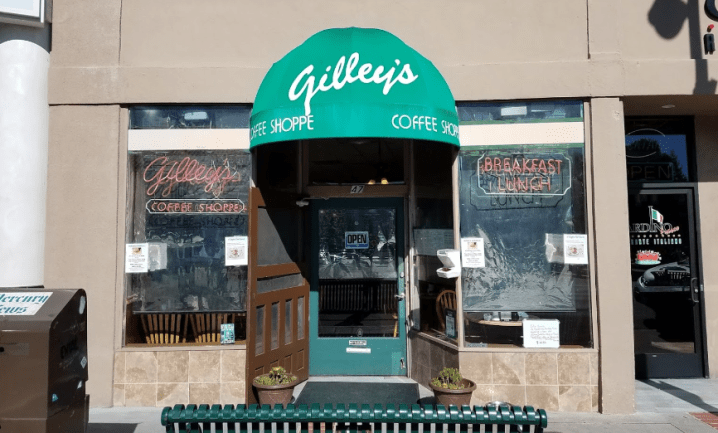
 Immediately after the Loma Prieta Earthquake, nothing was open for business downtown on North Santa Cruz Avenue south of Bean Avenue. As buildings were inspected for safety and cleaned up, sections of cyclone fence that had kept everyone out were slowly and systematically moved out so that businesses on the east side could open for business. The same slow process was repeated on the west side, moving south from the corner at Bean Avenue, but did not get very far. The old Los Gatos Cinema, as well as the several other building between it and the seemingly destroyed old La Canada Building on the southern corner of the block, were too badly damaged for the fence to be removed.
Right there next door to the Cinema where the fence stopped moving, Gilley’s Coffee Shoppe happened to be one of the fortunate businesses that was able to open for business again, and serve breakfast and lunch to those so diligently reconstructing downtown. It had always been there, longer than anyone can remember. Older people knew it as the ‘Sweet Shoppe’, a soda fountain that was very popular with those who cruised North Santa Cruz Avenue. It was the last of the first business that that moved into the old Cannery Building when it was converted to retail stores. Gilley converted it to more of a coffee shoppe and named it after himself in the 1970s. While everything in Los Gatos changed around it, Gilley’s remained about the same. Everyone knows Gilley’s.
I had not gone there more than a few times prior to the Loma Prieta Earthquake. I was away at school for the second half of the 1980s, and just did not go downtown much while in high school or earlier. I stopped by on the way to work early one autumn morning in 1990 because it was the only restaurant that was open in the recovering downtown neighborhood It instantly became my place to go for breakfast, and sometimes for lunch. It was nothing fancy, but it was what I wanted.
For the past twenty eight years, Gilley’s was where many of my work days started. I used their tables to sketch out irrigation systems and small sections of landscapes. I met clients there rather than at my home office. Back when I was able to write about local gardening events in my gardening column, I conducted interviews there. Readers sometimes brought me pieces of plants for identification, or for diagnoses of a disease. When Gilley’s sold and was prettied up a slight bit in the early 1990s, I procured small potted bromeliads, and later, cut flowers for the tables. Before permanent succulent were installed into the big pots flanking the door, I cycled flowering annuals for a little bit of color out front. A whole lot of horticulture went on at Gilley’s.
Sadly, nothing is permanent. Los Gatos is always changing, just like it has always done. By the time you read this, after 3:00 on September 30, 2018, Gilley’s will have closed for the last time.
Showy Stonecrop
 They sure took their time getting this far along. The bluish green succulent foliage of showy stonecrop, Hylotelephium spectabile, (formerly Sedum spectabile) first appeared at ground level in early spring, and has been growing into rounded mounds so slowly that it now stands less than three feet high and wide. Smaller types are half as big. Blooms are only now beginning to turn color.
Broad and flat-topped floral trusses of minute flowers are almost always some sort of pink. Sometimes, they are almost terracotta red. Sometimes, they are somewhat peachy. They might even be blushed with a bit of lavender. ‘Stardust’ blooms white. The biggest blooms can be as wide as five inches. If not pruned away as they fade, the blooms (according to some) dry nicely by winter.
New growth starts to appear from the ground almost as soon as old stems die in late winter. Established clumps can be divided in spring every few years. Even small plants can spare a few small pups that will grow into new plants. Stems might get taller in partial shade, but might also need to be staked as they bloom. Bees really flock to the flowers because not much else blooms so late.
Cacti Are Notorious For Nonconformity
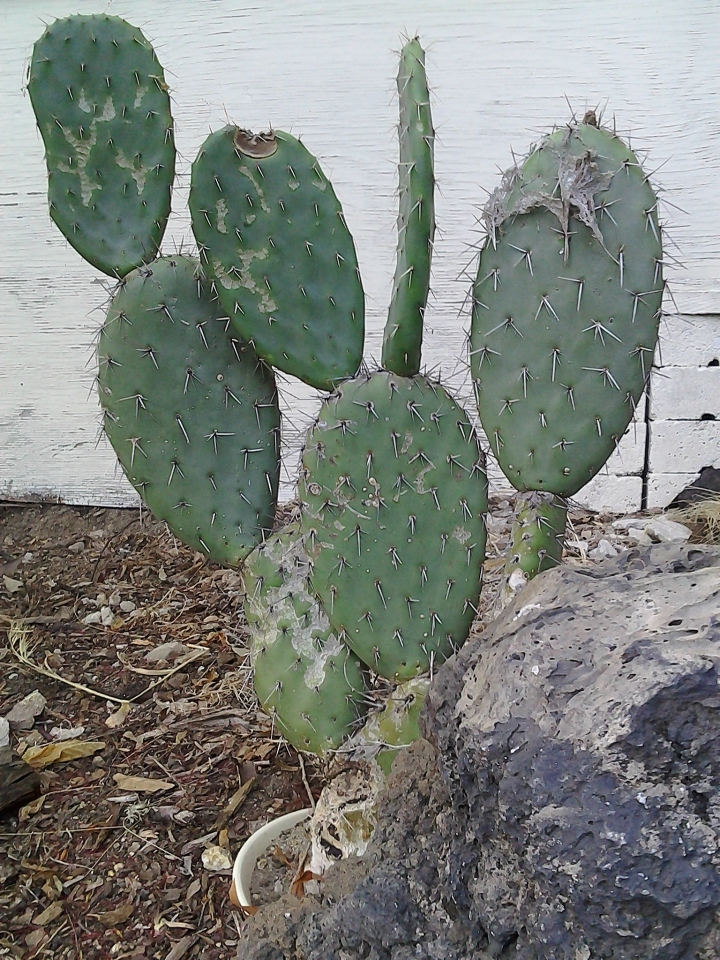 Almost everyone thinks of cacti as tough plants that live out in the hottest and driest parts of the deserts, where few other plants can survive. They are the sorts of plants that we threaten to plant out in the most inhospitable or neglected parts of the garden. We never actually do so, just because we do not appreciate cacti any more than weeds. They are fine over in the neighbor’s garden.
Whether we like them or not, cacti really deserve more respect than that. Even if they do not fit our style of landscape, they are striking and distinctive features within the landscapes that they are adapted to. Except for a few euphorbs that look sort of like cacti, there are no substitutes for their form and, of course, their texture! The uniquely specialized physiology of cacti is extraordinary.
Cacti really are built for the desert. In a climate where heat and arid air desiccates foliage, cacti do without. Photosynthesis is done in the green skin of the distended stems. Furrows in the stems of some cacti increase surface area for photosynthesis, but still expose far less surface area to the weather than individual leaves would. The succulent flesh of the distended stems stores water.
The foliage is not totally lacking. It is merely modified into sharp spines or irritating glochids with which cacti protect their succulent flesh from animals. Spines of the old man cactus are elongated into coarse hair that diffuses the intensity of the sunlight that might otherwise scorch the green skin below. Bigger thorns that extend beyond the spines within each tuft are actually modified stems.
Cacti certainly put significant effort into surviving desert climates; but surprisingly, most cacti do not even live in deserts, and many live in tropical rainforests of South and Central America! Some have weirdly pendulous stem structure, and some are epiphytic, so they hang from limbs of larger trees. In regions where most insect and animal activity is at night, cacti bloom nocturnally, with big luminescent and fragrant flowers that appeal to moths, bats and their associates.
Queen Victoria Agave
 Although a relatively small agave, the Queen Victoria agave, Agave victoriae-reginae, is also one of the most striking. Mature plants form dense foliar rosettes that are between only a foot, and a foot and a half tall and wide. What is so striking about them is the abundance of stout succulent leaves that can be so densely set that some older plants look like big, round and green pine cones.
Genetic variability within the species is considerable though; so not all plants will be so well rounded. Some resemble dark green aloes while young. All are adorned with distinctive white stripes on leaf margins, and wherever the leaves were touching the margins of other leaves before they unfurled. At least one cultivar is also variegated with white, and another is variegated with yellow.
Queen Victoria agave is bold either in the ground or in a large pot. Wherever it goes, it wants full sun exposure, and should be out of the way. The terminal foliar spines are very sharp! It does not need much water, but prefers occasional watering. Old rosettes might bloom with tiny pale white flowers on dramatic three or four foot tall spikes, but then die as they get replaced by basal pups.
Foliar Tapestries
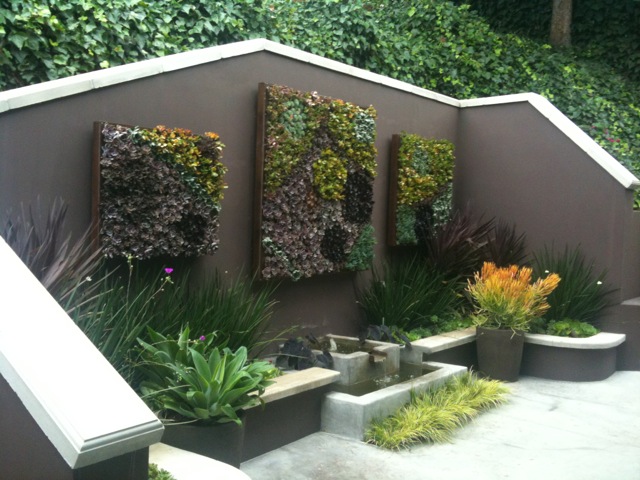 Succulent foliage is remarkably variable, even without bloom. There are so many unusual colors, textures and patterns to choose from. Many are complimentary to others. Many contrast exquisitely. What better way to display some of the favorites than to assemble them into a succulent foliar tapestry!?
This is actually old technology that started to become a fad again only somewhat recently, after these foiar tapestries were installed on a retaining wall in North Hollywood a few years ago by GreenArt Landscape Design. Small cuttings of succulent plants were plugged into rigid mesh panels that hold growing medium vertically against another flat panel of the same size. The whole contraption was suspended against the concrete wall, with a bit of space in between to limit staining and bleeding onto the wall.
With the fountain, potted plants and other features, the limited space was insufficient for a hedge to obscure the retaining wall. Besides, the uniform foliage of a hedge or clinging vines climbing upward, or cascading plants hanging downward, would have been rather boring. These foliar tapestries look like artwork that might hang on walls inside the home, except that they are outside, visually extending the interior living space out onto the patio.
Foliar tapestries certainly are not for everyone. There is nothing ‘low maintenance’ about them. The small plants must be groomed regularly, and trimmed to stay flat. Flowers will need to be snipped off before or after bloom. The heavy planters must only be installed onto concrete walls or walls that are able to support the weight, and must be installed properly to avoid staining and bleeding. Wooden walls would be likely to rot so close to so much moist growing medium. However, as you can see, in the right situation, such tapestries are worth the effort.

Candelabra Aloe
 As a group, aloes really deserve more respect. Many will naturalize and thrive with only occasional watering through summer. Candelabra aloe, Aloe arborescens, wants a bit more water than most other aloes, but not much. It looks like a sensitive jungle plant, but is surprisingly durable, and very easy to propagate. Any pruning scraps can be plugged wherever new plants are desired.
The foliage alone is striking. Some might say that the loosely arranged foliar rosettes are sloppy. Others might say they are sculptural. The long and curved leaves are outfitted with prominent but soft marginal teeth. Some specimens have narrower leaves that are almost curled. ‘Variegata’ is striped with creamy white. Mature plants may form dense mounds more than six feet high. Hummingbirds and bees really dig the flashy bright reddish orange floral trusses that bloom on tall stems in winter.
Pebbles
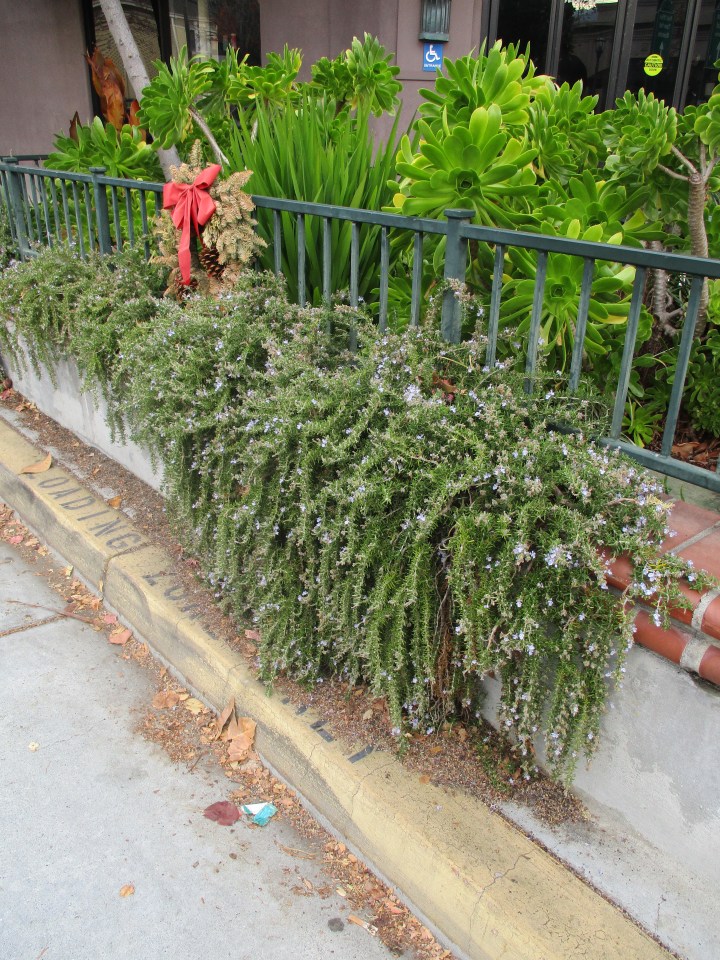 My little planter box downtown that I wrote about last week and earlier must be the weirdest garden that I have ever tended to. ( https://tonytomeo.wordpress.com/2017/11/04/my-tiny-downtown-garden/ ) I certainly enjoy it. There are not many horticultural problems that can not be remedied by simply removing plants that should not be out there anyway. The weirdness though is just . . . weird . . . and unique to the situation of a tiny garden in such a public space.
I have had weird neighbors before. Hey, I live where I do. Well, a resident of Nicholson Avenue saw me working on my garden one day and stopped to tell me what I should plant in it for compatibility with the color scheme of the front garden of her home a block and a half to the west. You see, she payed a lot of money for her home, and I payed nothing for my planter box that belonged to the town that her expensive taxes sustain. I just smiled and nodded my head until she drove away. I then continued to plant flowers that were compatible with the color scheme of Mike’s Bikes, the bicycle store that my planter box happens to be in front of.
Being in front of a bicycle store, the planter box collects quite a bit of discarded bicycle parts. Just about any part that can be purchased in the store and changed on the sidewalk out front has ended up in the planter box. I also find nice beer and wine glasses discarded by patrons of local bars. A worse aspect of the proximity to bars is that those who imbibe excessively sometimes barf into the planter box. Speaking of puddles, a contractor who was doing some tile work at Mike’s Bikes dumped a bucket of slurry from the mortar into my planter box, leaving a puddle of mortar that solidified into a round concrete disc about two and a half feet wide and an inch and a half thick. Cannas, housleeks, aloes and nasturtiums were all encased, and had to be removed with the concrete!
I prefer to grow flowers that are small and abundant rather than larger flowers that would be missed when they get taken. My bronze houseleek has been trying to grow as long as the green houseleeks, but gets broken off and taken as soon as it starts to look good. I figured that nasturtiums were too abundant to be missed if someone too a few. Yet, I noticed that so many were getting taken that the blank flower stalks were more evident than developing flowers. When I confronted someone who was taking them and putting them in a big plastic bag full of plucked nasturtium flowers, she told me that they are edible. So? I certainly do not mind sharing; but if anyone wants to eat THAT many of them, they should grow them in their own garden!
On another occasion, someone stopped to tell me that rosemary is a useful culinary herb, as if it were not something that a horticulturist would know about, and then yanked a huge chunk of it from the meticulously tailored rosemary that cascaded so nicely over the wall of the planter box before I could chase him away. Another chunk of rosemary was burned by the exhaust of a car that was left idling in the loading zone while a client of Mike’s Bikes was inside retrieving his bicycle from the repair shop. The drama just never ends.
But there is one oddity that I neither mind nor tamper with. It has not become a problem yet. On the north side of the planter box, adjacent to the backside of a park bench, pebbles and small stones have been gathering for a few months. Some disappear as new ones arrive, so that there are never too many at any one time. At first, I thought that they were just some of the detritus that someone flung aside after sweeping out their car while parked at the curb. Yet, there is no other trash or debris associated with the stones. They happen to be in the only spot that has been undefiled by discarded bicycle parts, glasses or barf. They seem to be placed quite deliberately in small groupings and patterns. They reminded me of those small stones that some people like to place in gravel Zen Gardens. I really do not know why they are there; but if someone is able to enjoy this little garden downtown in that way, than I probably should not interfere. The pebbles remain.
Well, Well, Well!
 Right next door to my downtown planter box, ( https://tonytomeo.wordpress.com/2017/11/04/my-tiny-downtown-garden/ ) just to the east on Nicholson Avenue, there is a tree well for a small London plane street tree that has not grown much in the past few years since it was installed. The poor tree is in a difficult situation. It probably does not mind getting bumped with car doors every once in a while, but bicycles getting chained to it have been abrasive to the bark of the main trunk. The location next to a Mike’s Bikes does not help. The staff at Mike’s Bikes has had limited success with promoting the use of a nearby bicycle rack instead, by displaying their own bicycles next to the tree.
The tree well collects a bit of trash that gets blown about by the wind. Weeds are sometimes able to grow up through the mulch of detritus. No one wants to pull the weeds or collect the trash because dogs do what dogs do on street trees. The crew that comes by to water young street trees through spring and summer occasionally stops to pull weeds and remove trash. As the tree eventually grows, they will cut more rings out of the grate to accommodate the expanding trunk. For now, the grate is only a few inches away from the trunk and the stake.
My planter box next door generates quite a bit of biomass. Some of it gets shared with neighboring planter boxes. The big houseleeks have really gotten around town. Two large specimens were installed into a pair of urns that flanked the front door of Mike’s Bikes, although only one remains. The nasturtiums that get so impressive through winter and into spring are even more prolific and generous with their seed. Cuttings of other minor succulents have been shared as well.
The tree well was a bit too vacant. We all know that the Public Works Crews take care of it, and no one want to tamper with that. Well, maybe. You know, houseleek and nasturtium can be so prolific. Nasturtium will drop their seed anywhere, and some unavoidably found their way into the tree well, where they grow right around the trunk. They do not go much farther without getting trampled back into bounds. A big cutting of houseleek seemed like it would be a good companion to the nasturtium, and adds a bit more substance. It grew like a weed last year before getting roasted and broken over summer. It is making a comeback now, with nasturtium seedlings appearing around the base. The Public Works Crews do not seem to mind them. Both the houseleek and the nasturtiums inhibit weed growth, and neither mind what dogs do to them. Well, well, well, the tree well gets a happy ending.
Six on Saturday: My Downtown Planter Box – again and up close this time.
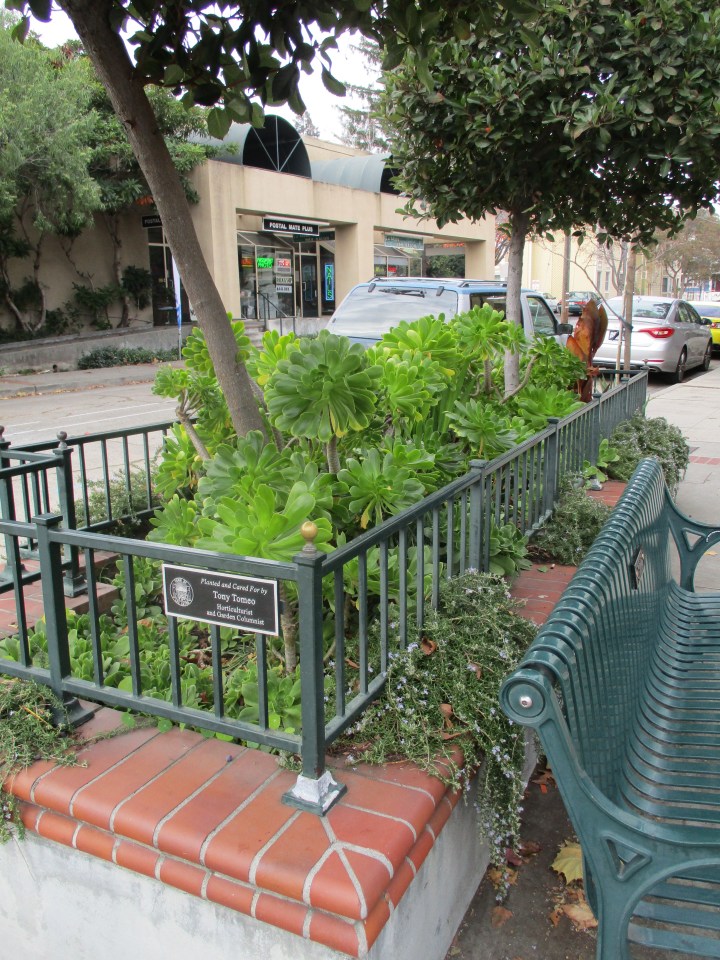
At the northwest corner of Nicholson Avenue and North Santa Cruz Avenue, in front of Mike’s Bikes, is my little downtown planter box. ( https://tonytomeo.wordpress.com/2017/11/04/my-tiny-downtown-garden/ ) That little brass plaque in front has my name on it. Everything is starting to recover from summer, and will look even better when the nasturtiums come back later in winter.
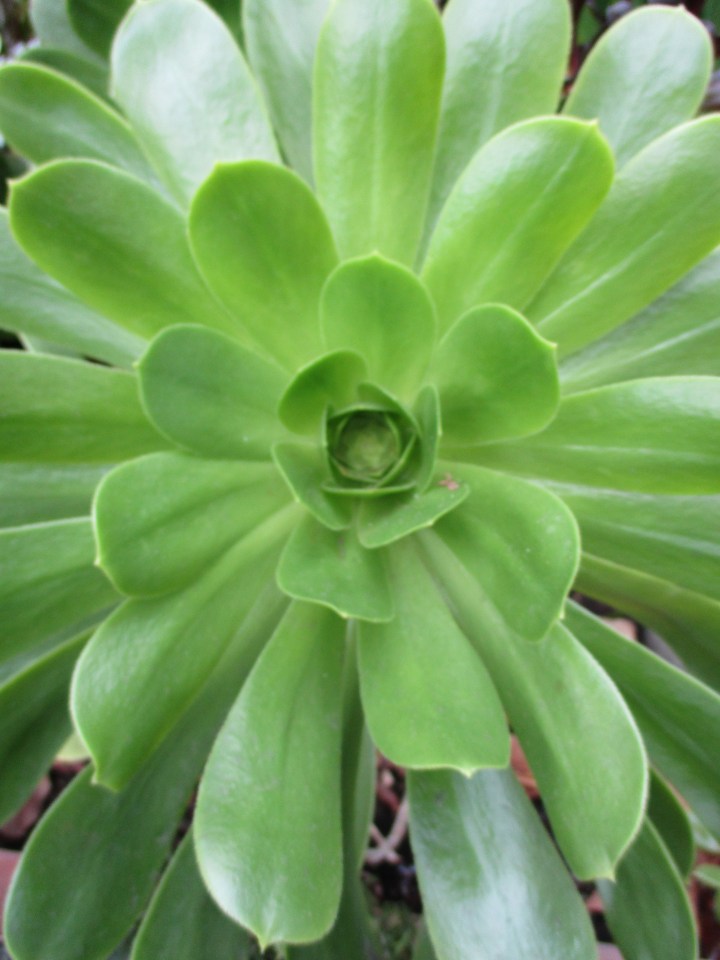
Most of the main plants were grown from cuttings taken from the home of a friend’s mother as we were emptying it out after she passed away. She lived in Monterey, and was a direct descendant of the first Spanish people to arrive in Monterey! Of the plants pictured here, only the dusty miller in the last picture is not from those cuttings. There are two of these big common housleeks, and a few of their babies.

This bronze houseleek is as old as the two big green ones but always gets broken off and stolen whenever it tries to grow big enough to get noticed. I really should grow more cuttings of it when I can, just in case the entire plant gets stolen.
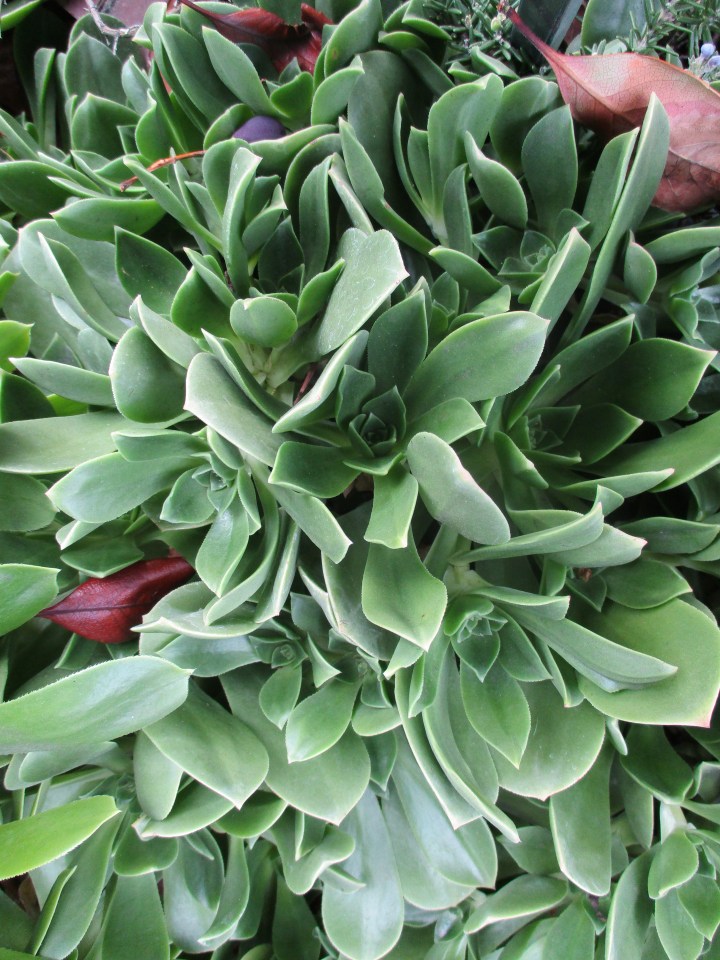
I refer to this one as an aeonium (or houseleek) as well; but it is really something else. I just do not know what it is.

I do not know what this aloe is either. The foliage is pretty cool, but I think that the bloom will be even better!

This dusty miller was added to contrast with so much pale green foliage. I love the housleeks and the nasturtiums that will grow later, but so much foliage of the same color looks rather bland. I also planted ‘Australia’ canna with dark bronze foliage.
This is my first ‘Six on Saturday’. I do not intend to make a habit of it, and would not get enough pictures anyway, but I might try it again once in a while.
This is the link for Six on Saturday, for anyone else who would like to participate:
https://thepropagatorblog.wordpress.com/2017/09/18/six-on-saturday-a-participant-guide/
My Tiny Downtown Garden
 Main Street and Santa Cruz Avenue are the two main streets of downtown Los Gatos. They are the main shopping district, and the part of town that everyone sees. As much as things have changed, a bit of the familiar remains. Gilley’s Coffee Shoppe is still next door to the (rebuilt) Los Gatos Cinema. The brick La Canada Building miraculously survived the Earthquake. The simple deco Park Vista Building across the street is just as elegant now as it was a century ago. There are still concerts in the Town Plaza in summertime, shaded by the Town Christmas Tree that gets lit up in December.
Both Main Street and Santa Cruz Avenue are outfitted with big planter boxes that give the downtown a more relaxed and colorful ambiance. Each planter is elevated about a foot and a half, and contains one or two Indian hawthorn trees. A low wrought iron railing protects the contents of the planter boxes. Irrigation s automated. That is about all that the planters have in common.
Each planter box is ‘adopted’ by a member of the community, or a community group, each with different styles and different ideas of what we should plant in our boxes. Some like things neat and trim. Others believe that bigger is better. Some like plenty of foliage. Others like lots of colorful flowers. Some planter boxes even get adorned with seasonal decorations.
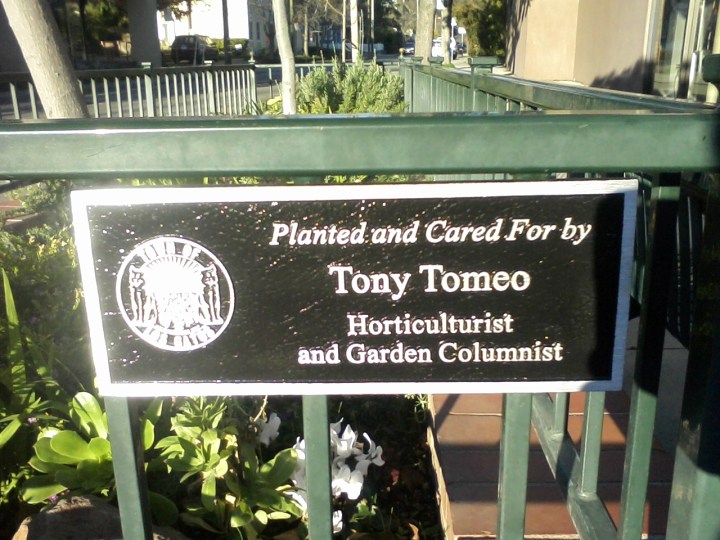
My little planter box is on the northwest corner of Nicholson Avenue and North Santa Cruz Avenue. It has a brass plaque with my name on it. It is my little garden space downtown, where I get to express my simple gardening style for everyone to see, even though I grow a few flowery things there that I would not actually waste space on in my own garden.
The trailing rosemary that cascades over the wall so nicely was there when I got the planter. So were the montbretia and liriope, which I did not want to remove because someone else had gone through the effort of planting them. When there was more space available, I planted a few inexpensive flowering annuals, like pansies and calendulas. As things grew, there was less space for annuals. Besides, I wanted to make a point of doing this planter nicely with sustainable plants that I propagated myself.
The two largest features are common aeoniums. The two original cuttings were on the dashboard in the car for weeks before I finally stuck them in the planter. They came from the home of a friend’s mother in Monterey. We emptied the home out after she passed away. It was gratifying that they found a home in my planter box, and even more gratifying that they grew so well and provided countless cuttings for copies all over town, including in other planter boxes. Between the two big aeoniums, there is a small bronze aeonium. It is the same age as the two big ones, but grows slower, and is regularly set back by people breaking off and taking the stems as fast as they grow.
These three aeoniums were not alone on the dashboard. They arrived with another related succulent, which I believe to be an old fashioned echeveria, and some sort of compact aloe. The echeveria has spread out over much of the area between the big aeoniums. The aloe is still confined to one corner.
To contrast with all the pale green foliage, I added two bronze ‘Australia’ cannas. They cost only a few dollars, and were probably my biggest expense in this entire project.
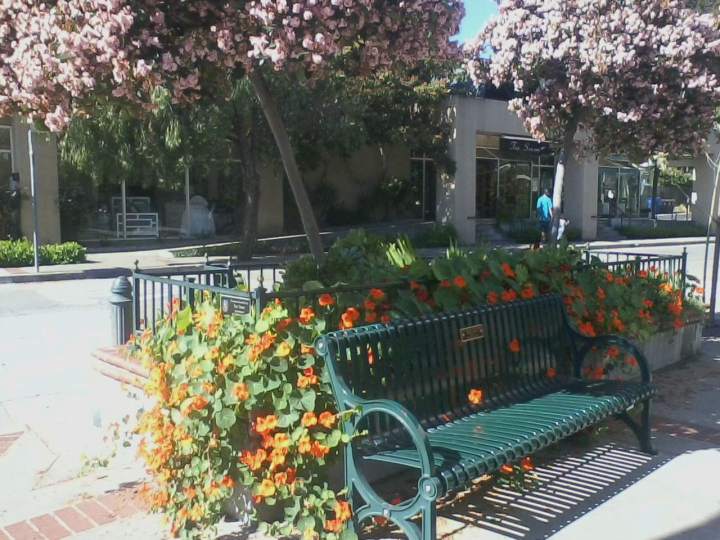
The most impressive feature of the planter box are the nasturtiums. Yes, common, simple and cheap nasturtiums. I wanted to get straight yellow nasturtiums for compatibility with the signs of the neighboring bicycle shop, but could not find any at the time. I instead started with the common ‘Jewels’ mix, which is still my favorite. After self sowing, the subsequent feral nasturtiums are only orange and yellow, with only one or two red blooming plants. What made them so excellent is how they grew! They overwhelmed the trailing rosemary (which is fine since they die back in summer when the rosemary takes over), and cascaded onto the walkway and curb. They filled the space between the railing and an adjacent bench, and even started growing through the bench. There was so much bright orange and yellow that no one seemed to mind that it was nasturtium.
After a long and warm summer, the aeoniums need serious grooming, and the nasturtium need to be replaced. I really hope that the planter box will be as impressive as it was last winter. The picture here is not very good. Perhaps I will get a better picture in a few months.
 Tony Tomeo