Norwegian Wood

P00222K
Isn’t it good?

This is really getting to be a problem. Too many feral plants that we find at work get canned as if they will eventually be installed back into a landscape somewhere. The small nursery where they recover until their relocation is getting crowded. Although many are practical and appropriate for such recycling within the landscapes here, some are not, so may be with us for a while.

Five feral Norway maple saplings were found in one of the landscapes where mature trees were pruned for clearance from a roof. We could not just leave them there. They eventually would have been overwhelmed by the rest of the forest, or grown too close to the same roof that we pruned other trees away from. They were very easily dug, so came back to the nursery with us.

It was too late to prune them as necessary. They are tall and lanky trunks, with too many comparably lanky branches. As much as I am instinctively compelled to prune them while they are bare and dormant, I will refrain until later in spring or summer, when they will not bleed so much. They look ridiculous. They seem happy though. Their buds are beginning to swell already.

We have no idea where they will go from here. After pruning, they should develop into exemplary specimens. As goofy as they are now, their trunks are remarkably straight. I happen to be fond of Norway maple, and would be pleased to find an application for them here. The problems is that there are too many trees here, and the forests and landscapes continue to make more!

Horticulture in a forest can be like that. It seems like there is plenty of space out there, but so much of the space is too shaded or too crowded.
Blow Out

P00216
Wind is messy!

While strong Santa Anna Winds were blowing through Los Angeles four hundred miles to the south, and Storm Ciara was arriving in Scotland and Norway, we were getting some remarkably strong winds of our own. They were not nearly as strong as winds that were causing so much damage in Europe, and involved no flooding rain, but they were dangerously messy nonetheless.

We live and work among dense forests of coastal redwood, the tallest tree species in the World. Beyond the upper edge of the redwood forests are more forests of huge Ponderosa pine. Huge Douglas fir are mixed throughout. Their understory includes trees that would be considered to be massive anywhere else, such as coast live oak, tanoak, Shreve oak, bay laurel and madrone.

Such big trees drop big limb, and in abundance. Furthermore, limbs that fall from such great heights are significantly more dangerous than those that fall from smaller trees that are closer to the ground. They gather major inertia on the way down. They do not necessarily fall straight down either, but can get blown significant distances to where falling limbs may not be expected.

While the winds were blowing through, I could hear crashing of falling limbs and entire trees from the mostly deciduous riparian forest outside. I know that many of the big cottonwoods, box elders, willows, alders and sycamores are deteriorating, but did not expect so many to be blown down while bare. I suspected damage would be worse among the bigger and evergreen trees.

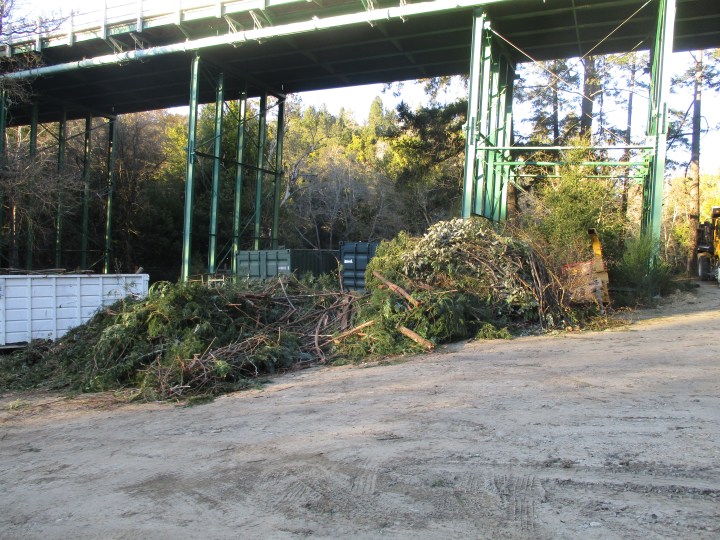
The pile to the left in the picture above is just the debris that was collected last Monday (while I was conveniently not here to help). It is more spread out but at least twice as voluminous as the pile on the right, which is pruning debris that took me several days prior to the wind to collect. The green cargo containers in the background demonstrate how big the piles of debris are.

More debris was collected on Tuesday (while I was still doing other work). The mess was not the worst of it. The roofs of a few buildings were impaled by falling limbs. Some of the damage is significant. Fortunately, the only big trees that fell did so into forested areas where there are no buildings, and electrical service was disrupted for less than a day. No injuries were reported.

Deciduous Fruit Trees Need Pruning

00122thumb
Dormant fruit trees will bloom soon.

Deciduous fruit trees have no business in a low maintenance landscape. They need as much specialized pruning while dormant in winter as roses need, and on a much larger scale. Neglected trees get disfigured by the weight of their own fruit. Disease proliferates in their thicket growth that develops without pruning. Overgrown trees produce most of their fruit where no one can easily reach it. Fruit that can not be harvested attracts rodents.

Of course, deciduous fruit trees are certainly worth growing if they get the specialized pruning that they need. Pruning concentrates resources so fewer but better fruits develop. Fruit bearing stems are better structured to support the weight of their fruit, and lower so that the fruit is easier to reach. Pruning also promotes more vigorous growth, which is less susceptible to disease and insects.

Now that it is February, and the weather has been unusually warm, deciduous fruit trees that have not yet been pruned will need to be pruned very soon. They will be sensitive to such major pruning once they start to bloom. The pruning is too specialized to explain here in just a few sentences. Fortunately, Sunset publishes an very detailed book about “Fruit Tree Pruning” that explains how to prune each of the different fruit trees. Pruning will be more extensive each year as trees grow, but also becomes more familiar.

Stone fruits like apricots, plums, prunes, nectarines and peaches (that have hard seeds known as stones), need the most severe pruning. Their fruit develops on stems that grew last year. These stems should get cut short enough to support the weight of the fruit expected to develop next year. The ‘four Ds’, which are dead, dying, damaged and diseased stems, should get pruned out as well. Cherries and almonds do not get pruned as much because their fruit is so lightweight; and out-of-reach almonds simply get shaken down anyway.

Apples and pears are pomme fruits that need similar pruning, but also produce on stunted ‘spur’ stems that should not be pruned away. Spurs may continue to be productive for many years. Figs, persimmons, pomegranates, mulberries and grapevines all need their own specialized styles of pruning.

California Sycamore

00212
California sycamore is a stately native.

California sycamore, Platanus racemosa, is a riparian species that wants to be a chaparral species. It seems to passively mingle with valley oaks and coast live oaks in chaparral regions. Yet, it stays close to rivers, creeks, arroyos, or low spots where water drains from winter rain. California sycamore does not follow waterways far up into forests though, as if it dislikes the deeper shade.

In urban situations, California sycamore is best for large scale landscapes, such as parks or medians of broad boulevards. It is complaisant enough for smaller landscapes, and tends to disperse roots too deeply to damage pavement. However, it grows so fast and so very big. Mature trees get to a hundred feet tall. Massive trunks are picturesquely irregular, with mottled tan and gray bark.

All the deciduous foliage generated by such large trees is generous with shade for summer, but stingy with color for autumn. Defoliation starts early and continues late, so is messy for a long time. Foliar tomentum (fuzz) is irritating to the skin, and much worse if inhaled. Anthracnose often deprives trees of their first phase of foliage in early spring. Although harmless, it makes another mess.

SODS?

P00202
Flagging (sudden necrosis of distal foliage) used to indicate the beginning of a sudden end.

Phytophthora ramorum is the pathogen that initiates Sudden Oak Death Syndrome, which is known simply as SODS. Monarthrum scutellare, which are known as ambrosia beetles, and are the secondary pathogen associated with the syndrome, infest and kill tanoak and coast live oak that are infested with Phytophthora ramorum, about as quickly as symptoms are observable.

Hypoxylon thouarsianum is a tertiary but merely opportunistic pathogen associated with the syndrome. By the time it gets established within galleries excavated by the ambrosia beetles, the affected trees are almost completely necrotic. That first ‘S’ in SODS is there for a reason. It is an efficient process. Death occurs too suddenly for affected trees to drop any of their leaves!

Each of these three pathogens causes distinct symptoms. Phytophthora ramorum causes trees to bleed black tar-like fluid, and causes tanoak to exhibit foliar flagging as seen in the picture above. Monarthrum scutellare expels finely textured frass from the galleries it excavates into infected trees. Hypoxylon thouarsianum produces distinct small and black fruiting structures.

In the past several years though, Sudden Oak Death Syndrome has often been a bit less than sudden. There are a few tanoaks here that have exhibited foliar flagging for a few consecutive years, without any bleeding from the trunk or infestation by ambrosia beetle. Some coast live oaks have exhibited minor bleeding, but likewise have not become infested by ambrosia beetle.

It is as if the ambrosia beetle is no longer proliferating as it had been. It actually seems to be rather scarce. Trees that were expected to succumb suddenly to ambrosia beetle infestation are succumbing slower to infestation of only Phytophthora ramorum. The process is variable, so might have potential to kill some trees rather suddenly, but may take a few years to kill others.

Could some possibly survive?

Pollarding Is Extreme Tree Pruning

50128thumb
Pollarded knuckles look like science fiction.

Most arborists insist that pollarding is horticulturally incorrect. However, most of us who pollard trees in our home gardens are not arborists. Pollarding is technically detrimentally disfiguring to trees. However, some trees that are naturally short lived can live much longer if pollarded properly. That is the trick; doing it properly. Pollarding is certainly a distinctive pruning style that is not for everyone, but can be both practical and sustainable in certain situations.

Pollarding is an extreme pruning technique that involves the removal of all or almost all of the stems that grew since the last time the technique was done. The new growth gets cut back cleanly to distended ‘knuckles’ that develop at the ends of the original stems. Traditionally, one or two strategically aimed stubs from the removed new growth are left on each knuckle to form a new knuckle a bit beyond knuckles of the previous year. Locally though, stubs are typically omitted.

New growth must get cut back cleanly so that the wounds can get compartmentalized (healed over) as efficiently as possibly. Stubs interfere with this process. If one or two stubs are left on knuckles to form new knuckles, they should be long enough to get some distance from the original stubs, but short enough to not be too awkward. Knuckles should not get cut off! Such large wounds do not compartmentalize fast enough to avoid rotting.

Pollarding can only be done in winter, both because plants are dormant, and also because the weather is not so dangerous. New growth starts to shade exposed bark before it gets scalded by intensifying sunlight and heat in summer. Once they come out of dormancy, plants would be seriously distressed by such severe pruning. Because new growth is so vigorous after pollarding, it can become sloppy if pollarded less than annually. Some plants that grow slowly or produce stout stems may get pollarded less frequently.

London plane (sycamore) and fruitless mulberry are the most commonly pollarded trees. Silver maple, silk tree and various elms, willows and poplars adapt well to pollarding as well. Locust and purple leaf plum can be pollarded, but will be deprived of bloom. Bottlebrush can bloom later in the same year after getting pollarded, and probably will not need annual pollarding anyway. Pollarded bay trees can be kept small, and will provide better herbal foliage. Certain eucalyptus can be kept juvenile if their juvenile foliage is more appealing than their adult foliage.

Horridculture – Memorials

P00129
Where are the cedars?

Memorial trees should be remembered . . . right? I mean, they are planted to remind us of . . . something, or . . . someone. They are typically trees that will be around for a long time, because that is how important memories should be. Redwoods and oaks work nicely. Most get outfitted with plaques to remind everyone what the trees are there to remind us of.

The old original Sunnyvale City Hall was landscaped with several memorial trees. The most prominent were redwoods and cedars that were mostly planted as memorials for local veterans of various wars. They accumulated over several decades and a few wars. City Hall seemed like a good place for them, where they could live for a long time without bother.

However, City Hall was demolished in the late 1970s, and replaced with a big mall. The larger redwood and cedar memorial trees were salvaged as the mall was build around them. Most survived in a courtyard within the mall until the mall was partly demolished less than a quarter of a century later.

All the cedar memorial trees died in captivity within the courtyard. One redwood that was not a memorial was added to the group where one of the cedars had been.

Prior to the demolition of the courtyard, I needed to inspect the surviving redwood to prescribe procedures for safe removal of surface pavement, and subsequent protection of exposed roots. The surviving trees were in remarkably good health. I was not very worried about them. What bothered me though, was the complete disregard for their historical significance.

The plaques associated with these memorial trees were a mess. It was as if they all had been collected from their respective trees, mixed up, and replaced randomly. Plaques from the absent cedars were assigned to some of the surviving redwoods. The oldest and grandest memorial redwood was labeled as the redwood that was added last, after the mall was built, and therefore of no historical significance. The smallest and youngest redwood that really was added after the mall was built was labeled as one of the more historically significant memorial trees.

I believe that all the trees that were there during my inspection are still quite healthy within a small park space that was built around them. I have no idea if they are outfitted with plaques. If they are, I can not help but doubt the accuracy of those plaques.

Horridculture – Tree Preservation Ordinances

P00108
Padding should protect these London plane street trees from minor altercations with machinery that will be used to demolish the associated buildings and construct new buildings.

Much of my work involves inspection of trees to assess health, stability and structural integrity, and subsequent composition of associated arborist’s reports to document such assessments. These reports are necessary for the issuance of permits to remove mature trees within many municipalities. They are only effective for that purpose if they recommend and justify removal.

If there is nothing wrong with the health, stability or structural integrity of subject trees, removal might be justified for other reasons. For example, the removal of superfluous trees might be justified if it would promote healthier development of remaining trees. Trees that disperse roots that are beginning to damage adjacent infrastructure might likewise need to be removed.

It seems like it is too much to be concerned with for something that property owners should not need permission to remove from their own property. For what people pay for property here, they should be able to do whatever they want to with it. However, mature trees are considered to be assets to their respective Communities, and components of the collective urban forests.

These majorly and justifiably controversial concerns are actually not the the only difficulties associated with municipal tree preservation ordinances.

While a young coast live oak in the extreme corner of my garden was not quite big enough to require a permit for removal, I asked the next door neighbor if he would like it to be removed before the roots damaged his driveway. I explained that if we waited any longer, the tree would be protected, and that a permit to remove such an exemplary tree would not likely be issued.

Tree preservation ordinances are often the motivating factor for the removal of trees before they get big enough to be protected! I was fortunate that my neighbor wanted my oak to stay.

California Pepper Tree

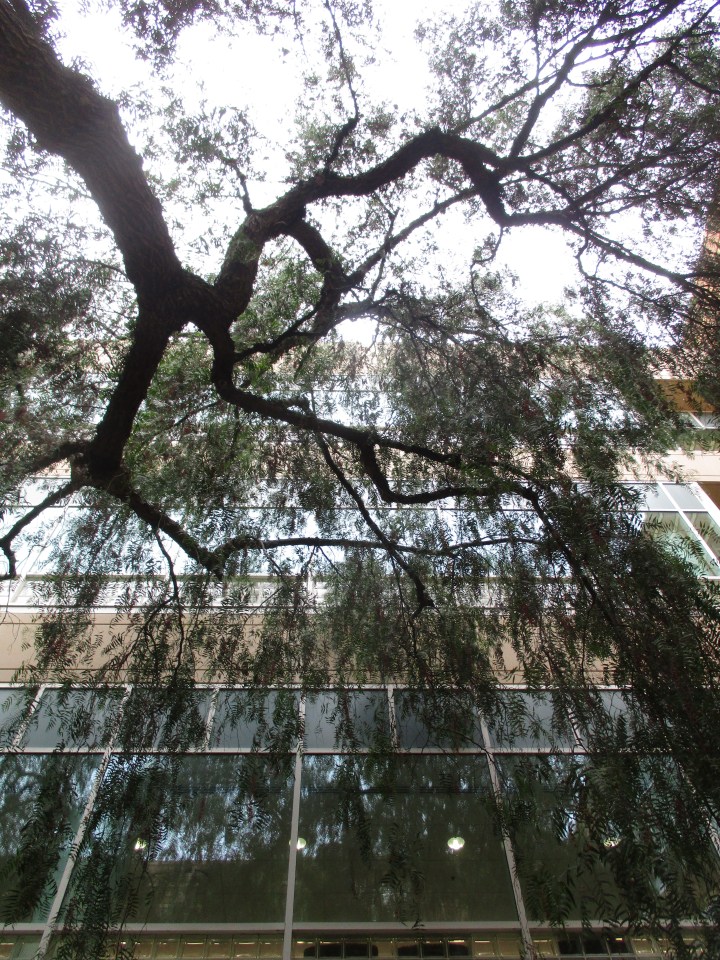
00101It has been naturalized in Southern California long enough to seem to be native. California pepper, Schinus molle, is actually endemic to Peru and adjacent arid regions of South America as far south as Central Argentina. Furthermore, although its small pink fruits with hard black seeds are sometimes used for culinary purposes, it is actually not related to black pepper, and is mildly toxic.

California pepper is as at home here as the name implies. Established and naturalized trees can survive on annual rainfall. They are better foliated if watered a few times through summer, and do not mind average landscape irrigation if their soil does not stay too damp. When they are not dropping a few leaves, they are dropping floral frass or dried berries, so their mess is considerable.

Old trees can eventually get forty feet wide, and almost as tall. Young trees grow rather aggressively. Growth slows with maturity. The distended and irregularly structured trunks and main limbs are picturesquely gnarly, with handsomely flaky tan bark. Foliage and outer stems are delightfully pendulous. The pinnately compound leaves are finely textured, and about three to six inches in length.

Growing Problem

P91221KRecycling plant material is practical and gratifying. We do quite a bit of it here. Back in September, I briefly wrote about recycling laurustinus that was removed from an area that was about to be landscaped, and relocated to other sites where it can grow into functional informal hedges. We were able to use something that was a problem in one location as an asset somewhere else.

We will be doing more of this sort of recycling now that the rainy season has started. Right now, the plants that need to be removed are as dormant as they get, so do not mind getting dug as much as they would have while they were still active. Rain helps settle them in at their new locations. A few get canned and stocked into the nursery, to be planted into new landscapes later.

Some of what gets recycled was intentionally installed in the past, but for one reason or another, became inappropriate for a particular site. For example, I will soon be relocating agapanthus that performed well for many years, but eventually became too shaded by growing trees nearby. Forsythia that has already been relocated was too big and awkward for its confined space.

Many plants that get recycled were not intentionally planted, but happened to grow wild in situations where they can not stay. Some are native. Some are descendents of desirable exotics. The laurustinus that I mentioned above are such an example. Just yesterday, I relocated a few naturalized but superfluous birches from an established landscape to an unlandscaped area.

We certainly do not recycle everything that can be recycled. Many plants, both native and naturalized exotic, are just too problematic. Fleabane that I wrote about yesterday is marginal.

Sweetgum happens to be one of those trees that we probably should not recycle. They are splendidly colorful in autumn, and particularly spectacular amongst the deep green redwoods. The problems are that the now overgrown trees here are developing serious structural deficiency, and producing an overwhelming abundance of messy and potentially hazardous maces (fruits).

Nonetheless, I found and canned these four rooted sweetgum watersprouts. They were growing from roots of one of several big and very problematic sweetgums that got removed last year. If they get planted here, they and their associated problems will be located outside of refined landscapes. In the future, thy can drop maces and limbs in the forest without bothering anyone.