Six on Saturday: Bark


Rhody said, “Cornus florida bark is rough.” He likely intended to say, “Dog would bark, ‘ruff!’.”

This is not about Rhody though. It is about these six pictures of bark of some of the more significant trees that I work with. All are native here. Only the sycamore was installed intentionally into a landscape. All of the others grew wild. There are so many interesting trees here that it was not easy to limit these pictures to just six. I actually took more pictures that were omitted.

Furthermore, a picture of Rhody is not included.

1. Platanus racemosa – California sycamore is bigger and bolder than other American sycamore. Trunks of mature trees are massive and gnarled, with this distinctively blotchy gray bark.P00613-1

2. Pinus ponderosa – Ponderosa pine is the grandest of pines. The massive trunks seem to be comparable to those of Douglas fir. Bark often flakes in bits that resemble jigsaw puzzle pieces.P00613-2

3. Quercus agrifolia – Coast live oak is second only to valley oak in regard to grandeur. Unlike valley oak, it is evergreen. Smooth gray young bark eventually becomes darker and furrowed.P00613-3

4. Pseudotsuga menziesii – Douglas fir is the majestic State Tree of Oregon, and a main timber crop there. Locally, it mixes with various ecosystems. Corky bark is rather finely furrowed.P00613-4

5. Acer macrophyllum – Bigleaf maple is the most imposing maple of the West. As the name implies, the leaves are bigger than those of any other maple. Bark gets sort of checked with age.P00613-5

6. Sequoia sempervirens – Coastal redwood is the grandest of all, and it happens to be the tallest tree in the World. Also, it is the state tree of California. The ruddy bark is distinctly fibrous.P00613-6

This is the link for Six on Saturday, for anyone else who would like to participate:

https://thepropagatorblog.wordpress.com/2017/09/18/six-on-saturday-a-participant-guide/

Post Script: For the first time, I am violating the recommended limit of six pictures to include this extra (but unnumbered) picture of Rhody for those who would be otherwise disappointed.P00613-7

Horridculture – Spruce Up

P00610
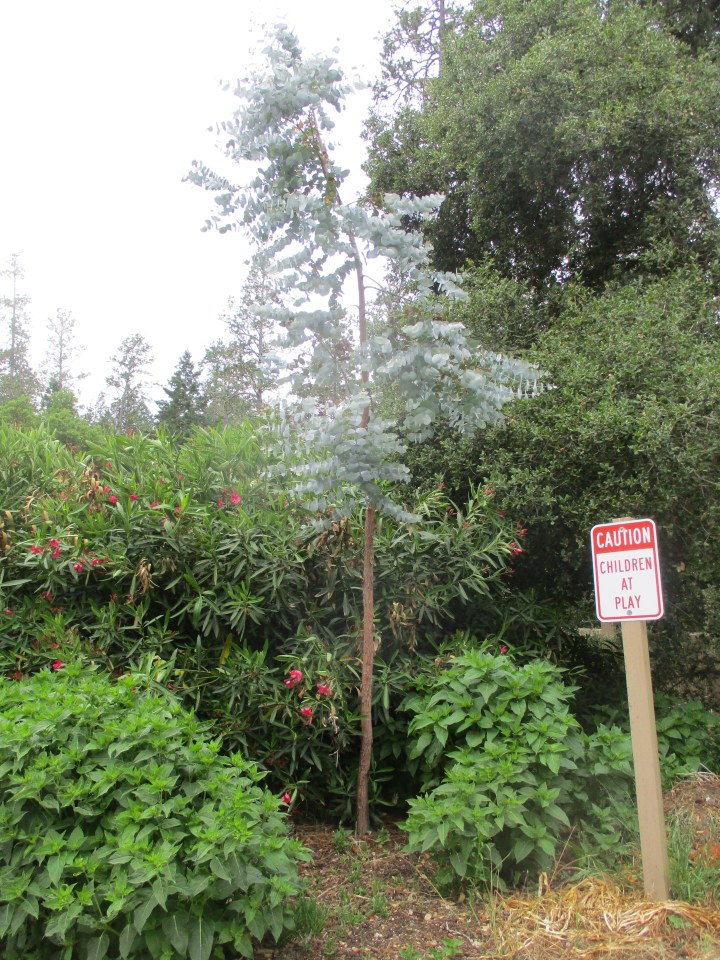
Even Charlie Brown would reject this little blue spruce.

No one wants to cut down this little blue spruce. What is worse is that no one wants anyone else to cut it down either. We all know it is ugly. We all know that it can not be salvaged. We all know that it really should relinquish its space to the healthy and well structured coast live oak next to it, in the lower left of the picture. Yet, it remains.

It was planted amongst a herd of gold junipers in about 1980 or 1981, shortly after the construction of the adjacent buildings. An abandoned irrigation system indicates that it was likely irrigated for some time afterward, although it is impossible to know for how long. Otherwise, it and the junipers were completely ignored for the last four decades.

When the vegetable garden was installed nearby, brambles, weeds and trash that had been accumulating for forty years was removed from the area. A few of the most decrepit junipers that were not worth salvaging were removed too. The young and feral coast live oak that grew next to the spruce should have been removed as well, but is actually in very good condition.

Furthermore, the coast live oak is a better tree for the particular application. It is native, so does not mind neglect. The spruce was never really happy there, which is why it is so puny and disfigured now, with the lower two thirds of the trunk bare of limbs and foliage. Obviously, the spruce should be removed so that the oak can continue to develop as it should.

We just like the spruce too much to remove it directly. Even though it would look silly if the bare trunk were exposed by the removal of the oak, the bit of foliage on top is so pretty and blue and familiar. I mean, it looks like we have a spruce in the yard; and everyone likes a spruce!

The plan is to subordinate it to the oak. As the oak grows upward and outward, the lower limbs of the spruce will be pruned away to maintain clearance. Eventually, the spruce will look so silly that the landscape would look better without it, and we will not mind cutting it down so much. It will be unpleasant, but it will be better than interfering with the development of the oak.

Hieroglyphs

P00606K
“111”? . . . “777”? . . . “TTT”? . . . “LLL”?

What does this mean? Is it ‘111’ deprived of the lower serifs? Is it ‘777’ with abbreviated arms? . . . ‘TTT’ lacking right arms? . . . ‘LLL’ with abbreviated legs? Is it pointing toward something important? Is a hieroglyph from an ancient language . . . or a language that has yet to be invented?! Is it like a miniature crop circle pattern cut into wood by Sasquatch or extraterrestrials?!

The arborist who left it here after cutting down the deceased ponderosa pine that formerly stood where this large stump remains might be amused to read that I contemplated it so intently. Actually, I did not really contemplate it so much. I only wrote about it as if I did because it is amusing to do so. I have no idea what this hieroglyph represents. I know that it is not important.

I have worked with enough respectable arborists to know that some of them prefer to leave their distinctive marks on the stumps of some of the impressively large trees that they cut down. In many of the suburban regions in which I work, most of such stumps get ground out shortly afterward. In the forested rural area here, such stumps remain until they rot and disintegrate.

On rare occasion, I encounter a familiar hieroglyph or the initials of a respected colleague. Now that we are as old as we are, familiar hieroglyphs are increasingly rare. Arboriculture is for the young. I sometime wonder about those who leave unfamiliar hieroglyphs. To me, the continuation of the tradition seems to indicate that they enjoy their work as much as my colleagues did.

That is important in horticultural industries. There are few in society who understand the appeal. We do what we do because it is what we enjoy.

Fung Lum

P00530K
Acer robustum, Chinese maple?

Fung Lum was an architecturally imposing Chinese restaurant in Campbell years ago. It was more famous for the facade of the building than for the food. Although the food was purportedly excellent, not everyone ate there. Everyone in town knew the building though. It was prominently situated right on Bascom Avenue, at a time when the region was still somewhat suburban.

The meticulously pruned and groomed landscape in the minimal space between the ornate facade and sidewalk was mostly rather low so that it did not obscure the architecture. The tallest features were strategically situated to be unobtrusive. Except for only a few of what seemed to be big, sprawling but low profile Japanese maples, there were no other significant maple trees.

‘Fung Lum’ means ‘maple grove’. Commercials on the radio said so. When I was a kid, I therefore expected to see at least a few maples that grew as trees rather than low sprawling mounds in the associated landscape. I figured that the maple grove must be out back where the parking lot was. I sort of wondered if their maples were Chinese, and what Chinese maples were like.

I probably should have been content in believing that the mix of holly oaks, flowering pears and other common trees in the neighborhood were maples. No one else noticed a discrepancy. For all I know, the name referred to a maple grove in China. Maybe the Japanese maples out in front were the grove. They could have been Chinese. Maybe I put way too much though into this.

Now, I actually work with what is purported to be some sort of Chinese maple, perhaps Acer robustum. It really does resemble a Japanese maple. It produces the foliage that can be seen to the right in the last (sixth) picture that I posted early this morning. If it really is a Chinese maple, I would not be surprised if cultivars of this species were what lived in front of Fung Lum.

P00530-6
This is the sixth picture from this morning.

Six on Saturday: Timber! II


Horticulture is not all flowery. It includes arboriculture, which is the horticulture of trees. As both a horticulturist and arborist, I get t0 work with it all. Not only do I work with arboriculture, but I get to work part of the time in forests of coastal redwoods, which are the tallest trees in the World. Compared to these redwoods, Douglas firs are rather average.

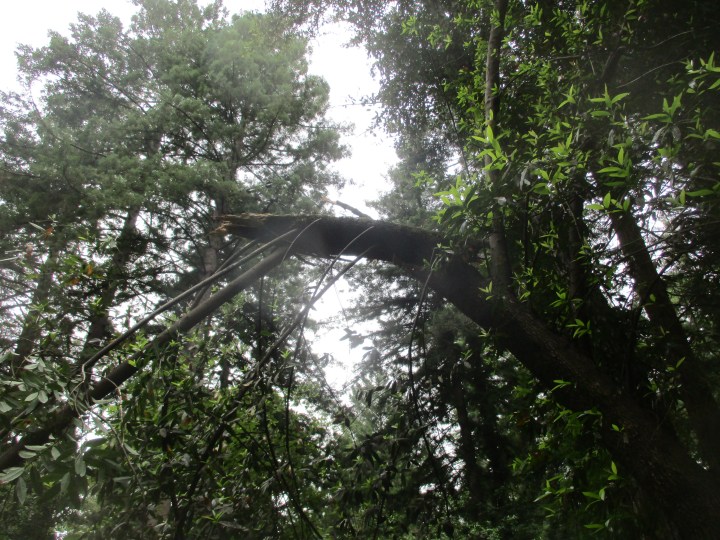
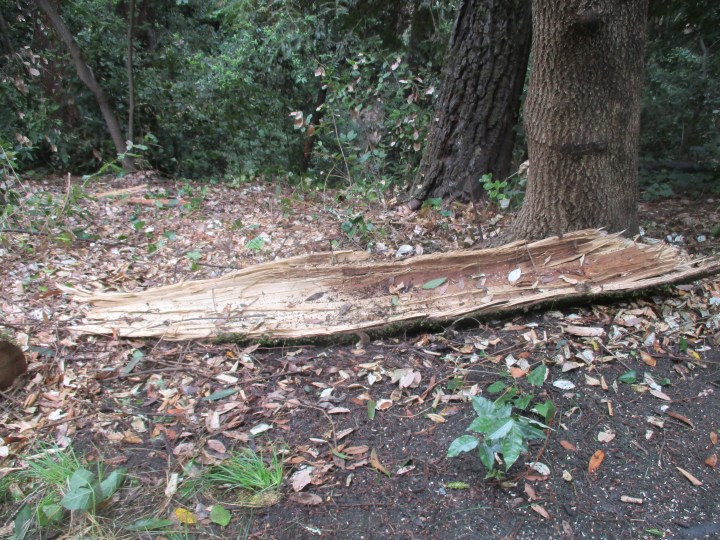
1. At about noon on May 7, this big Douglas fir fell unexpectedly. Since it was not cut down intentionally, no one actually yelled “Timber!”. This picture is recycled from a post from May 10.P00510-1

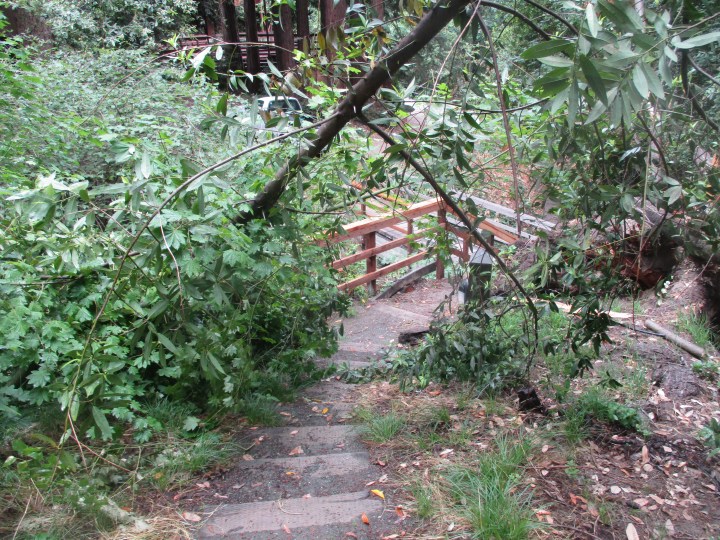
2. This is what it looks like now. Even though a bay tree fell on top of the Douglas fir and bridge after the picture above was taken, damage was minimal. Parts of the banister were replaced.P00530-2

3. The Douglas fir was less than eighty years old. It started growing here in the early 1940s. My grandparents might have met it when it was a baby. By the way, I did not count all the rings.P00530-3

4. The carcass of the Douglas fir is now more than twenty feet below. The light brown chips to the upper left are from the top of the tree that needed to be cleared from an adjacent roadway.P00530-4

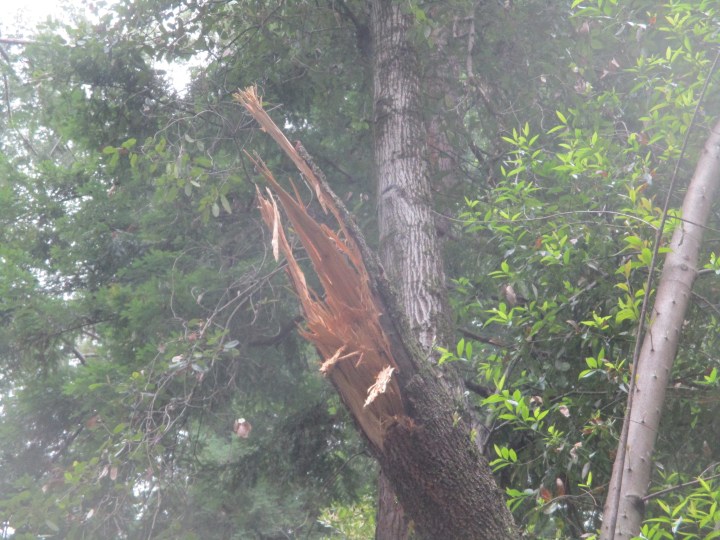
5. This unfortunate maple really was an exemplary young specimen before it got clobbered by the big Douglas fir and bay tree. Not only are the limbs stripped off, but the trunk is fractured.P00530-5

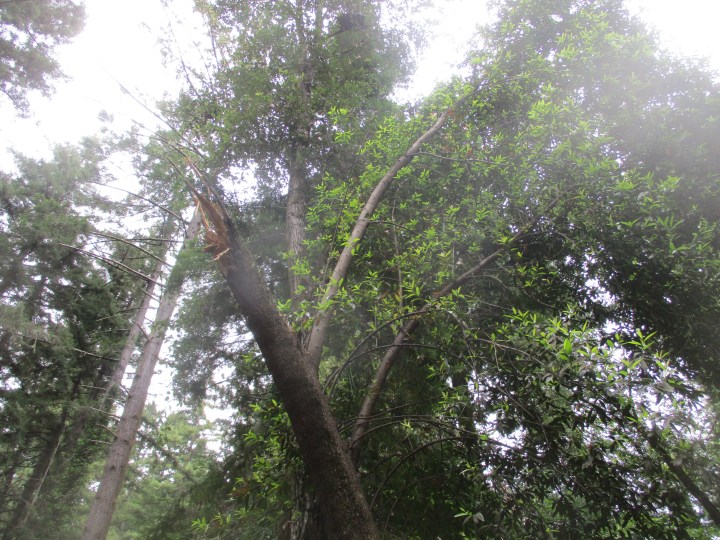
6. The third trunk from the left is what remains of the bay tree that was leaning on the Douglas fir, and then fell on top of it. The top limb extending to the right is now about to break too.P00530-6

This is the link for Six on Saturday, for anyone else who would like to participate:

https://thepropagatorblog.wordpress.com/2017/09/18/six-on-saturday-a-participant-guide/

Pin Oak

50520
Pin oak is not drought tolerant.

There are several oaks, especially natives, that do not need much more water than they get from rain. Pin oak, Quercus palustris, is not one of them. It is naturally endemic to areas that are damp or swampy for part of the year. It is more tolerant than others are to lawn irrigation, but is also more sensitive to drought.

Compared to other oaks, pin oak grows fast while young. It can get two stories tall in about ten years. Then, it takes more than twice as long to double in size. Old trees do not get much more than fifty feet tall, with trunks nearly three feet wide.

The deciduous foliage turns as brown as a grocery bag in autumn, and may linger late into winter, or until it gets replaced by new foliage in spring. The distinctively deeply lobed leaves are about two to five inches long, and about two thirds as wide. Each leaf has five or seven lobes. Each lobe has five to seven teeth.

Streets Are Cooler With Shade

P91124+
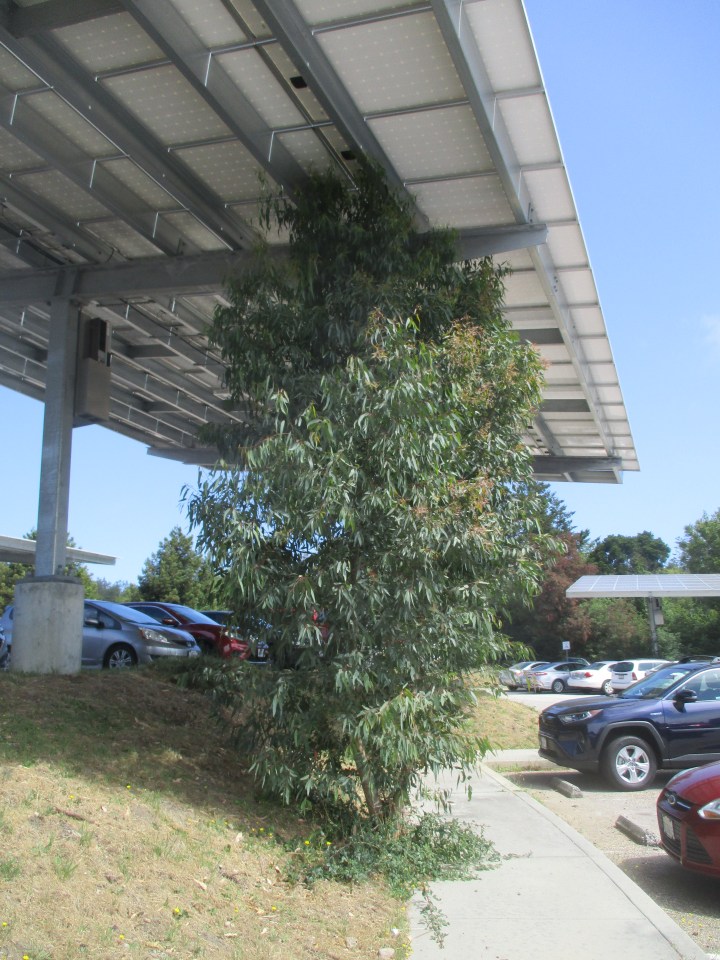
Parked cars stay cooler in shade.

There really is no such thing as a perfect tree. Some are not quite as messy as others. Some have better structural integrity than others. Some have gentle roots; and some stay proportionate to tight spots. However, without exception, all trees grow, drop leaves, and disperse roots.

This is an important consideration when selecting any tree, and especially when selecting a street tree for the narrow space between the curb and the sidewalk (which is commonly known as a park strip). Even where there is no sidewalk, or where the sidewalk is at the curb, most of the obstacles are the same.

Street trees should have reasonably complaisant roots that should not be likely to damage curbs, sidewalks or roadways, at least for several years. They should naturally develop reasonably high branches. They will need to be pruned higher than trucks that may park at the curb. Street trees must also tolerate harsh exposure.

Wider park strips can of course accommodate larger trees. Those that are only two feet wide or narrower are probably not wide enough for any tree larger than photinia, purple-leaf plum or English hawthorn, which are difficult to prune for clearance over roadways and sidewalks.

Messy leaves, flowers or fruit that might not be a problem within the garden might be more of a problem at the curb. It is not so easy to rake such debris if cars park over it. Trees that are commonly infested with scale or aphid are likely to drop sticky honeydew (scale and aphid poop) onto parked cars.

Unfortunately, those who get street trees do not always get to select them. Many municipalities assign specific trees to specific streets. Some streets have a few trees to choose from. Others have only one option. Home Owners’ Associations (HOAs) decide if and where new trees get planted.

Crape myrtle is probably the most common choice for a new street tree because the roots do not get big enough to damage pavement. However, the canopies are not very big either. They stay too low to be pruned above trucks. Crape myrtle is susceptible to scale infestation that can get bad enough to make sidewalks sticky.

For many years, London plane (sycamore) had been another popular street tree. Unfortunately, the voracious roots can damage pavement within only a few years. The messy foliage discolors and starts to fall before autumn.

Multi Trunk Trees Seem Natural

00527thumb
Overgrown shrubbery becomes multi trunk trees.

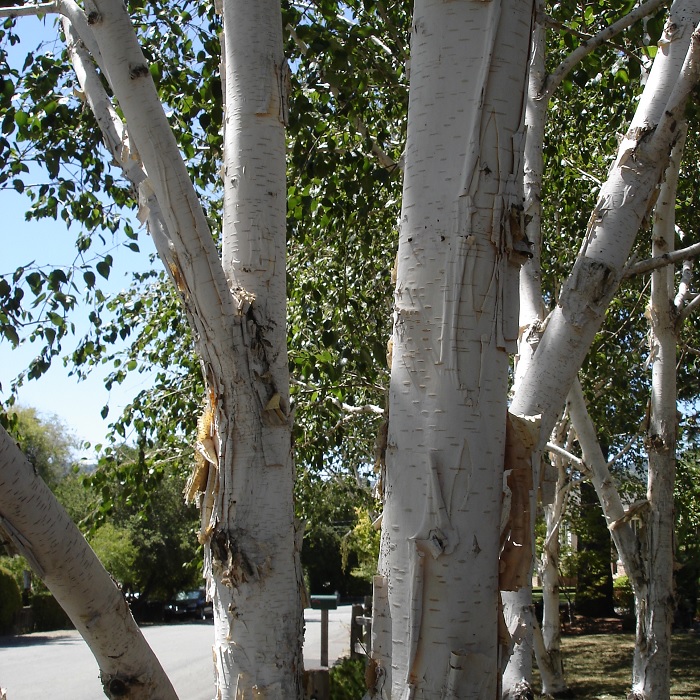
For several years in the late 1960 and early 1970s, European white birch were trendy. Most lived in ubiquitous groups of three. Where three did not fit, a single multi trunk tree, typically with three trunks, was a popular option. Each multi trunk tree provided as many trunks as a few single trunk trees. For these particular white birch, the elegant white trunks were their most appealing feature.

Multi trunk trees, which are popularly known as ‘multis’, are only structurally different from their counterparts with single trunks. Multi trunk crape myrtle are genetically identical to crape myrtle of the same cultivar, but with single trunks. The only difference is that multi trunk trees branch at ground level, instead of at the top of a single straight trunk. Each needs to be pruned to the desired form.

Multi trunk birch, paperbark and lemon gum exhibit appealing bark. More trunks display more bark than single trunks. Multi trunk strawberry tree, olive and oak exhibit appealingly sculptural form. Cork oak and crape myrtle provide both appealing bark and sculptural form. Silk tree, acacia and deciduous magnolia display their bloom more effectively with lower and broader multi trunk form.

Trees get help to develop into a desired form. European white birch, lemon gum and silk tree are more likely to develop single trunks naturally. Coppicing compels them to regenerate with several trunks. Conversely, olive, crape myrtle and strawberry tree develop a few trunks naturally. Single trunk trees need thinning to remove the superfluous trunks, and staking to straighten a single trunk.

In home gardens, multi trunk trees sometimes evolve from overgrown shrubbery. Pineapple guava may be shrubby for may years before lower growth gets pruned away to reveal sculptural trunks within. English laurel that gets too overgrown for containment pruning might become a delightful multi trunk tree instead. It will be pleased to grow freely from the top if lower growth gets pruned off.

Multi trunk trees are no more natural than trees with single trunks are, but they seem to be.

Timber!

P00510-1
This is a bit more than just slightly inconvenient. The trail continues forward from here, with another trail up the stairs to the right.

It is that time of year. Warming weather accelerates vascular activity, which makes foliage heavier. If evapotranspiration is inhibited by humidity and a lack of wind, the foliage can get too heavy to be supported by the trees that produce it. All that increasing weight can bring down big limbs or entire trees at the most unexpected times. The process is spontaneous limb failure.

By ‘unexpected’, I mean that it happens when there is no wind. It is startling because broken limbs and fallen trees are typically associated with wind rather than a lack of it. Gentle wind actually accelerates evapotranspiration, which relives affected vegetation of some of its weight and susceptibility to spontaneous limb failure. Aridity helps too, by absorbing more moisture.

Of course, even a gentle breeze at the wrong time can have disastrous results for vegetation that is already about to succumb to spontaneous limb failure. I suspect that is what happened here, since the air was not completely still at the time. It was just a bit warmer than it had been, and slightly more humid than typical. It is too late and pointless to analyze the situation now.

P00510-2
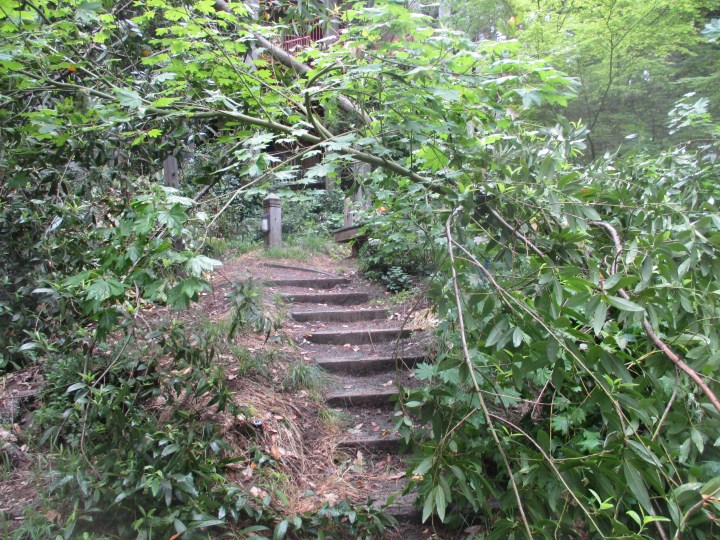
This is the top of the stairs that are to the right in the picture above.

At about noon on Thursday, someone who works nearby alerted me to the sound a a big tree falling. I was in the same neighborhood, but was driving by with the radio on. The tree is precisely where I was told it would be. No one was nearby when it fell. Damage was originally minimal, with a portion of trail displaced by roots, and a rail on a bridge crushed by the trunk.

By ‘originally’, I mean that this was not the extent of the damage. After barricading the trails and road leading to the site, and leaving, we heard another loud crash from the same location as a bay tree that had been leaning against the already fallen fir tree collapsed in pieces on top of the whole mess. Fortunately, the damage to the bridge, although worse, is not too terribly bad.

P00510-3
There is more timber here than lumber. The short section of main trunk is severely fractures. The double trunks beyond are not as big as they look.

Steven Michael Ralls Memorial Tree

P00502K
Steven Michael Ralls Memorial Tree is mostly camouflaged by the surrounding forest.

Steven Michael Ralls got his Memorial Tree this morning, three years after he passed away on May 2, 2017. The circumstances that coincided for this event were impossible to ignore. Just like the other Memorial Tree, which was installed to replace an oak that was missing from a parking lot island, the Steven Michael Ralls Memorial Tree also has a practical application.

The small tree is a young Monterey Cypress, Cupressus macrocarpa, that needed to be removed from one landscape, and was waiting in the recovery nursery to be installed into another. Of course, a Monterey cypress in no easy tree to accommodate. It is too big and too dark to be compatible with most of the landscapes into which we add smaller and mostly deciduous trees.

However, it happens to be ideal for obscuring undesirable scenery, just like a row of five Arizona cypress, Cupressus arizonica, will be expected to do when installed along a busy roadway. Furthermore, it just happens to grow bigger faster than Arizona cypress, so is even better for the low end of the row where a bigger tree is preferred. The row really needs six trees anyway.

The location of the tree just happens to be ideal as well. With all Arizona cypress spaced evenly along the roadway, and the Steven Michael Ralls Memorial Tree strategically situated around the lower corner of the fence, it is located precisely where Steven Michael Ralls camped while homeless late in 2012. I could not have selected a more appropriate location if I had planned it.

The new tree will need to be watered by bucket occasionally through summer, but will need no intervention after the rain starts next autumn. It knows what it needs to do to get established and become an evergreen asset to the forest.

FP00426
It was easier to see before it was planted.