silver dollar gum

50429

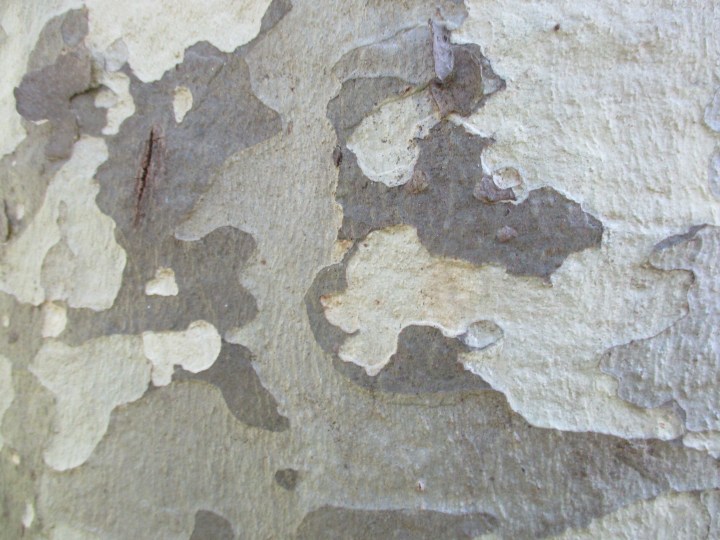
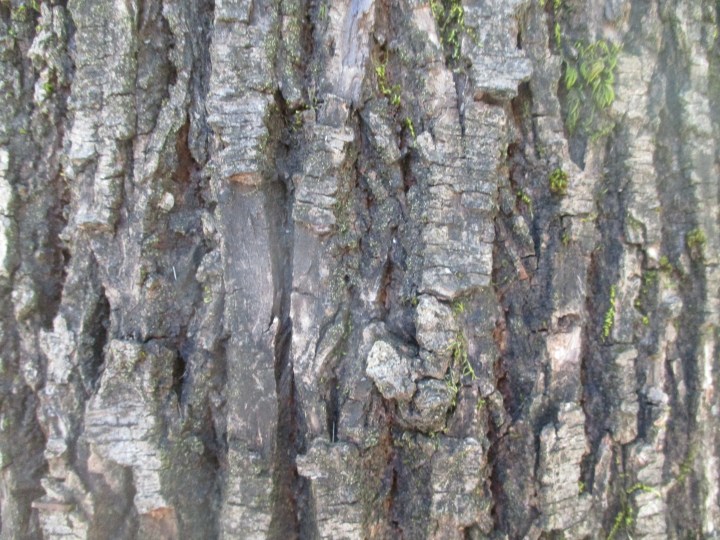
There are actually a few different eucalypti known as silver dollar gum. The most familiar and largest is Eucalyptus polyanthemos. Mature trees that were popularly planted through the 1960s are about forty or fifty feet tall. Some stay smaller. A few that compete with taller trees are more than sixty feet tall. Trunks and limbs are somewhat sculptural, with fibrous bark.

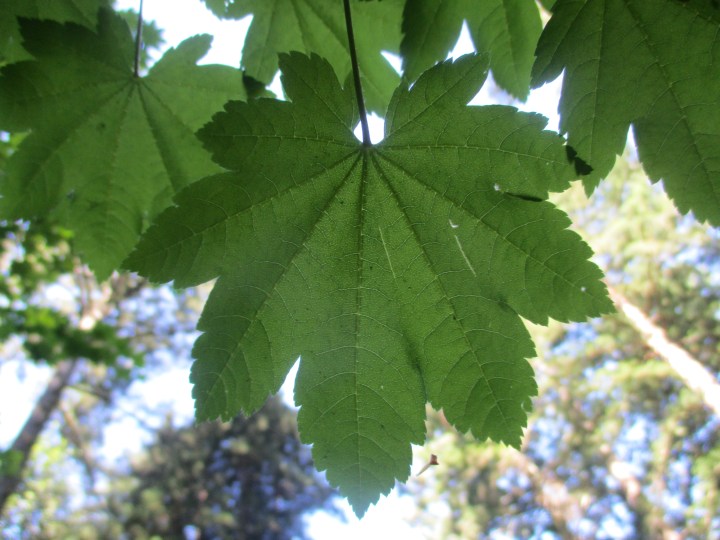
Grayish foliage on limber stems forms a billowy and rounded canopy that blows softly in the breeze. Juvenile leaves are nearly circular, and more silvery gray than adult foliage is, like silver dollars. Ovate adult leaves are about three inches long and half as wide. Tiny flowers with prominent white stamens bloom amongst the adult foliage in spring and summer.

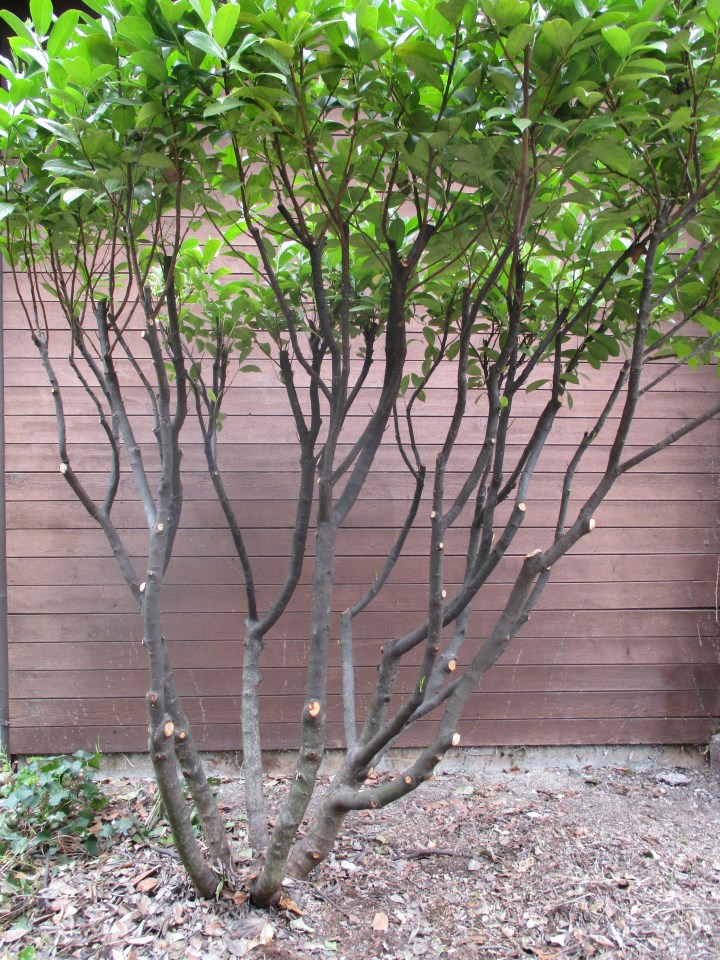
Smaller trees are often pruned aggressively or pollarded so that they continually produce the more desirable juvenile foliage without bloom. The problem with this technique is that it must be repeated every few years or even annually. Otherwise, vigorous secondary growth can get too heavy and break away.

Eucalypti Are Innately Drought Tolerant

50429thumb
Distinctive foliage provided by red ironbark.

Drought is nothing new here. There could be plenty of rain next winter and for years afterward; but eventually, there will be another series of dry winters, prompting rationing all over again. Landscapers and big box garden centers continue with business as usual. It is up to us to manage our gardens responsibly. Besides native plants, aloes, yuccas, junipers and eucalypti are four groups of formerly popular, drought tolerant plants that are worthy of more attention again.

Eucalypti had gotten a bad reputation even before they became popular the last time around. Tasmanian blue gum, Eucalyptus globulus, that was planted so extensively for wood pulp and timber throughout California, is a huge and extremely messy tree. Yet, it is still the most familiar of the eucalypti.

Garden varieties of eucalypti are much more docile. Even though they drop their evergreen foliage and hard seed capsules throughout the year, they do so on a smaller scale. The tall and elegant lemon gum constantly sheds strips of bark like the Tasmanian blue gum does, but does not get big enough to be too overwhelming.

Because they are so undemanding, and some are somewhat messy, eucalypti are best in unrefined parts of the landscape, and away from lawn. Their mess is no problem over ivy or iceplant. They are happiest where other trees might be unhappy. Generous watering actually inhibits root dispersion, and can cause vigorous but structurally deficient stem growth.

Eucalypti innately prefer to be planted while very young, even from four inch or one gallon (#1) pots. Larger (and more expensive) trees, such as boxed trees, take so long to get established that they get passed up by faster growing tiny (and less expensive) trees. Because they are sensitive to confinement, eucalypti are unfortunately rare in nurseries.

The online catalog of Annie’s Annuals and Perennials, which is famous for excellently weird and undemanding plants, features lemon flowered mallee, red capped gum, silver princess gum, bell fruited mallee and fuchsia gum, all in four inch pots. The bell fruited mallee and fuchsia gum are like large but airy shrubbery that do not get much taller than the eaves.

Lineup

P00426
The usual suspects.

There is significant traffic right outside. It is one of the three busiest roads around. No one here really minds, because we are mostly too busy with something else while we are here. We are accustomed to it as part of the ‘scenery’. The noise sometimes makes it necessary to shout to each other, or take a telephone call somewhere else, but is not too much of a bother otherwise.

However, the scenery that those in the traffic see from the road might be slightly less than appealing. Industrial buildings surrounded by pavement, building materials, work vehicles and all sorts of associated items are all that are in here. Next door, there is a herd of dumpsters! It is a view worth obscuring. Bay trees and box elders that used to screen the view are too tall now.

I should have planted these five Arizona cypress in a row along the road last autumn. If I were to plant them now, I will need to water them occasionally until next autumn, not that I would mind. After their first winter, they would be happy on their own. They would start to obscure the view within only a few years, and unlike box elders, would stay evergreen through winter.

They really should have been planted a long time ago. They have been in the same cans for so long that the medium within has decomposed and collapsed. Without staking, their lean trunks became disfigured in confinement. They really would not have needed to be staked if they had been planted sooner and been able to grow more vigorously. Fortunately, they should recover.

A Monterey cypress will be planted at the low end of the row next Saturday, even if these Arizona cypress are not planted until autumn. I will explain later.

Aleppo Pine

50408
Aleppo pine thinks it is native.

From coastal regions around the Mediterranean Sea, the Aleppo pine, Pinus halepensis, came to be right at home on and near the coast of California. Once established, it can survive quite happily on rainfall. Trees that get too much water can actually get too heavy with foliage, and may eventually get disfigured if limbs break.

Shade under an Aleppo pine is not too dark. The light and sometimes yellowish green foliage is rather wispy, comprised of thin paired needles that are about three inches long. The sculptural trunks almost always lean to one direction or another, and often divide into multiple trunks once they grow out of reach. Bark is light gray with light brown striations.

Young trees can get big rather fast. They tend to be somewhat conical, or at least upright, until they get to be about forty feet tall. Then, they tend to shed lower stems and develop irregular branch structure with rounded tops as their growth rate slows. Only a few old trees in ideal situations slowly get to seventy feet tall. Seedlings sometimes appear where they are not wanted.

Evergreen Trees Have Their Place

50408thumb
Evergreens are sometimes the best choice.

Deciduous trees that were bare all winter are now foliating and making shade. They sure will be appreciated when the weather gets warmer through summer. They will defoliate next autumn, in time to let warming sunlight through while winter is cool. Their lifestyles are naturally compatible with those of the people who live with them. They really have the system down.

Evergreen trees are good at what they do as well. They obscure unwanted views and provide privacy all year. If given adequate space and located far enough away from the home and neighboring homes, their shade should not be a problem. Like any other feature in the landscape, properly selected and strategically placed evergreens are quite functional.

There are certainly more to evergreen trees than the coniferous (cone-bearing) evergreens like pine, spruce, cypress, cedar and juniper. Any tree that retains foliage throughout the year is evergreen, including camphor, Southern magnolia, carob, California pepper, coast live oak, fern pine, all palms and all eucalypti, just to name a few. There are really too many to list.

Larger modern homes on smaller parcels are a bit more challenging to evergreen trees than more traditional homes that have more space around them. Average fences do not maintain privacy for upstairs windows that are too close to neighboring homes. However, there is less space and sunlight for trees, and additional shade can be a bother for lower windows.

It seems that smaller trees are often the best fit for bigger homes. Sometimes, a large evergreen shrub, like one of the various pittosporums, can do the job of an evergreen tree, but fits better where space is limited. As silly and passe as they seem to be, Italian cypress are narrow enough to fit into tight spots, at least until they get too big.

Contrary to popular belief, most evergreen trees are messier than most deciduous trees. They drop only minor volumes of foliage, but they do so throughout the year. Deciduous plants drop most or all of their foliage within a limited time about autumn. Only those that drop flowers, fruit or both in spring and summer are messier than evergreens.

Memorial Tree Update – March 22, 2020

P00322-1
Memorial Tree – Before

Updates get complicated as they link back to previous updates to previous updates to previous updates and so on. Linking and reblogging from another blog adds more complication. The last update for the Memorial Tree was reblogged from Felton League on August 10. It and previous updates should link back to preceding updates chronologically. At least it sounds simple.

Another brief update that will reblog here from Felton League at noon will describe more of the social significance of the Memorial Tree rather than horticultural concerns. It really is special.

This little Memorial Tree has certainly been through some difficult times. Despite reassurances that it would not happen again, and that the tree would be outfitted with an ‘approved’ trunk guard, the trunk base has been gouged by weed whackers on more occasions than I can remember. That is an unfortunate consequence of efficient but unaware community service workers.

Such major damage severely inhibited growth. As it begins its fifth year, the Memorial Tree is barely six feet tall. By now, it should be developing branch structure above minimal clearance. Fortunately, it was quite healthy last year. If it continues to grow similarly this year, it will grow above six feet, where it can later develop scaffold limbs. I intend to apply fertilizer regularly.

Stubble had been left on the trunk to enhance caliper growth. That which was developing into significant branches was removed to concentrate resources into vertical trunk growth. Stubble that remains is minimal, but should be substantial enough by winter to get mostly pruned away again. It will more likely be unnecessary, and pruned away completely from the main trunk.

Binding is unfortunately still necessary. The species innately develops irregular form. Binding straightens the otherwise curved trunk. Once the trunk lignifies in the desired position, binding and the associated stake will not be necessary. The larger lodgepole stake holds the binding stake vertical, but is more important for protection from those who bump into the still small tree.

Weeds were removed from around the base of the Memorial Tree, so that there would be no need for a dreaded weed whacker to get close to it. Former damage is compartmentalizing well.

P00322-2
Memorial Tree – After

Grande Finale

P00315
They still bloom spectacularly.

This is the third spring that I got picture of this pair of flowering cherry trees in bloom. I took several pictures last year, ranging from closeup pictures of the flowers, to pictures taken from a distance like the picture above. Fewer pictures were taken during the previous spring of 2018, before these trees were groomed of copious necrosis. Sadly, this picture will be one of the last.

The trees will be cut down this year. They stayed just long enough to bloom this one last season, but will not likely be here much longer. They are deteriorating at such a rate that if I were to prune the necrosis away after bloom, there would not be much remaining. The tree to the right in this picture would be only a rotten stump with a few limber twigs protruding from the top.

Structural integrity has been so compromised by decay that, even without the weight of all the limbs that have been pruned back during the past many years, the trunks could easily break off at the ground. When I remove them, I will likely just push the tree to the right over without cutting it first. If there were any branches left, a kid could knock it over by trying to climb it.

As much as I would prefer for these trees to last much longer, I want to install their replacements as soon as possible. Planting them this spring would give them all summer to disperse roots and grow a little bit before blooming next spring. I know they will not be much to look at for a few years, but many years from now, they might be as spectacular as these two originals were.

Regardless, it will be a saddening task to cut down these distinguished trees.

Alien

P00308-1
It really looks like something erupted from within!

That was a scary movie back when horror movies really were scary! The first appearance of the baby alien was the creepiest part and one of the scariest scenes! It is too disturbing and gory to describe here. Those who have seen it may have noticed how it might seem to be weirdly relevant to the cavity that opened in the rotting trunk of this deteriorating flowering cherry tree.

With a bit more distance, the rotting trunk looks sort of like an associate of ‘H. R. Pufnstuf’ after an interaction with a baby alien. If you can remember who H. R. Pufnstuf was, you probably shouldn’t. He starred in his own television show for children on Saturday morning in the 1970s. It was disturbingly weird and perhaps even inappropriate for the children it was intended for.

P00308-2
So, it is both rotten and unsightly.

With even more distance, it is obvious that this is nothing to joke about. This is one of two flowering cherry trees that I have been so protective of, and put so much work into temporarily salvaging. Both should have been removed and replaced years ago. This project was scheduled for after bloom in 2018, postponed until after bloom in 2019, and has yet to be done even now.

The problem is that these trees are so popular and so appreciated by the Community. They have been here in the most prominent spot in the neighborhood for several decades. There are not many who remember when the trees were young. No one seems to remember before the trees were here. They are as historical as the older buildings. I can not bear to cut them down.

As you can see, there is no choice now, at least for this particular tree. It is already so decayed that it can barely support its own weight.

P00308-3
As pretty as the bloom is, the disfigured branch structure and trunk are no longer appealing.

Norwegian Wood

P00222K
Isn’t it good?

This is really getting to be a problem. Too many feral plants that we find at work get canned as if they will eventually be installed back into a landscape somewhere. The small nursery where they recover until their relocation is getting crowded. Although many are practical and appropriate for such recycling within the landscapes here, some are not, so may be with us for a while.

Five feral Norway maple saplings were found in one of the landscapes where mature trees were pruned for clearance from a roof. We could not just leave them there. They eventually would have been overwhelmed by the rest of the forest, or grown too close to the same roof that we pruned other trees away from. They were very easily dug, so came back to the nursery with us.

It was too late to prune them as necessary. They are tall and lanky trunks, with too many comparably lanky branches. As much as I am instinctively compelled to prune them while they are bare and dormant, I will refrain until later in spring or summer, when they will not bleed so much. They look ridiculous. They seem happy though. Their buds are beginning to swell already.

We have no idea where they will go from here. After pruning, they should develop into exemplary specimens. As goofy as they are now, their trunks are remarkably straight. I happen to be fond of Norway maple, and would be pleased to find an application for them here. The problems is that there are too many trees here, and the forests and landscapes continue to make more!

Horticulture in a forest can be like that. It seems like there is plenty of space out there, but so much of the space is too shaded or too crowded.

Blow Out

P00216
Wind is messy!

While strong Santa Anna Winds were blowing through Los Angeles four hundred miles to the south, and Storm Ciara was arriving in Scotland and Norway, we were getting some remarkably strong winds of our own. They were not nearly as strong as winds that were causing so much damage in Europe, and involved no flooding rain, but they were dangerously messy nonetheless.

We live and work among dense forests of coastal redwood, the tallest tree species in the World. Beyond the upper edge of the redwood forests are more forests of huge Ponderosa pine. Huge Douglas fir are mixed throughout. Their understory includes trees that would be considered to be massive anywhere else, such as coast live oak, tanoak, Shreve oak, bay laurel and madrone.

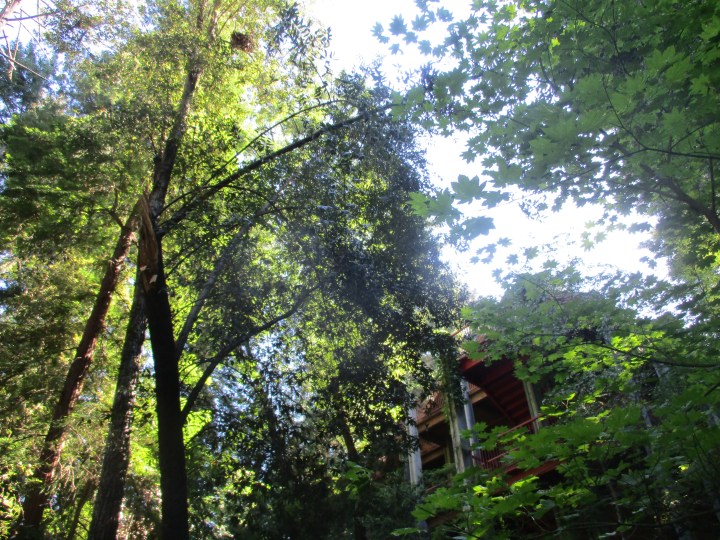
Such big trees drop big limb, and in abundance. Furthermore, limbs that fall from such great heights are significantly more dangerous than those that fall from smaller trees that are closer to the ground. They gather major inertia on the way down. They do not necessarily fall straight down either, but can get blown significant distances to where falling limbs may not be expected.

While the winds were blowing through, I could hear crashing of falling limbs and entire trees from the mostly deciduous riparian forest outside. I know that many of the big cottonwoods, box elders, willows, alders and sycamores are deteriorating, but did not expect so many to be blown down while bare. I suspected damage would be worse among the bigger and evergreen trees.

The pile to the left in the picture above is just the debris that was collected last Monday (while I was conveniently not here to help). It is more spread out but at least twice as voluminous as the pile on the right, which is pruning debris that took me several days prior to the wind to collect. The green cargo containers in the background demonstrate how big the piles of debris are.

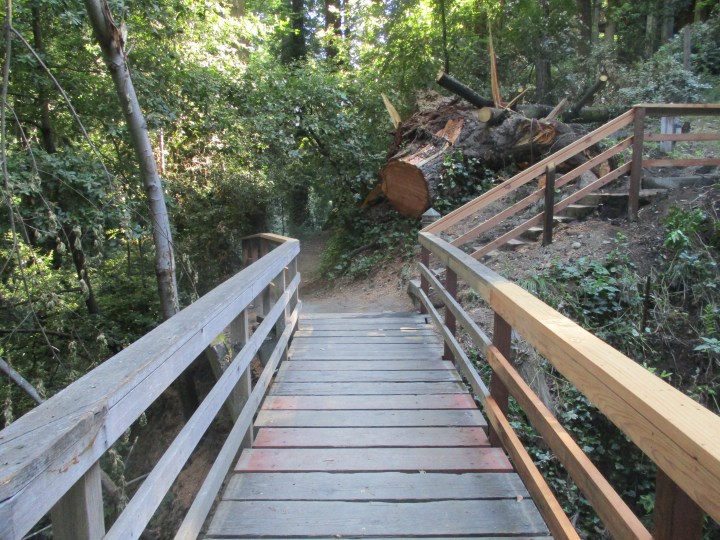
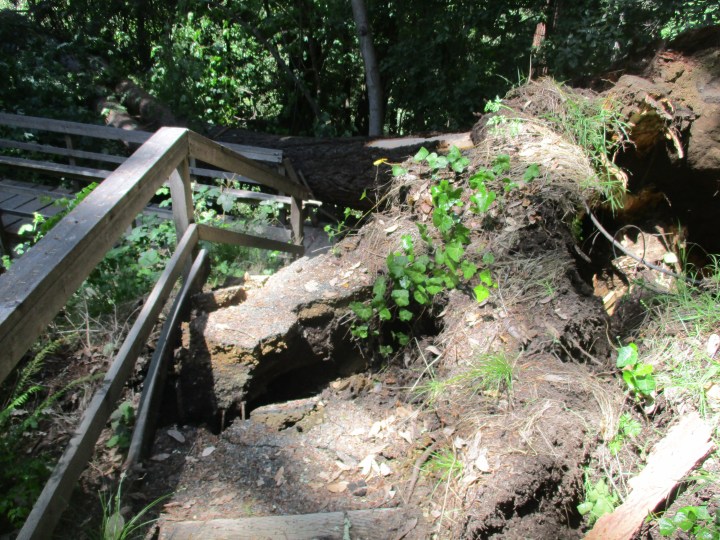
More debris was collected on Tuesday (while I was still doing other work). The mess was not the worst of it. The roofs of a few buildings were impaled by falling limbs. Some of the damage is significant. Fortunately, the only big trees that fell did so into forested areas where there are no buildings, and electrical service was disrupted for less than a day. No injuries were reported.