Coastal Redwood

91106Of all the Official State Trees, the coastal redwood, Sequoia sempervirens, of California is the grandest. Seriously, it is the tallest tree in the World, so it really ‘is’ the grandest! The tallest is 380 feet tall! Although the related giant redwood of the Sierra Nevada develops bigger trunks, the bulkiest coastal redwoods are thirty feet wide at the base! The oldest are more than 2,000 years old!

All that sensationalism is not so practical for home gardens though. A thirty foot wide trunk on a sixty foot wide city lot would likely be a serious obstacle to gardening for whoever lives there 2,000 years from now. Although, those below the thirty-fifth floors of adjacent buildings might appreciate the foliage. Redwoods are exquisite evergreens in the right situations, but need plenty of space.

Cultivars are more compact than wild trees are, with more strictly conical form. ‘Soquel’ is the most popular. Redwoods are incredibly stable, but as they age, can eventually drop limbs from great height. Trunks are nearly vertical. Limbs are nearly horizontal, and sag with age. Leaves are less than an inch long, but messy as their flat browned tufts shed in abundance through late summer.

Arborists Maintain The Big Trees

91106thumbThe trees know what time of year it is. Even evergreen trees have shed some of their older foliage through late summer. Deciduous trees generally start later, but will be more blatant about their process as they defoliate completely through autumn to winter. Some get strikingly colorful first, as if to brag about it. Foliage is not so important during shorter days and dimmed sunlight anyway.
By the time storms start to arrive later in autumn, trees intend to be ready. There will be less foliage to be blown by wind, or to absorb the weight of the rain. Remaining deciduous foliage is likely to be dislodged by wind and rain before supporting limbs succumb. Trees will be mostly dormant, so will not mind so much if a few minor limbs do happen to get broken. They know their routine.

For many types of trees, this is a the best season for major pruning. While dormant, they are much less likely to be offended by it. In fact, they sort of expect to wake up in spring with a few limbs missing. They do not distinguish what was pruned away from what might have been broken by the weather. Besides, it is better to prune questionable limbs civilly, before they get broken brutally.

Trees that are beyond reach will need the attention of professional arborists.

Arboriculture is merely the horticulture of trees. An arborist is therefore a horticulturist who specializes in trees. They assess the health, stability and structural integrity of trees, and prescribe any necessary arboricultural procedures. They or their associated crews are qualified to perform the work that the trees need. The most proficient of arborists are those who are certified with the ISA.

The ISA is the International Society of Arboriculture. ISA Certified Arborists have passed an examination of their arboricultural expertise, and maintain their credentials by continued involvement with ISA educational seminars, classes and workshops. Information about the International Society of Arboriculture and local certified arborists can be found at their website, www.isa-arbor.com.

Midnight Oil

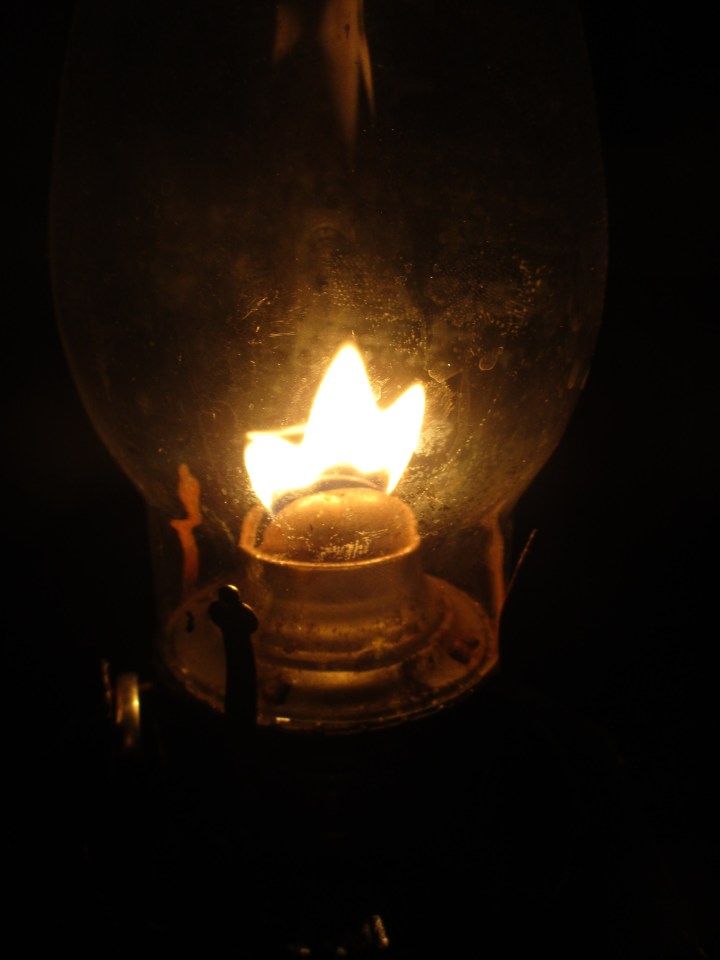
P91027The electricity is still on here at 8:20 p.m.. I just turned the lights off to get the cool picture above. The outages in this region were scheduled to begin twenty minutes ago, so the electricity could be disconnected here at any moment. I may not finish writing and scheduling this to post later at midnight before that happens. So, if you are not reading this presently, you know why.
Before you waste another second thinking about that, I will tell you now that it makes no sense.

Scheduled electrical outages are now one of the consequences of living in this excellent place. We live with trees. Some of these trees are the biggest in the World. Some are very combustible. Regardless of the diligence of those who prune trees to maintain clearance from utility cables, big trees are likely to drop limbs onto cables, causing sparks that can ignite combustible trees.

The electricity just went out at 8:40 p.m..

As I was saying, we also live with weather. It happens to be excellent weather. It is pleasantly warm through summer, with minimal humidity and an almost constant cooling breeze. When the weather gets a bit too warm, it compensates with lower humidity and increased breeze. Unfortunately, this combination of weather is precisely what accelerates the worst of forest fires.

Scheduled electrical outages are intended to coincide with forecasts of weather conditions that are dangerously conducive to the initiation and perpetuation of forest fires. As inconvenient as they are, such outages are a sensible precaution.

The smoke that made such a colorful sunset earlier is from a fire in nearby forests, on the southern coast of San Mateo County.

Now, I will go to town to see if I can find someplace to get online to schedule this for midnight.

Arborists’ View

P91026KArborists see trees very differently from how most of us see them. They know their trees very intimately, and by botanical name. Arborists know how big particular trees get, both tall and wide, and if they are likely to develop structural deficiency or aggressive roots. They can tell us which are deciduous, which are evergreen, and which are messy with foliage, bloom or fruit.
Some arborists are happy to divulge a bit of history of some trees, whether exotic or native. They might tell us where the exotic trees came from, and why they were imported. Some trees were brought for timber. Some were brought for fuel. Some were imported just because they were pretty. Some naturalized, and now impose on the natural ecosystem. Natives try to adapt.

Since they know the innate characteristics of trees, arborists know what their cultural preferences are. They know that some are understory trees that prefer the company of other bigger trees. Many others are those bigger trees, that want to dominate their respective landscapes. Some want plenty of water. Many of the natives do not want much more than annual rainfall.

An arborist might provide you with way more information than you ever thought you wanted about your seemingly innocuous trees.

Besides all that, arborists are a weird breed that really enjoy their work. Arborists like me simply enjoy diagnosing problems with trees, and prescribing corrective arboricultural procedures. Those who climb trees to execute such procedures are much more involved! Their work is as demanding as extreme sports, and they take it very seriously. They must. It is their profession.

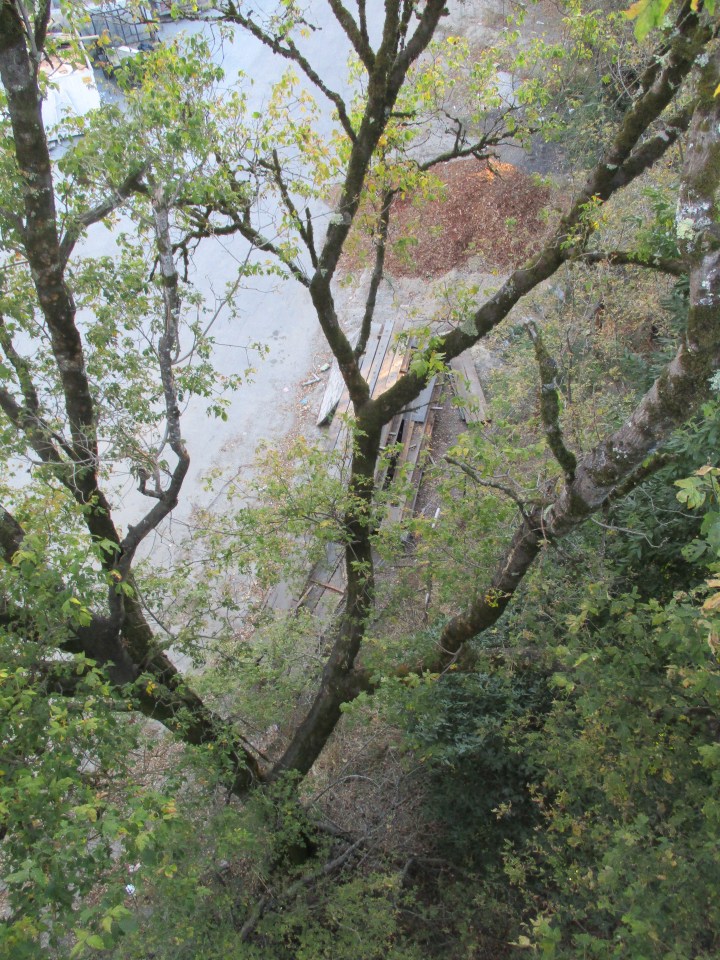
This view of a big box elder, Acer negundo, from above, which I got from the edge of a bridge, might be that of just another day at the office for other arborists.

Work Day Renovation Of A Flowering Crabapple

P91020P91020+It is amazing what just a few parishioners and friends can accomplish in just a few hours from about nine to noon on Saturday morning. It is only happens a few times through the year, so we make the most of it to catch up on all sorts of maintenance and projects at Felton Presbyterian Church. (My parish should do this sort of thing.) I was there to work in the minimal landscape.
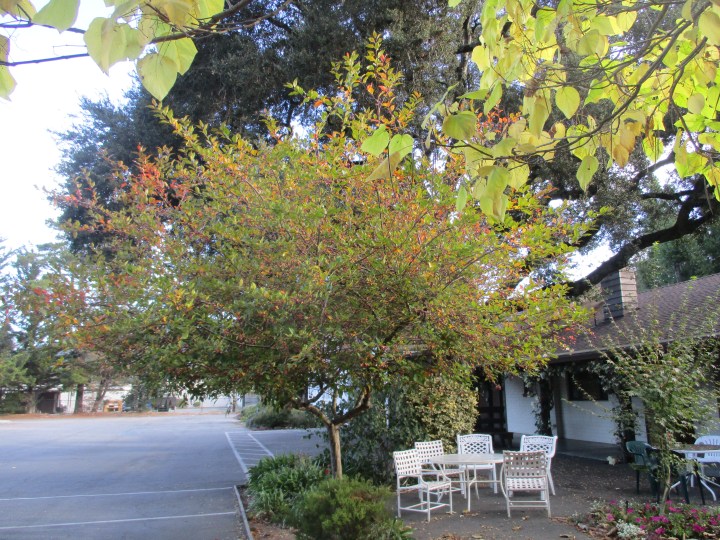
I started working with this ‘Prairie Fire’ flowering crabapple several years ago. As I pruned for clearance above the adjacent parking spaces and patio, I retained lower growth in the space in between. The tree bloomed too nicely to unnecessarily remove all that was right where it was most visible. Besides, from the patio, it was more visually appealing than a view of parked cars.

Then, I missed a work day. There were plenty of volunteers. There were plenty of power tools. There was plenty of enthusiasm. There was no horticultural expertise. Someone decided that my once exemplary flowering crabapple was in need of pruning, so executed the task with power hedge shears. The damage is irreparable. Lower growth is gone. Upper growth is mutilated.

It was very discouraging. It was done out of season, so I could do nothing to start to repair the damage at the time. There was not much left to repair anyway. I could only let the tree grow through a season so that there would be something to work with later.

Well, this was later. I would have preferred to wait for complete defoliation, but the tree is starting to go dormant now, which is technically good enough. I also would have preferred to prune less away; but really wanted to remove as much of the disfigured growth as possible.

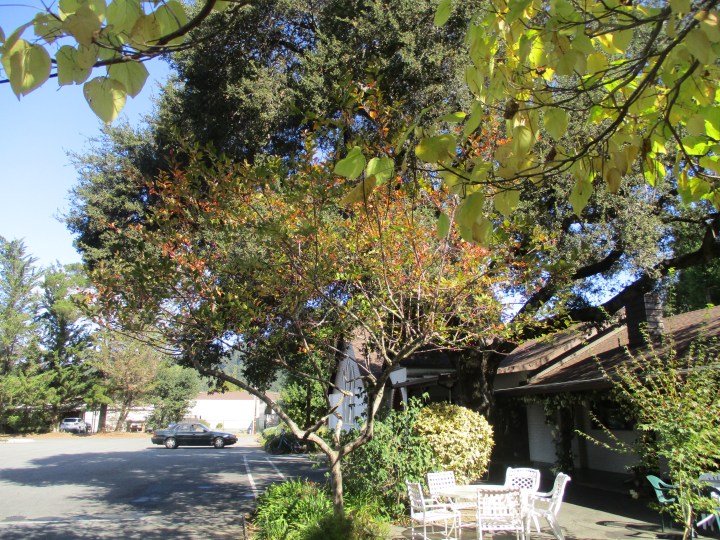
I am less than pleased with the results. With all the disfigured lower growth removed, only the new upper canopy remains. The tree got what my colleagues might refer to as an ‘Ethiopia cut’, which is what much taller trees in Ethiopia get when their lower growth gets eaten by giraffes. It will be a long recovery.

The upper picture is the ‘before’ picture. The bright sunlight at noon does not look so good in the lower ‘after’ picture. I mentioned the Work Day and an update in my other blog, Felton League.


Self Grafted Redwoods

P91019K

Redwoods are some of the most stable trees in the World. That is partly why they can survive for thousands of years. In my entire career, I have seen very few fall, and only inspected two.

Of those two, one fell because it had co-dominant leaders (double trunks) that fell away from each other, which is more of a structural deficiency than instability. The other, which I suspect was demonically possessed, was a small tree less than thirty feet tall, that literally jumped up out of the ground and onto an Astro van more than ten feet away. A rare ‘updraft’ was blamed.

Almost all of the redwoods here regenerated from the stumps and roots of much older trees that were clear cut harvested a century or so ago. Most of those that grew back with structurally deficient co-dominant leaders are very effectively sheltered from wind by their collective groves. Roots systems are very extensive, very resilient, and too intermeshed to be compromised.

The trunks in the picture above are part of a group of several trunks that grew from roots of the same tree that has been gone for a very long time. All are genetically identical and very close together. They happen to be a focal point of a big patio at a conference center. Although the structural integrity of the limbs within their canopy is a concern, the stability of the trunks is not.

Regardless, I am impressed by their attempt to improve stability. The limb that extends horizontally across the middle of this picture from the trunk to the left grafted to the trunk to the right! It is not uncommon for crossing limbs and trunks to rub through their bark to expose the cambium, but how do they stay still long enough to graft together?!

Horridculture – Sign Up

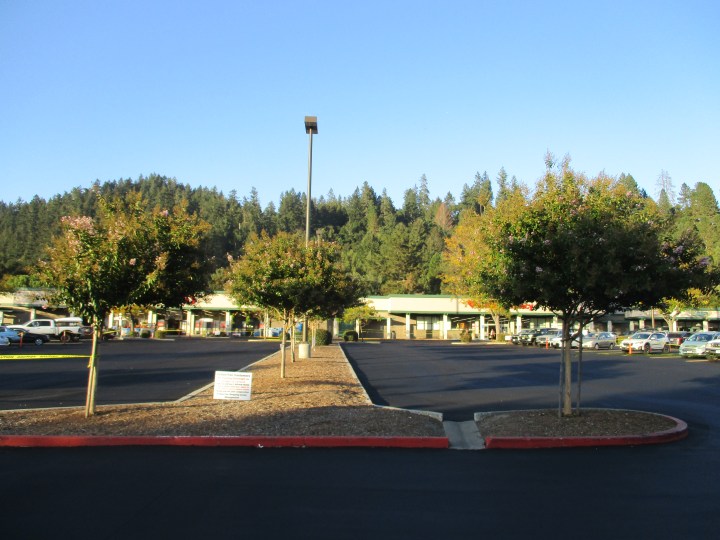
P91016Perhaps the signs should be down instead. They are obscured by the crape myrtles where they are now. They would be more visible if they were either higher or lower, but not in line with all these trees. The trees were planted only a few years ago, but have done very well. Lodgepoles need to be removed. The specimen to the left is recovering well from earlier disfigurement.
Selection of trees for parking lots is not easy. Such trees must disperse complaisant roots that are not likely to displace pavement or curbs. They should should be reasonably high branched and conducive to pruning for clearance above parked cars, and where necessary, for delivery trucks. Excessive floral or foliar mess would be a problem. So would fruit that attracts wildlife.

Unfortunately, not many trees conform to all limitations. Those with the most complaisant roots do not get big enough to be pruned up high enough for adequate clearance, or even provide significant shade over the often hot black pavement below. Since shade is the primary function of such trees, an abundance of diminutive trees often compensate for fewer substantial trees.

This presents another range of problems. The smaller trees can be pruned for minimal clearance above pedestrians and parked cars, but not delivery trucks. What is worse is that they can not be pruned above lighting and shop signs either. Pruning them lower than the signs instead would only work if the signs were to be viewed horizontally, from the same height as the signs.

Nonetheless, that is what is most commonly done. This is the result. All those flashy and expensive signs on the buildings in the distance are mostly obscured from this vantage. Fortunately, the honey locusts closer to the signs can be pruned up higher for adequate clearance.

Herbaceous Trees

P91005KPalms are like ‘Red Delicious’ apples. It seems that most people dislike them; but they also seem to be very popular. Seriously, if only a few people like ‘Red Delicious’ apples, why are they so common in supermarkets? If most of us dislike palms, why are they so common in the San Jose Skyline?

I suspect that palms really are as unpopular as they seem to be, but that they are also very conspicuous within their situations. Not only are they focal points of the landscapes in which they live, but most types eventually stand as tall as the tallest trees in the neighborhood, and some get significantly taller. They are innately the most prominent trees within their neighborhoods.

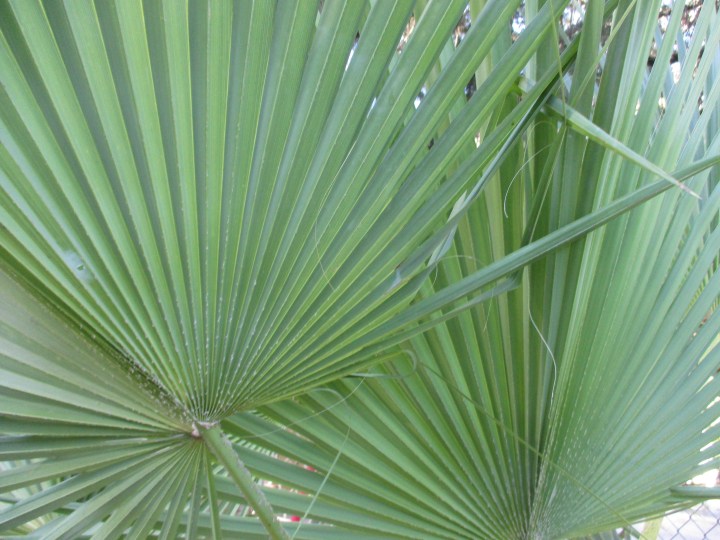
Palm are not like other trees though. Arborists may classify them as ‘herbaceous trees’. They are foliar plants while young, producing increasingly large leaves from terrestrial rosettes. They only ‘launch’ and start to develop their trunks after the formerly terrestrial rosettes have grown wide enough to do so.

Not only are their trunks no wider than their associated foliar rosettes, but they get no wider as they grow taller. The base of a trunk of a palm is as wide when the tree is only a few feet tall as it will be when the tree grows to forty feet tall. Mexican fan palms are only wider at their bases because they start out like that.

Palms with slender trunks can launch much sooner than those with wider trunks. It does not take long for their rosettes to get as wide as their trunks. Canary Island date palms have rather plump trunks, so may need to mature for many years before they launch.

Yuccas and dracaenas are not really palms. Their trunks expand and develop branches as they grow and mature.

Another Johnny Appleseed

P90330+++++

Just to be clear, I earned the title of Johnny Appleseed before my colleague Brent Green did. While Brent was secretive about our tree planting projects in Los Angeles, I was not so about our similar projects in Los Gatos. While Brent’s neighbors wondered where their new street trees were coming from, mine read about their new park trees in the Los Gatos Weekly Times.

In fact, the exposure from that article is how I started my weekly gardening column in the same newspaper just a few months later, in October of 1998. Los Gatos is a smaller town than Los Angeles is. Secrecy was not an option. Sadly, our projects in Los Gatos, and then in Scott’s Valley, did not continue. We concentrated our urban tree planting efforts in Mid City Los Angeles.

The tree planting projects that I am referring to are our Birthday Trees that I wrote about last January. As I explain in that article, Brent had been wanting to plant trees in the formerly blank and broad medians of San Vicente Boulevard in Los Angeles. I just happened to be able to supply such trees from those at the farm that got a bit too past their prime to be marketable.

I do not intend to be redundant to that article, but want to share this video, Johnny Appleseed. As much as I hate to admit it, Brent is much more entertaining than I am. (I should later share one of my old videos from Gardening By The Yard, so you can compare.) I should probably look through more of Brent’s old videos to see if there are others that would be interesting.

If I had more time, I would write more about Brent’s work to improve the urban forests of the Los Angeles Region.

Horridculture – Opposite Poles

P90904This is not about North and South. It is about a utility pole and a pole that remained from a redwood tree that was too close to it. One is there to support a variety of cables and a streetlamp. The other just wanted to grow into a redwood tree to join the rest of the forest. One has been deceased for many years or decades. The other was alive just recently, but is now only a stump.
The picture above shows how many cables the utility pole supports, as well as the streetlamp. When I did my internship in 1988, the arborists whom I worked with knew what each of the various cables were for; high voltage, lower voltage, cable television, telephone and whatever else was up there. Fiber optic cables have since simplified the telephone and television cables.

The picture above also shows how the unfortunate redwood tree needed to be cut back for clearance from the electrical cables. I was mortified to see this so prominently visible on the edge of a main road, because I should have noticed the problem earlier and just cut the tree down. Not too long ago I was pruning many other redwood trees for clearance from other streetlamps.

Those who pruned it instead, along with any other trees that were encroaching into the electrical cables, were very efficient with establishing clearance, but not so proficient with aesthetics. Obviously, I could not leave this tree like this on the side of the road. Even if I did not care what it looked like, I did not want it to regenerate and immediately encroach back into the cables.

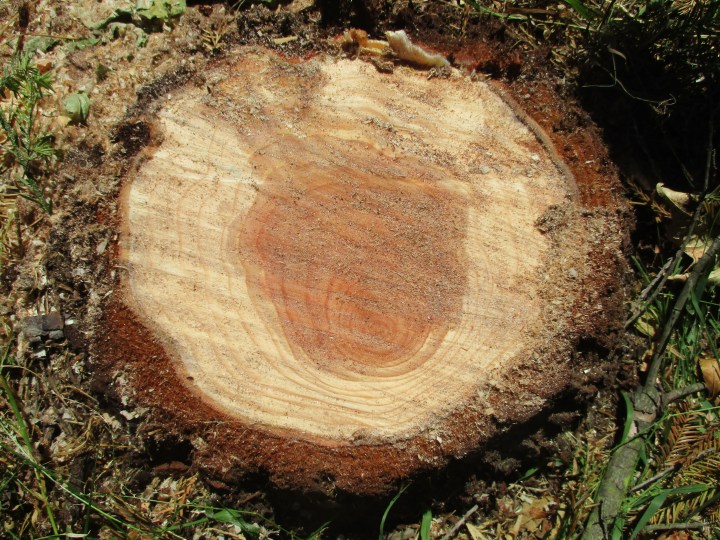
The picture below shows my corrective pruning. The stump is certainly not dead, and will try to regenerate, but will be easier to keep down. If kept down long enough, it may eventually die.

The second picture below shows the stripped trunk in two sections that are nearly eight feet long, and a short bottom section that is a bit more than two feet long. The two long sections are straight enough for gate posts (although there is another plan for them). It is a sad demise for the formerly healthy and sound redwood tree, but became necessary to keep the electricity on.P90904+P90904++