 English ivy, Hedera helix, is probably the nastiest and most aggressively invasive exotic species that I work with. It climbs high into redwood trees and overwhelms understory plants (that live below the trees). It invades many of the landscapes, and worst of all, it climbs building where it ruins paint and causes rot. It grows faster than we can keep up with it.
English ivy is actually a nice ground cover plant for refined landscapes. I grew it at my home in town. Contrary to popular belief, it does not root into and parasitize the trees that it climbs. Actually, it rarely overwhelms and shades out large trees. It prefers to keep them alive for support, from which it disperses its seed. However, it does promote decay in the trunks that it climbs, particularly where it retains moisture at ground level. Native trees are not accustomed to that.
We try to remove as much English ivy at work as possible, which includes removing it from trees and buildings. So far, with a few exceptions of small bits of ivy that broke off high in the trees that it climbed, I have been able to remove all ivy from the trees and walls that I have worked on.
Others were not so fortunate. When quick and efficient removal of ivy from the bases of as many mature trees as possible is the priority, ivy is more often severed down low, and left to die on the trunks of the infested trees. It looks shabby to say the least, and takes many years to deteriorate and fall away. In the picture above, dead ivy that was severed within the past few years is already being replaced by new ivy, which will also need to be severed.
The same technique happens with ivy on buildings. It gets cut at the foundations, but left on the walls to shrivel and turn brown. The dead ivy in the picture below was reaching upstairs eaves when it was severed, and remains there a few years later.
What annoys me so much about this technique is that it does not take much extra effort or time to tug quite most of the lower ivy from trees and walls. For most situations, all ivy can be dislodged, although tiny aerial roots remain. It is much easier to dislodge while fresh than after it is dried and crispy.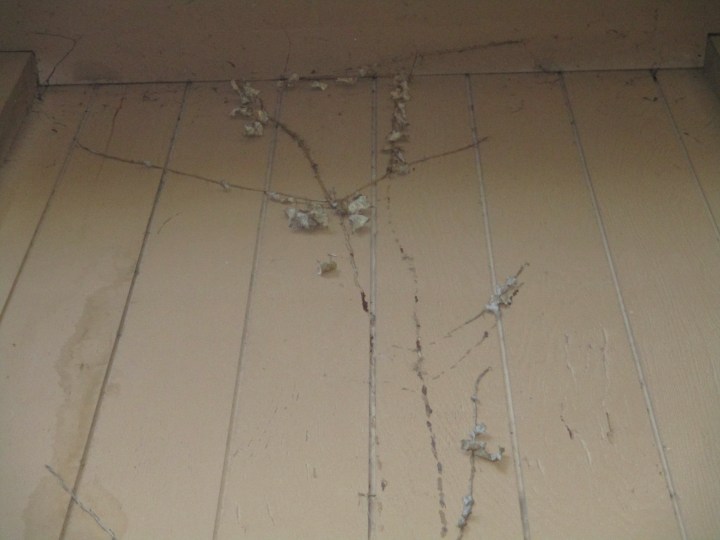
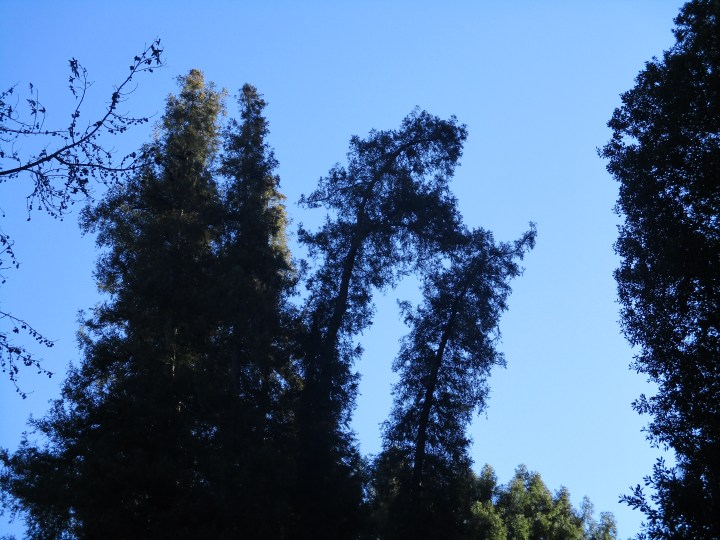 Coastal redwood, Sequoia sempervirens, are remarkable stable trees. They rarely fall, which is how they get to be thousands of years old. They prefer to live in groups, where they mesh their roots together, and shelter each other from wind. Those that live outside of a group stay shorter than forest trees, and typically develop multiple trunks that function as a group.
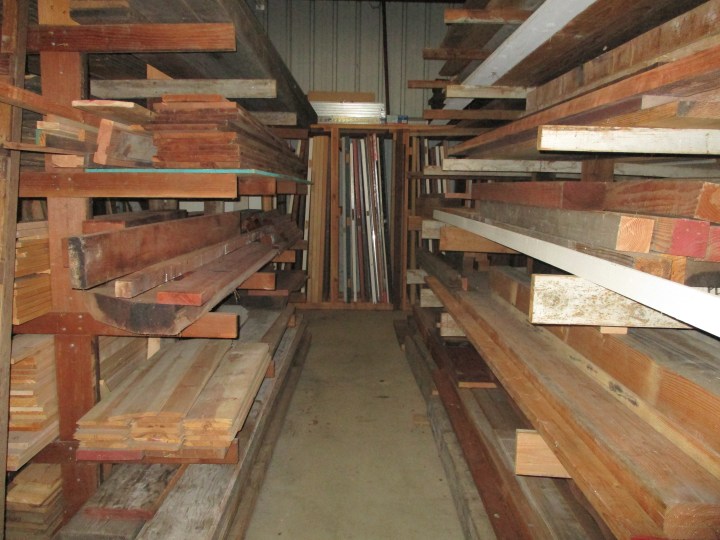 Saint Joseph did not have it so good. He is still the most famous carpenter, and somehow got the most excellent city in the World named after him, but he did not work in a shop like this one. The most well outfitted carpentry shops back then lacked modern power tools, and the selection of woods that are now so easily imported from all over the World.
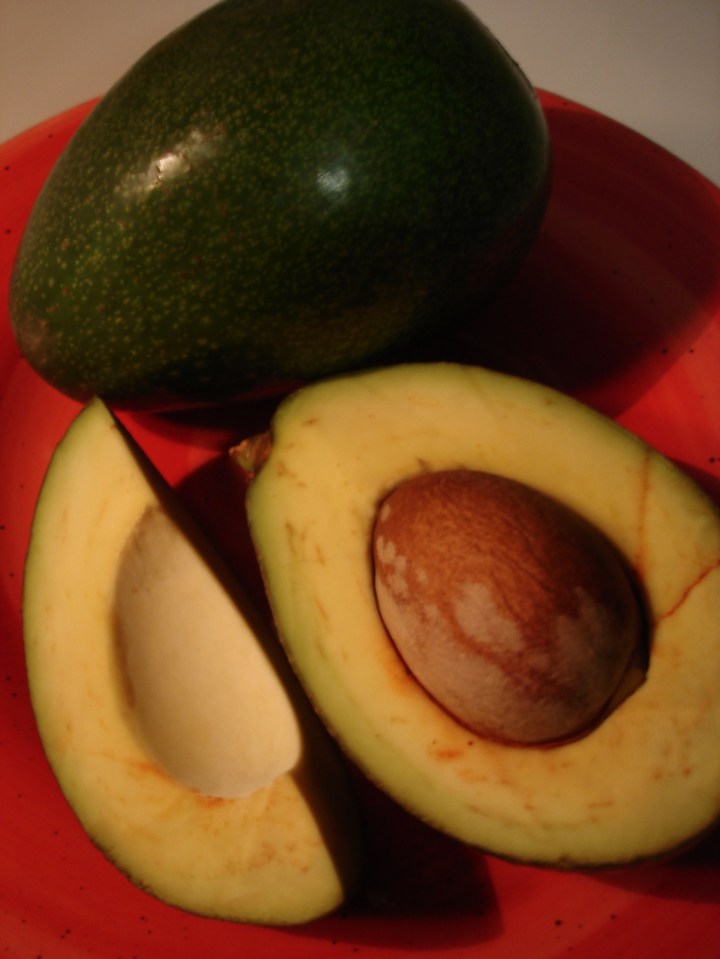 Avocado trees, Persea americana, grown from seed need to be about five years old to produce fruit that can be considerably different from the fruit from which the seed was taken, although such fruit is almost always quite good. Some trees need to be twice as old to produce. Grafted trees from nurseries are specific varieties that can start to produce their specific fruit immediately.
 This landscape is nothing fancy. It is out in front of a fast food establishment on Ocean Street in Santa Cruz. It is low maintenance, and starkly simple. It would be nice if the so-called ‘gardeners’ would cut back the African iris and English lavender a bit better, but they may have left them like this so that they are less likely to get trampled. The colored chips get replenished regularly, and the trash gets harvested quite efficiently. As I said, it is nothing fancy. The only remarkable feature had been this exemplary crape myrtle in the middle.
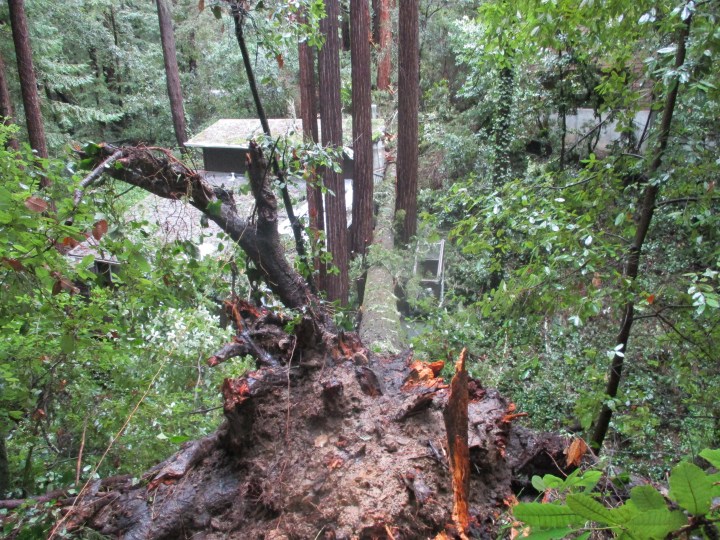 If there were lawns and fences in this neighborhood, the grass would likely seem to be greener on the other side of the fence. In this situation, the greenhouse probably seemed to be more comfortable than being left out in the storm. This tall Douglas fir tree dropped in to find out. It did not go well. What remains can be seen in the middle of the picture above, just to the right of the fallen fir, and in the close up of the picture below.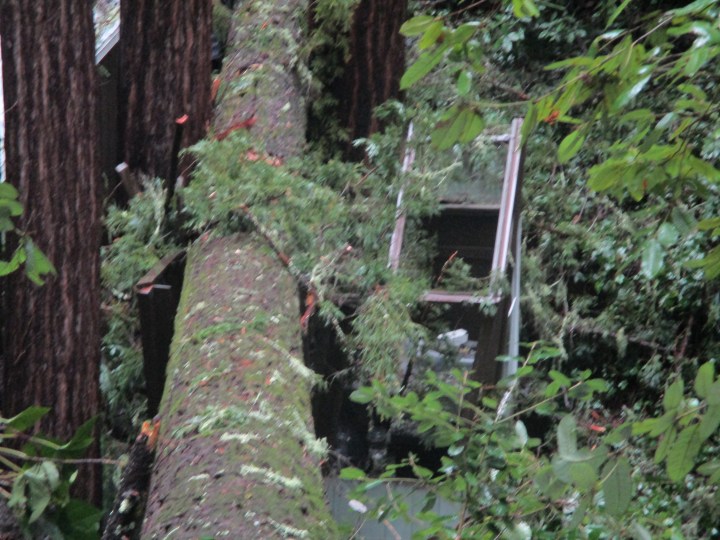

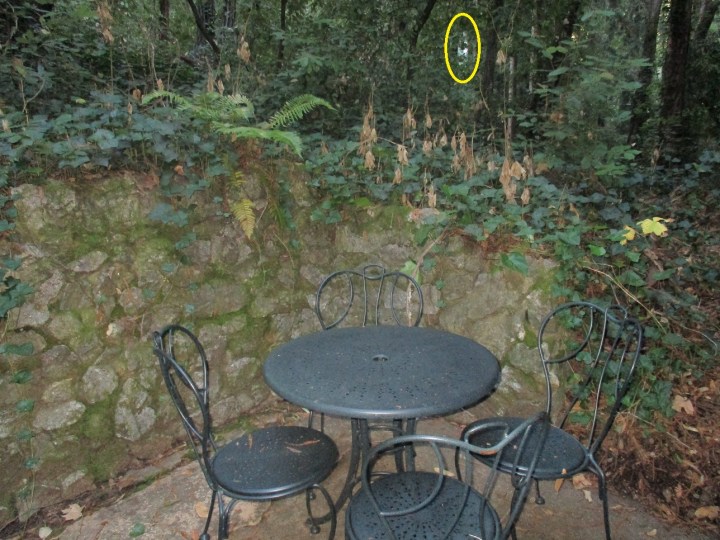
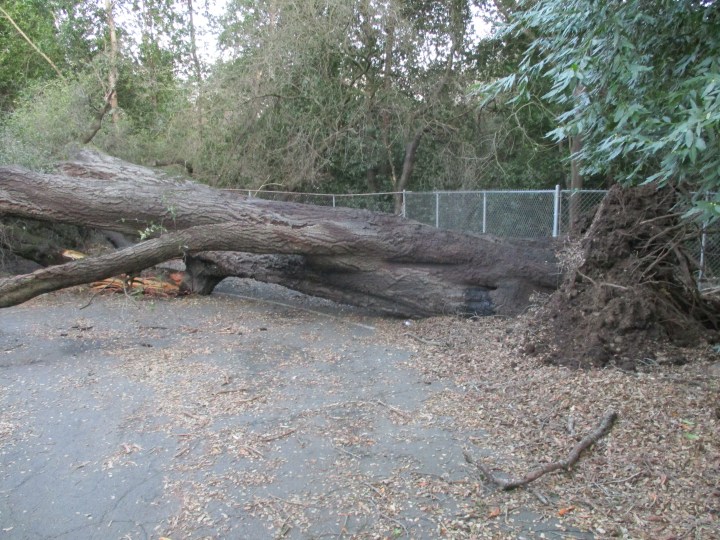
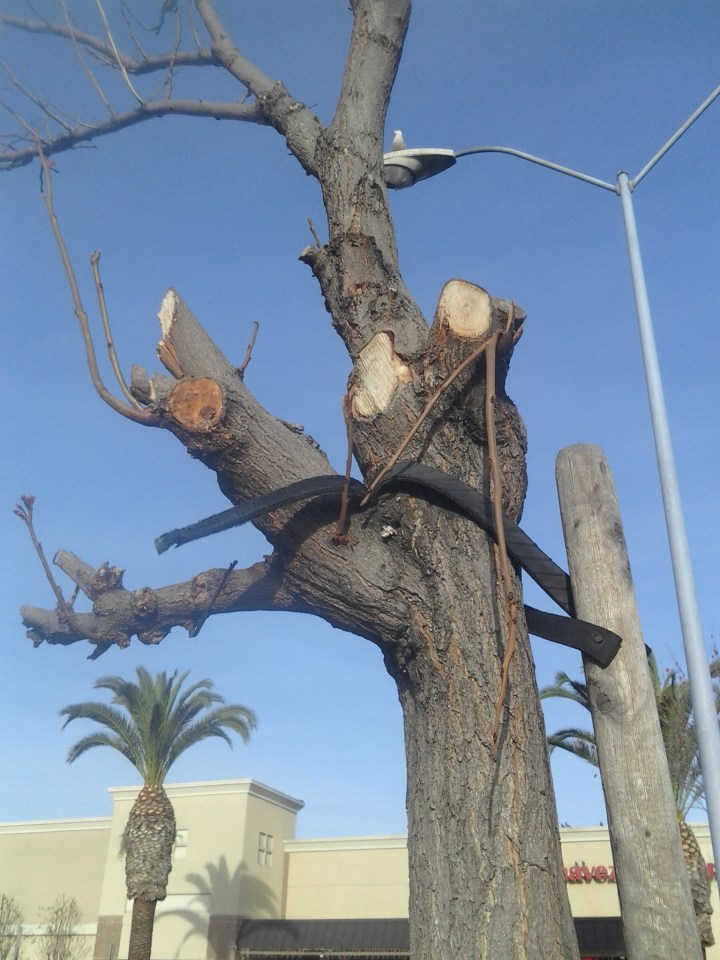 Okay, we get it; someone really hates trees. That’s fine. Trees are not for everyone. Just cut it down. Put it out of it’s misery. Take away the useless lodgepole stake and strap along with it. Maybe those Canary Island date palms that look like the home of SpongeBob SquarePants in the background will recover from their own form of abuse to compensate for the loss of this seemingly unwanted goldenrain tree.
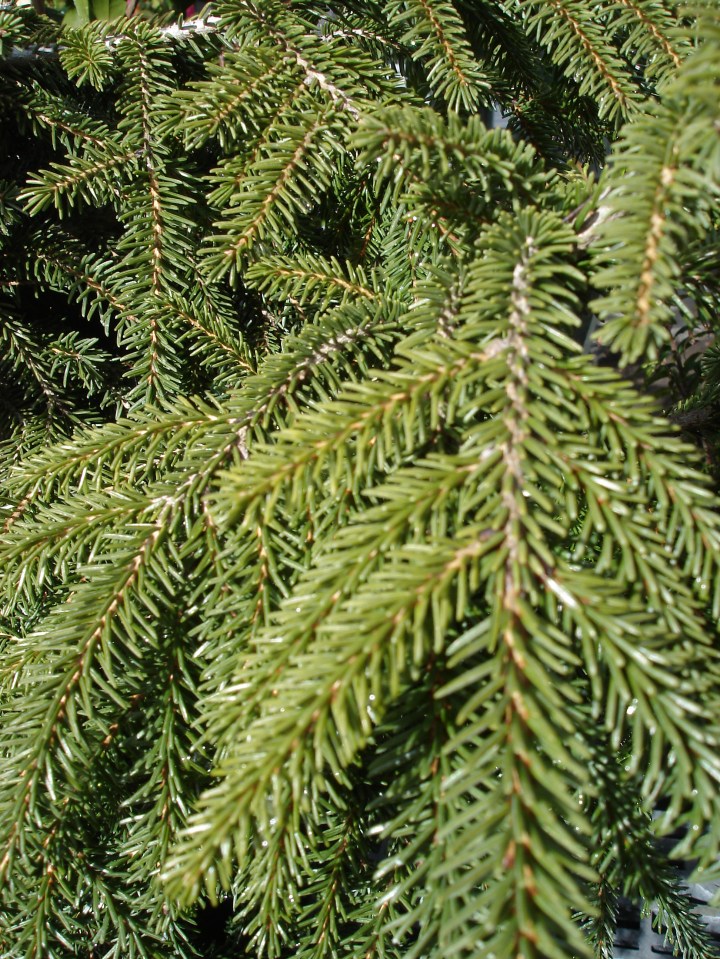 If it got as big as it does in the wild, Oriental spruce, Picea orientalis, would not fit into many home gardens. It can get more than a hundred feet tall! Fortunately, it does not often get much more than twenty five feet tall locally. Trees that compete with taller trees in forested landscapes might get to forty feet tall. Their symmetrically conical canopies get about fifteen or twenty feet broad.
 It seems that I have been negligent about writing about my colleague Brent Green and some of our crazy adventures in horticulture. I said I would do so when I started writing my articles here way back two Septembers ago. It is easy to get distracted from such topics, particularly since we do such different types of work. Brent is a renowned landscape designer and proprietor of GreenArt Landscape Design in Southern California. I am just a horticulturist and arborist who really should get back to growing horticultural commodities in Northern California. For all of our similarities, there just might be as many differences.
