FLUX

P80523This unhappy native white alder, Alnus rhombifolia, had been deteriorating for quite a while. White alders do not last long even in the wild. A few nearby have already been removed. This one is next. They were nice and shady when the landscape was new. Nicely maturing sycamores and a bigleaf maple can take over for this one now.

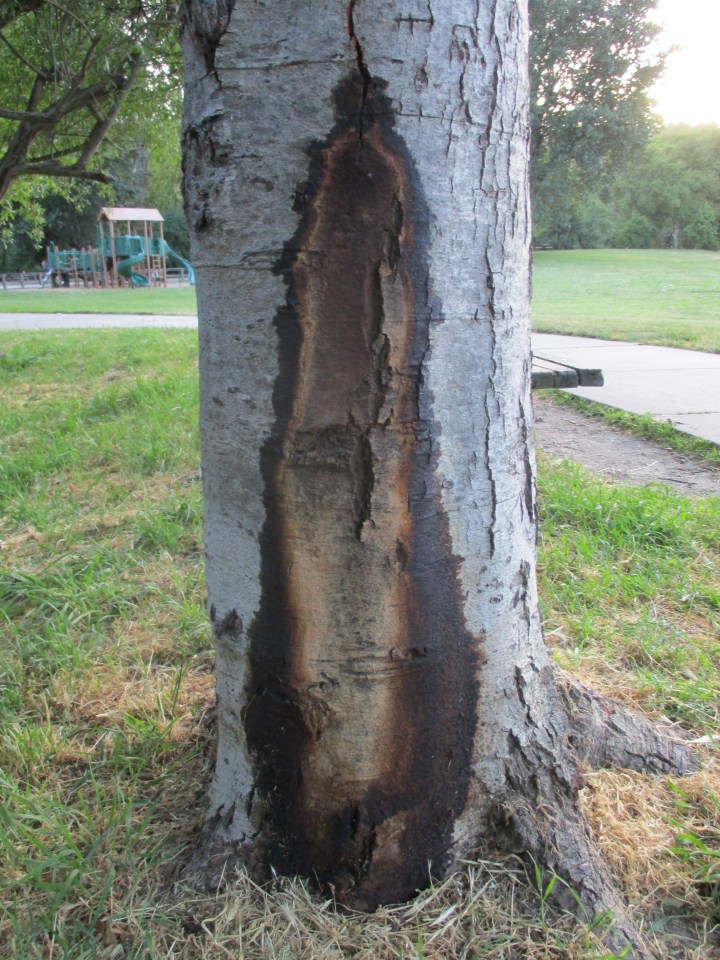
As bad as it looks, this nasty stain had nothing to do with the imminent doom of this tree. It developed only recently, and very quickly. It is not nearly as bad as it looks. If the tree were not to be removed, it could survive with this problem for quite a while. Other healthier trees can live with it for many years or indefinitely, and some actually recover.

It is ‘flux’. More specifically, it is slime flux, which is also known as bacterial wetwood. The obvious symptoms are this unsightly bleeding and staining. A less obvious symptom is the swelling that caused the fissure in the bark from which the unsightly fluid is draining. The fluid can smell nasty!

Furrows in the bark develop naturally as the trunk expands over many years. They do not penetrate through the bark into the cambium below.

Fissures are fractures that penetrate through the bark and into the cambium. The fissure in these pictures developed so recently that the orange interior of the bark has not oxidized to tan or gray yet. The fissure is about six inches long, and slightly lower than a doorknob.

Even for healthy trees, there is no remedy for slime flux infection. It can only be left to do whatever is going to do. It can accelerate internal decay, but is otherwise not as detrimental to the health of an infected tree as it would seem to be.P80523+P80523++

(The article from my weekly gardening column that is typically posted on Thursday was posted yesterday, which is why this article, which is more appropriate for Wednesday is posted today.)

Overgrown Shrubbery Becomes Small Trees

80530thumbThose of us with ‘maintenance gardeners’ are likely aware of how rare it is to find someone who knows how to maintain hedges properly. It seemed so simple years ago. Several identical plants could simply be planted in a row, and then somewhat regularly shorn for confinement to a prescribed space. They were not allowed to exceed a specific height or width for long between shearing.

Formal hedges are now passe. They do not conform to modern landscape style. No one wants to maintain their formality anyway. If a gap develops, it is likely to be filled with a different cultivar or species that is not identical to the rest of the hedge, merely because it happened to be available at the nursery. Feral or invading shrubs, vines or even trees get shorn right into the whole mess.

Then there is the problem with bloat. Rather than staying confined, hedges typically get slightly larger with each shearing. What is worst is that most of the extra bulk is high up and shading lower growth, causing it to grow slower. Hedges eventually develop that all too familiar top-heavy appearance, and encroach into otherwise usable space that they were designed to provide privacy for.

There are few simple options for hedges and shorn shrubbery that have gotten too big for their space. Some can be renovated and cut back beyond their outer surfaces, but recovery will take a bit of time, and can not fix unmatched plants. However, such restoration is likely better than replacement. Just like for a new hedge, feral and invading vegetation must be removed in the process.

Another option is to completely change the form of improperly shorn shrubbery to small trees. This can be done with individual shrubs, or a few selected remnants of an otherwise removed hedge. Cherry laurel, photinia, bottlebrush, tea tree, privet, various pittosporums and many other large hedge shrubs work quite nicely. Rather than getting pruned back into submission, the lower growth gets pruned away to expose sculptural trunks within, and the upper growth gets pruned only for clearance above.

Not So Fruitless Cherry Trees

P80520The ‘politically correct’ designation for them now is ‘flowering cherry’. We all know what it means, but it is not quite as accurate. After all, they all flower. Fruiting cherries can not make fruit without flowering first. The old fashioned designation as ‘fruitless cherry’ is more accurate, but not so appealing. Besides, after half a century, the work of these two deteriorating old fruitless cherry trees has not been in vain.

We are not certain what cultivar they are. I think of them as ‘Akebono’ because that is what I am familiar with. However, those who have been acquainted with them longer know them as ‘Yoshino’. The tree structure seems to be more similar to that of ‘Akebono’. The bloom seems to be more similar to that of ‘Yoshino’. My Mother happens to like ‘Akebono’, so if she ever asks, I know what to say. However, I would tell my Pa that they are ‘Yoshino’ because that happens to be the middle name of his newest son in law, who he gave my baby sister #5 away to. It does not really matter what their name is. They are some of the most important trees in the neighborhood.

You would think that with all the very old and very big redwoods here, that these puny and decrepit flowering cherry trees would not be all that important. Some of the redwoods are hundreds of feet tall and hundreds of years old. They will still be here for a very long time after the flowering cherries are gone. Flowering cherries can last for centuries where they are happiest and pampered in old gardens in Japan, but rarely last half a century here, even in the best of conditions.

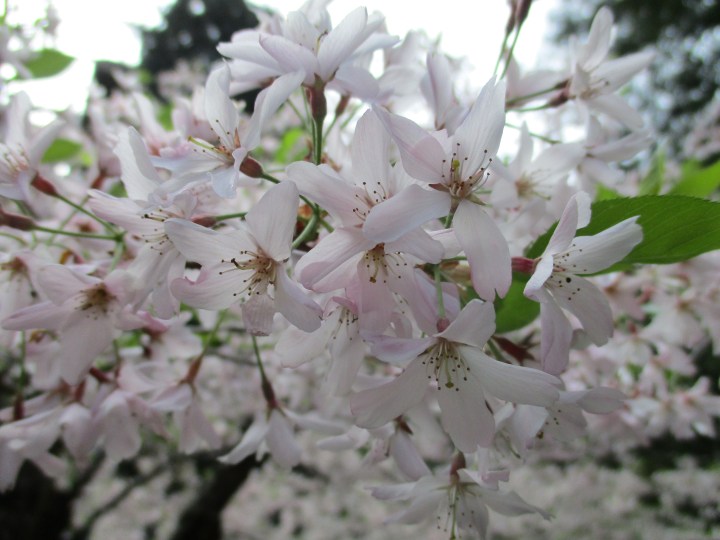
However, everyone in the neighborhood knows these cherry trees. There are only a few people who can remember before the trees were planted in the late 1960s. They are spectacular in bloom, particularly with the dark green backdrop of the rest of the landscape and redwoods. The picture below shows a close up of the bloom about a month and a half ago. One can imagine the entire canopy of the trees covered with this bloom before new foliage appears. It was even more spectacular years ago, before the canopies started to deteriorate and die back. There is not much left of them now.

They really are as bad as they look in the picture above. The closer of the two trees is just a stump with that silly little stub on top to make it look even more disfigured. I could not cut off the stump because some of the minimal remaining viable stems originate there. It does not matter much. There is no way to repair these trees, or make them any prettier. Either of the trees could die at any moment. We are ready to plant at least one replacement, although we will likely only plant one. The objective is to restore the bloom that was there before, but we know that there is no replacement for the trees that those who are familiar with are so fond of.

I have worked with MANY trees through my career, including a few that are (or were) very cultural significant. I was very disgusted by the lack of respect for a group of historic redwoods that used to be outside the old City Hall in Sunnyvale before the mall was build around them, over the area that used to be downtown. I inspected the big old coast live oak at the Scott Residence in Scott’s Valley, where the founder of the town resided. Again, I was saddened by the lack of concern from people who live there now but know nothing of local history, and care even less. At the Winchester House, I witnessed idiotic mislabeling of the historic California fan palms flanking the driveway, as well as blatant lies about their history. Well, I could write another article about this rant. These not so fruitless flowering cherries do not fit into this category anyway.

It seems that everyone is aware that the flowering cherries will be gone soon, and they understand why. No one questions the need for removal. It is saddening anyway. Yet, it is also gratifying to know that these trees are appreciated and respected as much as they are. Those who know them appreciate all the work they put into making their lives a bit more colorful and happier. For half a century, these flowering cherries have been doing what they were planted to do. They had a very good and fruitful career.P80414

Drunk Stick

P80516Seriously, I am not making this up. ‘Drunk Stick’ is what the Spanish name of ‘palo borracho’ translates into. It is one of the few common names of the tree I know only as floss silk tree, Chorisia speciosa or Ceiba speciosa. Yes, it sounds crazy, but not as crazy as what the trunk and limbs looks like. One can speculate why it is known as ‘drunk stick’. I am not certain that I want to know.

The trunk in the picture is that of a small tree still in a #5 can. Larger trunks are no better. They are fat and green, and outfitted with these weird conical thorns. The thorns are not too terribly sharp like those of hawthorns or cacti, but they are terribly stout. Seriously! They are like made of wood! As the green trunk grows, it becomes distended, but only makes more thorns to cover the expanding surface of the bark. Even large trees are covered with these horrid things! Only the smallest limbs lack them, and even they have smaller versions. Drunk stick might be endemic to Bedrock, but Bamm-Bamm Rubble would not build his treehouse in one.

Why on Earth would anyone want this aberration of nature in the garden?! Well, it is interesting. After all, it got your attention. Several were planted as street trees in the medians of Santa Monica Boulevard through West Hollywood, to show off their weird trunks. On top of that, over the exteriors of their low and broad canopies, their fluorescent pink bloom matches their lime green trunks about as well as socks that Valley Girls (from the Santa Clara Valley of course) wore in the 1980s. Neither inebriation nor intimidation with a thorny stick is necessary to appreciate the uniqueness of the drunk stick.

Six on Saturday: Tree Ring Circus


When a tree falls in a forest and there is no one around to hear, it makes a big noise, as well as a mess, and it leaves some if its root in the ground. If a redwood tree falls in a forest, and there is no one around to hear, it is probably better that way. It wold be dangerous to be too close to a redwood when it comes down! They are so big and tall, and are typically so crowded amongst other trees, that they bring down tons of debris with them.

Falling redwoods are rare. They live for centuries or thousands of years. Yet, sooner or later it happens. In more modern history, after the ecology of the redwood groves was disrupted by extensive harvesting, redwoods sometimes get killed by forest fires. (Redwoods are some of the few trees in California that survive forest fires by being fire retardant, but can be killed if enough of the more combustible trees around them burn hotly enough. Extensive harvesting allowed more of the other combustible trees to mix into redwood forests than would normally be there.)

The one thing that redwoods do even less frequently than fall is die. Even after they fall, burn to ‘death’ or get cut down, they regenerate from their stump or roots. Sometimes, several or many genetically identical new trees that are all attached to the same root system develop around a dying parent before it falls. They sometimes do so after a parent burns or gets cut down. Eventually, the original tree decays, leaving a circle of new trees around where it once was. Outsiders often refer to them as ‘fairy rings’. To us, they are just tree circles or rings. Larger and more impressive circles might be known as ‘chapels’ or better yet, ‘cathedrals’.

They are impressive features in the forests. When the area nearby gets landscaped, they are typically ignored because they are so excellent that they can not be improved. There are not many plants that live in the debris of redwoods anyway.

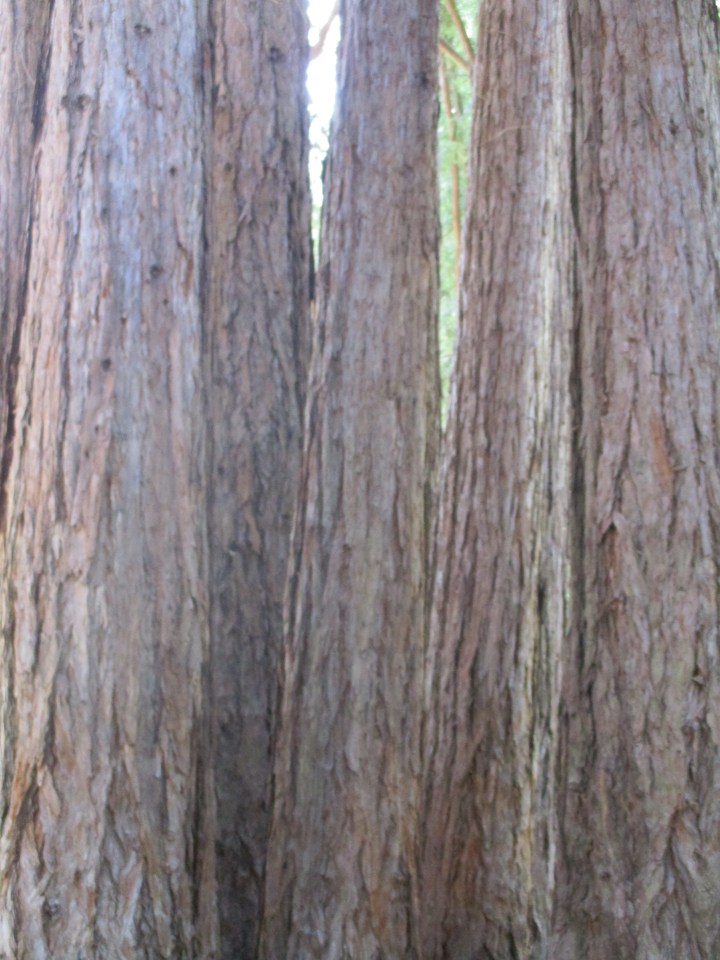
1. This is a nice small but crowded chapel where I work.P80512
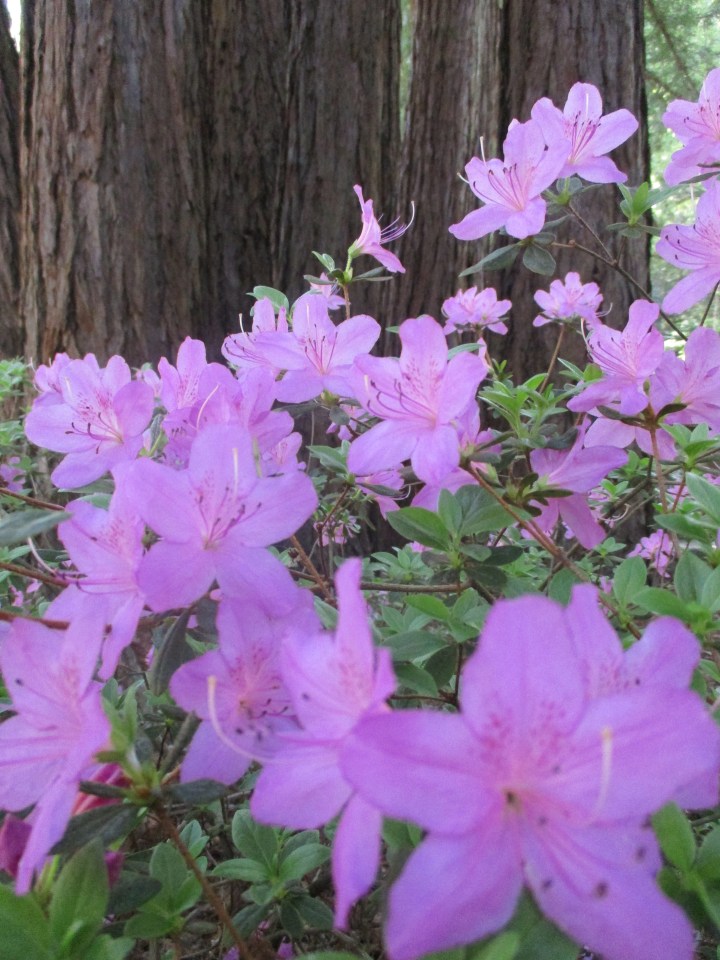
2. How does such a chapel get landscaped? It doesn’t. Ours happens to have a nice patch of azaleas nearby. This picture was taken earlier. Bloom finished a while ago.P80512+
3. These azaleas are just so excellent that I had to get a better picture to show them off.P80512++
4. Forget-me-not happens to be one of those few plants that does not mind light redwood litter, so we often let it grow and bloom if it shows up in a good spot.P80512+++
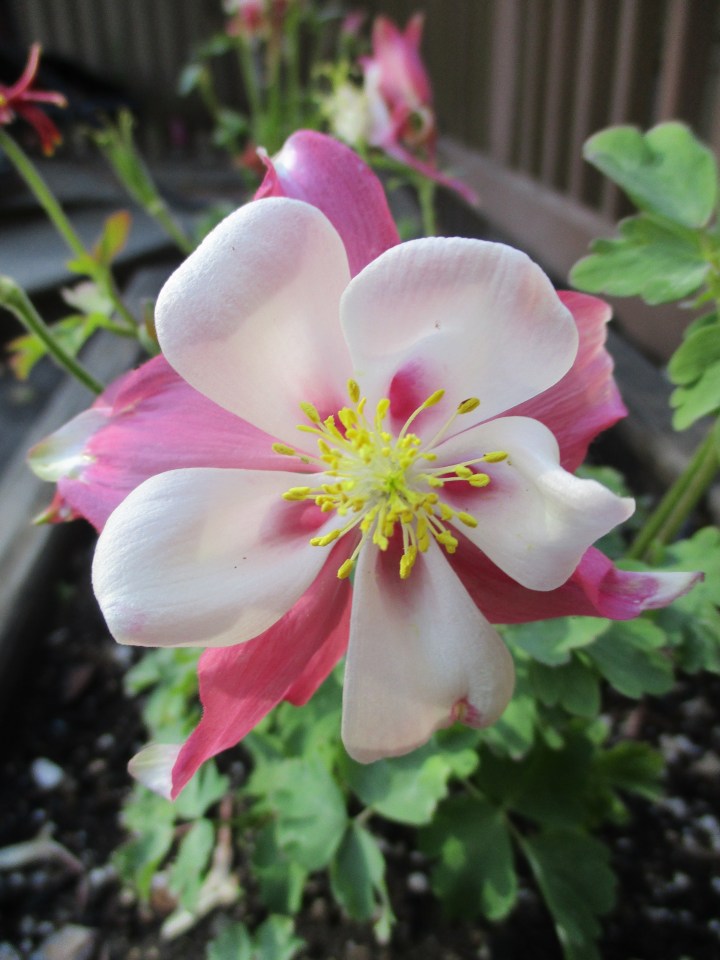
5. Columbine just seems to look good with redwoods for some reason, but it dislikes the litter. This columbine is in a nearby planter that does not get much litter.P80512++++
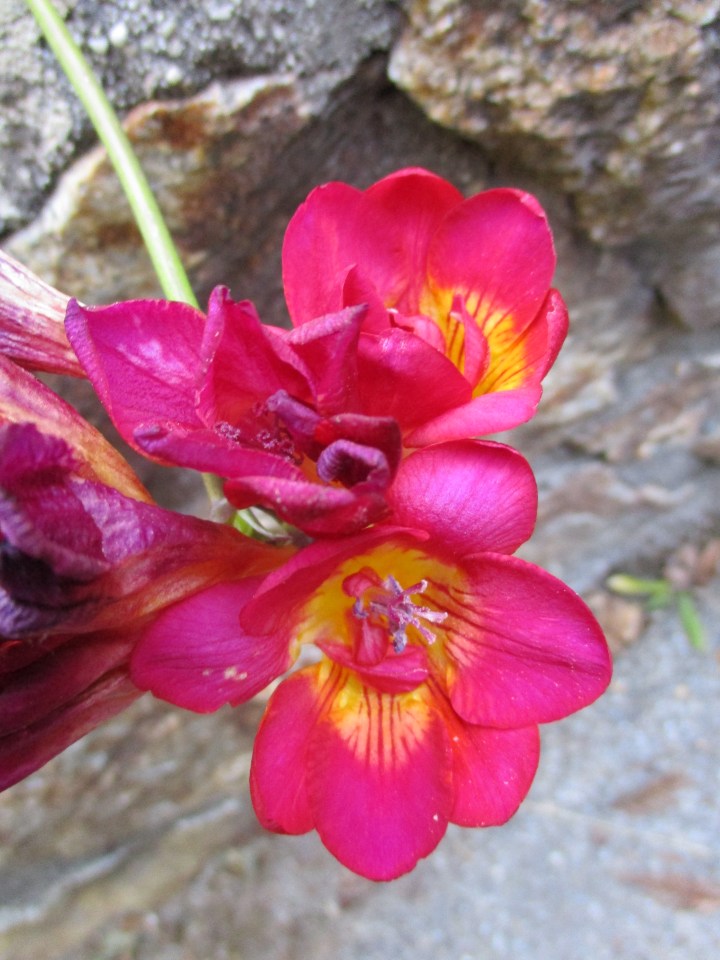
6. I can not explain the red freesias that bloom earlier in spring. There are yellow and purple ones too. No one knows where they came from, but they do not seem to be bothered by a bit of redwood litter.P80512+++++This is the link for Six on Saturday, for anyone else who would like to participate:

https://thepropagatorblog.wordpress.com/2017/09/18/six-on-saturday-a-participant-guide/

May 2

P80502When I started writing this blog eight months ago, I reserved the right to occasionally write about topics that were irrelevant to horticulture and gardening. I designated the category of ‘elaborations’ for posts that were not from my weekly gardening column; but so far, I have tried to post articles within this category that were at least remotely relevant to horticulture, even if only to discuss a single tree, or merely a single ginkgo leaf that somehow appeared in Felton Covered Bridge Park.

Today is May 2. My post for today is only relevant to horticulture in that it explains the importance of the ‘Memorial Tree’ in Felton Covered Bridge Park.

Steven Michael Ralls passed away a year ago, on May 2, 2017

Jeffrey Dale Scofield passed away two years prior to that, on May 2, 2015

They were two of my most intimate friends. I wrote both obituaries. The obituaries are posted below, and are irrelevant to horticulture.

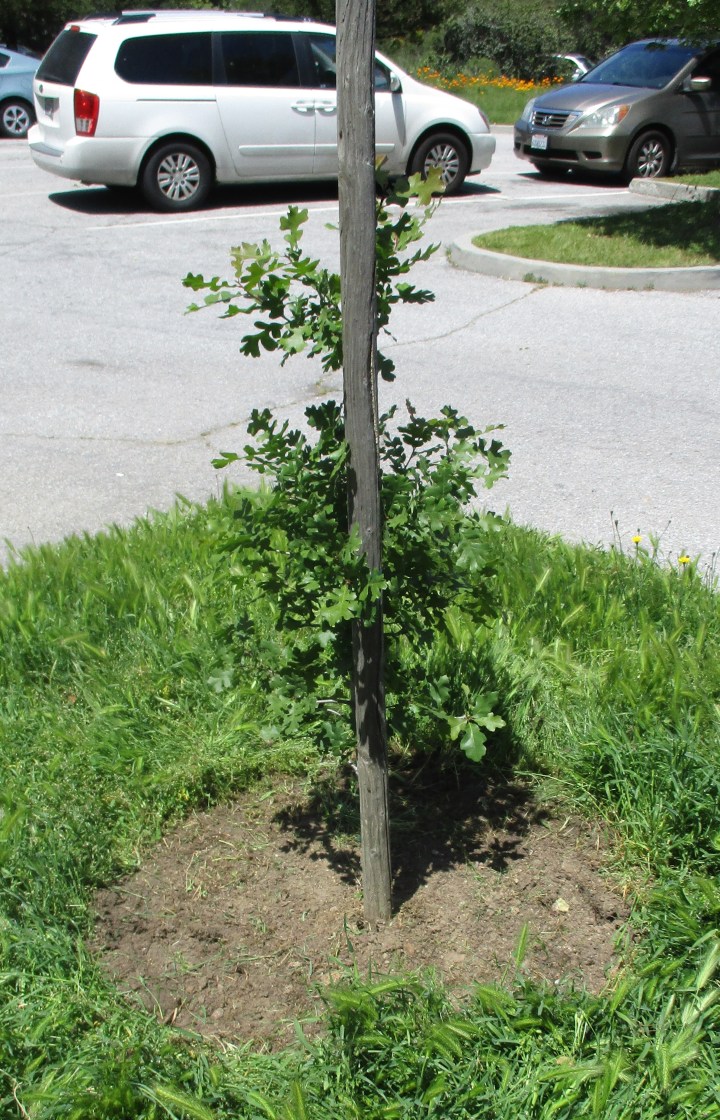
The small valley oak ‘Memorial Tree’ that was planted in Felton Covered Bridge Park was originally designated as the ‘Scofield Tree’. However, a few more prominent friends of our Community passed away afterward; and the Park could not accommodate more memorial trees. Finally, when we could not find an appropriate situation for a memorial tree for Steven, the ‘Scofield Tree’ was designated simply as the ‘Memorial Tree’. These are a few brief articles about it.

https://tonytomeo.wordpress.com/2017/10/06/small-tree-in-a-big-park/

https://tonytomeo.wordpress.com/2017/12/24/scofield-tree-update/

https://tonytomeo.wordpress.com/2018/03/31/scofield-tree-update-spring-2018/

https://tonytomeo.wordpress.com/2018/04/15/memorial-tree-update-to-the-updated-update-etc-the-sequel-to-all-those-other-sequels/

These are two articles about some of our adventures with Steven, and a third about the ginkgo leaf that appeared in Felton Covered Bridge Park on Steven’s birthday last December 13:

https://tonytomeo.wordpress.com/2017/11/19/oklahoma/

https://tonytomeo.wordpress.com/2017/12/13/birthday/

https://tonytomeo.wordpress.com/2018/01/21/okie-mowers/

P80502+
Jeffrey Dale Scofield of Felton passed away peacefully from complications associated with cancer on May 2, 2015, in Santa Cruz, only a short distance from where he was born on June 9, 1959. Except for when he traveled for work in other regions, he lived his entire life in the San Lorenzo Valley.

After harvesting timber earlier in his career, Jeffrey Scofield became well known professionally for setting “miles of tiles” and stone. More recently, he harvested firewood. He was a champion of both baseball and arm wrestling.

Mr. Scofield is survived by his sister Valerie of Las Vegas, nephew Rodney of Bethel Island, niece Christa, nephew Charles of Reno, and many lifelong friends of the San Lorenzo Valley. Ashes will be scattered privately.

P80502++Steven Michael Ralls of Felton succumbed to complications associated with a variety of chronic medical conditions, and passed away in Aptos on May 2, 2017, at the age of 46. Steven was born on December 13, 1970 in Fort Leonard Wood, Missouri, and then spent most of his childhood in Norman, Oklahoma. He came with his family to Berkeley, California in 1987, and then lived in Hayward, before settling in Felton in 1999. His recent relocation to Aptos was considered to be only temporary, as he would have preferred to return home to Felton.
Prior to the onset of debilitating medical conditions, Steven had a distinguished career in specialized woodworking and finish carpentry. His work can be found in some of the more luxuriously outfitted homes and offices of the San Francisco and Monterey Bay Areas. Steven was also remarkably proficient with the restoration of old homes, cabinetry and furniture.
Later in life, Steven devoted more attention to art, particularly drawing and guitar music. His talent with the guitar was exceeded only by his exquisite voice that accompanied it.
Steven Ralls is survived by his son Michael Forrest Ralls of Oakland, California, wife Gayle Schermerhorn of Murphys, California, brother Jonathan Ralls of Hayward, California, sister Tammy Roberts of Wichita, Kansas, sister Brandi Ralls Sullivan of Lakewood, Washington, brother Brent Patty of Saginaw, Texas, mother Virginia Bates of Newalla, Oklahoma, father Michael Ralls of Olathe, Kansas, and many old friends of the San Lorenzo Valley.
Pinnate Leaves

P80428K.JPGThat refers to the pattern of the veins in the leaves. Long before studying horticulture and botany at Cal Poly, my classmates and I learned a bit about horticulture within the contexts of studying ‘nature’. While in the sixth grade, we all went to camp for a week. One of the many projects we did during that time was collecting a few leaves to represent three different vein patterns, and mounting them under clear plastic on a cardboard plaque. The three different patters were, ‘pinnate’, ‘palmate’, and ‘parallel’. I do not remember if we all used the same leaves, but for my plaque, I got a blue gum eucalyptus leaf to represent pinnate veins. Palmate veins were represented by English ivy. Parallel veins were represented by English plantain.
These two blue gum trees are the same trees that provided the leaf with pinnate veins for my plaque. This is not a good picture. There really are two trees here. The picture below is even worse, but shows that there really are two separate trees. They probably flanked a driveway to the old house outside of the picture to the right. They are not very healthy right now, and do not seem to be much bigger than they were back in November of 1978, when my sixth grade class was here at camp with them.

This camp happens to be right down the road from the farm. We are neighbors. It is gratifying to see that so much of the camp is just as it was four decades ago. The English ivy that was so common back than is completely gone now, probably because it is so invasive. The lawn around the blue gum eucalyptus used to be much weedier, and provided the English plantain leaves for my plaque.P80428K+

Flowering Dogwood

80502Flowering dogwood, Cornus florida, seems like it should be more popular here than it is. It blooms spectacularly in April. The foliage can color nicely in autumn. Mature trees are proportionate to medium sized or smaller suburban gardens. However, the limiting factor to their popularity in the local climate is that they are understory trees that prefer to be in the partial shade of larger trees.
They certainly do not need to be shaded all day. Nearby trees or tall buildings that shelter them during the hottest part of the afternoon might be sufficient. Foliage that is too exposed gets roasted by hot sunshine or drying breezes while the weather is warm, especially if exposure is enhanced by glare from nearby walls or pavement. Otherwise, flowering dogwood is not overly demanding.

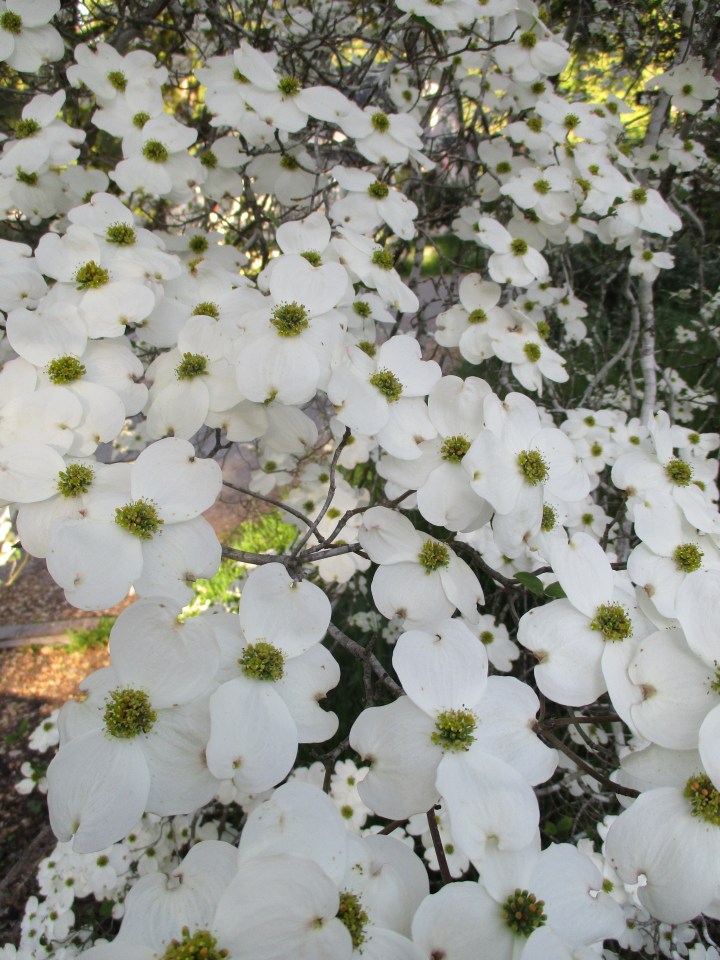
The abundant white, pink or rarely brick red bloom is actually comprised of modified colorful leaves known as bracts. Each cluster of tiny green flowers is surrounded by four upward facing bracts. Simple paired deciduous leaves develop after bloom. The leaves of some cultivars are variegated with white or yellow. Mature trees can reach upstairs eaves but typically stay lower and broader.

Location – Location -Location!

P80422Speaking of which, this is not the right location!
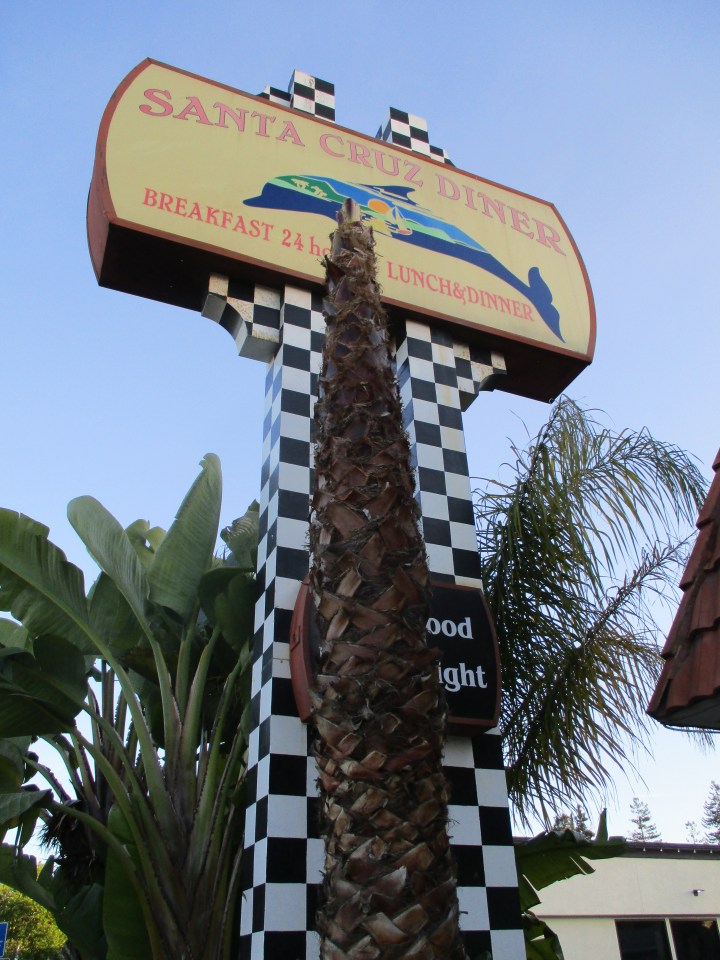
This unhappy Mexican fan palm may have grown here from seed, as they often do. They are notorious for growing under utility cables because that is where birds drop so many of their seed. Perhaps the seed for this one was dropped by a bird perched on the sign many years ago.

Ironic, isn’t it. Birds tend to perch on utility cables and signs and in trees and everywhere that palms should not be planted. How often do they drop seeds out in the open, where whey will not encroach into something as they grow up? Why can’t they drop palm seeds in places where palm trees would actually be an asset? It happens sometimes, but not as often as palms appear where they are not wanted.

The picture below shows three larger Mexican fan palms that were intentionally planted in the original landscape, with a smaller palm between two of the larger palms. The palm in the first picture is barely visible in front of the sign in the background, and is about the same size as the smaller tree that is more visible between the taller trees.

It is possible and perhaps likely that the two smaller palms were not planted intentionally. It is also possible that someone actually planted them.

It does not matter now. The palm in front of the sign needs to be removed. The removal of all the foliage will not kill it. It will generate new foliage that will again obscure the sign if the tree is not eliminated soon. There is no way to prune the palm to divert growth around the sign. It has only one terminal bud, and is unable to generate another if topped. Palms under utility cables have the same problem. Once they get too close to the cables, they must be removed.

Getting back to the first picture. The shock and awe of the defoliation of the subject Mexican fan palm was likely sufficient distraction to prevent anyone from noticing the queen palm foliage peeking around the right side of the sign. Unlike Mexican fan palms, queen palms rarely grow from seed here, especially in a spot where there are no other queen palms nearby. Yes, someone planted ‘another’ palm in the same spot!P80422+

Prelude to Dogwood

P80481My weekly gardening column does not have much space for everything that should be said about the various topics and featured specie. I just try to fit the most basic of information into the space available, but usually would like to fit more in.

Sometimes, I would like to fit more pictures in too. It can be difficult to select just one camellia, or just one rhododendron. I typically select those that have the best contrast for black and white pictures, just in case some newspapers must deprive them of their color. That often means that I get to select my favorite white flowers rather than their more colorful counterparts. Regardless, there are so many good pictures that do not get seen. Then, there are also many qualities of the subjects that are difficult or impossible to show in pictures.

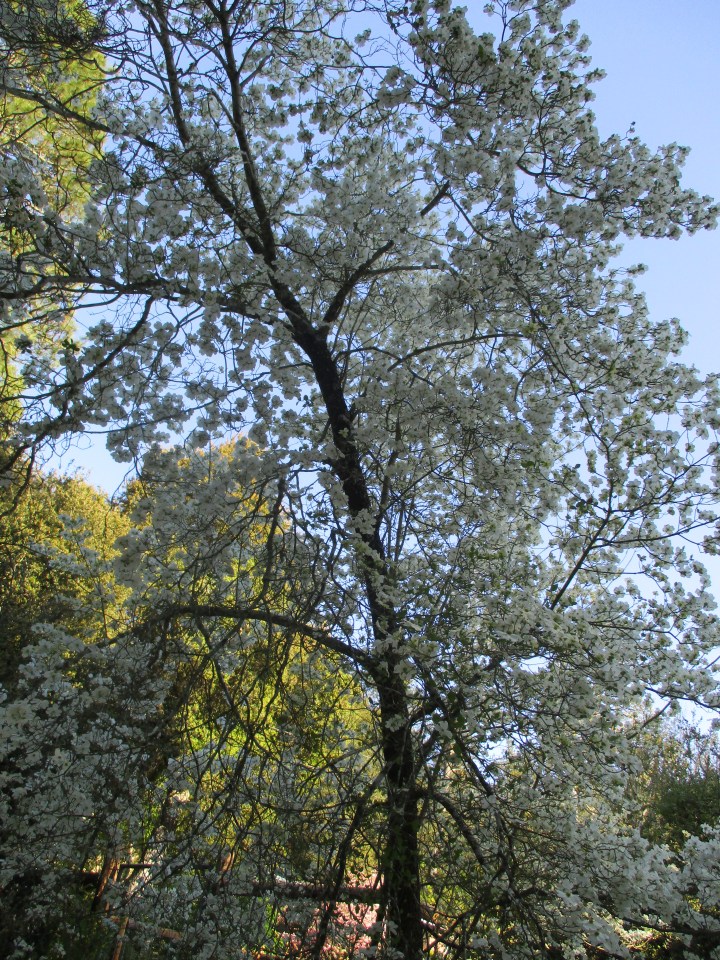
The dogwood picture that will get posted on Tuesday is pretty good, and happens to be white, but does not show how spectacular the tree that produced the bloom is. I selected a picture that was a close up of the same flowers in the picture below. Unfortunately, even if I had room for another picture, I could not get one that adequately represented the splendor of the tree. The best I could get is the picture above. I might try to get more pictures of pink and red dogwoods in the next few days, but pictures are nothing like the real thing. I had the same difficulty with the flowering cherries. The bloom was spectacular close up, but the trees looked like pink clouds on trunks from a distance.

If you can imagine, the tree in the picture is about twenty feet tall. It can be seen half a block away, through the adjacent deciduous trees. It looks just like a dogwood in Virginia should look, but happens to be right here on the West Coast, where you would not expect to see such an excellent specimen. Does that help?

I used to grow dogwood trees in the mid 1990s. They are not my favorite spring flowering tree because they do not do so well in the Santa Clara Valley. You would not know that by how well they do here on the coastal side of the Santa Cruz Mountains, just a few miles away. There are many specimens in the neighborhood that are comparable to this one. Some are pink. A few are almost brick red. The foliage probably does not color as well in autumn as it would in Virginia, but by our standards, it colors nicely.

Two very happy pink dogwoods are in front of an elegant home of early American architecture that is located just downhill from the white dogwood in the picture above. Even with redwoods and coast live oaks all around, the dogwood trees and home really look like they could be in the vicinity of Virginia. It is obvious why those from the East are so fond of dogwoods.P80481+