
A combination of modern horticultural apathy and too many choices was probably the demise of conformity in home gardens. Formal hedges or even informal screens of several of the same plants are nearly obsolete. Ironically, long and low barrier hedges and so called ‘orchards’ of identical trees planted in regimented rows or grid patterns have become common in large landscapes in public spaces.
Those of us who still crave formal hedges, paired trees or any such symmetry in our home gardens must be more careful with the selection of the plants that need to conform than would have been necessary decades ago when there was less variety to complicate things. It is just too easy to get different varieties of the same plant. Only plants with matching cultivar (cultivated variety) names will necessarily match. (Yet, on rare occasion, even these are inaccurate.) For example, ‘Emerald’ arborvitaes will match other ‘Emerald’ arborvitaes, but will not match ‘Green splendor’ arborvitae, no matter how they resemble each other in the nursery.
Plants that are identified by their characteristics instead of by cultivar name are riskier. Blue lily-of-the-Nile could be any one of many different cultivars with blue flowers. It is therefore best to obtain all lily-of-the-Nile for any matching group from the same group in the same nursery at the same time. What will be available next week may actually be a different variety with a different shade of blue and different foliar characteristics. Nurseries bring stock in from so many different growers.
Adding new plants to replace those that have died within established hedges or streets flanked with the same trees can be particularly difficult, especially if the old varieties are no longer available. The old fashioned yellowish Japanese boxwood that was so common for small hedges in the 1950’s has not been common in nurseries for several decades. Replacement plants are darker green. Some are even compact cultivars or different specie like English boxwood. When lined up and shorn together, they make ‘calico’ hedges.

 Remember this from Sesame Street?
 California poppies are like no other wildflower. They are so perfectly bright orange, and look almost synthetically uniform in profusion, as if painted onto coastal plains and hillsides. They may be a bit more yellowish in some regions, or a bit deeper orange in others, but they are always bright and strikingly uniform.
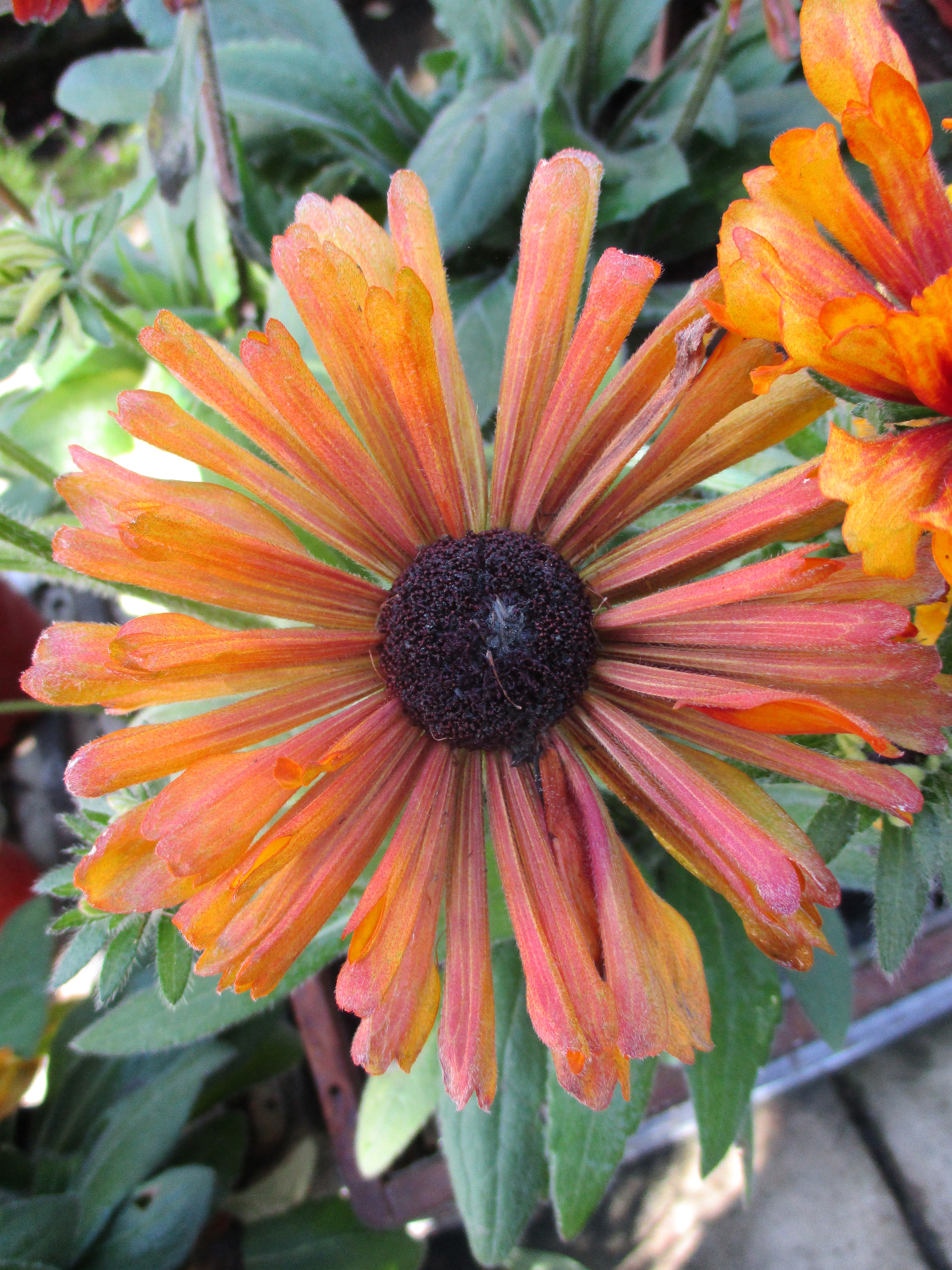 Nomenclature of the botanical sort was so much simpler back when we studied it back in the 1980s. It was intended to be like that. It was how the various specie of plants were identified and classified. There were certain rules that simply made sense. After ‘family’, plants were classified into general ‘genera’, and then further classified into specific ‘specie’. Some specie were further classified into ‘varieties’ and ‘cultivars’. (Cultivars are simply ‘cultivated varieties’ that need to be perpetuated by cloning because they are too genetically unstable to be true-to-type from seed.)
 What are they doing out there, in those two pots in the island of such a vast parking lot? It is hard to say from this distance. They are so isolated. They might be happy and healthy summer blooming annuals. They might just be weeds. They could be plotting World domination. Plants can do some weird things in isolation.
 It is not science fiction. It involves neither ninjas nor turtles. Cultivars really are mutant plants that can only be propagated by cloning. The word ‘cultivar’ is a portmanteau (two words combined into a single word) of ‘cultivated’ and ‘variety’. Unlike other varieties of plants that can be perpetuated by seed, cultivars must be cultivated by unnatural techniques to maintain their genetic distinction.

 Tony Tomeo