Squash For Summer And Winter

80425thumbConsidering that some of the winter squash can last right through winter and into spring, there really is a squash for every season. By the time the last of the winter squash run out, the first of the summer squash will be ready later in spring. They get an early start here, and continue until frost. By that time, the earliest of the winter squash will be ready for autumn, and will last through winter.

However, they all get planted about now. There is no such thing as cool season squash. They are all warm season vegetables (actually fruits). The vines and foliage all grow like weeds while the weather is warm, and then succumb to frost at the end of their season. They all grow very easily from seed, but because each garden needs only a few plants, they are often planted as seedlings.

The main difference between summer and winter squash is that summer squash plants continue to produce many smaller fruits while the weather is warm, and winter squash plants produce only a few larger and firmer fruits that develop slowly while the weather is warm, and then finish ripening as the vines that produce them die in autumn and winter. One begins where the other finishes.

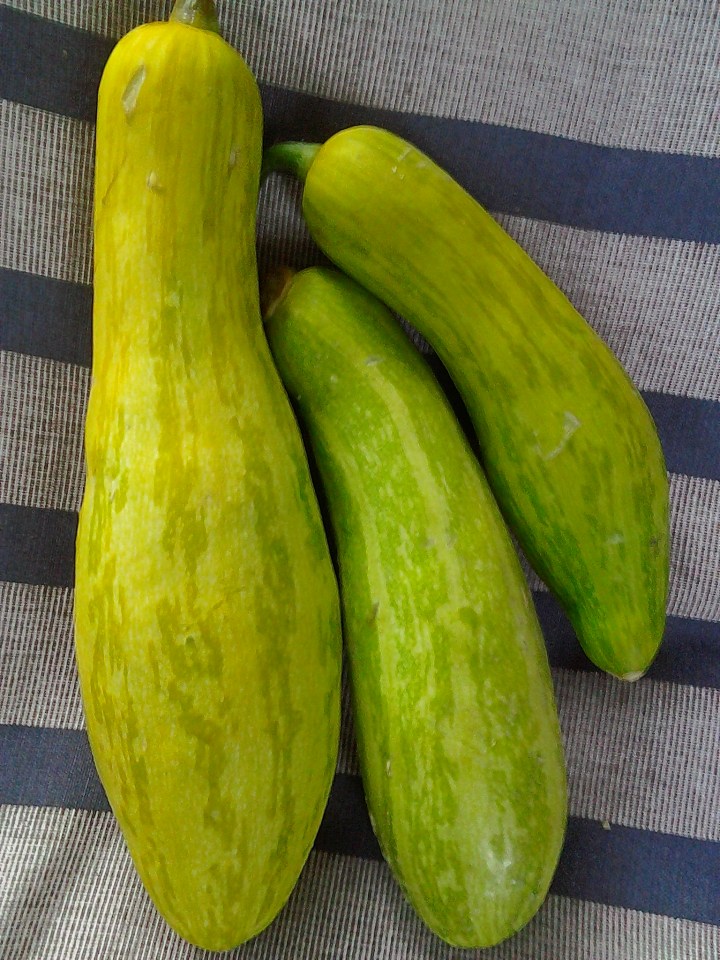
Zucchini is the most familiar summer squash here. It is most productive if regularly deprived of its tender juvenile fruit, and is notably less productive if the fruit is allowed to get bigger and tougher. Pumpkin is the most familiar winter squash here. It is expected to produce only a few big and firm fruit that take all season to develop. Extra juvenile fruit may get plucked to favor one or two fruits.

Summer squash deserve more prominent locations in the garden because the fruit gets harvested regularly. Zucchini grows as a large plant, but stays somewhat confined. Winter squash want the same sort of rich garden soil and watering, but can be put out of the way. Except for plucking a few extra fruit, not much more needs to be done to them. Some like to climb fences. Pumpkin vines can be directed to the edge or just outside of the garden.
All Good Things In Moderation

70405thumbToo much of a good thing can be a problem. That is why bacon is not one of the four basic food groups. It is why sunny weather gets mixed with a bit of rain. It is why we can not give plants too much fertilizer. Since late last summer or autumn, there has not been much need for fertilizer. If fertilized too late, citrus and bougainvillea develop new growth just in time to be damaged by frost.

Now it is time to start applying fertilizer, but only if necessary or advantageous. Fertilizer really is not as important as the creative marketing of fertilizers suggests. It is useful for new plants, fruits, flowers, lawns and especially for vegetables, but is probably overkill for healthy and established plants. There is no need to promote growth of trees and shrubbery that are at their optimum size.

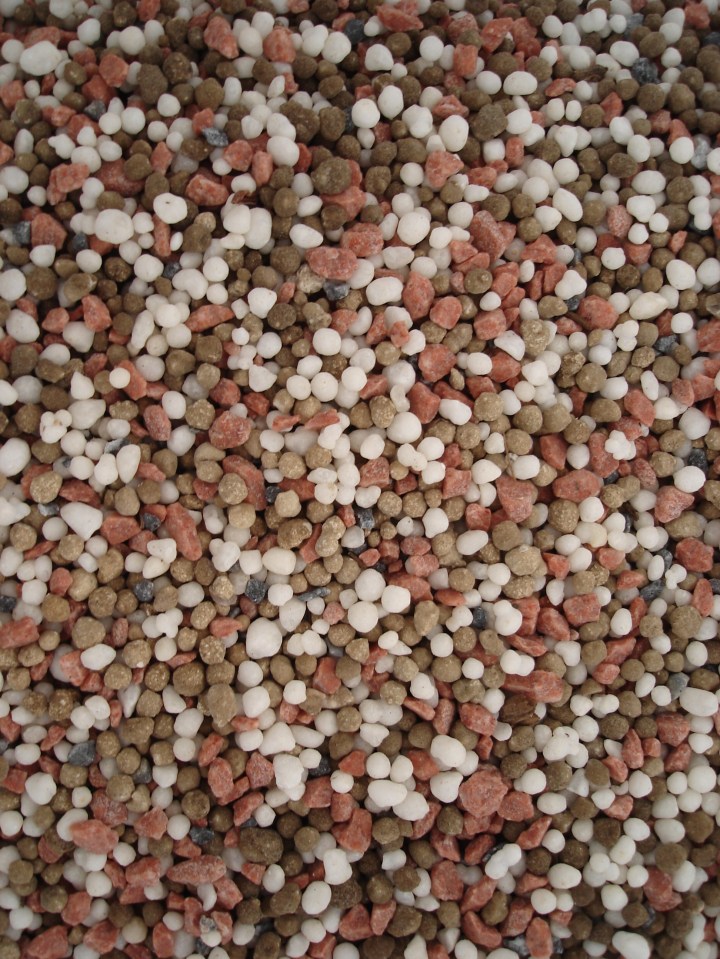
Some of the specialty fertilizers are a bit fancier than they need to be. With few exceptions, complete fertilizers are useful for most applications. As long as plants get the extra nutrients that they crave, they should not complain. They can not read the labels of the fertilizers that they receive. Plants are more likely to have problems if they get too much of something that they do not need.

Rhododendrons and azaleas might like specialty acidifying fertilizer, but should be satisfied with a complete fertilizer. Citrus might likewise appreciate fertilizer that is specially formulate for citrus, but are probably not too discriminating. Palms only want specialty palm fertilizer if they demonstrate symptoms of nutrient deficiency. (Some palms are sensitive to deficiencies of micro nutrients.)

Too much fertilizer, especially fertilizer with a good amount of nitrogen, can inhibit bloom of several plants. Bougainvillea puts more effort into vigorous shoots and foliage than into bloom if it gets strung out on nitrogen. Nasturtium will do the same. In pots and poorly drained locations, excessive fertilizer can become toxic enough to discolor foliage or even scorch the edges of large leaves.

The most justifiable uses for fertilizers now are for flowering annuals and vegetable plants. Tomato and corn plants respond very favorably to fertilizer because they are so greedy with the nutrients they require for their unnaturally abundant production. (In the wild, the ancestors of tomato and corn do not really produce like garden varieties do.) Flowers, of course, take a lot of resources too.

Summer Vegetables Enjoy Warming Weather

40910thumbIf there are any cool season vegetables left in the garden, they should probably be harvested pretty soon. If left too much longer, they will be ruined by warming weather. Cabbage will bolt (start to bloom) once it realizes that it is spring. Cauliflower and broccoli, which are juvenile flowers, will become bitter as the flowers mature and try to bloom. Besides, they all need to get out of the way.
Warm season vegetables need the space. Tomato, pepper, eggplant, zucchini and other squash plants are ready to disperse their roots and get to growing. They are usually planted as seedlings because only a few of each are needed. A few seedlings of each type are more reliable, but not much more expensive than a packet of seeds; and they do not need to take the time to germinate.

However, because they are so easy to grow, seed for zucchini and other squash, as well as melon, are popularly sown directly where plants are desired. There was no need to sow them indoors earlier to plant in the garden as seedlings now. Onions can be grown from seed for late harvest, or they can be grown from juvenile onions known as ‘sets’ for earlier harvest or for green onions.

There are two main reasons why cucumbers, beans and corn should be grown from seed, although cucumber seedlings can be practical if only a few are desired. Otherwise, so many individual plants are needed that it would be relatively expensive to purchase enough seedlings. The main reason for sowing seed directly is that their seedlings are sensitive to the stress of transplanting.

Tomato, zucchini and beans are likely the most popular of warm season vegetables because they are so productive and reliable, even in limited space. Pole beans can be grown on trellises against fences or walls in very tight spots. Corn is less popular because it needs so much space, and needs to be watered so regularly. Too few plants may not be adequate for cross pollination. Pepper and eggplant, as well as okra, are not too demanding, but appreciate rich soil, regular watering and warm exposure.

Warm Season Vegetables Start Now

P80312The calendar does not always agree with the weather. It really is about time to start replacing aging cool season vegetable plants with fresh new warm season vegetable plants. Earlier warm and dry weather had suggested that it was getting late. More recent frosty weather followed by rain suggested otherwise. Regardless, there is no point in arguing with what the calendar determines.

The last seedlings for broccoli, cauliflower, cabbage and Brussels sprouts (for those who are able to grow them) should be well established in the garden. There should be enough cool weather for them to finish before the heat of summer causes them to go bitter. No more should be planted this late. Also, the last seed for beets should have been sown already. Peas should finish soon.

Warm season vegetables like tomato, pepper, squash, cucumber, corn and bean are the main concern now. Tomato and pepper are most easily planted as seedlings purchased in cell packs. A packet of seed costs as much as a cell pack, but must be sown and grown into seedlings, which is extra work. If necessary, varieties that are unavailable in cell packs can be grown from seed.

The other warm season vegetables grow so fast from seed that there is no advantage to planting them as seedlings here. Some would be distressed from transplant as seedlings. Besides, so many individual plants of each type are typically grown together that it would be expensive to purchase so many cell packs. Squash might be an exception if only a few plants would be enough.

Bush beans may seem like they would be easier to grow than pole beans because they do not require support. However, pole beans can grow on the sunny side of a fence in the background of a vegetable garden, utilizing otherwise useless space. If it would not damage the fence, string can be strung in a zigzag pattern (up and down) between nails pounded part way into the top and bottom of the fence. If the string is held an inch or so from the fence (at the heads of the protruding nails), bean vines would be happy to climb it.

Anti-Community Garden

P71217Isn’t this a delightful meadow? It is located right across from the historic Felton Covered Bridge (https://tonytomeo.wordpress.com/2017/12/02/felton-covered-bridge/). The trail to the left goes up the embankment into the parking lot of the old County Bank Building, right downtown. On a warm day, it is a nice cool short cut to the Felton Covered Bridge Park, just over the San Lorenzo River.

You should have seen it a few years ago. It was not such a nicely inviting meadow, but was instead an excellent collection of small garden plots within a fenced Community Garden that deer could not get into. There were about nine small olive trees behind the fenced area. The stumps in the foreground and to the left were two small curly willows. People living in apartments or where the shade of the surrounding mountains and redwood forests prevented gardening could rent parcels here to grow vegetables, flowers or herbs. It really was nice.

Then it was destroyed.

Everyone who rented plots there was evicted. Surrounding oaks, box elders, willows and other vegetation were eradicated. Fortunately, the olive trees were relocated. The whole area was graded by bulldozer; and the Community Garden was gone. Now, the vacant meadow grows only a thicket of thistles that needs to get mown down every summer.

P71217++Apparently, someone thought that there might possibly be the remote chance of the potential for homeless people to maybe engage in activities that could perhaps be determined to be bad, right behind the Community Garden. If you look closely, you might be able to see them back there. Maybe not. (More accurate information can be found at the Facebook page of Felton League at https://www.facebook.com/Felton-League-520645548069493/ .)

Well, after making this observation, the expert on the sociology of the homeless, and self-proclaimed representative of the thousands of others in Felton, convinced the owners of the property to fix the problem. You see, only by singling out and targeting a particular segment of our Community can we put Unity back into CommUnity. Demolishing a Community Garden certainly helps too. It took a lot of hassling, and a lot of lies, but it was finally done. This is what we have to show for it, as proof that killing a Community Garden helps with homelessness.P71217+.JPG

Too Late For Pie

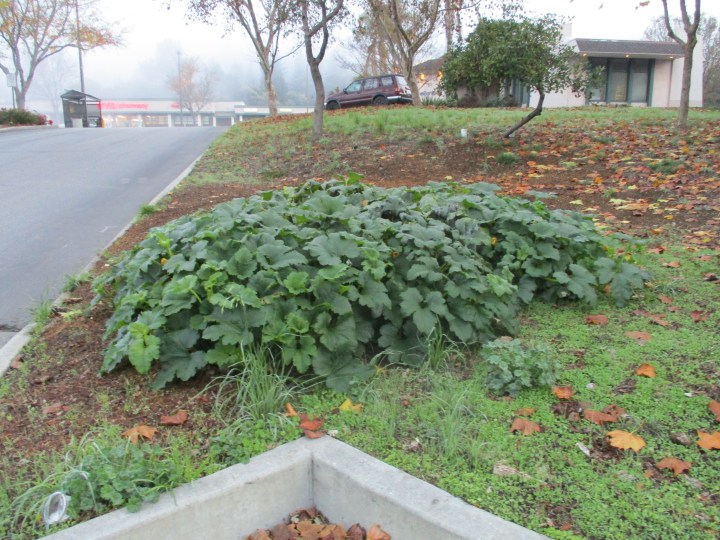
P71203Just a few feet downhill from where the old valley oak had lived for centuries (https://tonytomeo.wordpress.com/2017/09/11/goodbye-to-an-old-friend/), a pumpkin vine appeared shortly after the big oak stump was ground out. That was in late September, so was much too late for it to do much; or so I thought.
The vine grew very quickly! It is hard to say if it got water from a leaking pipe. A valve manifold that is visible in front of the stump in the original picture is completely obscured by the foliage of the vine in the second picture. With all the heavy work that was done right on that spot, it would have been very easy for a pipe or exposed valve to get damaged. (Water from a previously leaky pipe or valve could have contributed to the demise of the tree, by promoting the development of excessively heavy foliage that caused the large limbs to break and fall.)

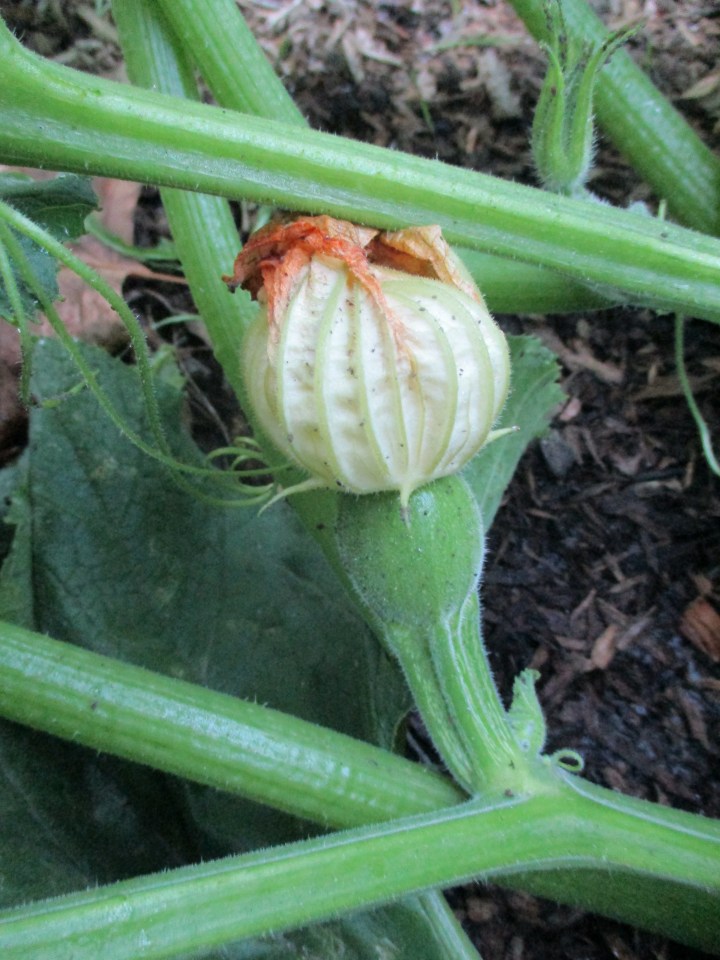
Despite the vigor and size of this remarkably healthy pumpkin vine, no fruit developed. Only a few undeveloped fruit can be found now, and the weather is getting too cool for it to mature. The foliage and flowers are already starting to succumb to mildew and decay, and will eventually get frosted. If there is any fruit obscured by the foliage, it will become visible when the foliage collapses.

Regardless, the pumpkin vine really seemed to have fun while it had the chance. How many of us get to grow pumpkin vines this big through an entire growing season? It got plenty of sunlight, and must have been getting water from somewhere. The soil is good there. As you can see in the picture, it had plenty of room to grow.

What is so special about that spot? If there is not a water leak that needs to be repaired, what else could be grown there next year?!P71203+

This Is No Food Blog

P71129There are not many things that will grow in my zone that I will not at least try to grow if I have the space and resources to do so. I really like to grow fruits and vegetables, particularly those that I am familiar with from when I was young. They are just as productive now as they were then. The only problem is that I do not know how to cook. I can freeze, can or pickle large quantities of produce, but cooking is something that I leave to experts.
I notice that almost all garden columns or blogs include recipes for the produce grown in home gardens. Mine does not. Except for a few recipes for pickles, jams and jellies, I just do not have any recipes that I would share.

When I get big winter squash, I really do not know what to do with them. I sometimes give them away to those who will cook them. Sometimes, I just cut them up, cook them, and then freeze what I can not eat. They are fun to grow, and I really like how I can keep them around for such a long time before I get around to cooking them; but they would be so much easier to work with if they were small like summer squash.

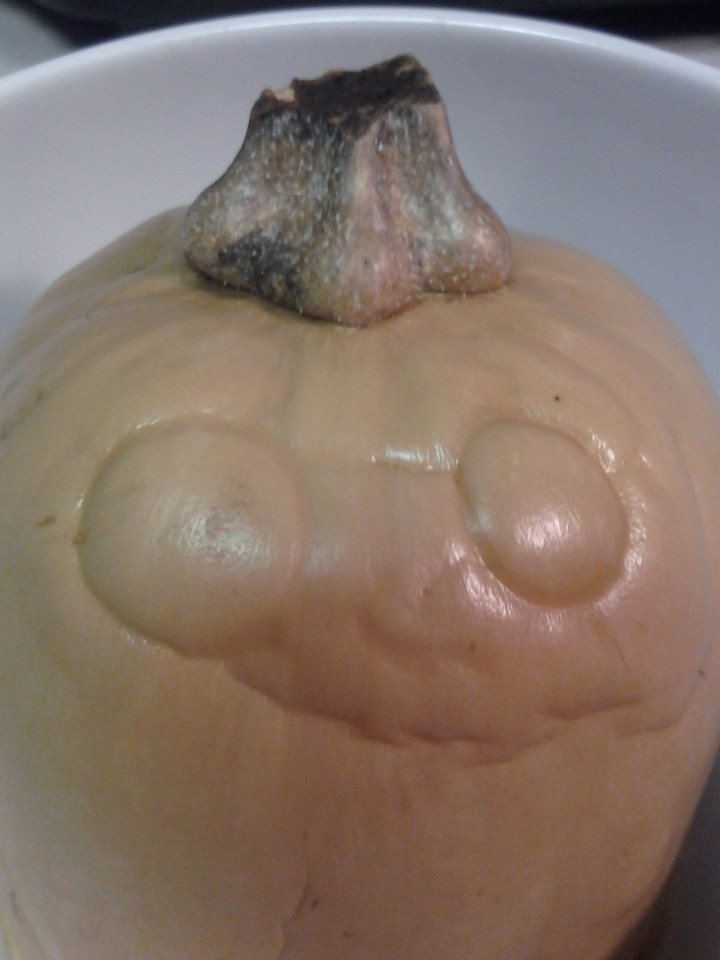
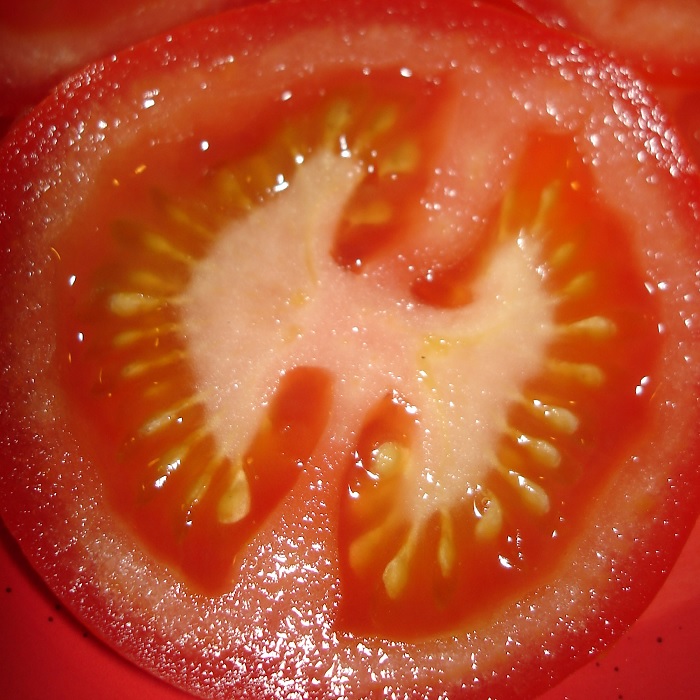
This weird squash was on the kitchen counter for a long time. Before it was cooked, it was very smooth, without any lumps, bumps or beady eyes. It was not ridiculously big. In fact, I only cut in half and ate it in two days. At the time, I was in a situation where I had a microwave oven in which to cook it, so I did so for several minutes. With a bit of butter, the first lower half was quite good, and separated nicely from the outer skin. I cooked the upper half in the same manner on the second day. It was making weird noises as it cooked, as if it were very unhappy about something. It was hissing and spitting for the several minutes that it was in there.

When I opened the door, this is what I found staring back at me from a small puff of steam! It looked angry! Apparently, it did not like to be cooked that way; or perhaps it was just a hateful squash. Regardless, it was rather creepy, and difficult to enjoy. I peeled the outside away and discarded it, but could not help to think that it was still watching me from the trash can with those beady tan eyes and crooked mouth! I do not think that I will be growing this variety again.

Anatomically Correct Horticulture

P71026Certain fruits and vegetables were so much more palatable before studying botany. Knowing what they really are sort of puts a damper on things.

Real fruits, including those known as vegetables, are no problem. We all know what they are, and they have the seeds to prove it. Just like flowers reward pollinators with nectar, many plants use fruit to get animals and people to disperse their seeds. Therefore, the fruit is designed to be eaten.

The majority of vegetables are fine too. It seems natural to eat leaves, stems, roots and even flowers. Things get a bit weird with petioles of rhubarb, celery and cardoon, since the leaves are not eaten. Cinnamon bark and saffron stamens also seems a bit odd. What about maple syrup? Is it a vegetable too?

Then there are fruits and vegetables that are not what we think they are.

You will never look at a potato the same way knowing that it is a subterranean stem known as a stolon. If it is looking back at you, it is because it has eyes, which are actually modified axillary buds, which only stems are equipped with. It it were a modified tuber or or a tuberous root like most of us think it is, it would not have these eyes.

Pineapple might be watching too, with its many eyes. Each eye actually represents a flower. What we think of as a pineapple fruit is actually a densely crowded collection of distended and fused flowers. Does that mean it is a vegetable like broccoli or cauliflower?

Strawberry is sort of fruity; but only what we think of as strawberry ‘seeds’. They are actually single seeded fruits known as ‘achenes’. Really, those little black things are outfitted with everything that they need to be classified as fruit. The red part of the strawberry is only a ‘receptacle’ for the achenes.

Everyone knows that fig trees do not bloom. So, how do they make fruit? Well, they technically don’t make any visible fruit; but they do bloom. What we think of as a fig fruit is actually a weird inside out inflorescence, with minute flowers on the inside. Each species of fig is pollinated by a particular species of minute wasp that enters the inflorescence through a very small hole at the end. Minute achenes about the size of strawberry achenes are the crunchy bits in ripe figs. To make figs even more unappealing, some wild figs contain the eggs and larvae of the wasps that went inside to deposit their eggs before dying there. Yum. Most garden varieties attract the wasps, but lack the necessary floral parts for the wasp to want to leave their eggs there. They therefore do the job of pollinating without dying inside.

Vegetables Grow All Year Here

71018thumbThe difficult part is pulling up the warm season vegetable plants while they still seem to be productive. It gets much easier after that. Putting new cool season vegetable plants back into the garden is much more gratifying. Vegetable gardening never stops here. One season starts before the previous season ends. If cool season vegetable plants get a late start, they take longer to produce.

If there is enough space in the garden, the cool season vegetable plants can go somewhere else, while the warm season vegetable plants finish with what they might still be working on. Tomatoes might last until frost. Even when it get too cold for the foliage, green fruit can still ripen on the vine, and a bit more on the kitchen windowsill. Green tomatoes remaining after that can be pickled.

If the soil does not need too much amendment, and the spacing works out well, new cool season vegetable plants can be planted in with the warm season vegetable plants so that they can start to grow and disperse roots while the warm season vegetables finish. By the time the warm season plants succumb to cooling weather, the new cool season plants will already be maturing nicely.

This technique does not work so well with last season’s tomatoes only because they are so greedy with nutrients. Fertilizer might compensate for plants that seem slow where tomatoes had been previously. A bit of amendment can be added to the soil when new cool season plants get planted, and more can be added between them when old warm season vegetable plants get removed.

Broccoli, cabbage and cauliflower should all be planted as seedlings, so can work nicely with interplanting with aging warm season vegetable plants. Since only a few of each type are needed for a well outfitted garden, one or two cell packs of six or eight plants each should be sufficient. Each cell pack does not cost too much more than a packet of seed. Seedlings get established quickly.

Beets, carrots, lettuce, spinach and peas should be grown from seed sown directly into the garden, so do not work so well with interplanting. Too many individual plants of each type are needed. It just would not be practical to grow them from cell pack seedlings. Besides, they grow so efficiently from seed. Kale can be grown either from seed of seedlings. It might be too late for cucumbers.

Blue Ribbon

P71001Somewhere in the San Lorenzo Valley, there is a little old lady who is stitching a blue quilt. It is made of all the blue ribbons that she wins every year at the Jelly and Jam Contest of the Santa Cruz Mountains Harvest Festival. I do not know who she is, but I recognize her squiggly writing on the fancy labels. It is barely legible. Her hands are worn and tired from three quarters of a century off picking fruit, processing it into jelly and jam, and then stitching all her blue ribbons together. She probably giggles as she works, and thinks about everyone who wins only red or white ribbons.

Three years ago, I submitted my blue elderberry jelly and ‘Shiro’ white plum jam into the contest. They both won! Blue elderberry won second place. White plum won third. Two years ago, the blue elderberry jelly won second place again, although the white plum jam did not win anything.

Last year, I submitted the maximum of five jellies and jams. I was determined to get my blue ribbon! In conjunction to blue elderberry jelly and white plum jam, I also submitted peach jam, blackberry jelly and Santa Catalina Island cherry jelly. However, the Jelly and Jam Contest was not publicized like it should have been. Very few people were aware of it. Consequently, there was only ONE other entry! It was a sloppy and seedy strawberry and kiwi jam made from fruit that was not likely home grown. I knew I would finally win my blue ribbon, and probably red and white too! Technically, it was not cheating. It was just the way things worked out.

It was no surprise that the blackberry jelly won third place. It was a bit of surprise that the blue elderberry won second place, even though it had done so twice before. I was hoping that it would be the blue ribbon winner. That was not a problem. I was sure it won second place only because one of the other three had won first place. I stepped off the grandstand after claiming each of the two ribbons, but thought about just staying there for the third. I did the tactful thing and walked off stage.

Finally, the first place winner of the blue ribbon in the Jelly and Jam Contest was to be announced. I was halfway into my first step back to the grandstand when I heard “STRAWBERRY AND KIWI JAM”! What?! How was this possible? What was she putting in that jam?! The winner was not present to claim her ribbon, but she won nonetheless. I imagined her watching with a telescope from the window of her secret hideout in the mountains above town, and laughing maniacally.

Well, the Santa Cruz Mountains Harvest Festival was yesterday. For the Jelly and Jam Contest, I submitted only two entries; blue elderberry jelly and blackberry jelly. There were only four other entries; fig jam, peach jam, another blackberry jelly and the infamous strawberry and kiwi jam. I was pleased that my blackberry jelly won third place, and I still hoped for the blue elderberry jelly to win second or first. The peach jam won second. It was made by . . . WHO? MY MOTHER’S PEACH JAM WON SECOND PLACE?! This was intolerable! I ALWAYS win at least second place! What made it worse is that I lost to my MOTHER’S peach jam! Where did she learn how to make jam? . . . and from peaches from the tree that I grew? Before I could recover from this baffling revelation, the first place winner was announced; and it was again, the strawberry and kiwi jam.

Wow! I do not know what to think. I got to meet the lady who makes the strawberry and kiwi jam. She is not a little old lady who lives in a secret hideout. She is a pretty young lady, and she actually told me that she does not intend to compete next year, and told me that I should try her recipe. I thanked here but declined. I do not want to use store bought produce. Now the difficult part. I need to deliver the second place red ribbon to my mother who was not there to claim it.