Vegetables Change With The Seasons

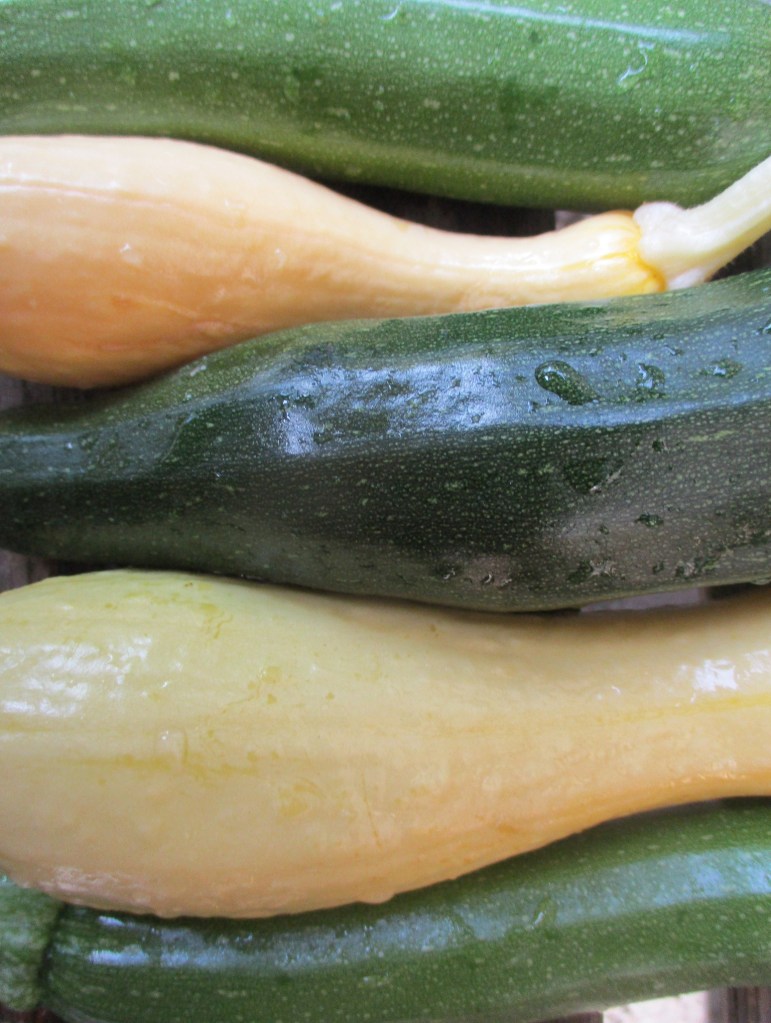
Zucchini seed can be sown now.

Annuals are not all that change with the seasons. Vegetables do also. After all, with few exceptions, vegetable plants are also annuals, or perform as such. Most of those that are biennials are edible only during their first year. They bloom and become inedible if they survive for a second year. Most perennial vegetables are easier to replace than recycle.

As with annuals, it seems to be a bit too early to replace cool season vegetables. Some continue to produce, and may do so for a while. The weather still seems to be a bit too cool for warm season or summer vegetables. Technically, it actually is too cool for some. However, some must grow from seed. The weather will be warmer by the time they do.

Most cool season vegetables are actually vegetables. In other words, their edible parts are vegetative rather than fruit. Conversely, most warm season vegetables are actually fruit. In other words, they contain seeds. Tomato, chili, eggplant, cucumber, squash, corn, okra and bean are familiar examples. Some but not all continue to produce until autumn.

For example, zucchini and other summer squash produce until frost. So do pole bean, some cucumbers and indeterminate tomatoes. However, winter squash only grow during summer to ripen all at once for autumn. Okra, eggplant and various chilis should produce throughout summer, but likely will not. Secondary phases can prolong their production.

Determinate tomatoes, bush beans, and corn benefit most from phasing. They produce all their fruit within a brief season and then produce no more. Subsequent phases should start before preceding phases finish. Some can eventually replace lingering cool season vegetables. With good soil, fresh new tomato plants can start below aging tomato plants.

Seed for corn, beans, root vegetables and greens prefers direct sowing into their garden. Seedlings are stressed by transplant, and too many are needed. Cucumber and squash grow as well from seedling as seed, and a few should suffice. Tomato, chili and eggplant prefer to grow from a few seedlings a bit later. Some varieties are available only as seed, though. Such seed should be sown by about now, directly or within cells, outside or in.

Sustainable Vegetable Gardening

It will be time to add warm season vegetables to the garden soon.

This article is recycled from several years ago, so the information about the class is no longer relevant.

            Just as we are getting accustomed to winter, it is already time to begin to get ready for spring. The first of the six sessions of the Sustainable Vegetable Gardening class with Master Gardener Ann Northrup at Guadalupe River Park and Gardens will be from 7:00 to 9:00 p.m. on February 10. Subsequent sessions continue weekly at the same time until the sixth session on March 17, in time for warm season vegetables to replace cool season vegetables.  

            Topics include: soil preparation, amendments and fertilizers; irrigation methods and systems; working with both seeds and seedlings; cultural requirements of specific warm and cool season crops and varieties that do well locally; and how to identify and manage common pests, weeds and diseases of vegetable crops in the Santa Clara Valley. Sustainable Vegetable Gardening emphasizes sustainable gardening techniques, such as mulching, efficient watering techniques, composting, integrated pest management and organic fertilizers and soil amendments. Participants will learn how to manage a successful and environmentally responsible food garden that will produce vegetables and herbs throughout the year.  

            Sustainable Vegetable Gardening will be at the Guadalupe River Park and Gardens Visitor and Education Center at 438 Coleman Avenue in San Jose. Admission is $72. Pre-registration is required and can be arranged by telephoning 298 7657. More information about this and other classes can be found at www.grpg.org.  

            Another reminder of the distant but eventual spring is that seed catalogues start to arrive. Some arrive by email as links to online catalogues. It seems that the best still arrive by mail though. I have yet to receive two of my favorite catalogues from Baker Creek Heirloom Seed and Park Seed. Baker Creek not only has some of the oldest heirloom seeds, including Early American seeds, but also some of the weirdest vegetable, herb and flower seeds from all over the world. Park Seed supplies the more contemporary traditional seeds that I grew up with, as well as all sorts of bulbs and plants.

            It may be too late by the time their catalogues arrive, because the Renee’s Garden Seed Catalogue is already here! The online catalogue can be found at www.reneesgarden.com. Even though I typically do not like mixed seeds, I do like Renee’s Garden color coded mixes with the different types within the mixes dyed different colors. I simply separate the different seeds as I plant them. It is like getting two or three packets of seed in one.

            I think I like Renee’s flowers as much as the vegetables. There is an entire page of sweet peas to choose from! I also like the selection of sunflowers, nasturtiums and morning glories. This last year, the delicate blue stars in the centers of the big white flowers of ‘Glacier Star’ morning glory were my favorite.

Thanksgiving

Thanksgiving is a celebration of gratitude. It was created by early American settlers who were grateful for their harvest at a time when the exotic fruits, vegetables and grains that they brought with them from Europe were only beginning to get established in unfamiliar climates and soils. They were also grateful for the generosity of the indigenous people, as well as the native fruits, vegetables and game that they introduced them to. Regardless of how meager their resources now seem to be by modern American standards, early American settlers were very grateful for what they had.

Nowadays, for most Americans, sustenance from all over the World is so reliably available and in such abundance that many neglect to appreciate it. As in the past, those who lack such abundance are more grateful for what is available to them. Perhaps that is why Thanksgiving is still so relevant, and such an excellent Holiday. It is a reminder of the importance of gratitude.

Gardening to grow fruits and vegetables, even on a scale that is very minor relative to how early American settlers did so, facilitates gratitude for the sustenance and any surplus that it generates. Produce from the garden is so much more satisfying than produce from a supermarket. A pantry of canned surplus from the garden is so much more gratifying than a pantry of food that was purchased from a supermarket. Perhaps there should be no difference, since food from a supermarket is purchased with money that is earned from other work, which should be comparatively gratifying.

Realistically, there is so much to be grateful for, and so much gratitude to celebrate. In fact, there is enough to justify a specific Holiday for it. Work and gardening can be resumed tomorrow or later, after this celebration of gratitude, Thanksgiving.

Cool Season Vegetables Will Hopefully Do Better Than Warm Season Vegetables Did

Tomatoes were adequate, and perhaps quite good, but not as vigorous as they should have been.

Now that it is half way through September, it is impossible to ignore that tomatoes did not have a good season. Most of us who grow tomatoes were embarrassed by their performance until we realized that everyone else who grows them was also experiencing similar disappointing results. It was not because we did not water them properly. Nor was it because they lacked particular nutrients. They simply wanted warmer weather.

Plants that were put out early before the warm weather last spring did much better at first, but then decelerated as the weather became milder instead of warmer. Cool nights certainly did not help. Mildew, which typically slows a bit as weather becomes drier (less humid) though summer, instead continued to proliferate so that new foliage became infected almost as soon as it developed.

Earlier predictions that the weather would eventually get warm were not accurate enough for many of us who are only now getting enough tomatoes for fresh use, but not an abundance for canning, drying or freezing. There is still some time for most of the tomatoes that are on the vines now to ripen; but many will probably remain green by autumn. Some but not all of the last green tomatoes can ripen off the vine. Perhaps the only good news about all this is that there should be plenty of green tomatoes for pickling.

Sadly, tomatoes were not the only warm season vegetables to be dissatisfied with the weather. Green bean vines and bushes were generally healthy and made good beans, but did not produce very abundantly. Corn was likewise of adequate quality, but on smaller ears and less abundant. Even zucchini, which typically produces too much, was a bit subdued. Marginal vegetables that really prefer warmth, like eggplant and bell pepper, were downright disappointing.

Even if the weather gets warmer in the last days of summer, languishing tomato plants can not ketchup on production. They can be left to make a few more tomatoes, but will eventually need to get out of the way of cool season vegetables. Cabbage, kale, turnip greens, beets, radishes and all the slower growing vegetables that take their time through autumn, winter and early spring will want their space back soon. They will hopefully have a better season.

If possible, cabbage, broccoli, cauliflower and some of the larger cool season vegetable plants can be plugged in amongst the finishing warm season vegetable plants. Then, by the time the finishing warm season vegetable plants need to be removed, the next phase of cool season vegetable plants is already somewhat rooted and has a head start. This process works well in small spaces with good quality soil.

The main problem with this procedure is that it prevents potentially depleted soil from getting amended and well mixed between planting. It can also be a bit awkward to get the spacing of rows, furrows or mounds of the next phase of vegetable plants to match up with the previous phase. Smaller vegetable plants that get sown directly from seed into rows, like turnip greens, carrots, beets and radishes, really prefer customized bed preparation, after the warm season vegetables have been removed.

Frisee

Frisee is a type of endive.

Many popular salad greens are somewhat discriminating about the seasons here. Some dislike even a minor chill during winter. Several more dislike arid warmth during summer. Frisee is a sub variety of curly endive, Cichorium endivia var. crispum, that dislikes both. It prefers weather from late summer through autumn, and from late winter through spring.

Frisee is related to chicory, which includes radicchio, puntarelle and Belgian endive. It is less closely related to dandelion. Because it is relatively unfamiliar locally, some know it as chicory or curly endive. It is typically a component of fresh green salads. Alternatively, it sautees nicely, or mixes with other cooked greens. Frisee is apparently quite versatile.

Frisee may be unavailable as seedlings in cell packs from nurseries. Because individual plants are small, it is most practical to grow them from seed anyway. Seed germinates in about a week. Seedlings mature in about a month and a half. Mature frisee is only a foot wide. It requires full sun exposure with frequent watering. Phasing prolongs productivity.

Cool Season Vegetables For Autumn

Tomatoes need warmth to be productive.

Warm season vegetables will be productive until autumn. Several will produce until frost. Those that grew slowly during mild weather through last spring are performing well now. Summer does not end until later in September. Summery weather may not end until a bit later. Several climates never get frost. Yet, cool season vegetables are now seasonable.

This does not require productive warm season vegetables to relinquish their space. Most should stay until they finish. It only means that it is likely too late to grow any more warm season vegetables. Also, it is time to start growing any cool season vegetables that grow from seed. Transitioning between seasons begins prior to the actual change of seasons.

It is most efficient to sow seed for most vegetables directly into the garden. However, It is more practical to plug seedlings of some big vegetables somewhat later. Because only a few cabbages are adequate, there is no need to sow many of their seed. Instead, two six packs of seedlings may be sufficient. They are not very much more expensive than seed.

This applies to broccoli, cauliflower and many other large cool season vegetables. Their plugs or seedlings are available from nurseries while seasonable. Alternatively, they are easy to grow in cell packs or flats, from seed, in a home garden. This technique is useful for quantities that are expensive in cell packs. Also, more varieties are available as seed.

Of course, it is not much more effort to sow their seed directly into a garden. The problem with doing so is that warm season vegetables are not yet done. Sowing seed below and between them is an option, but interferes with later cultivation. Any relinquished space is necessary for smaller cool season vegetables. These really should grow only from seed.

Baby lettuces and small greens must be too numerous for plugging. Therefore, they must grow from seed. Peas are both too numerous and too sensitive to transplant for plugging. Transplanting damages cool season vegetables that are roots. Therefore, it is necessary to sow seed for beet, carrot, radish, turnip, and parsnip directly. Some can wait a bit later. Most cool season vegetables comply with phasing.

Jalapeno Pepper

Jalapeno peppers are harvested before ripening.

Pecan is the State Tree of Texas. Bluebonnet is the State Flower of Texas. Less natively, jalapeno pepper, Capsicum annuum, is the State Pepper of Texas. It is naturalized there from Central and South America. Jalapeno pepper is merely one of countless varieties of the species though. Furthermore, it comprises several and various culinary subvarieties.

Jalapeno pepper typically grows as a warm season annual vegetable. It has potential to be perennial. Overwintering is likely more work than annual replacement though. Mature plants can grow almost three feet tall. They may produce nearly two dozen fruits through summer. They crave sunny and warm exposure, rather rich soil, and consistent watering.

Mature fruits, or jalapeno chile peppers, are firm and crisp. They should be between two and four inches long, and as wide as an inch and a half. Their smooth and glossy skin is deep green, but can ripen to red, orange or rarely yellow. Red fruit is preferable for some culinary application. Jalapeno pepper may be the most familiar of the ‘hot’ chile peppers.

Crop Rotation Promotes Garden Efficiency

Squash eventually depletes particular soil nutrients.

Maya Angelou likely enjoyed gardening. She said, “In diversity there is beauty and there is strength”. That is how the healthiest of ecosystems, including home gardens, function. Vegetable gardens are generally diverse. However, each group of a particular vegetable is rather homogenous. Crop rotation can compensate with diversity through the seasons.

Crop rotation is growing different vegetables in particular places from season to season. It is the same as growing particular vegetables in different places from season to season. Distinctly consumptive vegetable plants should relocate each season. Less consumptive sorts may perform adequately in the same place for years. Diversity makes it interesting.

Each type of vegetable plant consumes particular nutrients from the soil. Eventually, they can deplete their soil of these particular nutrients. Crop rotation allows them to utilize the nutrients they need from undepleted soil instead. Meanwhile, other vegetable plants can grow in the vacated soil. These different types of plants utilize different types of nutrients.

For example, tomato plants notoriously deplete the soil of particular nutrients. Corn does the same. However, each depletes different nutrients. Therefore, corn can be satisfied in soil vacated by tomato plants. Likewise, tomato plants can be satisfied in soil vacated by corn. Furthermore, each promotes the restoration of the soil nutrients needed by the next.

Crop rotation also disrupts proliferation of several pathogens that infest vegetable plants. Dormant spores of bean rust disease overwinter in the soil beneath infested bean plants. They efficiently infest any receptive bean plants to occupy the soil during the next spring. However, they can not infest plants that are not related to beans, such as pepper or okra.

Summer vegetables should be situated accordingly as they return to vegetable gardens. Tomato, pepper and eggplants are related, so should not grow where any grew last year. The same applies to bean and pea. Squash and cucumber are related also, but are less consumptive. They may perform adequately within the same soil for more than one year. Several summer and winter vegetables are related.

Sweet Corn

Corn takes space, water and diligence.

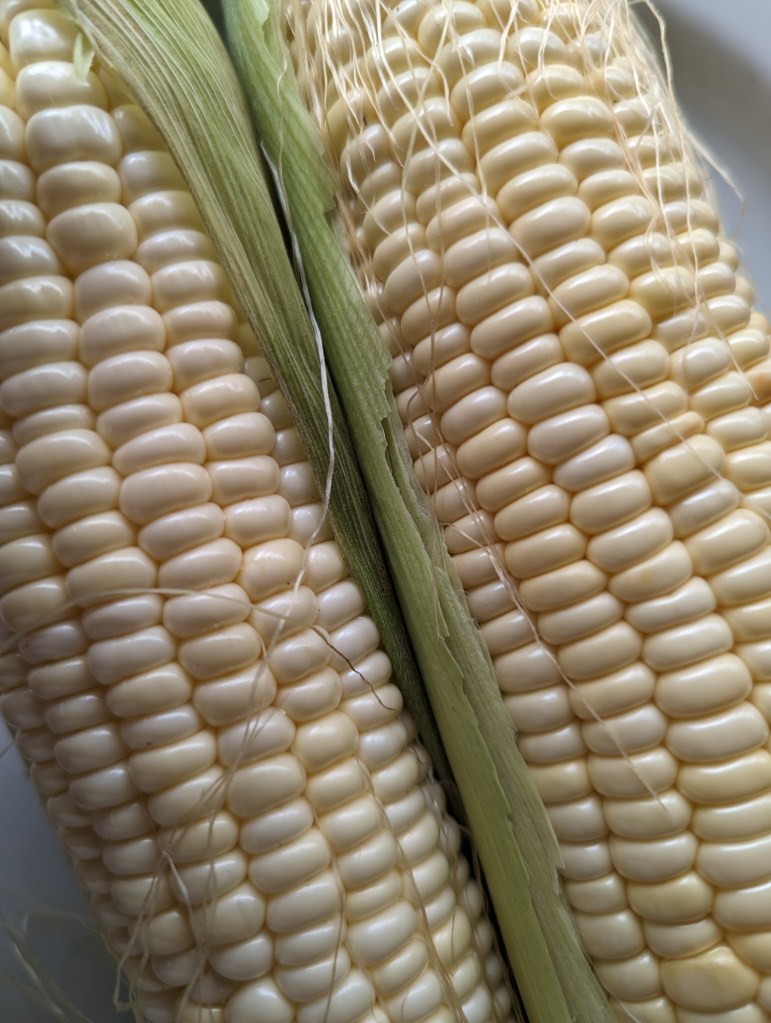
Almost all corn that grows in home gardens is sweet corn (Zea mays convar. saccharata var. rugosa). It is among the most popular of the warm season vegetable plants. Popcorn remains uncommon for home gardening. Other types of corn are mostly grains and other agricultural commodities that are rare within home gardens. Some corn becomes biofuel.

Corn stalks can grow as high as twelve feet! Most popular varieties grow only about half as high. Each stalk should produce one or perhaps two ears of corn. Each ear produces many kernels of corn in very neat formation on a central cob, all within a tight foliar husk. Male blooms protrude from the tops of stalks like antennae. Foliage is coarse but grassy. Stalks resemble giant reed, except smaller.

Of the various warm season vegetable plants, corn is one of the more consumptive sorts. It occupies significant area. It requires methodical and generous irrigation. Also, it craves rich soil, but depletes nutrients. Corn grows best from seed sown directly into the garden. Squared orientation, rather than typical rows, improves pollination and ear development.

Warm Season Vegetable Plants Begin

Tomato seed should already be sown.

Warm season vegetables, or summer vegetables, can occupy a garden systematically. A few lingering cool season vegetables may continue production for a while. Warm season vegetable plants can replace them as they finish. Several warm season vegetable plants should start as early as possible. Others grow in a few later phases through their season.

For example, indeterminate tomato plants are productive throughout their entire season. They can start as soon as convenient. However, determinate tomato plants produce only for two weeks or so. After their initial phase of a single plant or a few, subsequent phases can start about every two weeks. Each phase continues production after its predecessor.

Bush bean and several varieties of eggplant and pepper also produce for brief seasons. Okra and cucumber might produce for most of summer. Secondary phases may increase their production as well though. Of all warm season vegetable plants, corn benefits most from phasing. Each phase tends to mature so uniformly that it finishes within a few days.

Pole bean, squash, some cucumber and Indeterminate tomatoes need no phasing. Such warm season vegetable plants perform from spring planting until frost. Winter squash are warm season vegetable plants, but their fruit finishes for autumn. Indeterminate tomatoes are less profuse than determinate types. Cumulatively though, they are more productive.

It will soon be time to sow seed for corn, beans, root vegetables and most greens directly into garden soil. Seedlings for these warm season vegetable plants are not conducive to transplant. Besides, too many are needed. Cucumber and squash grow either from seed or small nursery seedlings. Only a few plants are needed, and they transplant efficiently.

For the same reasons, tomato, pepper and eggplant can grow from seedlings rather than seed. Moreover, since they are so vulnerable as they germinate and begin to grow, seed is less practical than seedlings. Varieties that are unavailable at nurseries can grow from seed in flats inside or in a greenhouse. Ideally, they should have started early enough for transplant into a garden during appropriate weather.