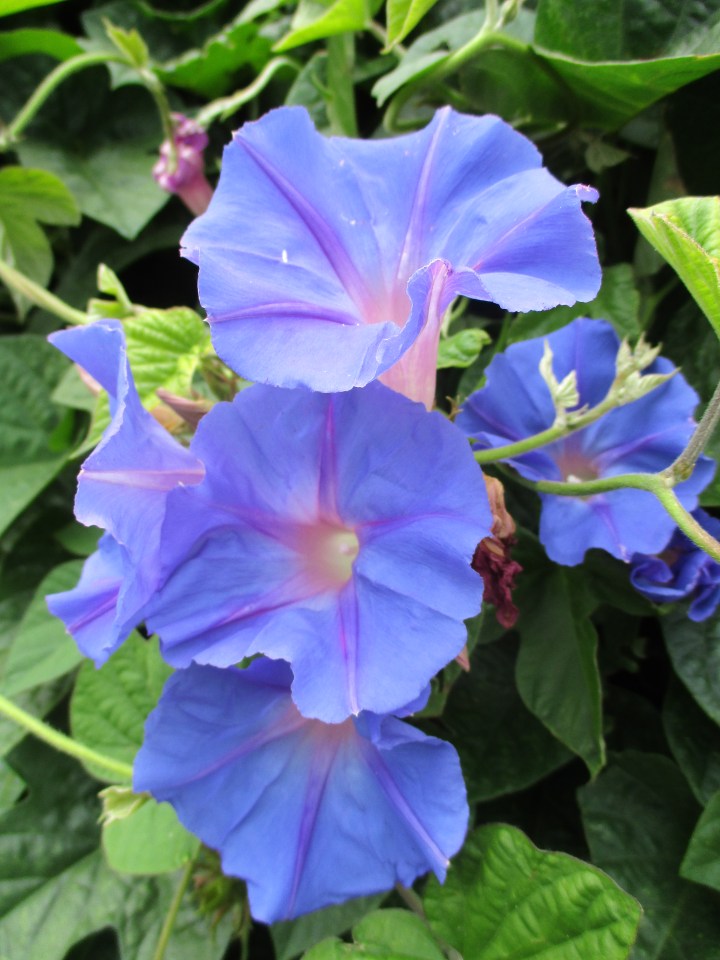
 Even within its native range, blue dawn flower, Ipomoea indica, can be a problem. There are not many other plants in some coastal regions of Peru that can avoid getting overwhelmed by the aggressive wiry vines. These vines grow roots where they touch soil, so can spread indefinitely over the ground. Vines that succumb to frost over winter regenerate as if nothing ever happened.
Three inch wide flowers are rich purplish blue when they open at dawn. They then fade through the day, only to be replaced by fresh new flowers the following morning. Bloom continues from spring until autumn, and can get profuse at times. The lush rich green leaves are cordate (heart-shaped) or lobed (with only three lobes). Too much fertilizer promotes growth but inhibits bloom.
Blue dawn flower’s main weakness is a dependency on water. If it gets too dry briefly in summer, it can die back like it does with frost, and then recover once it gets water, but it will not survive for very long if it stays dry. As aggressive as it is, it should not spread very far from landscaped areas or riparian areas where summers are too warm and dry for it.
 Like Ginger and MaryAnn, choosing between the flashier hybrids of clematis and the anemone clematis, Clematis montana, might not be so easy. The fancier hybrids have the bigger, bolder and richly colored flowers that the genus is known for. Anemone clematis has smaller and more subdued flowers in soft pastel hues, but is more prolific, more vigorous, and blooms for nearly a month.
 Anyone can plant a grapevine. With a bit of work, almost anyone can make a grapevine grow. Most who put forth the effort can figure out how to prune and cultivate a grapevine. Yet, grapevines so often get very out of control. They easily escape confinement, overwhelm nearby plants, climb into trees and overburden their trellises or arbors. It is easy to forget how aggressive they can be.
 There are so many different specie involved with the extensive breeding of the modern cultivars of clematis that they are not even assigned full Latin names. They are simply known as ‘clematis’ (without a specie name), with a respective cultivar name. Clematis X jackmanii is the oldest known hybrid, so the name is often applied to other hybrids, whether or not they are actually related.
 Lawns composed of turf grasses are the most functional, but also the most demanding forms of groundcover. That is old news. There are so many other less demanding low growing plants that that can cover the ground in areas that are not used like lawns are. Sometimes they work nicely just to control weeds. Sometimes they help to control erosion on otherwise unlandscaped hillsides.
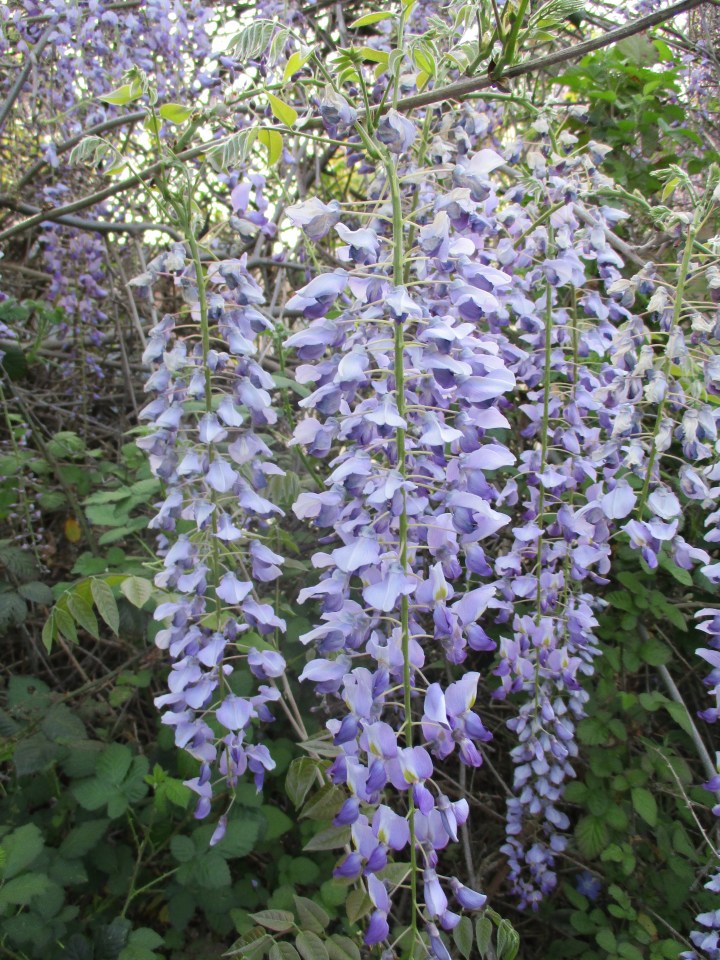
 The popular wisterias that bloom so profusely before their new foliage appears in spring are Chinese wisteria, Wisteria sinensis. Others specie are rare. The impressively longer floral trusses of Japanese wisteria are not as abundant, and bloom late amongst developing foliage. American and Kentucky wisteria are more docile small vines, but their floral trusses are both short and late.
 Foliar tapestries are impressive in the right situation.

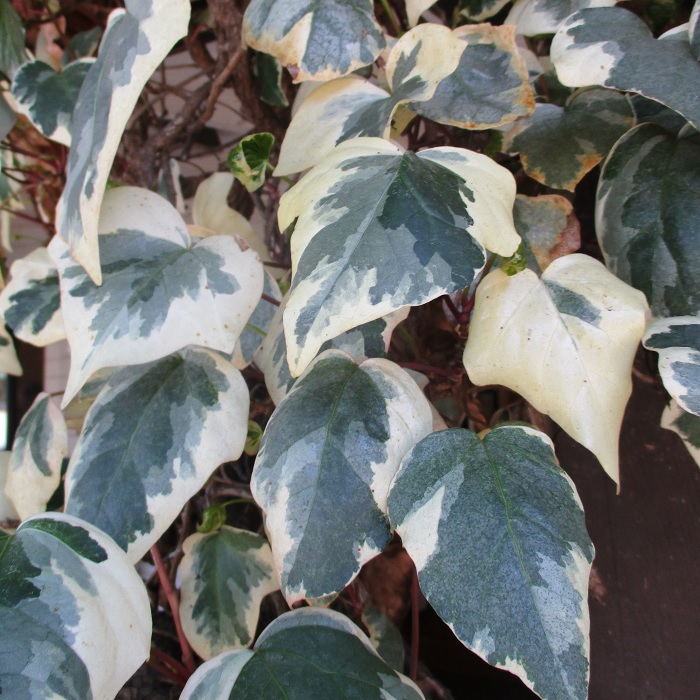 This is one of those plants that many of us have strong feelings about. Many of us who remember it from when it was more popular in the 1970s might consider Algerian ivy, Hedera canariensis, to be an aggressively invasive weed. Those of us who are less familiar with it might appreciate it as a vigorous and resilient groundcover that gets dense enough to exclude most other weeds.
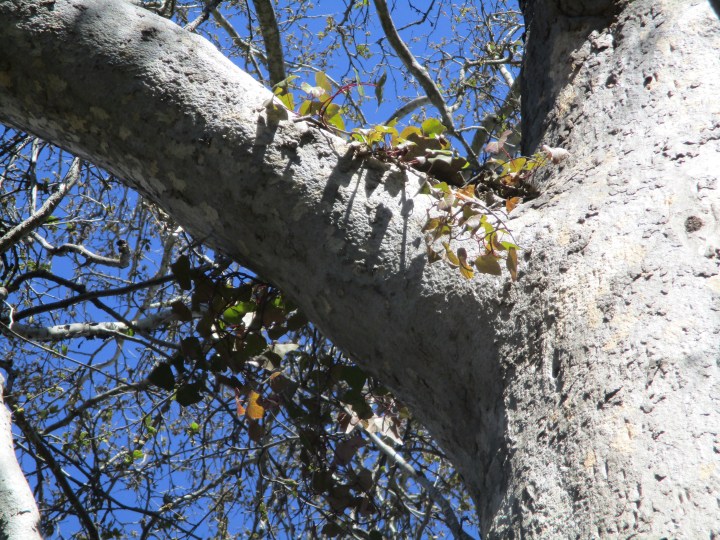
 The ivy in this sycamore did not just climb up from the ground to hang over this big limb. If you look closely, you will see no vine coming up from the ground. This small patch of ivy as well as a small pyracantha, are growing in a decayed cavity on top of the big limb. The ivy may have climbed up a long time ago, and then rooted into the cavity before the original vine was somehow removed. Alternatively, the ivy might have grown from a seed that was dropped by a bird or ivy vines that are higher up in nearby box elder trees. It is impossible to say now.
 This is no timid vine! Flame vine, Pyrostegia venusta, is related to the lavender trumpet vine and blood red trumpet vine, and is just as vigorous. Although it can not be recommended for tight spaces or small refined gardens, it excels at obscuring concrete walls. It only needs wires or stakes to be convinced to climb. If it gets too big, it can be cut back after bloom to regenerate quickly.
 Tony Tomeo