 Is it coming or going? Autumn that is. It normally gets here last. We are typically only beginning to see the first foliar color of autumn while other parts of America get their first snow. We typically get a few more tomatoes out of our vegetable gardens long after most everyone else has pulled out their frosted tomato plants.
Well, we still got it. Tomatoes that is. The plant that produces these bright orange cherry tomatoes is looking a bit tired and pale, but the tomatoes are as good as ever. It probably will not last until frost. The plant might get pulled out when the tomatoes run out. Without bloom, that could be pretty soon. Frost does not happen until well into winter. Regardless, tired tomato plants say that autumn is coming.
We got foliar color too. This Japanese maple turned this nice garnet red quite some time ago. Sweetgum trees all over town are also well colored. They seem to be ahead of schedule, as if winter is on the way. Defoliating black oak trees say that autumn is going.
While the days are still pleasantly warm, with temperatures into the 80s, the nights get cool enough to color deciduous foliage. Warm days are quite normal for this time of year. So are cool nights. However, the two typically do not happen together for more than a few days. Warm days typically alternate with mild nights. Cool nights typically alternate with cool days.
Well, even in our mild climate, the weather is always full of surprises. We will enjoy it while it lasts. Autumn has always been a mere in-between season anyway. In the chaparral and desert climates of California, winter and the rain that comes with it will be welcome when they arrive.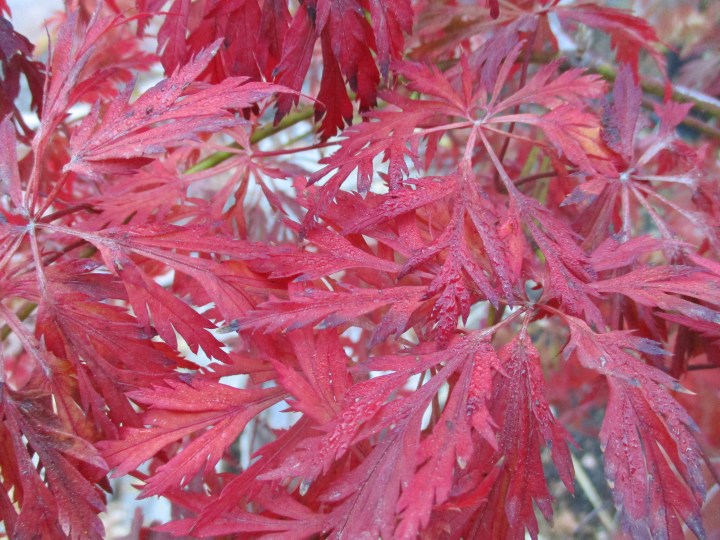
No Rain
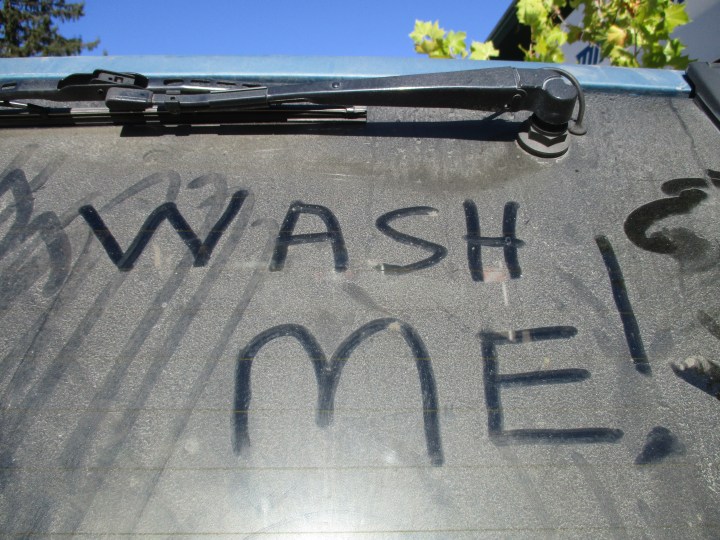 For the first time since last winter, a few raindrops were heard on the roof early last Monday morning. It was over by the time I realized that the odd and unfamiliar noise really was that of raindrops. By the time the sun came up, everything was dry. I do not even know if these few raindrops could be considered to be the first rain of the season. There were a few similar raindrops on my windshield a while back, but they were dismissed as such; merely a few random raindrops rather than a confirmed rain shower.
That is how our climate works here. The Santa Clara Valley is in a chaparral climate. Much of Southern California is in a desert climate. We do not get much rain, and it is almost exclusive to a limited rainy season that is centered around winter.
Dust and crud that accumulates on foliage through the long dry season tends to stay there until the rain rinses it away. Oddly, many native plants do not mind, and a few seem to appreciate it. Some have tomentum (fuzz) on their leaves that collects dust, particularly during the warmest and driest summer weather when foliage is most sensitive to desiccation and scorch. Others have sticky foliage that does the same. However, such foliage is remarkably efficient at allowing such crud to rinse away in the first rain. Both deciduous foliage that will be shed shortly after the rainy season starts, and evergreen foliage that will be replaced through winter, seem to prefer to start the rainy season clean. Is this just coincidental, or do the plants intentionally collect dust and crud to shade and insulate their foliage through the harshest summer weather, and then wash up for a good sunning at the last minute?
Indian Summer Is The Norm
 The popular definition of ‘Indian summer’ suggests that it is unseasonably warm and dry weather in spring or autumn, and that it typically happens after frost. Well, that definition just does not work here. It makes about as much sense as our so-called drought, which is actually the normal weather for our chaparral climate. Weather that repeats annually is neither unseasonable nor abnormal.
There are certainly years with more or less rain, and years with warmer or cooler weather in late summer and early autumn. Weather is naturally variable. It does not work like the thermostats in our homes, or the automated irrigation systems in our gardens. It is impossible to predict precisely how this summer will end, but it will likely have some characteristics of a normal Indian summer.
The one characteristic of the popular definition of Indian summer that will be notably absent is frost. That will not happen until after autumn. Locally, Indian summer can either be what seems to be a continuation of summer weather, or a resumption of warm summery weather after a bit of cooler weather. The main difference from earlier warm weather is that the nights are significantly cooler.
That is more important than it sounds. We do not notice the cooler nights as much as the plants that are outside all night do. While the days are as warm as they had been, some deciduous plants will begin to defoliate. Eventually, those that get colorful in autumn will begin to do so. Roses can be fertilized one last time, but even as they continue to bloom, they should not be fertilized again.
Indian summer prolongs the summer growing season significantly, but also has the potential to interfere with the winter growing season. Warm days keep warm season vegetables and flowering annuals performing so nicely that we do not want to remove them to relinquish their space for the cool season plants that will be needing it soon! In other climates, frost ends the summer season for us, and necessitates the transition to cool season crops. Indian summer can be too much of a good thing.
Horridculture – Drought
 It is a way of life in much of California. Many of us grew up with it, or at least believing in it. Many of us never heard the end of it. That is how it lost its meaning.
Drought is a weather condition. It might last one year or a few. Drought can even continue for several years. For us, it entails less than normal rainfall through winter, only because winter is when rain is supposed to fall here.
As a weather condition, drought is not permanent. There have been a many during the past few centuries of recorded history here, and a few of those have been in just the last half century that I can remember. They happen frequently enough that I can not remember the exact years that were drought years, although I can remember a significant drought in the middle of the 1970s. No drought lasts forever.
If drought lasts forever, or at least as long as anyone can remember, then it is not a weather condition, so is therefore not really a drought. It is ‘climate’.
The climate of much of California is naturally arid. San Jose and the entire Santa Clara Valley have a ‘chaparral’ climate, which is classified as ‘semi-arid’. Some areas near the base of the Santa Cruz Mountains get only about a foot of rainfall annually. Los Angles and the region around it in Southern California have a ‘desert’ climate, which is ‘arid’. Parts of the Mojave Desert get less annual rainfall than other climates get from a single storm.
Although droughts happen here, the limited availability of water is due to the natural climate, not weather. Those who came to California a long time ago knew how to use what was available. The problem now is that there are simply too many people wanting too much of a naturally limited supply of water. Way too many expect way too much.
Krispy Kritter
 This really is the best climate here. Winters are just cool enough for many plants that require a bit of a chill, but not unpleasantly cold. Summers are just warm enough for most plants that need warmth, but the weather does not stay too unpleasantly hot for too long. Warm weather here typically lasts no more than a week, and is accompanied by light evening breezes and cooler nights. Minimal humidity typically makes the worst of the heat a bit more tolerable.
While much of North America and parts of Europe were experiencing abnormally and uncomfortably warm weather earlier in summer, our weather somehow stayed relatively mild. For a while, it was significantly warmer in Portland than here. It certainly was nothing to complain about. Vegetable plants that crave warmth were not too inhibited by the mild weather. Flowers that typically deteriorate in warm and arid summer weather lasted a bit longer than expected.
Then the weather changed. It did not get too unseasonable warm. In fact, the weather merely did what is typical for this time of year. The problem was that it happened so suddenly. The weather went from pleasantly mild and somewhat humid, to more seasonably warm and arid overnight. Flowers faded and warm season annuals wanted for more water.
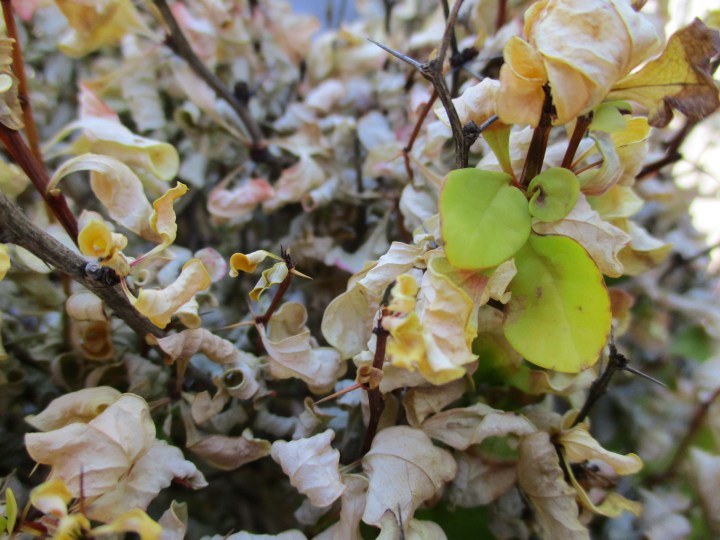
The worst of it was that exposed foliage of some plants got roasted. English laurel and rhododendron were particularly susceptible Because we had no way of anticipating the sudden change of weather, we had just shorn a large hedge of English laurel, just in time for the warm weather to cook the freshly exposed inner foliage.
At about the same time, new plants were being installed into a small newly landscaped area. The transition from the cool and comfortable nursery on the coast to the warm and arid landscape where they were surrounded by black groundcloth (prior to the installation of chips) was too much of a shock for some of them. We could not water them enough to prevent some of the foliage from desiccating.
This crispy barberry is fortunately not as dead as it seems to be. Only the outer foliage is roasted. The stems and buds do not seem to be damaged. It will probably foliate again before defoliating in autumn. Even if it induces premature dormancy, it should recover as next winter ends.
Nonetheless, such damage on new plants is disconcerting.
Things Heat Up In Summer
 This does not seem like such a mild climate when it is difficult to distinguish between the time and the temperature on a local bank clock tower. You know; when punctuation is the only difference between four minutes past one, and one hundred four degrees. Fortunately, like mild frost in winter, hot weather does not happen too often, which is why this climate really is milder than most.
Most of us know what to do for the garden when the weather gets warmer. Obviously, many plants want more water. What we do not often consider is that there a few things that we should ‘not’ do. Unlike us, the plants in the garden can not find shade when the weather gets warm. Those that are exposed find creative ways to provide their own shade. We really do not want to mess with that.
By this time of year, outer foliage of exposed plants is mature enough to tolerate heat. Only foliage of plants that prefer to be partly shaded is likely to be damaged. However, inner foliage of even the toughest plants is not as resilient as outer foliage is. Simply shearing a hedge exposes inner foliage that can be scorched by overexposure. Sunlight enhances the effects of heat and aridity.
If possible, it is best to delay such pruning and shearing until after unusually hot weather. No one wants to be out working in the garden on a hot day anyway. More typical seasonable weather may not seem to be much cooler, but a few degrees can be a big difference to plants. Once exposed, inner foliage should adapt, and hopefully be resilient to heat before the weather gets hot again.
While young and thin, formerly shaded bark that suddenly becomes exposed can be damaged by sun scald. (Deciduous trees do not get scalded while defoliated in winter because the intensity of sunlight is diminished at that time of year.) Sun scald of bark is much more serious than foliar scorch because it kills bark, leaving open wounds on main limbs and trunks. Decay within these wounds compromises structural integrity, and can ruin otherwise healthy trees.
Although rare, spontaneous limb failure can occur in some trees during warm weather, particularly if humidity increases and breezes remain minimal. It sounds silly, but warmth accelerates vascular activity, possibly until foliage becomes too heavy for the limbs that support it. If limbs break, they can cause major disfigurement, and detrimentally expose bark of inner limbs and trunks.
Na2CO3•NaHCO3•2H2O
 Trona
Trona
That is what this seemingly disorganized jumble of letters and numbers represents; the chemical formula for the mineral known as trona. It is what a certain small town in the very northwestern corner of San Bernardino County is named for. Trona is one of a few minerals mined and refined there. Apparently, not much else happens there.
Trona the town is about as out of the way as one can get in the contiguous United States of American. Death Valley to the northeast at least gets tourists. Not much flora survives in the hellish summer heat and caustically saline soil. The athletic field at Trona High School is famous for being grassless dirt. Even the now defunct golf course was dirt. Roofs are more important for providing shade than for keeping the four inches of annual rainfall out. A leaky house is more likely to petrify before it rots. The inertly arid air, roasting heat and acrid drifting minerals seems to sterilize and embalm even abandoned houses. The Google Satellite image shows how boringly uniform the factory tract houses are. Many are now abandoned. Some are missing.
Why am I mentioning Trona here? Because horticulture is so limited in Trona. There might not be many better places in America for a horticulturist who lives amongst dense forests of the tallest trees in the world to go on vacation! There are so few distractions! The vast desert extends for miles in every direction, with only a few plants surviving in home gardens in town. The satellite image shows how empty the gardens are. A single lawn can not be found. Even artificial turf is notably absent, perhaps because no one wants to go outside in such horrid weather.
I suppose that I will never know until I go there.
Frost Is History For Now
 There is no doubt that frost will return next autumn. It does that every year. Right now, we are more concerned that is should not return prior to that. It is now safe to plant plants that are sensitive to frost. Even if the weather were to somehow get cold enough to necessitate protection of frost sensitive plants, it will not be severely cold, and it will not last long. It is best to start now than to delay.
It is also safe to prune away foliage and stems that were damaged by frost through winter. It was best to leave it in place through winter, both to provide a bit of insulation for undamaged stems below, and to not promote new growth. Pruning it away allows warming sunlight to the undamaged stems, and stimulates generation of new growth. A bit of new growth might already be apparent.
Many leafy perennials can be cut to the ground, or at least just above their rhizomes. The tall vertical canes of cannas can be cut back to the low horizontal rhizomes that creep along the ground. The canes are not really stems anyway, but are merely upright foliar shoots. Any shorter new shoots that are beginning to develop can remain, even if a few outer leaves happen to be damaged.
Zonal geraniums can likewise be pruned almost to the ground, leaving only stubs of lower stems, even if only upper and outer foliage was damaged by frost. Although they do not need to be cut back so severely, they respond to such pruning splendidly, with vigorous new stems and foliage. The fungal foliar disease known as ‘rust’ overwinters in old leaves that get removed in the process.
Lemons, limes and any other citrus that were damaged by frost only need to have their damaged stems removed as far back as viable growth, where new buds might already be visible. However, if more pruning is necessary, this would be a good time to do it. Major pruning should not be done later in summer because the sensitive bark of inner stems can be scalded by sudden exposure to too much sunlight. Small trees that are sensitive to frost become more resilient as the grow larger.
RAIN!?
 This is not sequel to ‘SNOW!?’ from yesterday.
Nor is it a sequel to any of the other brief article about rain in the past.
I just recycled the picture because I still find it to be amusing.
If you are a native of California like I am, and are wondering what ‘rain’ is; I have already explained it sufficiently in previous articles. Basically, it is those unfamiliar droplets of water that fall mysteriously from the sky and get everything wet. Look it up if you must.
The article that I posted earlier this morning was recycled from this time last year, long before I started posting articles here. Our rain has actually been very deficient. It has rained only a few times this season.
We tend to talk about rain often here because it is so important to us. So much of California gets such a limited supply. Although our annual rainfall is technically sufficient, and has been sufficient longer than anyone can remember, there are millions of people living here who need the water that it provides. Fluctuations of weather are normal, but are somewhat distressful for those of us who are aware of how weather affects the water supplies that rely on rainfall. Much of the population of California gets water from surprisingly remote sources that are much more reliable than local sources. However, some regions rely on local aquifers that are sustained by local rainfall.
The ‘mostly’ good news for now is that is it raining presently. Seriously! It is raining; and is expected to continue raining through Saturday.
I say that this is ‘mostly’ good news because so much rain within a short time is likely to be disastrous to areas burned by wildfires just a few months ago. Floods and mudslides could, and are actually expected to cause significant damage near Montecito and in other areas of Santa Barbara and Ventura Counties. Highway 101 could be closed again.
We just can’t seem to get it right. If we get enough rain, vegetation in wildlands becomes more combustible. If the combustible vegetation burns, the burned area is more susceptible to mudslides and flooding if we get enough rain again in the subsequent season. So, major wildfires, as well as mudslides and floods, are less likely if we do not get enough rain. If we get enough rain, we are more likely to get a messy situation.
Rain Makes Watering Seem Obsolete
 Watering has not been much of a concern lately. All the rain has kept our gardens too wet to work in. Some of us have been more concerned with erosion caused by runoff. Automated irrigation systems are probably disabled until the rain stops. Soil can drain somewhat between rain, but will not really dry out until the weather gets warm again. Dormant plants do not draw much moisture.
However, as strange as it may seem, there are a few plants that might want to be watered. Potted plants on roofed porches are sheltered from rain, just like houseplants. They will not dry out nearly as quickly as they would during warm summer weather, but they do eventually get dry if not occasionally watered. Hanging pots and small pots containing big plants typically dry out faster.
Plants that were moved onto porches for shelter from frost can be moved out into the rain if that would be easier than watering them. It is very unlikely that they will be damaged by frost this late. Besides, as long as it is raining, the weather can not get cold enough for frost. (In fact, any frost damage that was left through winter can be pruned away now that fresh new growth is developing.)
Small plants in the ground under big eaves might need to be watered as well, if they have not been in the ground long enough to disperse their roots beyond the eaves. Annuals do not last that long. Mature plants might have dispersed their roots well enough to get enough moisture from outside. They might not notice if the soil inside is too dry, as long as the weather is cool and humid.
Houseplants are of course in a league of their own, and as long as they are inside the home, get no water from rain. They might need less watering in winter if the home stays cooler; or they might need slightly more watering if the home heating system reduces humidity. Regardless, some might enjoy going outside to a spot sheltered from the wind, for a brief rinse from a mild rain shower.
Eventually, the weather will get warmer and drier, and automated irrigation systems will need to be reactivated. When that happens, the emitters and sprinklers should be checked for efficient function. While inactive over winter, they can get grungy or clogged with mineral deposits. Plants will not need much water early in the season. Irrigation increases as spring and summer progress.
 Tony Tomeo