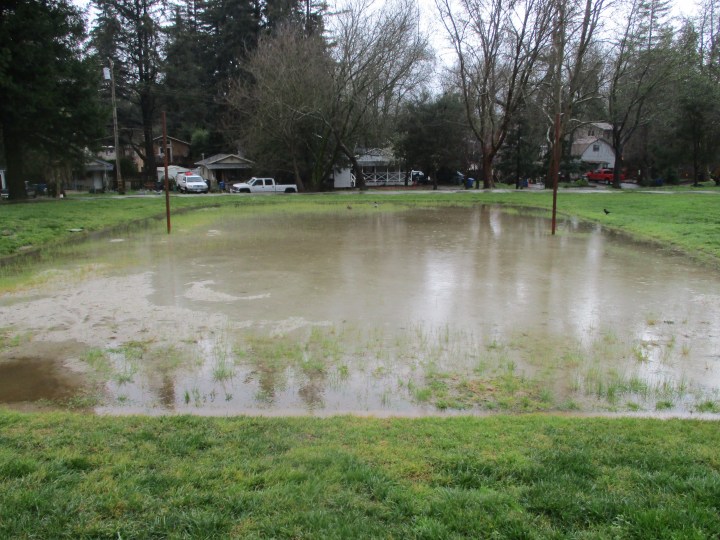
 Supposedly, all this rain has not been too terribly excessive. It seems to have been raining more frequently than it normally does, with only a few days without rain in between, and more often, many consecutive days of rain. The rain also seems to be heavier than it normally is. Yet, the total rainfall is not too much more than what is average for this time of year, and well within a normal range.
The volleyball court at Felton Covered Bridge Park looks more like a water polo court at the moment. The pair of ducks out of focus on the far side seem to dig it. The water is not as turbulent at it is the San Lorenzo River where they live.
Speaking of the San Lorenzo River, it has been flowing very well and at a relatively continuous rate. It came up high only for a short while. None of the heaviest downpours lasted long enough to keep it very high for very long. The ivied log laying in the river in the middle of the picture below was an upright cottonwood tree only recently, but fell into the river as many riverbank cottonwoods do when the ground is softened by rain and higher water.
When things get as soggy as they are now, this great blue heron strolls the lawn at Felton Covered Bridge Park, probably because the San Lorenzo River is too turbulent, and also because the worms that live in the lawn come to the surface as the lawn gets saturated. He or she is never in a hurry, but just strolls about slowly, occasionally prodding the muddy soil. However, when it wants to move fast, it is quick enough to catch small frogs. Supposedly, this great blue heron caught and ATE a small gopher!
Six on Saturday: Above and Below
All that rain was excellent! Now it is cold. There was snow in Malibu in Southern California. It has not been this cold in quite a while. Nonetheless, the weather is grand, and not so cold in the middle of the day. The first three of these six pictures prove it.
1. This was just about sunrise on the first day in a while that did not start with rain. It was cold, and the sky was clear. The trees to the left are Douglas fir. The tree just to the right of center is a ponderosa pine. The tree in the right corner is a coast live oak. This is in one of those spots where different ecosystems collide. The firs merge into redwoods to the left. Ponderosa pines mixed with a few coast live oaks continue to the right, with more pines farther back. All are native.
2. Now it is raining again. I would not say it was real rain, but merely a brief rain shower, with really big and soggy raindrops. Since it lasted only a few minutes, I would still classify this as a sunny day. Unfortunately, the raindrops are not visible in the picture; but the light duty clouds in an otherwise clear sky are. It was sunny when this picture was taken, which means that from some other vantage, this spot was at the end of a rainbow. Those trees are native (coastal) redwoods.
3. While looking up, I noticed that the exotic (nonnative) sweetgum is mostly defoliated. Rain tends to dislodge the colorful foliage in winter. The two leaning redwood trunks in the middle of the picture are a concern because, although they (and palms) are the most stable trees that I work with, redwoods do not accommodate structural deficiency very well. The asymmetrical distribution of the weight of the trunks above the curves exerts lateral tension on the trunk.
4. Below all these tall trees, we have a pile of nice madrone firewood that is ready to be split for next year. The native madrone is notorious for instability. Big trees often blow over, or just fall over because they are really bored. The tree that produced all this firewood was cut down because the lower trunk was so very rotten. Yet, as you can see, the firewood from upper limbs is in good condition. Madrone firewood is quite desirable, so this wood is expected to be gone soon.
5. The shade under redwood forests is so dark that even these shade tolerant (exotic) gold dust plant want more sunlight. I should have just cut these down, but instead tried to give them a second chance. I pruned out all the dead material, and then pruned out some of the deteriorating stems, hoping that the process would stimulate new grown. That was almost a year ago. Not only has there been no growth or improvement, but the foliage looks even more distressed than it did before!
6. Out in a sunnier spot, and after most others have finished, these (exotic) daffodils are still blooming. Actually, they have been blooming for a while. Since there are two different varieties blooming now, I suspect that those that bloomed here earlier were a different variety, or varieties. There is a bit of (exotic) tulip foliage mixed in with them. No bulbs were intentionally planted here on the riverbank, so were likely dumped here in soil that came from a planter or a landscape somewhere.
This is the link for Six on Saturday, for anyone else who would like to participate:
https://thepropagatorblog.wordpress.com/2017/09/18/six-on-saturday-a-participant-guide/
Six on Saturday: After The Storm
Contrary to popular belief, we do get a bit of wintry weather here. It is neither as cold nor as snowy as weather is in most other regions, but it gets sufficiently cool and rainy to let us know it is winter. In fact, here on the western slopes of the Santa Cruz Mountains, we get the little bit of extra weather that does not quite get over the Summit into the Santa Clara Valley. Clouds must unload slightly in order to gain sufficient altitude.
There have been more storms so far this winter than there normally are, and this last week was particularly stormy. It is both a lot of fun, and a lot of work. Storms are innately wet, as well as messy. By the time we catch up from one storm, another arrives. The first few storms are something to be celebrated. The last few start to be rather bothersome.
1. Do you see the well kept shop buildings on the left and right? Neither do I. This is what I found when I got to work on Thursday morning after the electricity was put out by a wicked storm. The lights in the middle are those of a car out on the road. I managed to set up the coffee ‘machine’ to make coffee for the crew when the electricity came back on. I also put the leftover coffee that someone made late the previous night into a pitcher, so that if the electricity did not come back on in time for the crew to make fresh coffee, the first few to arrive could warm up the leftover coffee in the . . . . . . microwave. Okay, perhaps that was not such a good idea. The coffee was just swell cold.
2. Many trees fell during the last few storms. Many more trees lost significant limbs. This unfortunate coast live oak is not as bad as it looks. Once the stub of the fractured limb is removed, it should be just fine. We try to identify potentially hazardous trees, and either work with them to make them less hazardous, or remove them completely. It is nonetheless impossible to predict all hazards. I would have not considered this particular subject to be hazardous prior to the damage seen here.
3. Artificial poinsettias were removed about a month after Christmas. https://tonytomeo.com/2019/01/26/pseudodendron-falsifolia/ They are no longer seasonal. Besides, this is the stormy season here, when these artificial poinsettias would be likely to get blown about the neighborhood if left out. If they were to survive the storms, they would fade in sunnier weather of spring. But hey; why must I justify their removal? They are tacky! They will stay hanging in the barn until after next Thanksgiving.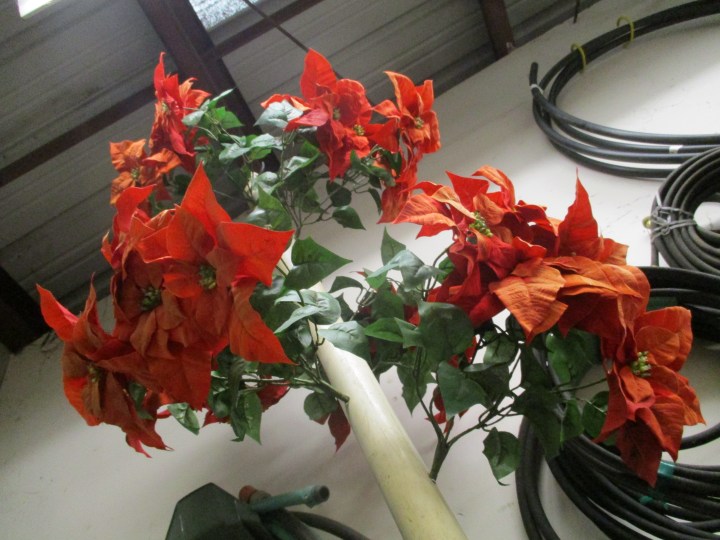
4. Pruning scraps from zonal geraniums that needed to be pruned back earlier in winter were just too tempting. Rather than discard them, I processed them into cuttings. I tried to give most of them away, but ultimately needed to plug some back into the landscape. They get plugged this time of year so that they get soaked by the rain as they disperse roots. Many went into situations where they will be without automated irrigation. If planted too late, they would just desiccate when the rain stops. These are in a neat row along the base of a stone wall separating a few roses from the roadway, so they will get a bit of water from the roses. So far, they ALL are doing well. Propagation can be such a bad habit.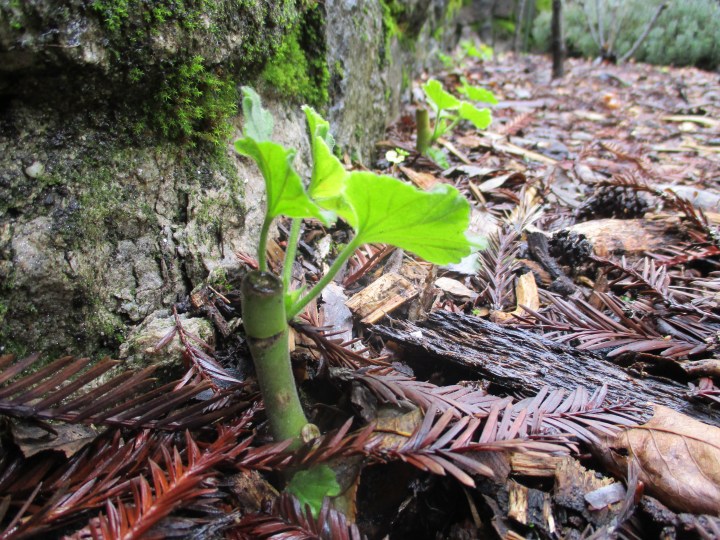
5. This was NOT my idea. I am none too keen on Japanese maples. Yet, this one works very nicely for the particular landscape it is in. I am impressed by the vibrant red color because this particular tree is somewhat sheltered and partly shaded. (Exposure to sunlight and cool wintry weather enhances color.) It looks great among the redwoods.
6. No, I do NOT grow ANY of the snowdrops, Galanthus nivalis, or any of the hybrids. ‘Snowflakes’, Leucojum vernum, are only here because they naturalized on the riverbank, likely from seed or bulbs that washed in from a garden upriver. They are spreading quite nicely, and are pleased to bloom in this unirrigated spot after soaked by a few storms. I could have gotten a picture with more flowers in it, but most are already deteriorating. I got these as a closeup instead. I know they are not really snowdrops, but I can brag about them anyway.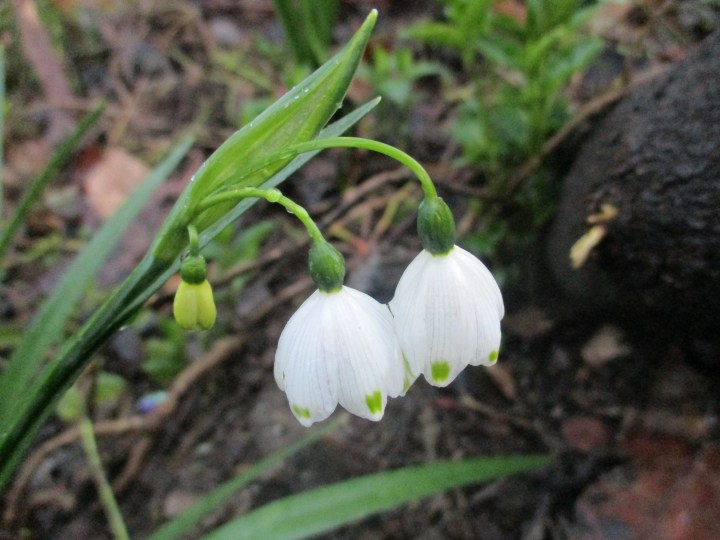
This is the link for Six on Saturday, for anyone else who would like to participate:
https://thepropagatorblog.wordpress.com/2017/09/18/six-on-saturday-a-participant-guide/
Warm Weather Confuses Dormant Plants
 Climate is what makes gardening so excellent here. It is just warm enough in summer for plants that like a bit of heat, but not too unbearably hot for too long. It is just cool enough in winter for plants that like a chill, but not cold enough for hard frost or heavy snow. The climate is also comfortable for us while out in the garden! Yet, even local climate is neither perfect nor predictable.
El Nino is still out there, and likely to deliver an abundance of rain. The rain last month was great while it lasted. This presently dry and warm weather in between has been excellent, but is likely to cause serious consequences. Some deciduous plants that are normally bare through winter are being deprived of adequate dormancy. Some are blooming prematurely, and may foliate soon.
When the rain resumes, it will ruin some of the premature bloom. This is generally harmless for most fruitless flowering trees like the various acacias, flowering plums and saucer magnolias, but compromises their most alluring feature. It can be more dangerous to flowering pears (including evergreen pear) and flowering crabapples, because wet blossoms can be infected with fire blight.
The more serious problem is that rain ruins blossoms and juvenile fruit of various deciduous fruit trees. Stone fruits such as almonds, apricots, cherries, plums, prunes, peaches and nectarines bloom first, and do so with delicate blossoms. If the blossoms do not get knocked off by rain, the juvenile fruit will rot if it stays damp too long. Many fruit trees are likely to lose all fruit this year.
Apple and pear trees should be safer because they bloom later, and bloom with more substantial flowers. (However, like their fruitless relatives, their wet blossoms are very susceptible to fire blight.) Persimmons and pomegranates bloom even later, and with even tougher flowers, so should be safe. Figs are in a league of their own, and should be fine if summer is warm.
Fortunately, destruction of bloom and fruit, although disappointing to us, is harmless to the affected trees.
San Lorenzo River
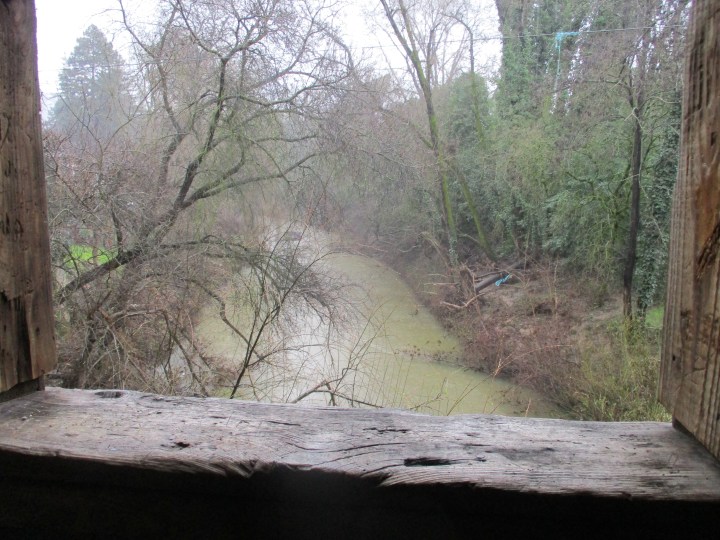 It may not look like much, but before all the rain started, the San Lorenzo river was shallow enough here to walk across. The water was clear and barely flowing. It is impossible to guess how deep it is now. It looks like cafe au lait, and is certainly flowing better than it had been. The watershed is less than a hundred and fifty square miles, so all this water is not coming from very far away.
The first picture above, of the San Lorenzo River flowing south to Santa Cruz and the Monterey Bay, was taken from the western of the two windows on the south side of the Felton Covered Bridge. Experts believe this to be the best of the four windows. My Mother has an old black and white picture of my older sister, my younger brother and I looking out from this window when were just little tykes. There was a railroad bridge out there a long time ago. Only concrete foundations remain.
The second picture below, of the San Lorenzo River flowing from the Santa Cruz Mountains beyond, was taken from the western of the two windows on the north side of the Felton Covered Bridge. The San Lorenzo River flows south on this side too!
It has been raining rather well here. Boulder Creek, which is at the far north end of the San Lorenzo Valley, gets more rain than most places in California, and far more than the rain shadow region on the inland side of the Santa Cruz Mountains. Local rain does nothing for the water supply of the rest of California, but is a good indication that snow is falling in the Sierra Nevada, where most of the water for much of the rest of California is stored in the snowpack.
Snow?
 What is this? It looks more like hail now. It was softer and squishier when it fell out of the sky only an hour or so before this picture was taken. There was a slight bit of snow up on Summit above Los Gatos. It will probably melt as quickly as the clouds clear to let the sunlight through. Snow sometimes appears on the higher peaks around the region, but is rare in lower elevations. Forty three years ago from today, on February 5 in 1976, snow fell in the Santa Clara Valley. It was about half an inch deep in some areas, an inch and a half in others, and was the last snow to fall there.
Electric Snow
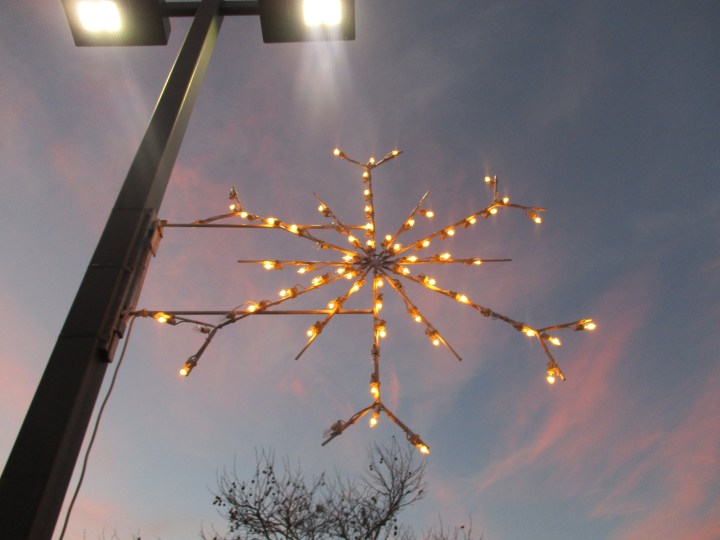 It was one of the more common types of snow in the Santa Clara Valley in the early 1970s.
In school, we made paper snow by folding paper squares in half and then into thirds (so that they were folded into sixths), and then cutting notches and slices out of them. They unfolded into the prettiest and laciest snowflakes!
In Westgate Mall, snow was blown by small fans about the new models of Singer sewing machines that were magically suspended in big acrylic spheres. We children could not get into the spheres, so were left wondering if the snow within was as cold and wet as we were told it was, and why it was necessary to demonstrate that the new sewing machines were resistant to weather. Our mother did her sewing inside.
We sort of suspected that the snow around the Nativity at Saint Thomas of Canterbury and other local parishes might be artificial because it looked like the stuffing of a pillow, which is something that all children seem to be familiar with. We said nothing about it, just in case our parents were not aware of the potential deception. However, it was rather disturbing to see so much of the same sort of snow at Christmas in the Park in San Jose. At that point, we accepted that either it must be genuine, or that we were committed to just going along with it.
Snow that was sprayed onto Christmas trees was rather interesting. It was neither wet nor cold, and sometimes it wasn’t even white. It could be pastel blue or pink, and was often sparkly with glitter! Wow!
Off in the distance, we could see snow on top of Mount Hamilton. Sometimes it was just on top. Sometimes, it was spread out from left to right, along the ridge. On rare occasion, snow appeared on the ridge of the East Hills, in front of the Diablo Range that Mount Hamilton is part of. We never saw who was up there folding and cutting all that snow, but they must have been VERY busy!
Snow on top of the Santa Cruz Mountains, right behind our part of the Santa Clara Valley, was closer to home, but did not look like much. The greenish blue of the forest was just a lighter hue of blue, with more mottling. It was exciting anyway.
Then, on February 5 in 1976, it actually SNOWED on the floor of the Santa Clara Valley!
It really was as awesome as snow was supposed to be. It was cold. It was wet. It was white. It was fun to wad up and throw at each other. It accumulated just like it would in a blizzard, and got almost an inch deep!
. . . but . . . was it really SNOW?
Windows Of Heaven
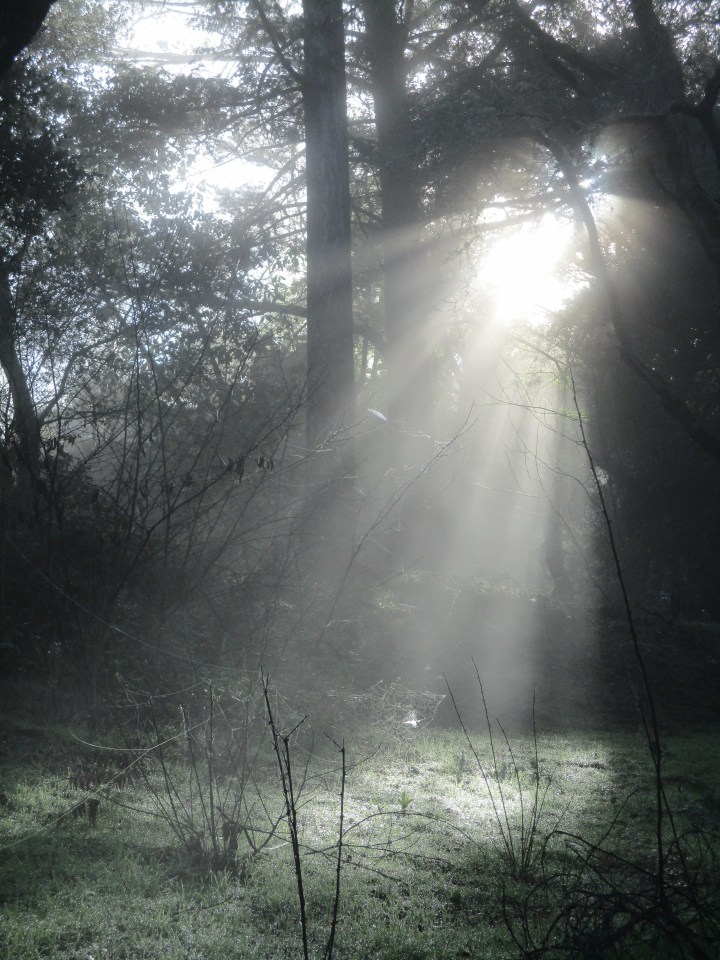 Or . . . a close encounter of the third kind. Let’s just go with the former rather than the latter.
I am no photographer. The pictures that I post are merely illustrations for articles from my gardening column, and other articles. This picture just happened to make itself available while I was getting the first of the six pictures of the earlier ‘Six on Saturday’ post. The location is nothing special. It is not really out in the forest like it seems to be. A lodge building of six suites is directly to the left. A big ‘housekeeping’ building is to the right. There is a road in the background above, as well as below, from where the picture was taken.
Even the flora in uninteresting. The most prominent straight trunk in the middle is that of a young Douglas fir. The slightly leaning trunk with upward reaching branches to the right is some sort of cypress. There are a few nice small coast live oaks to the left. Most of the other trees to the right are black locusts that I really should cut down. The small shoots in the foreground are watersprounts from black oak saplings that were already cut down. There are some California bay trees in there somewhere, probably off in the background to the very far left.
The deteriorated colony of oak root rot fungus, Armillaria mellea, that was described too graphically in the earlier post was located in the foreground of the lodge building to the left. https://tonytomeo.com/2018/12/02/the-humongous-fungus-among-us/ . There was not much left of it then, so there would be even less now. . . fortunately.
Well, isn’t this way more information than necessary? I should have left this (too artistic for my ability) picture with just the title.
Winter
 We are now two days into it. Is it any different than three days ago, the last day of autumn? Not really. Even in harsher climates, the changes from one season to the next are gradual. Like the phases of the moon, the seasons are constantly phasing out of the previous, and into the next. The dates of the first and last days of each season, which are determined by the position of the Earth within its orbit around the sun, are technicalities.
Seasons in the Southern Hemisphere are of course opposite of what they are here. That seems odd to me. The calendar is the same there as here. It seems obvious to me that winter and all seasons should be determined by the same dates there that they are determined by here. If winter began last Friday here, it should have done the same there, on the the same date. Longer days and warmer weather are consequences of location, south of the Equator. It is hard to imagine that January and February are summer there.
It also seems odd to me that all maps are oriented with North directed towards the top. Shouldn’t South be at the top South of the Equator? Must Australia be the ‘land down under’ to those who live there? Things would be so much simpler if Columbus has just stayed home, and the World was still flat.
Anyway, we do not get much winter here. The weather gets a bit cooler, and we will eventually get more rain. When I went to Oklahoma six years ago, I thought that I would finally get to experience a real winter, but we left just before New Year’s Day, while the weather was still somewhat mild. This little bit of snow was about all we got.
Red Sky At Morning
 Red sky at morning; sailor take warning. Stormy weather is to be expected.
Back before modern meteorology, there were all sorts of ways to predict the weather. Some of the ways to know what to expect in the short term were obvious, such as simply observing what was happening off in the distance in the direction from which the weather comes. For the experienced, it is easy enough to feel changes in humidity and temperature in an incoming breeze.
Halos around the moon or sun, as well as the color of the sky at sunrise, provided a bit of insight about what could be expected a bit farther out than the short term. Some techniques were not always accurate, and some were not accurate at all.
Flora and fauna are better at predicting the weather than we are. Horses, dogs and cats get extra fluffy if they expect the winter weather to be colder than it normally is, and they shed early if they expect an unusually warm summer. Sycamore trees are so responsive to the weather that what they are saying about it is not always obvious. Are they browning and defoliating just because the weather got too hot and arid late in summer, or because autumn is going to be extra cool? Experts could tell, but because of modern meteorology, there are not many experts left here.
This red sky over Mount Hermon occurred at sunrise last Sunday, just prior to the storm that finished early Monday morning, and provide picture #6 for my earlier Six on Saturday post. I tried to avoid the streetlamp at the bottom of the right edge. I did not see the bird when I took the picture. The tree to the left is a golden honeylocust.

