 There is no doubt that frost will return next autumn. It does that every year. Right now, we are more concerned that is should not return prior to that. It is now safe to plant plants that are sensitive to frost. Even if the weather were to somehow get cold enough to necessitate protection of frost sensitive plants, it will not be severely cold, and it will not last long. It is best to start now than to delay.
It is also safe to prune away foliage and stems that were damaged by frost through winter. It was best to leave it in place through winter, both to provide a bit of insulation for undamaged stems below, and to not promote new growth. Pruning it away allows warming sunlight to the undamaged stems, and stimulates generation of new growth. A bit of new growth might already be apparent.
Many leafy perennials can be cut to the ground, or at least just above their rhizomes. The tall vertical canes of cannas can be cut back to the low horizontal rhizomes that creep along the ground. The canes are not really stems anyway, but are merely upright foliar shoots. Any shorter new shoots that are beginning to develop can remain, even if a few outer leaves happen to be damaged.
Zonal geraniums can likewise be pruned almost to the ground, leaving only stubs of lower stems, even if only upper and outer foliage was damaged by frost. Although they do not need to be cut back so severely, they respond to such pruning splendidly, with vigorous new stems and foliage. The fungal foliar disease known as ‘rust’ overwinters in old leaves that get removed in the process.
Lemons, limes and any other citrus that were damaged by frost only need to have their damaged stems removed as far back as viable growth, where new buds might already be visible. However, if more pruning is necessary, this would be a good time to do it. Major pruning should not be done later in summer because the sensitive bark of inner stems can be scalded by sudden exposure to too much sunlight. Small trees that are sensitive to frost become more resilient as the grow larger.
 This is not sequel to ‘SNOW!?’ from yesterday.
 Watering has not been much of a concern lately. All the rain has kept our gardens too wet to work in. Some of us have been more concerned with erosion caused by runoff. Automated irrigation systems are probably disabled until the rain stops. Soil can drain somewhat between rain, but will not really dry out until the weather gets warm again. Dormant plants do not draw much moisture.
 If you do not know what it is, ‘snow’ is like frozen rain.
 Between here and Hawaii, there is a whole lot of water. Between Hawaii and Australia, there is a whole lot more. Everywhere to the west and southwest of California, there is a lot of water. Unfortunately, none of this huge volume of water is useful for gardening. It is saline. It would kill plants.
 Don’t worry. He is not really deceased. He is just making good use of the lawn. The well foliated trees in the distance are a clue that this pictures was not taken recently, although it illustrates the current weather conditions accurately. We all want to be out in it, whether getting lazy in a local park, walking on the beach, or just staying home and working in the garden.
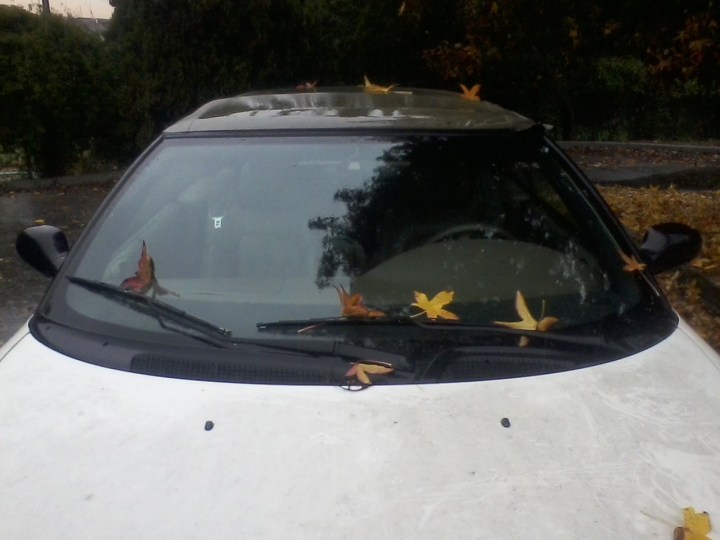 The old Chrysler looks different this time of year. Like dogs, cats, horses and deciduous plants, it adapted to the weather.
