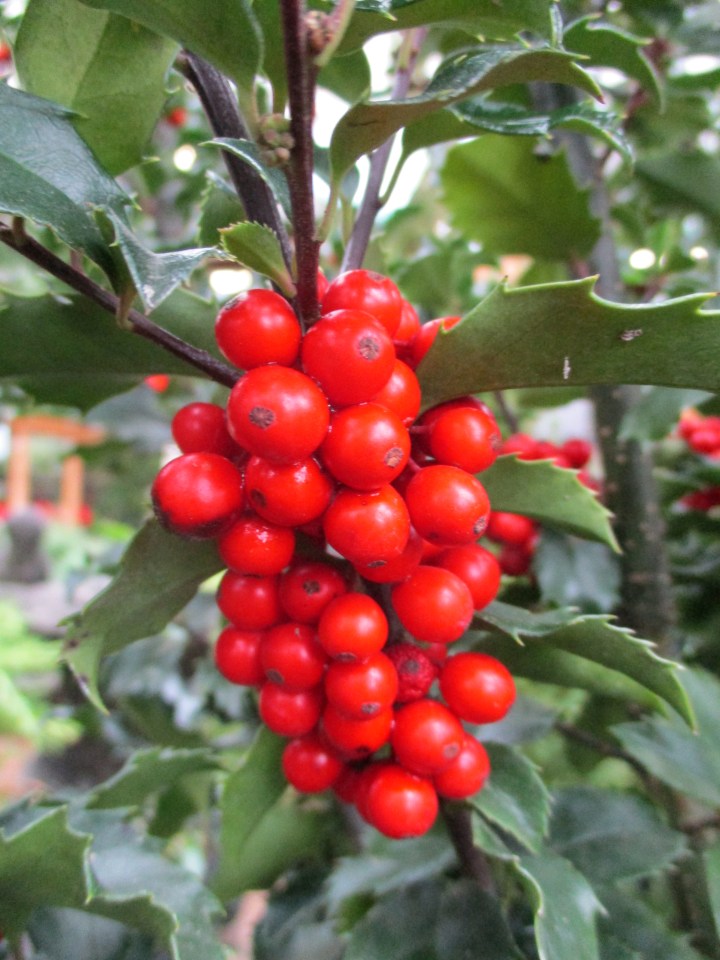
 Plants compensate for their immobility by procuring the services of animals and insects. They bloom with flowers that attract pollinators with colors, fragrances and flavors. Their fruits use similar techniques to attract those who consume the fruits to disperse the seeds within. It is a pretty ingenious system. The animals and insects probably think that they are taking advantage of the plants.
Firethorn, toyon, cotoneaster, English hawthorn and the hollies all produce profusions of small bright red berries that are designed literally for the birds. They are just the right size for birds to eat them whole. If they were smaller, birds might prefer other fruits. If they were any bigger, birds might eat them in pieces, and drop the seeds. The bright red color is a blatant advertisement to birds.
Firethorn is probably the most prolific with its berries. It might also be the most popular with the birds. If the colorful berries are not gone yet, they will be soon. Toyon berries seem to last longer, perhaps because they do not all ripen at the same rate. Because it gets big and takes some work to contain. toyon is more common in unrefined landscapes and in the wild than home gardens.
English hawthorn and cotoneaster are variable. Some varieties are more productive with berries than other are. Some types of English hawthorn are grown more for their bloom or foliar color in autumn. They are deciduous, so their berries hangs on bare stems. Late cotoneaster produces more berries than other cotoneasters, and somehow manages to keep its berries late into winter.
Holly is not related to firethorn, toyon, cotoneaster or English hawthorn, which are all in the Rosaceae family, although the bright red berries suggest that it should be. Because most holly plants are females that lack a nearby male pollinator, berries can be scarce. Some plants in nurseries are actually two plants together in the same pot, one male and one female, to ensure adequate pollination and berry production. Deciduous hollies are unfortunately rare.
 Tony Tomeo
Beautiful photos of holly berries. Pyracantha and Cotoneaster are both considered to be weeds here. We can be a bit precious in Australia.
LikeLiked by 1 person
Pyrcantha too? Cotoneaster will be featured tomorrow. It has the potential to be invasive here too.
LikeLiked by 1 person
I didn’t know that nurseries sell a male and female tree together. It’s a good way to up the odds of getting fruit.
LikeLiked by 1 person
They only started doing it a few years ago, without much marketing about it. Prior to that, Female English hollies were available without male pollinators. My holly hedge makes no berries.
LikeLike
I think the robins wait until late winter to eat holly berries because they are fermenting by then… before that they ignore them.
LikeLiked by 1 person
So the robins are drunks?
LikeLike
Robins love the winterberries here. Some more than others. Winter Red is a big favorite. Sparkleberry, a winterberry that grows right beside a Winter Red in my garden, goes begging so far as robins are concerned, while the Winter Red gets stripped of berries usually in late December or January. Winterberries are deciduous hollies. Males are required for berry production.
LikeLiked by 1 person
We have almost no deciduous hollies. Deciduous plants are not popular here anyway. We tried to grow it (although I do not remember the cultivars), but or clients were not interested in it.
LikeLike
This variety would look spectacular against our New England snow…. but I bet it doesn’t grow in hardiness zone 5–6. At least I haven’t seen the plant around here.
LikeLiked by 1 person
There are probably several prettier berries to grow there. Cotoneaster berries are a more subdued shade of red relative to the bright reds of winterberries and such. They just happen to do well here, and we do not have winterberry.
LikeLiked by 1 person
Winterberry is our crown jewel.
LikeLiked by 1 person
I love plants with red berries that last into winter. I planted some Cranberrybush Viburnum for that very reason. Maddeningly, the berries all get eaten by early fall (by squirrels, I think). I hate squirrels.
LikeLiked by 1 person
Squirrels are EVIL!
LikeLiked by 1 person
Reblogged this on Wolf's Birding and Bonsai Blog.
LikeLiked by 1 person