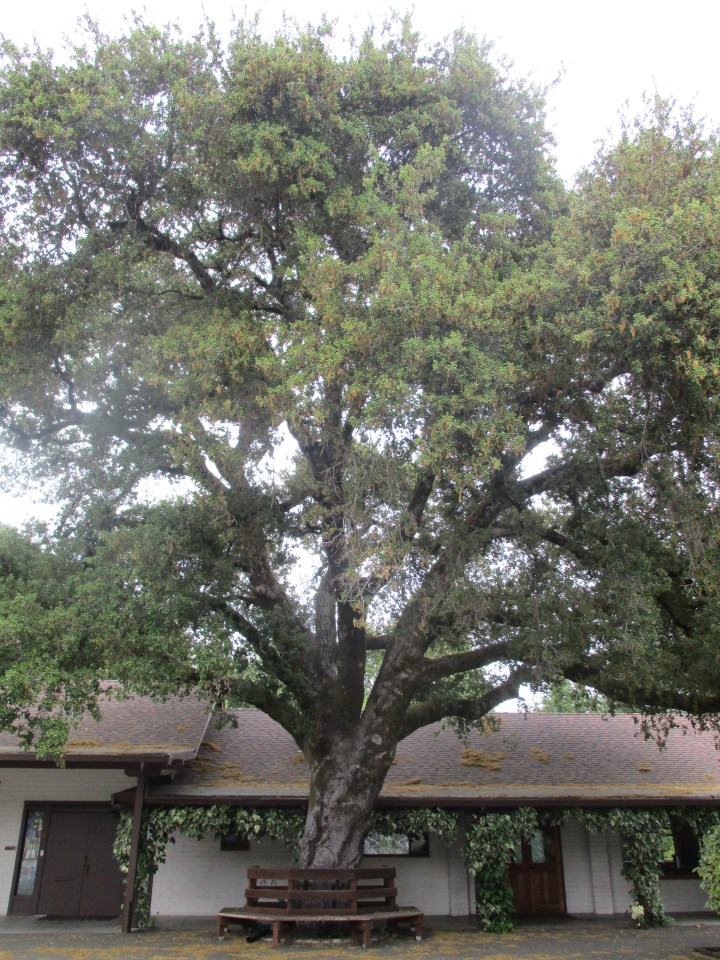
 The valley oak of the Sacramento Valley, San Joaquin Valley, and coastal valleys to the west, is the grandest oak of North America. Within the coastal half of that range, and extending down past San Diego, the coat live oak, Quercus agrifolia, is a nearly comparable second grandest. The biggest subjects may be as tall as seventy feet, and nearly as wide, with trunks wider than ten feet!
However, there is significant variability. Trees in forest situations do not get as big, and may stay lower than twenty five feet, with shrubby branch structure. While the biggest can get older than two centuries, smaller trees may not live half as long. The canopies of exposed solitary trees might reach the ground, while more social or sheltered trees are likely to shed lower growth with maturity.
Coast live oaks are typically pretty gnarly, and many have multiple flaring trunks. The dark evergreen leaves are only about an inch or two long, and half as wide, with bristly teeth on convex edges. The narrow inch long acorns can be messy. Roots are very sensitive to excavation and excessive irrigation. Sudden Oak Death Syndrome prevents new trees for getting planted in many regions.


Live oaks are prominent in many parts of Texas. In Austin you see many venerable ones sprawling across lawns in old neighborhoods.
LikeLiked by 1 person
They are a different species. ‘Live oak’ is a generic term. I never saw a live oak when I was in Oklahoma, although I did see a few other compelling oaks. The blackjack oak is native to that region.
LikeLike
Even in Texas there are two native Quercus species (or varieties) that are both called live oaks. Here’s one that’s found in Texas and Oklahoma:
https://en.wikipedia.org/wiki/Quercus_fusiformis
LikeLiked by 1 person
That looks more like what I would expect. I did not see it in Oklahoma, but was not looking for a live oak. I thought the blackjack oaks were weirdly rad.
LikeLike
That is one huge Oak!!!
LikeLiked by 1 person
It has been through a lot! It used to be on the edge of train tracks, and survived the excavation to remove the tracks, and the construction of the building behind it. The area around it is paved. I really do not know how it not only survived this long, but has also continued to grow healthily.
LikeLiked by 1 person
Amazing!
LikeLiked by 1 person
His neighbor down below the far right corner of the building was not so fortunate.
https://tonytomeo.com/2019/02/09/six-on-saturday-untimely-death/
LikeLike
Thank goodness it didn’t fall and hurt anyone.😃
LikeLiked by 1 person
Yes, it could have done some serious damage.
https://tonytomeo.com/2019/02/09/six-on-saturday-untimely-death/
LikeLiked by 1 person
You write so well, liked your story!
LikeLiked by 1 person
Thank you.
LikeLiked by 1 person
☺️❤️️
LikeLiked by 1 person