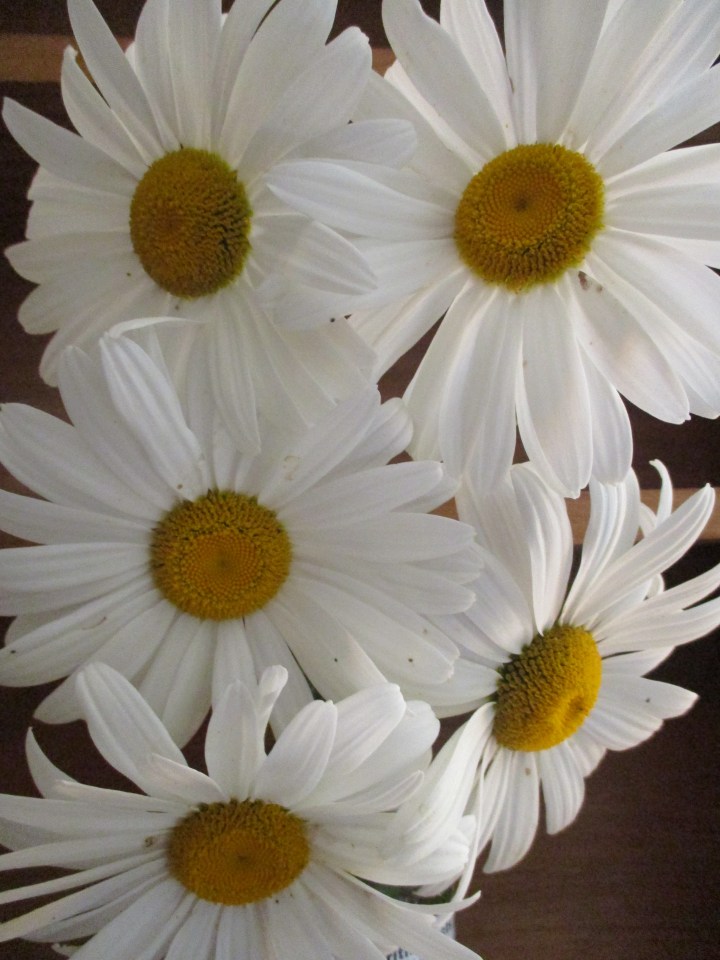
 It just might be one of the most popular daisies nowadays, but Shasta daisy, Leucanthemum X superbum, is not a naturally occurring species. It was developed by Luther Burbank in 1890, as a complicated hybrid of four different species, one of which is of a different genus. Yet, it is somehow genetically stable enough to produce viable seed, although seed of cultivars is not true-to-type.
Shasta daisy is an herbaceous perennial that forms a substantial network of sturdy rhizomes that mostly stay close to the ground, with blooming stems that can get almost three feet tall. Primary bloom begins in late spring or early summer, and continues until autumn, either in minor subsequent phases or as sporadic bloom. Flowers are big classic white daisies with bright yellow centers.
Although it can survive neglect and lapses of watering, Shasta daisy prefers to be watered at least occasionally, and is much more appealing if flower stalks are pruned away as they finish. It likes full sun, but will tolerate a bit of shade through part of the day. Mature plants are easy to divide for propagation. If the odd aroma is not too objectionable, Shasta daisies are delightful cut flowers.


I like them. By the way, I just watched a 2015 episode of Gardeners’ World that also talked about deadheading lavender for rebloom (per your recent post).
Sent from my iPad
>
LikeLiked by 1 person
You, know, I only deadhead Spanish lavender to keep it neat. I would not have guessed that it would improve bloom, just because the flowers are already dead and dried by that time. However, my colleague Brent tells me that it helps, and he knows the lavenders much better than I do.
LikeLike
My shastas really struggle in the summmer. Just too hot for them here.
LikeLiked by 1 person
That must be wickedly hot. I have never seen them unhappy about warmth. Our climate is mild, but it does get warm in some regions. Is you region also arid, or is it windy and warm at the same time?
LikeLike
We had temps in the 40s last summer, Tony and it was also very dry at that time. It was a challenge for many plants. I wouldn’t describe our climate as being arid, but we certainly can go for long periods without rain. Also, because my garden is relatively young, there isn’t a lot of shade yet.
LikeLike
That is about as warm as it gets in the Santa Clara Valley, but the lack of humidity (which makes it more comfortable for people) is difficult for many plants. Shasta daisy does fine there where it is watered, but gets crispy real quick without water.
LikeLike
We also get the same temperatures and no rain for several months. I have several Shasta Daisies in my yard, but they make it with watering during the summer. Without the water, I wouldn’t be able to grow much of anything!
LikeLiked by 1 person
NICE! I haven’t tried those yet.
LikeLiked by 1 person
I don’t feel so left out. I grew them for the first time only a few years ago, but not again until just now.
LikeLiked by 1 person
One of my top-ten perennials – We grew them in the Catlins for a while – 45°South, cool, humid, salty and very terribly windy (apart from they latter they were amazing).
LikeLiked by 1 person
You would think that such a nice perennial would be more popular than it is.
LikeLike
I love Shasta daisy’s 🤗
LikeLiked by 1 person
More people should. When ours bloomed, so many people commented on it, but no one took pieces of it. Since it was not planted before the end of spring, it will likely get planted in pieces next autumn.
LikeLiked by 1 person
Do people usually just take pieces of the daisies?
LikeLiked by 1 person
I was hoping they would so that I would not need to plant so much into the landscape. I would be happy with one good sized piece, rather than a whole big pot full of it. I don’t know where it came from
LikeLike
I grew one from a seed (in a seed mix of perennials for pollinators) and now I have too many! They are also way too tall, I am 5’9″ and the oldest plant is past my shoulders right now! I have some nice petite “Angel” ones that I divide that have the same nice big flowers on plants I can deal with. It’s perfect for containers, and the ends and edges of beds.
It’s quite a coincidence you wrote this, I was posting to my blog about them, and recommending “Angel.” I saw this article on another site, but when I went back ten minutes later it was gone. Page wasn’t there it said…
LikeLiked by 1 person
Are you certain that the tall ones are Shasta daisies? That seems to be too tall. I know that they ‘can’ get quite tall, but they should only do so if they need to; for example, if they are competing with other plants.
LikeLike