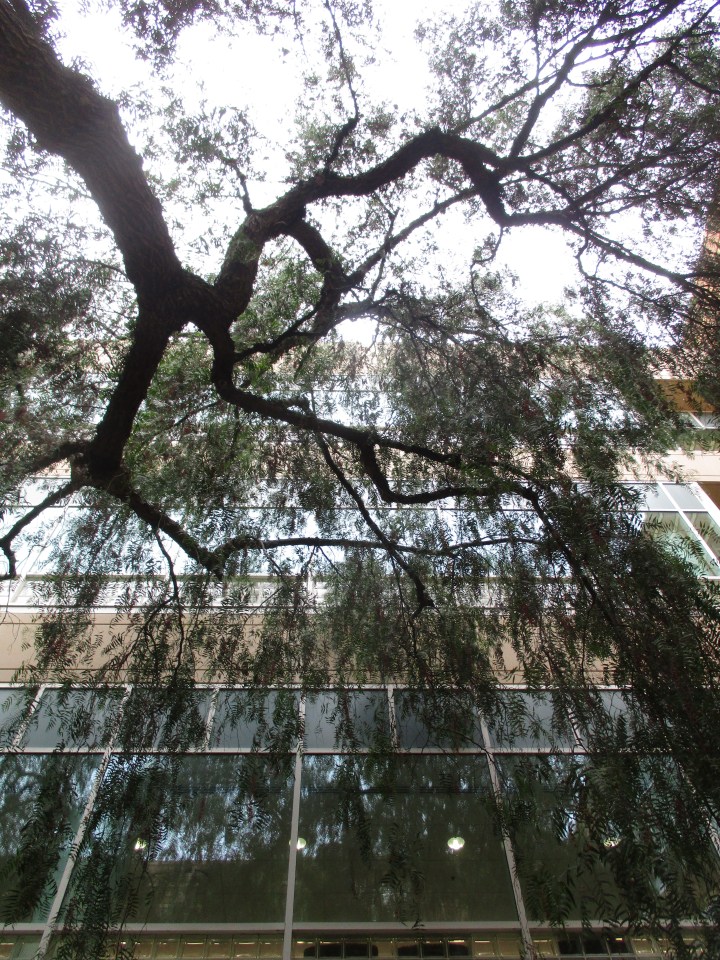
 It has been naturalized in Southern California long enough to seem to be native. California pepper, Schinus molle, is actually endemic to Peru and adjacent arid regions of South America as far south as Central Argentina. Furthermore, although its small pink fruits with hard black seeds are sometimes used for culinary purposes, it is actually not related to black pepper, and is mildly toxic.
California pepper is as at home here as the name implies. Established and naturalized trees can survive on annual rainfall. They are better foliated if watered a few times through summer, and do not mind average landscape irrigation if their soil does not stay too damp. When they are not dropping a few leaves, they are dropping floral frass or dried berries, so their mess is considerable.
Old trees can eventually get forty feet wide, and almost as tall. Young trees grow rather aggressively. Growth slows with maturity. The distended and irregularly structured trunks and main limbs are picturesquely gnarly, with handsomely flaky tan bark. Foliage and outer stems are delightfully pendulous. The pinnately compound leaves are finely textured, and about three to six inches in length.
 Tony Tomeo
Great up view of this tree – and I like your description – also – felt a life analogy here – with this “Growth slows with maturity.” same with humans eh?
LikeLiked by 1 person
Yes, I have heard that before; but many trees make more babies as they age too.
LikeLiked by 1 person
Somehow plants from Central and South America seem less exotic. I feel that way about marigolds and four o’clocks. Doesn’t make sense, but there it is.
LikeLiked by 1 person
It makes less sense that I find North American species to be so interesting just because everyone else promotes exotics so much.
LikeLiked by 1 person