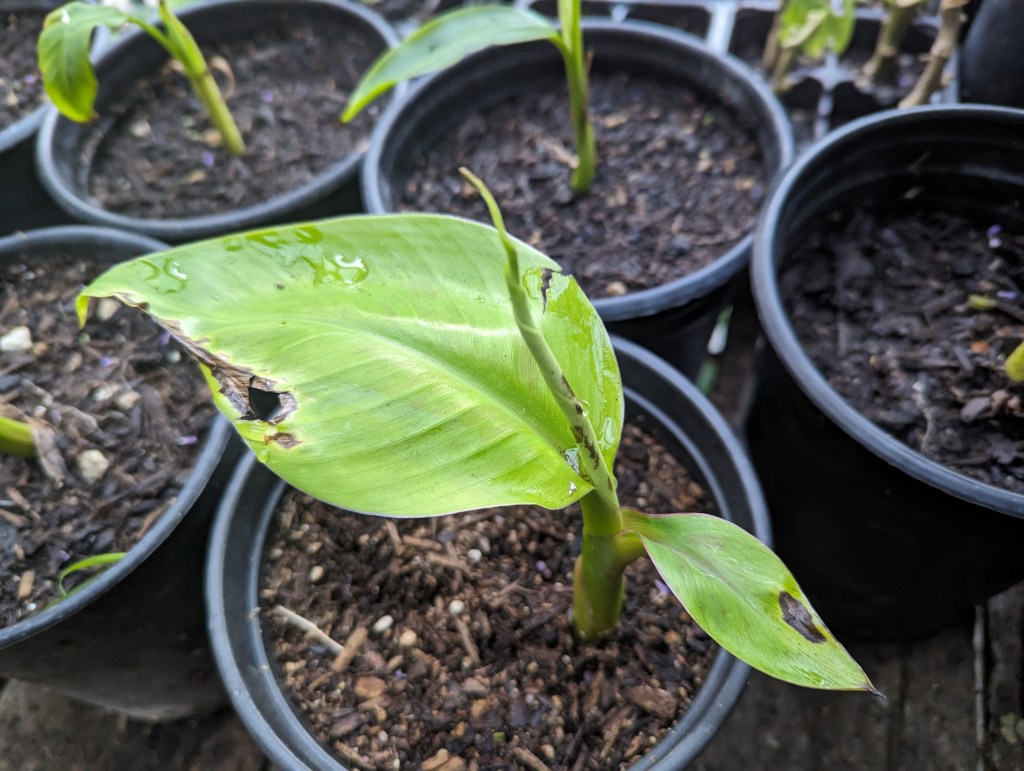
Its name is so minimalistic and blunt in the language of the indigenous people who are most familiar with it. Others might know it as the giant highland banana. It seems to me that most of us who find it to be of interest know it by its botanical name of Musa ingens.
Oem, or giant highland banana, or Musa ingens, is native to the tropical montane forests of New Guinea. Because it is endemic to high elevations, it does not perform so well in the sort of continually hot and humid tropical climates that most other species of banana enjoy. It actually prefers the weather to get somewhat cool at night. Therefore, it is more likely to be happier here than in Southern Florida, Hawaii or coastal San Diego County.
Not many horticultural enthusiasts grow it anyway. Actually, I do not know of anyone else who grows it. I have seen only a few comments online regarding germination of the very rare and expensive seed. Furthermore, no one seems to be successful with germination. This particular species does not generate pups as readily as other species of the genus, and even if it did, there are no established specimens from which to procure such pups.
However, its lack of popularity is less likely a result of its rarity and difficulty to propagate, but more likely because of its massive scale. In the wild, oem can grow to a hundred feet tall! It may be limited to about half as tall within cultivation, and without competition from other tall trees, but that is nonetheless a potential to get fifty feet tall! That may not seem like much relative to other trees, particularly the redwoods that are more than a hundred feet tall, with potential to get three times as tall. The concern is that banana trees are not actually trees. They are merely humongous perennials. Their pseudostems do not grow for very long before they begin to deteriorate and collapse. Pseudostems of smaller sorts may complete the process within two years, but are easily removed afterwards. Fifty foot tall pseudostems take significantly more time to mature and then deteriorate, but are not so easily removed from refined landscapes. Arborists can not climb them to cut them into sections. They require space to fall harmlessly. They are full of water, so are very heavy.
Now, oem lives here. It is merely a single dinky pup, but grows very efficiently. I have no idea of what to do with it. It can likely stay canned through this year, but may need to go into the ground next year. Not only does it need plenty of space, but it does not conform to the styles of any of the landscapes here. Consequently, it might eventually inhabit my home garden, regardless of its awkward appearance. This will likely get very interesting.
 Tony Tomeo
2 thoughts on “Oem”