Some of these Six are leftovers from last week. Some might have been late last week, and are a week later now. African daisy and calla bloom somewhat randomly, so technically, may not qualify as late. Likewise, candelabra aloe does not bloom quite as randomly, but is not always punctual either. I should be more observant of bloom schedules. Evergreen clematis and bridal wreath spirea are more likely to be blooming late. I am more certain that flowering quince should have bloomed earlier. Only calla and candelabra aloe were grown here. The others were originally acquired from nurseries many years ago, so I can not gloat about growing them. Incidentally, Rhody and I will leave for Washington early Wednesday morning, so my next two ‘Six on Saturday’ posts should be from there.
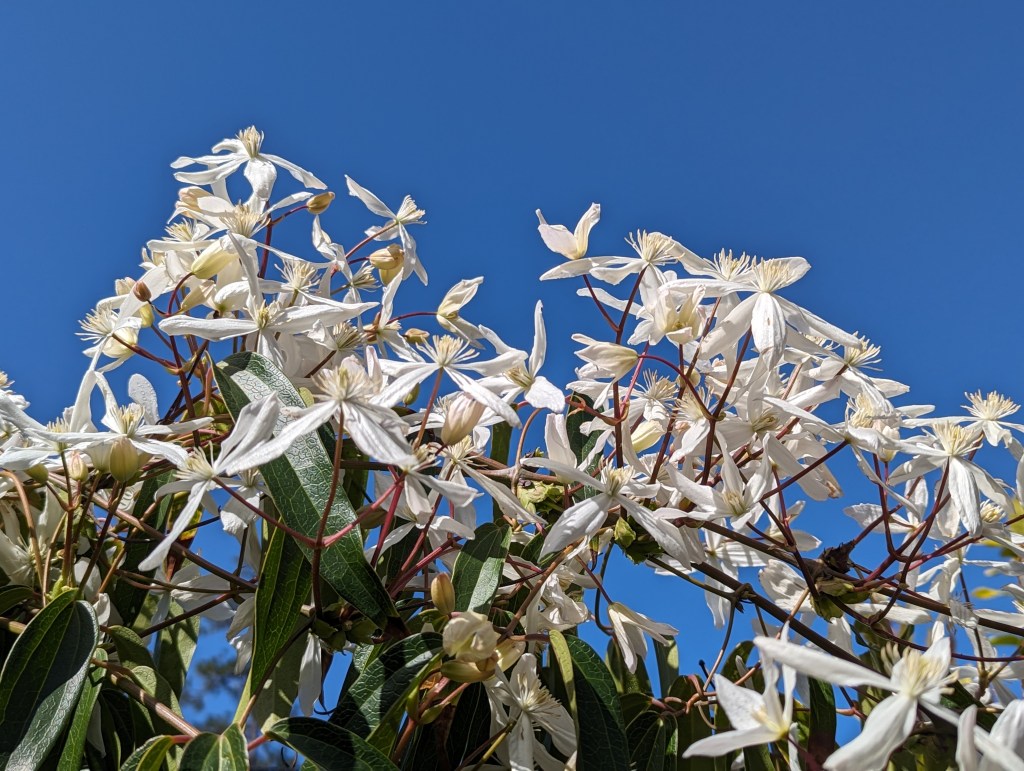
1. Clematis armandii, evergreen clematis bloomed while I was not looking. This picture is from last week. Bloom lasted a bit longer than expected, but is presently deteriorating.
2. Osteospermum ecklonis, African daisy also bloomed last week, but of course, is rarely without bloom. It blooms a bit more profusely in phases between now and late summer.

3. Aloe arborescens, candelabra aloe typically blooms for late winter. These vivid orange flowers are resilient to wintry weather, and contrast splendidly with blue California lilac.

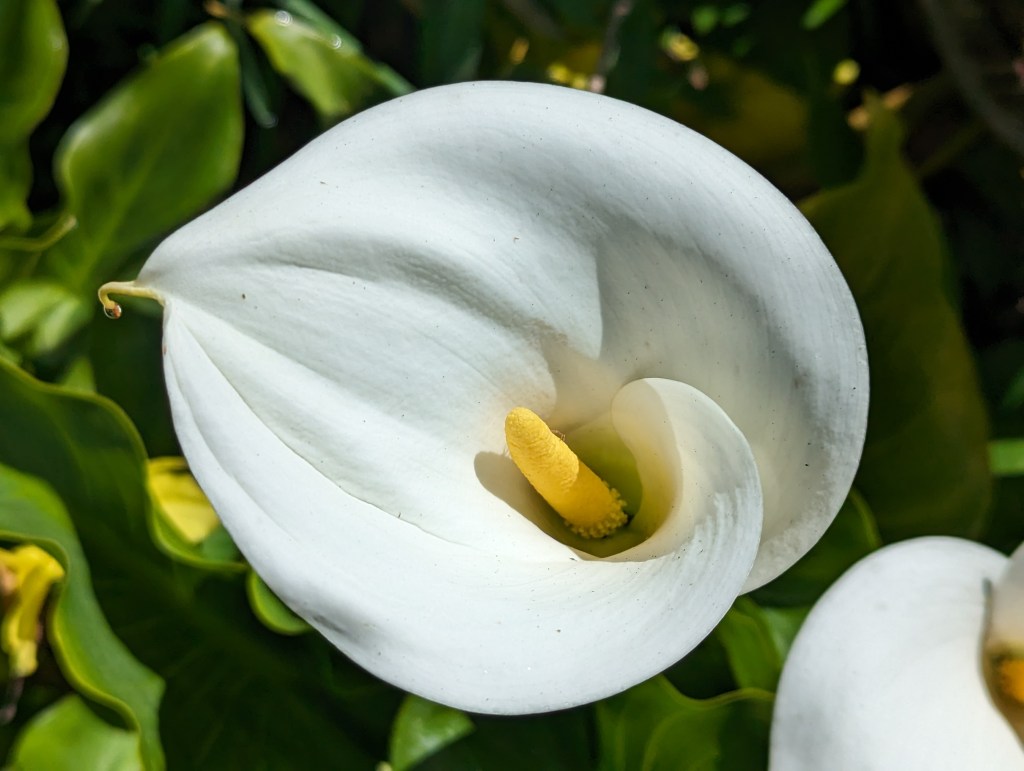
4. Zantedeschia aethiopica, calla grows wild within a portion of one of the landscapes. It could do the same elsewhere if we were to relocate some of it, which is why we rarely do.
5. Spiraea prunifolia, bridal wreath spirea seems to be blooming late. I do not know for certain because I do not remember when it typically blooms. Foliage develops afterward.

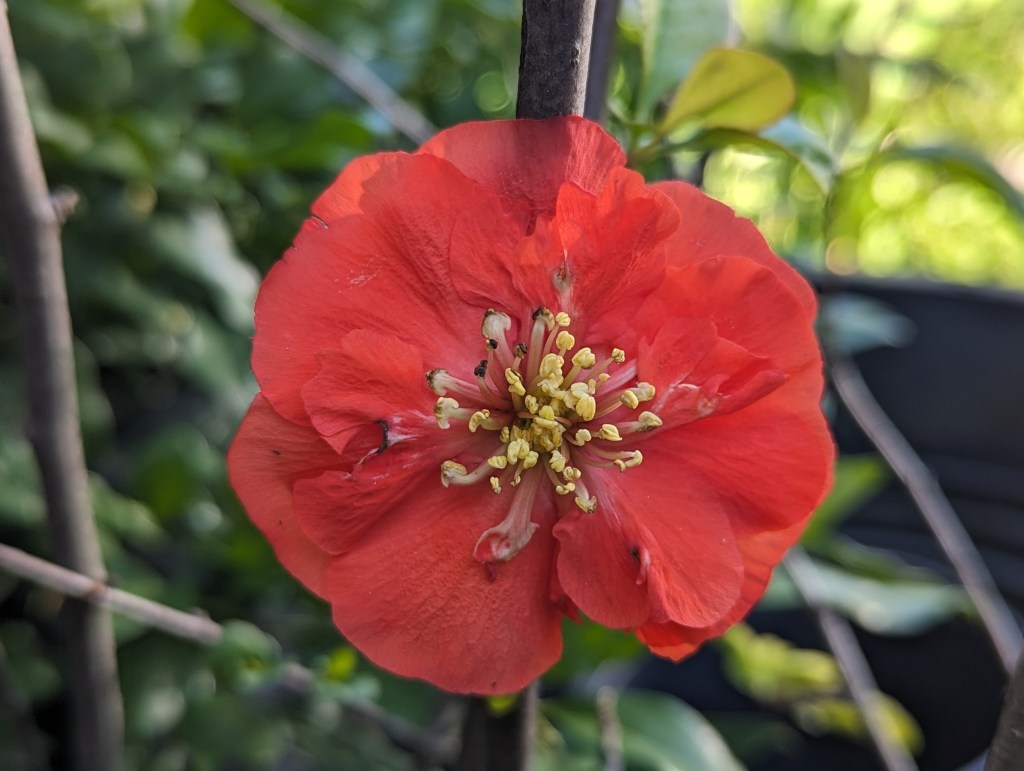
6. Chaenomeles speciosa ‘Double Take Orange’ flowering quince also develops its foliage after bloom. I am more certain that it is blooming late. It typically blooms with forsythia.
This is the link for Six on Saturday, for anyone else who would like to participate: https://thepropagatorblog.wordpress.com/2017/09/18/six-on-saturday-a-participant-guide/
 Tony Tomeo
Very nice shot of the clematis armandii with blue skies !
LikeLiked by 1 person
Thank you. It is an uncooperative vine that grows only on top of its support. The bloom is what redeems it. I believe that it is white, although I am told that it is ‘Apple Blossom’. Does ‘Apple Blossom’ bloom mature to white, or is it always blushed?
LikeLiked by 1 person
here the ‘Apple Blossom’ is rather full white.
LikeLiked by 1 person
So, this is what it should look like? It is different from what I read about it online. I happen to prefer it without the blush, and even if I disliked it, I would not replace it.
LikeLiked by 1 person
The spiraea is lovely. So is the clematis photo.
LikeLiked by 1 person
Thank you. I do not remember how we got the spirea. It took me a while to realize that it is the same that I envy in other gardens. I thought of it as a species of Eastern gardens. The clematis is likely the most reliable of the genus here. The fancy hybrids do not like the arid climate.
LikeLike
Bridal wreath spirea is my favorite one. I like the clematis as well, too far south for both now. Have fun with Rhody.
LikeLiked by 1 person
Bridal wreaths spirea is remarkably popular. When it got noticed here, I thought that I was the only one who liked it. Then, I noticed others discussing it online. I like it because it looks like something from New England or the Pacific Northwest, where horticulture is taken more seriously.
LikeLiked by 1 person
I also love the clematis with blue sky background. You bridal wreath spirea has pretty puffy flowers.
LikeLiked by 1 person
Goodness; I was not impressed by the Clematis.I would prefer the bloom to be more evenly dispersed over the foliage, but the foliage is not evenly dispersed either. It all goes to the top of the support. I suppose that I should just accept its behavior and appreciate its beauty.
LikeLiked by 1 person
My bridal wreath spirea has simple flowers and is covered. My only problem with it is I built my garden too close, so it is annoying when I want to be between the hedge and the garden. C’est la vie!
LikeLiked by 1 person
I do not even know how to prune it yet. I am inclined to alternate canes (prune out canes as they get old so that new canes replace them), but might want to prune it up on more permanent trunks like I would with a fruit tree. I suppose that I can figure it out as it progresses. Right now, it just flares outwardly and roundly. It is very pretty, but sort of intimidating. If it were crowding usable space within the garden, I do not know how to prune it. Forsythia is like that, but larger, which is why it stays away from cultivated garden space.
LikeLike
I struggle with it since I built my garden too close to the hedge! I sometimes get frustrated and just use the hedge trimmer, but that pretty much ruins the effect of the gently arching branches. Maybe removing canes on the garden side, or judicious pruning. Last year it had a lot of aphids for some reason, much to the delight of ladybugs.
LikeLiked by 1 person
Yes, although I do not know much about it, it seems to me that it is likely best where it has space to take its naturally outwardly flaring form, with grooming only to remove old canes. It is rare here, and I have seen very few, but unfortunately, the few that I have seen are deprived of their form and much of their bloom by shearing by so-called ‘gardeners’.
LikeLiked by 1 person
It definitely loses its charm if one shears it. I know from experience. Due to get 5-8 inches of heavy wet snow tomorrow, so that should be pretty, if annoying during the commute. I have arranged things so that if I think it looks too sloppy I can just work from home (as I am today and Monday due to workmen coming by). Best thing the pandemic did for us is make it obvious that yes, we can work from home sometimes without losing efficiency.
LikeLiked by 1 person
I work from home for part of the week, but I can not expect the landscapes to come here.
LikeLike
The spirea is putting on quite a show.
LikeLiked by 1 person
Yes; apparently, it does not need much of a chill to do so. Perhaps that is why I am so fond of it. It looks like it should be in the sort of climate that peonies and other flowers that need chill perform well in.
LikeLike