It is a long story. To be brief, Rhody and I are again far away from work and home, near Phoenix in Arizona, without time to write.
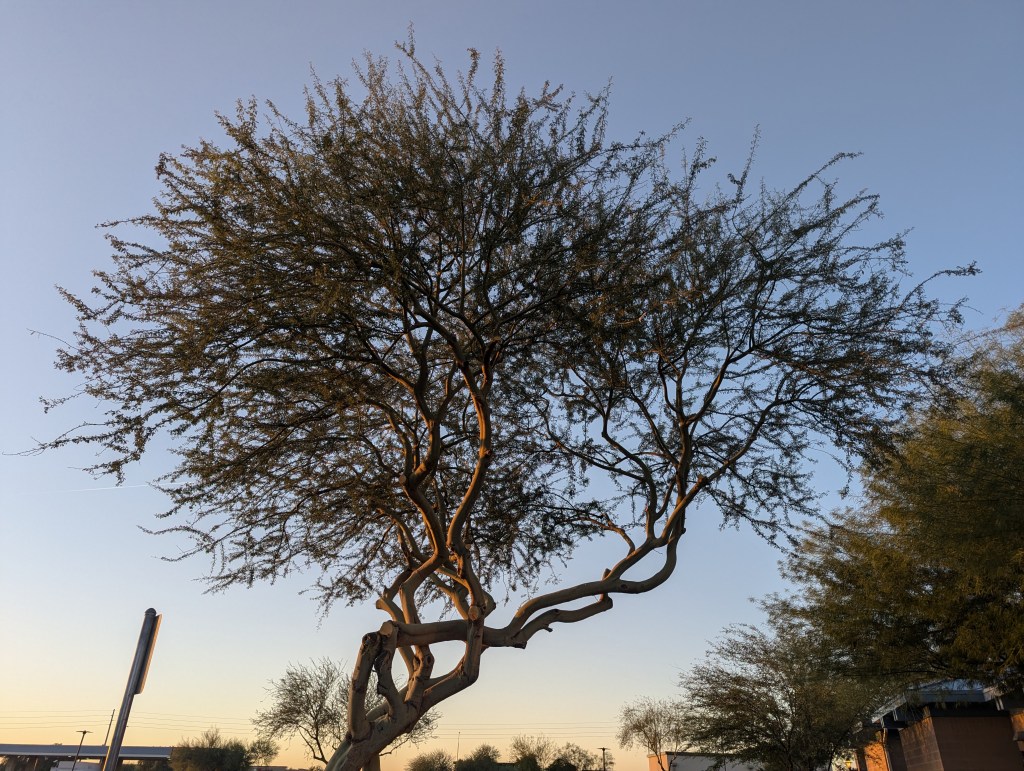
1. Prosopis velutina, velvet mesquite is supposedly the most common mesquite here and is also native. It develops sculptural form, but only light shade, which seems to me to be substandard for such a warm climate. Perhaps it is common because it is undemanding.
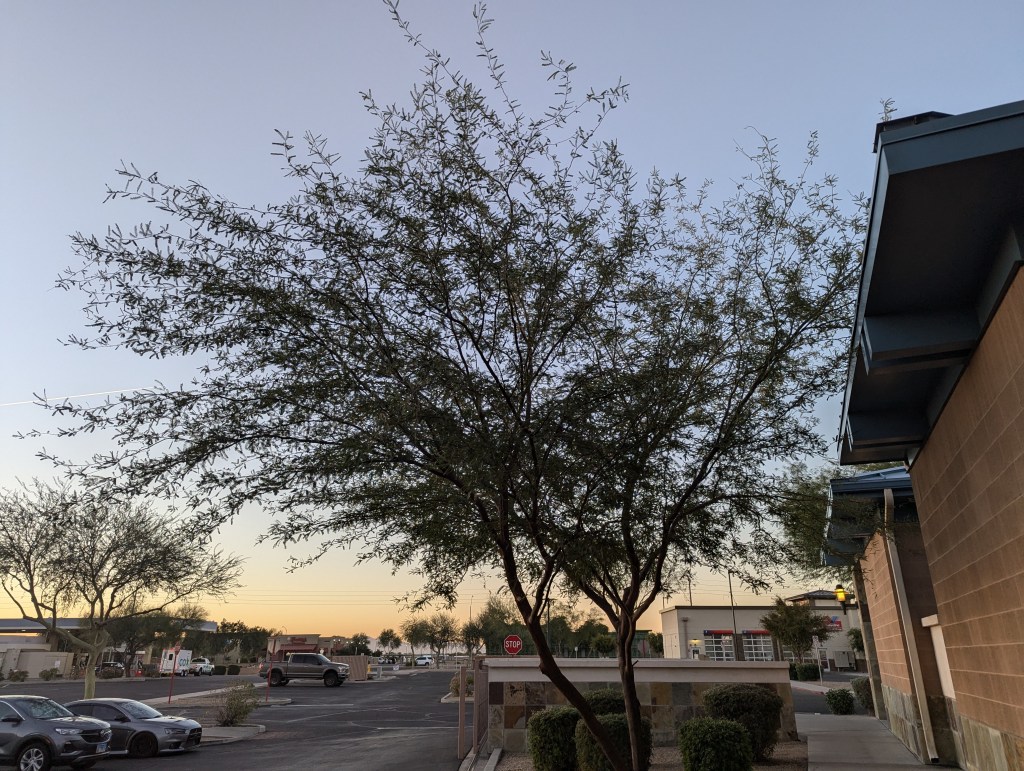
2. Parkinsonia florida, blue palo verde is also native like velvet mesquite, but is only one of the two most common palo verdes here. Foothill palo verde is the other. Both develop sculptural form and light shade, also like velvet mesquite, and are a bit more sculptural.
3. Lantana montevidensis, trailing lantana is the same common type that I occasionally work with at home, but seems to be happier and more colorful here, even while shorn as these weirdly compact globs, and humiliatingly deprived of its naturally sprawling form.

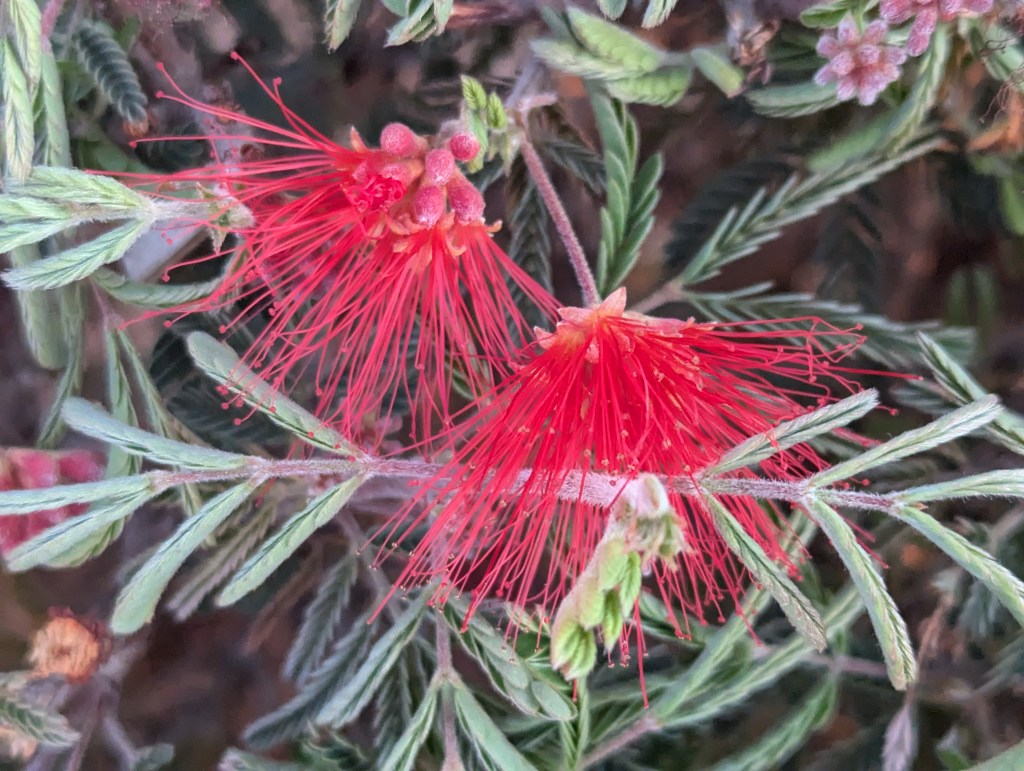
4. Calliandra californica, Baja fairy duster seems to be more prevalent here than it is in California. Of course, Baja California is a very big and very diverse region to the south of the State of California that I am familiar with. I suspect that this is a hybrid or a cultivar.
5. Leucophyllum frutescens, Texas sage, like so much of the flowering shrubbery here, is shorn too abusively to bloom as well as it likely should. Its silvery gray foliar color is also compromised. I can not even guess what its natural form or branch structure should be.

6. Rhody is so tolerant of my interest in unfamiliar vegetation. His only interaction with it involves just ‘claiming’ it. I absconded with a handful of seed pods and three seedlings of velvet mesquite, and a seedlings of Baja fairy duster (which will get a different name).

This is the link for Six on Saturday, for anyone else who would like to participate: https://thepropagatorblog.wordpress.com/2017/09/18/six-on-saturday-a-participant-guide/
 Tony Tomeo
You saved the best till last! Rhody knows he’s the star of the show:-)
LikeLiked by 1 person
Yes, of course.
LikeLiked by 1 person
Here, the Texas sage more often is called Cenizo, or ‘the barometer bush.’ This post has some photos of it from my area. I think the pinker, last version probably is one of the cultivars that’s become popular. It often becomes rather tall if unpruned: perhaps 6′-8′. It’s a pollinator magnet, for sure.
LikeLiked by 1 person
Oh wow, I had no idea that this is the barometer bush! I had read about it, but did not expect to ever encounter it. These particular specimens are too severely shorn to be representative of the species, but after meeting them, I might recognize others that are more typical.
LikeLiked by 1 person
Safe travels, Tony, and I hope all of your seeds and cuttings thrive. The Calliandra reminds me a great deal of our Asian Albizia julibrissin, which we call mimosa. It naturalized in Virginia long ago and is one of my favorite summer flowering trees. Does the Calliandra grow in tree form? Both the flower structure and leaf structure appear similar, though yours is a Western American native. I appreciate the introduction to the velvet mesquite and blue palo verde. Such different trees grow on your side of the continent! They are beautiful and I’d love to grow them if we could.
LikeLiked by 1 person
This particular Calliandra and other like it are shrubby, and barely get as high as first floor eaves.Calliandra haematocephala is more common in the Los Angeles region. It works better if espaliered than as an awkward freestanding shrub. They are related and visually very similar to Albizia julibrissin, but do not grow nearly as large. Albizia is naturalized in some regions here also. We grow only a single specimen at work. No one knows if it grew as a feral specimen or was intentionally planted. It blooms white white flowers (!), but they are not as pretty as pink bloom.
LikeLike
I’m glad you showed the lantana because your other plants were unfamiliar to me. Always good to see something new.
LikeLiked by 1 person
They are unfamiliar to me also, which is why I got pictures of them. They are not so interesting to those who are familiar with them.
LikeLike