A Week Of Flowers’ at ‘Words And Herbs’ got me started. It finished two weeks ago, and I did not even participate, but it reminded me that I should exhibit more floral pictures. Although the original project featured any floral pictures from any time of year, these six are all from yesterday, and actually, all are from the same relatively confined landscape. Minor frost that damages some vulnerable species within nearby landscapes is somehow less bothersome within this particular landscape. Elsewhere, some flowers are not quite as fresh. The only other common lantana within another landscape here was already cut back to the ground because its foliage succumbed to frost. It seems to know to postpone regeneration until after frost, but will likely succumb to frost next winter also. Although frost is mild here, it does happen.
1. Lantana camara, lantana was already damaged by mild frost at a lower elevation and less than a mile away. Even while damaged, though, it was still trying to bloom like this.
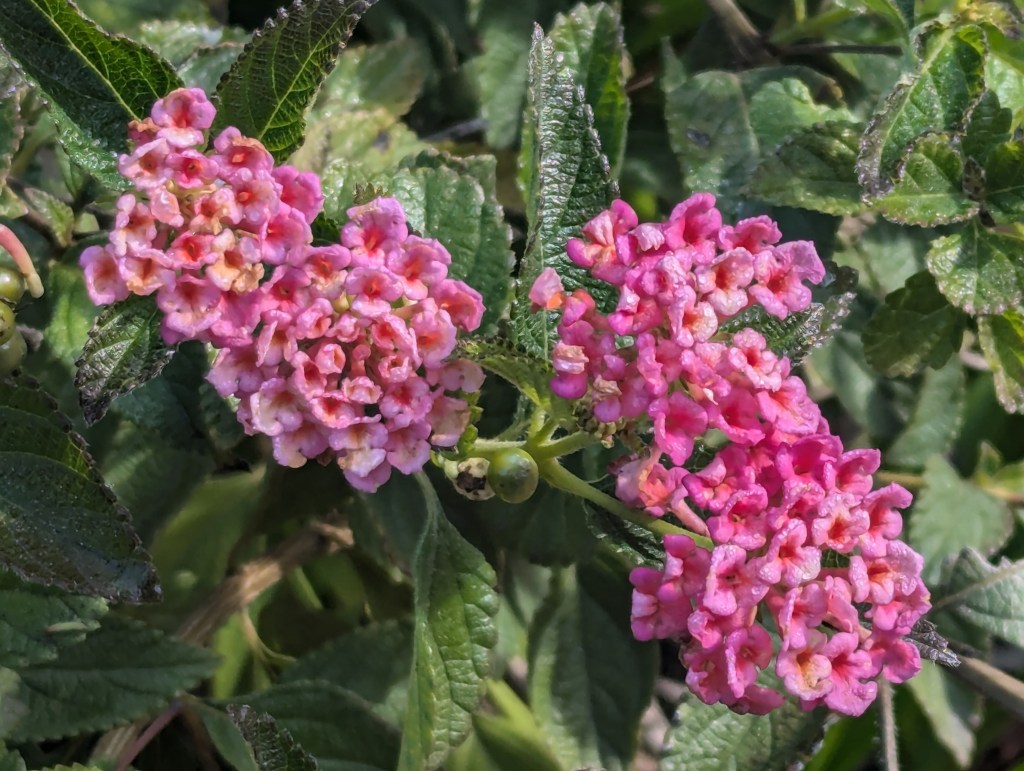
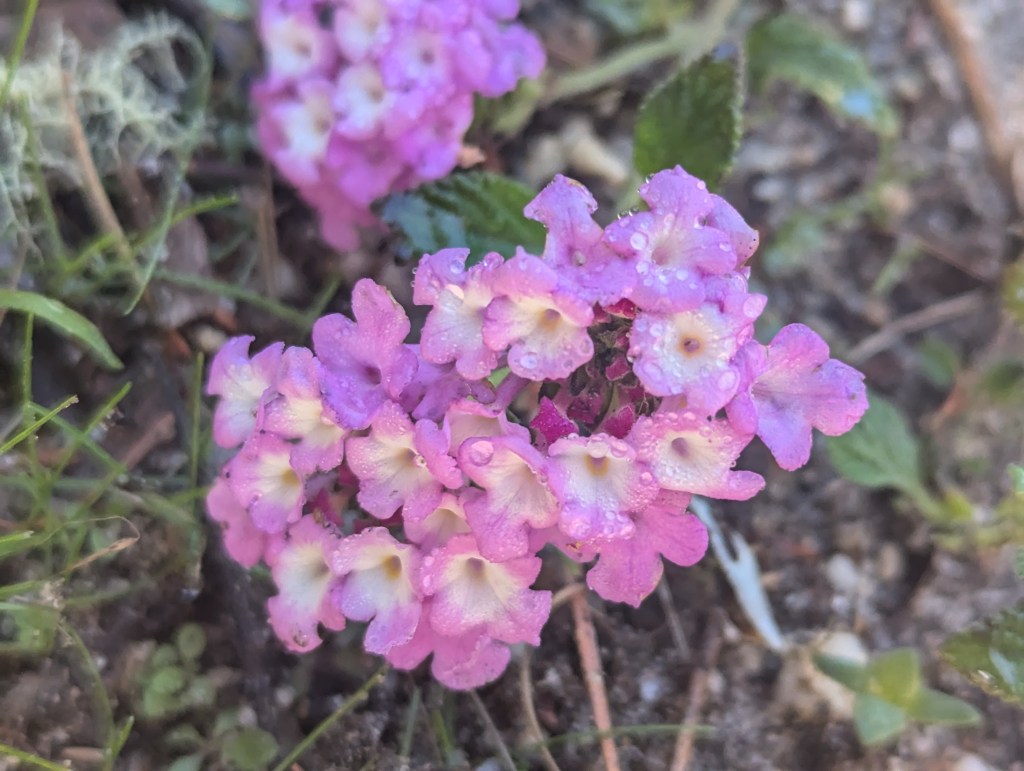
2. Lantana montevidensis, trailing lantana is purportedly slightly more resilient to frost than common lantana. However, its foliage can become very dark, as if it were damaged.
3. Tecomaria capensis, Cape honeysuckle is overrated. Its orange floral color is nice, but its flowers and floral trusses are too small and too scarce to display the color adequately.

4. Leonotis leonurus, lion’s tail bloom seems to resemble that of Cape honeysuckle, most likely because both attract sunbirds as pollinators where they are native in South Africa.

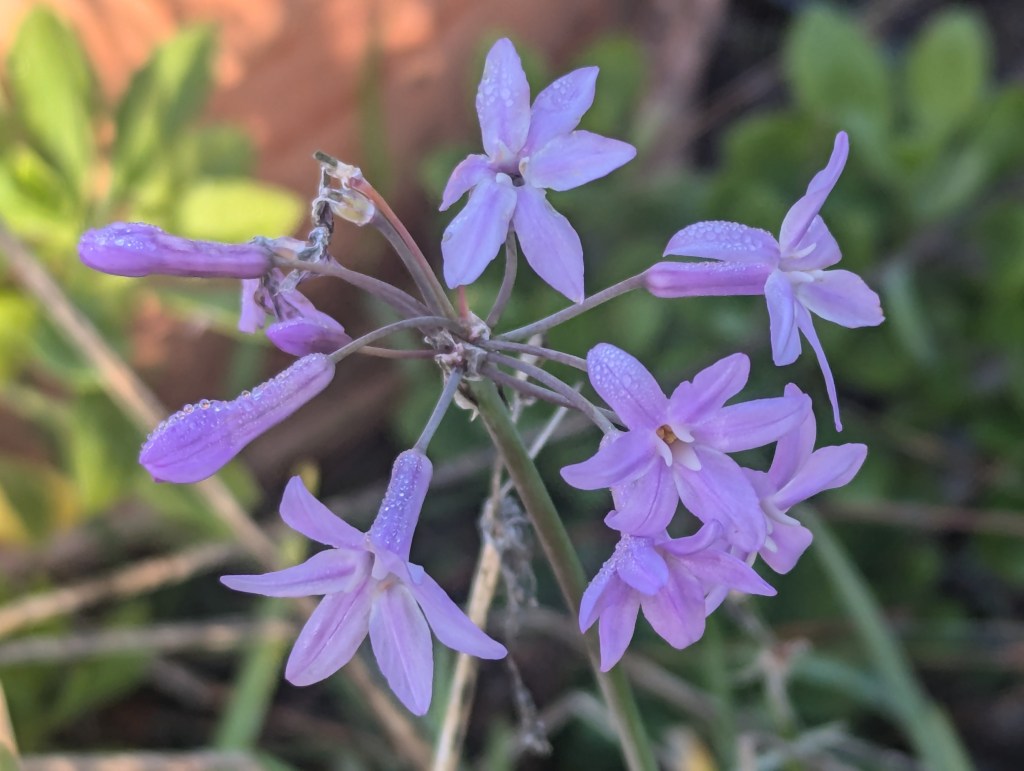
5. Tulbaghia violacea, society garlic is not among my favorite perennials, but is resilient and undemanding. This specimen has been abandoned for years, but constantly blooms.
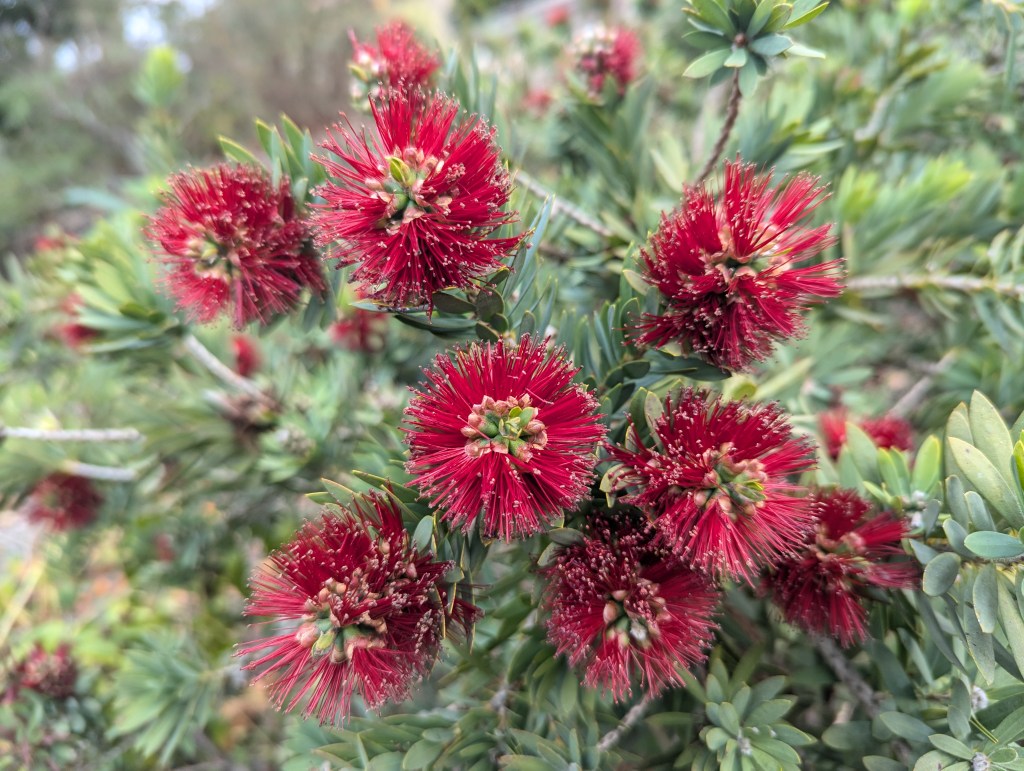
6. Callistemon viminalis ‘Little John’ bottlebrush is now Melaleuca viminalis. I learned it as a cultivar of Callistemon citriodora that is more proportionate to compact gardens.
This is the link for Six on Saturday, for anyone else who would like to participate: https://thepropagatorblog.wordpress.com/2017/09/18/six-on-saturday-a-participant-guide/


It is so nice to see some flowers again, so thank you for sharing yours Tony. Leonotis is very striking and has an apt name. I can see tiny hairs or fringes on the petals. Do you think that is why it got that name? Or is it the shape of the flower, which I think is similar to an Antirrhinum (called ‘Lion’s mouth’ in German)?
LikeLiked by 1 person
‘Lion’s mouth’ for snapdragon makes more sense, since it actually looks like something with its mouth open. I have no idea how ‘lion’s tail’ got its name. It is also known as ‘lion’s ear’. Except for Heather, I never met a lion. I suspect that they are assembled somewhat similarly to Heather, with their tails and mouths at opposite extremities, with their ears closer to their mouths.
LikeLike
😄
LikeLiked by 1 person
Fabulous, all beautiful, it has brightened my very gloomy day. Happy Christmas Tony and a big cuddle to Rhody x
LikeLiked by 1 person
Gloomy? Well, if Rhody could send you some cuddles, he most definitely would.
LikeLiked by 1 person
Do you know if all Lantana flowers are edible? I ate some when I was on holiday in Reunion Island, but I wanted to know if all the varieties including hybrids that we find here in Europe are also edible. Very nice Six again this week
Merry Christmas to you and yours Tony.
PS ; that reminds me that I need to sow some Leonotis seeds …
LikeLiked by 1 person
Goodness, I have no idea! I never thought to taste one. Their foliage is so strongly aromatic, but not in a gustatorily appealing manner. I mean, it smells like anything associated with it would not have an appealing flavor. Another specimen produces a few berries, but I leave them for the birds. The Leonotis leonurus is nice within its particular situation, but it would not be easy to accommodate within other landscapes here. It enjoys the climate here, and does not need much water. The difficulty is that it grows so large so fast, and must then get cut back to the ground. I hate doing that. I suppose that, if I can do it for Mexican blue sage, I should get more comfortable with doing it for lion’s tail.
LikeLiked by 1 person
That’s a glorious post for those of us suffering a gloomy December in the UK. Thank you.
Wishing you and Rhoddie a great Christmas.
LikeLiked by 1 person
Gee, you are not the first to mention that the weather there has been gloomy. The rainy season here started only recently, and it is something to be celebrated. I suppose that it would be gloomy if it lasted for too long, and it does get messy, but for now, it is refreshing for the forest. By the time we begin to get tired of it, the rainy season is over, but without the abundance of splendid spring flowers that bloom so exquisitely where winters are cooler and longer. We grow spring bulbs, but they do not naturalize and proliferate here like they do there. Merry Christmas!
LikeLike
Attractive six flowers this week, with the bottlebrush my favourite.
LikeLiked by 1 person
Thank you. Are you familiar with the formerly common bottlebrush, Callistemon citrinus (the simple species rather than a cultivar)? It got such a bad reputation from overuse until the 1970s or so. I sort of miss it now, so may eventually add it to my own garden. Although we all joke about it now, it is still sometimes available from nurseries. Only one inhabits the landscapes at work. It is getting crowded by other vegetation, but I do not want to eliminate it.
LikeLike
I am not at all knowledgeable on Callistemon, but always enjoy seeing them in Botanic Gardens or when on holiday around the Mediterranean. I find the form and even when it is semi dormant during the winter period attractive, and there is one growing in a front garden not far aware that I admire on my walks. When I was a youngster my father had a few in the garden but that was in Mauritius.
LikeLiked by 1 person
It seems that some of the Callistemon are more appealing to those who are unfamiliar with them. I know how icky Callistemon citrinus can be when it gets overgrown, or worse, shorn for so many years that it becomes an impenetrable thicket. The single specimen at work was cut down a few years ago, and regenerated with only a few trunks, with a relatively small canopy, which I keep groomed. It does not grow so voraciously because its situation is shadier than it had been in the past. If I grow it at home, I will do the same, because I am fond of the odd bloom. It is reminiscent of the 1970s.
LikeLike
Floral wonders! I wish I could grow Leonitis here, it just doesn’t quite make it..
LikeLiked by 1 person
Is the weather too humid? Leonotis leonurus is surprisingly happy in a warm and dry situation here. If it gets irrigation, it is not much. It would make sense for it to dislike humidity.
LikeLiked by 1 person
I don’t know. Oddly it’s easy to grow in Tampa which is north of me. Maybe just too far south.
LikeLiked by 1 person
It is native to South Africa, which is much farther south.
LikeLiked by 1 person
It’s strange and Tampa is just as humid.
LikeLiked by 1 person
Soil or water quality may influence performance.
LikeLiked by 1 person
Probably both.
LikeLiked by 1 person