Tulip is the only single flower of these Six this Saturday. The other five are dinky flowers that are colorful in their natural profusion. Even tulip is more colorful with at least a few friends, as it bloomed in its landscape. Flowering quince shows only three flowers in this closeup picture, but it actually blooms more comparably to forsythia or spirea.
1. Tulipa X hybrida, tulip is of an assorted batch, but seems to be the same color as all of the others. Such batches typically contain a preponderance of varieties that happen to be overly abundant when they are mixed, but are not likely to be completely homogeneous.

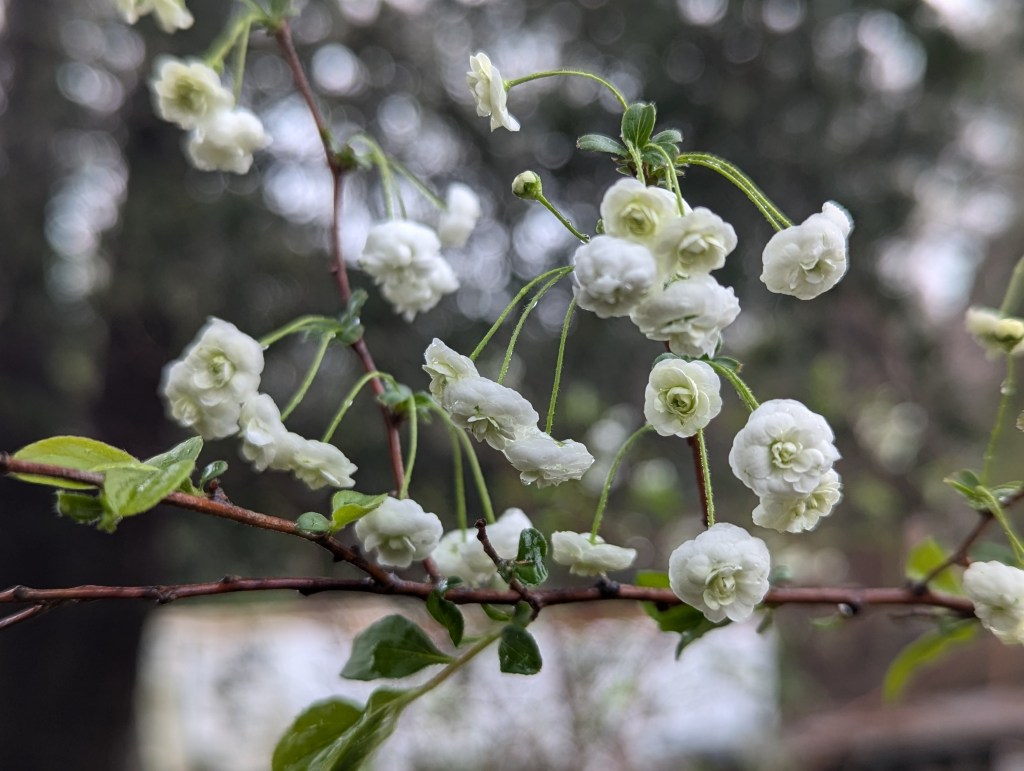
2. Spirea prunifolia, bridal wreath spirea could have bloomed more fluffily if it had been in a sunnier situation. This specimen has been in partial shade in the storage nursery for too long as it waits for reassignment to a real landscape. I remember it only as it blooms.
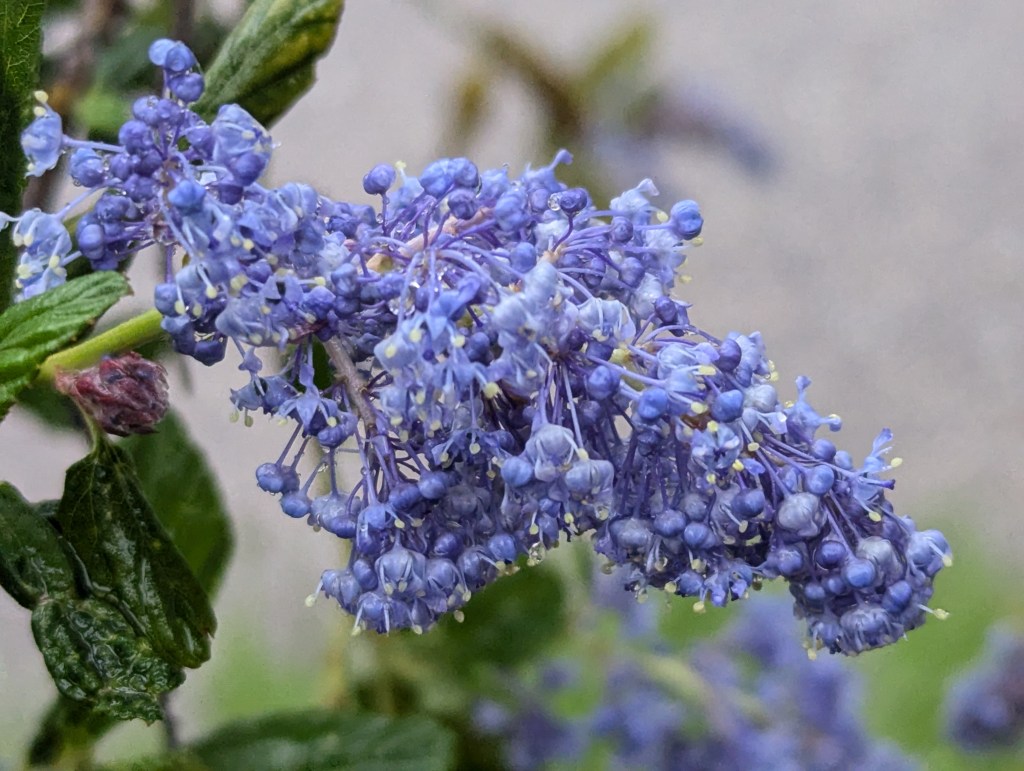
3. Ceanothus thyrsiflorus, California lilac is the same that I posted a picture of here two weeks ago, but neglected to remember until now. It is the only of these six that is native. It could have been installed intentionally into its landscape, but it more likely grew wild.
4. Chaenomeles speciosa ‘Orange Storm’ or ‘Double Take Orange’ flowering quince has a pair of cultivar names, which is two more than I can identify for the other five of my six. I can not determine if one is more correct than the other. It is pretty, but a bit overrated.

5. Forsythia X intermedia, forsythia was with the bridal wreath spirea and ‘Double Take Orange’ flowering quince in the storage nursery for a long time before assignment to the landscape that it now inhabits only last winter. It has not grown much, but blooms well.

6. Loropetalum chinense, Chinese fringe flower is pretty enough to be an illustration for the gardening column. I may feature it next week or the week after. If I do so, it must be within its bloom season. When it became a fad several years ago, I was not so keen on it.

This is the link for Six on Saturday, for anyone else who would like to participate: https://thepropagatorblog.wordpress.com/2017/09/18/six-on-saturday-a-participant-guide/


I have to check my loropetalum to see if it survived our winter under fleece , but the flowers are more likely to open in a month around here.
LikeLiked by 1 person
Gee, I never considered their frost tolerance. I noticed some exemplary specimens at the coast near Portland, so assumed that they perform well in the Pacific Northwest. But of course, coastal climates there are not much colder than climates here.
LikeLiked by 1 person
I read that -6°c is the minimum( without fleecing)
LikeLiked by 1 person
Well, even Portland, which is quite a distance inland from the coast, does not get that cold.
LikeLiked by 1 person
Now I know: the shrub used extensively for landscaping around here is Loropetalum chinense. I suspect one reason for the choice is the attractive foliage that makes the plant a nice addition even when not in bloom.
LikeLiked by 1 person
Yes, it is quite appealing. I found it to be more appealing before it became so common. Now that it is no longer a fad, I find it to be somewhat appealing again.
LikeLiked by 1 person
Wow. Spring has arrived with you. It’s all looking fabulous. Thank you for sharing!
LikeLiked by 1 person
Well, it is still winter here, and we still hope for a bit more rain before the rainy season ends.
LikeLike
Beautiful flowers today, do the tulips last for you?
LikeLiked by 1 person
No; which is why I am hesitant to grow them. These were not my idea.
LikeLike
That’s a beautiful Tulip. And the other blooms are lovely, too. The Chinese Fringe Flower is so unique. Lovely post!
LikeLiked by 1 person
Thank you. I was not so keen on the Chinese Fringe flower because it was such a fad here years ago, but have learned to appreciate it, particularly since it is no longer such a fad.
LikeLike
I will try Lorapetalum again one day but have lost two in the past, to frost. We perhaps don’t get enough sun to really ripen the wood?
LikeLiked by 1 person
Ripen? I really do not know. I was not so impressed with them when they first became popular. They seemed wimpy to me anyway. Now, they are quite large and sturdy!
LikeLike
I find both the Spiraea and the Loropetalum really prettty flowers and wish they were both a bit hardier so I could grow them here. But I can grow other white Spiraea, so all is not lost!
LikeLiked by 1 person
Spirea is not hardy?! Goodness, I thought that it would perform better with a bit more chill than it gets here. I am pleased that it performs as well as it does within such a mild climate. I do not know how hardy Loropetalum is, since I lack experience with other climates. I thought that it was hardy because I saw it on the coast west of Portland, but then realized that the coastal climates there do not get as cold as inland climates just a few miles away.
LikeLike
That Spiraea isn’t, but I can grow others, such as S. japonica or S. arguta.
LikeLiked by 1 person