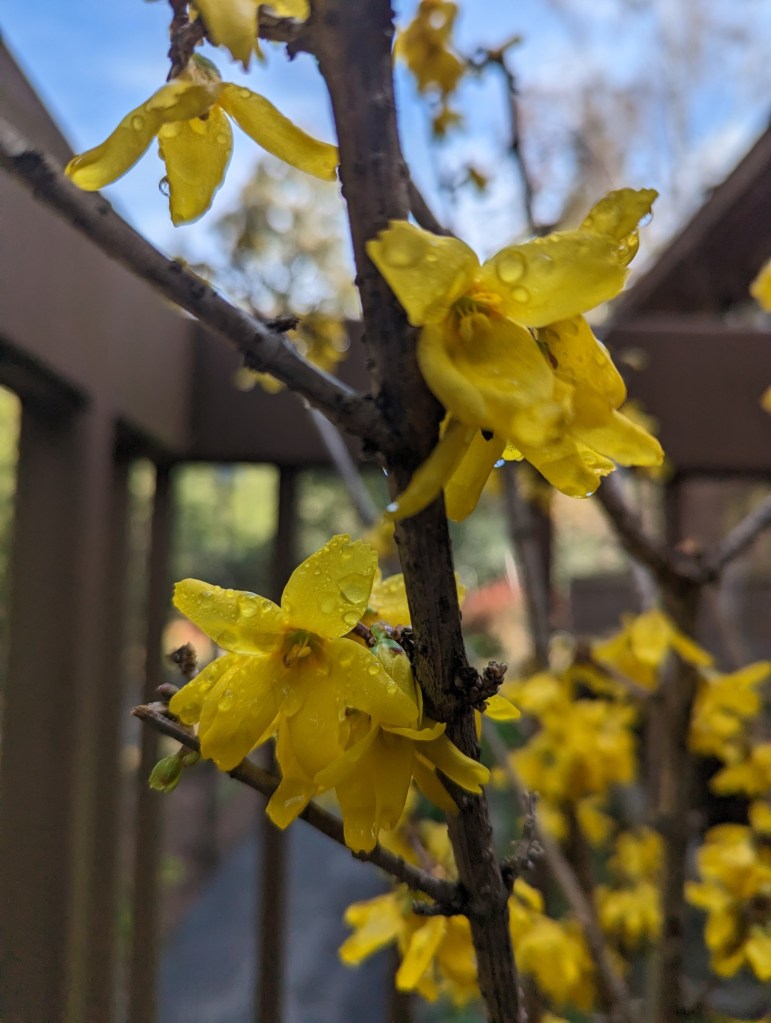
Spring bulbs, with prechilling, were conducive to the technique of forcing bloom earlier. A few summer bulbs might still be responsive to it, although it is getting late for most. Now, it is about time for forcing bloom with certain dormant deciduous stems. Most are already beginning to bloom. Forcing bloom merely accelerates this process for cut flower stems.
Forcing bloom for dormant deciduous stems is actually simpler than for bulbs. It involves merely cutting stems that are about to bloom and bringing them indoors. The warmth of a home interior is what accelerates profuse bloom. Aridity of home interiors may accelerate the deterioration of this bloom. However, homes also provide shelter from wind and rain.
Witch hazel, flowering quince and forsythia are mostly done blooming locally. Otherwise, they are conducive to forcing bloom, and will be available next winter. Several flowering cherries and flowering plums are now about ready for forcing bloom. Redbuds are ready also, though some will be later. Flowering crabapples should bloom later in their season.
Several fruit trees are as conducive to forcing bloom as their fruitless flowering relatives. Their floral color and profusion are less extravagant only because of their breeding. Fruit is, after all, the priority. With planning, dormant pruning can involve leaving a few surplus stems to cut later. Then, cutting them about now should not compromise fruit production.
With precise timing, wisteria and lilac are conducive to forcing bloom. Technically, so are dogwood and several deciduous magnolias. They bloom relatively slowly though. A few flowers should therefore be blooming before collection of their stems. Evergreen species are less striking in bloom. Fringe flower and Oregon grape can perform elegantly though.
Forcing bloom is more popular where winters are cooler. This is partly because gardens lack floral color for so long through winter. Those who enjoy flowers are in more of a rush to bring some into their homes. Also, dormant vegetation is more reactive to warmth after colder winters. Warmth might not stimulate bloom as effectively after locally mild winters.
 Tony Tomeo
Forcing blooms is fun! I’ve done it a few times, and Forsythias have worked well, as you mention. Your photo of them with the water droplets is lovely.
LikeLiked by 1 person
Thank you. I wanted a bigger picture from a step or so back, but the specimen was so dinky. Forsythia is uncommon here, so there are not many to get pictures of.
LikeLike
I’ll bring forsythia stems into the house soon. Usually I like them to bloom indoors for Easter, but with Easter so relatively late this year, they may be on the verge of opening outdoors by then! I’ve also brought some daffodil and tulip bulbs out of cold storage to force.
LikeLiked by 1 person
My timing for this topic was not the best. I did not want to write about too early, while only a few species were conducive to forcint; but by the time it appears in some of the newspapers that use it, there will not be much left to force within their particular climates. Some flowering cherries can still bloom this late, and flowering crabapple blooms even later. Forsythia is about done outside, so, although some stems might still be brought in, there is no point in forcing it. This topic would have been more relevant where spring begins a bit slower.
LikeLiked by 1 person
It’s pretty darn slow here! A high of 38 and a little snow in the forecast today.
LikeLiked by 1 person
Egads!
LikeLike