Tangly Cottage Gardening was a primary destination of my vacation. I posted pictures of it last week. These are six more species that I received as gifts.
1. Acanthus spinosus, armed bear’s breech has the strangest common name of these six. Is the bear armed or just its butt? Regardless, I happen to like common Acanthus mollis, and had coincidentally been wanting to try this less common species as well. Now, I will.
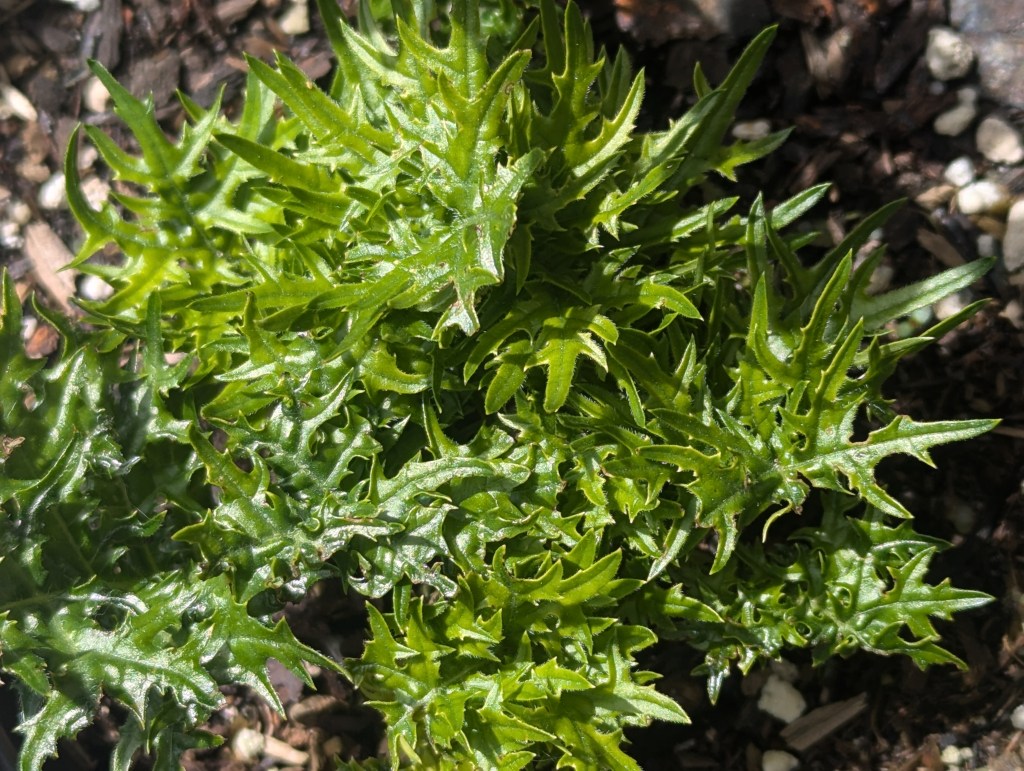
2. Echinops ritro, globe thistle was a minor crop where I worked with cut flowers during the summer of 1986. I did not enjoy harvesting it then, but recently, I had coincidentally been wanting to add a single specimen to my garden. I just could not think of an excuse.
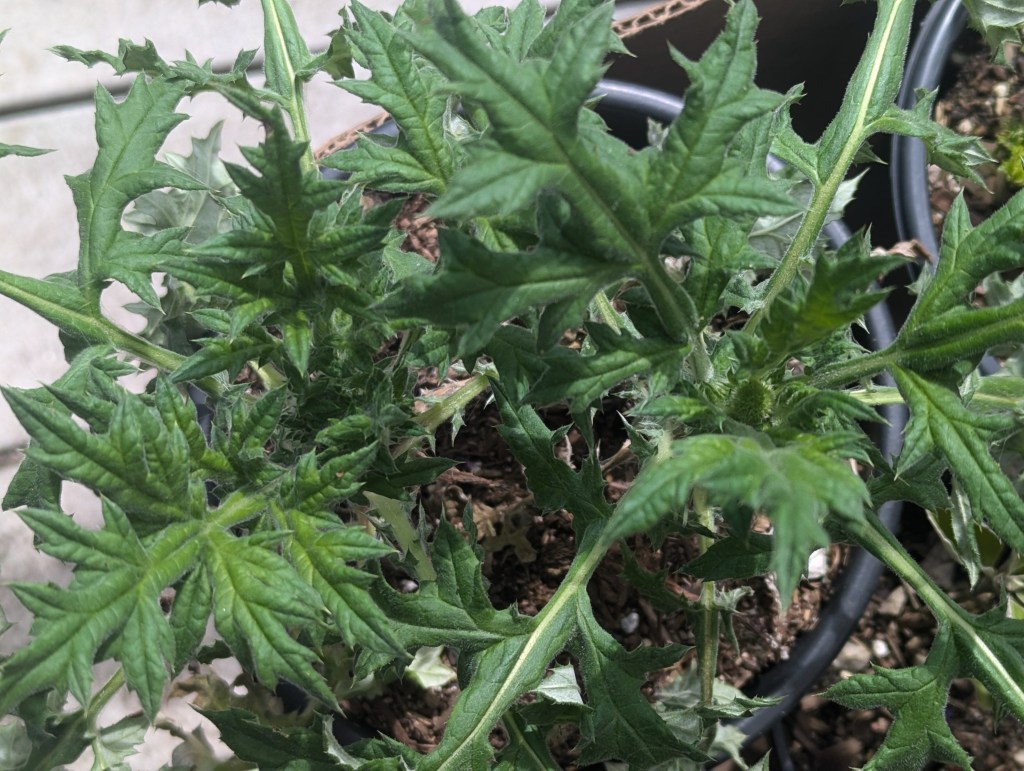
3. Helenium autumnale, common sneezeweed also has an amusing common name. I am unfamiliar with this species, although its botanical name somehow seems to be familiar. I got three distinct cultivars of it now! If we were not already acquainted, we will be now.

4. Brachyglottis greyi, daisy bush has a contrarily mundane common name. Many other species could easily qualify for its name. Somehow though, it makes it more compelling. Now, I want to see what makes it distinct from all other daisies, bushes or daisy bushes.
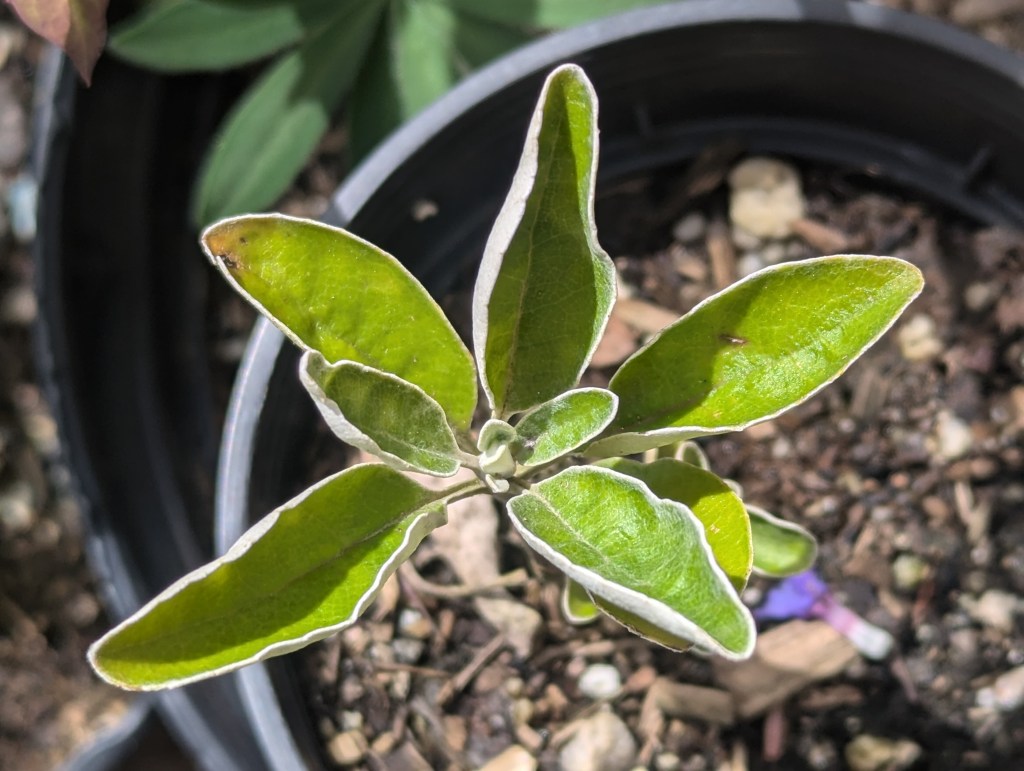
5. Leycesteria formosa, Himalayan honeysuckle or pheasant berry is yet another species that I had coincidentally been wanting to acquire. I embarrassingly did not recognize its name initially. I was told that I would find its flowers to be more appealing than its fruit.
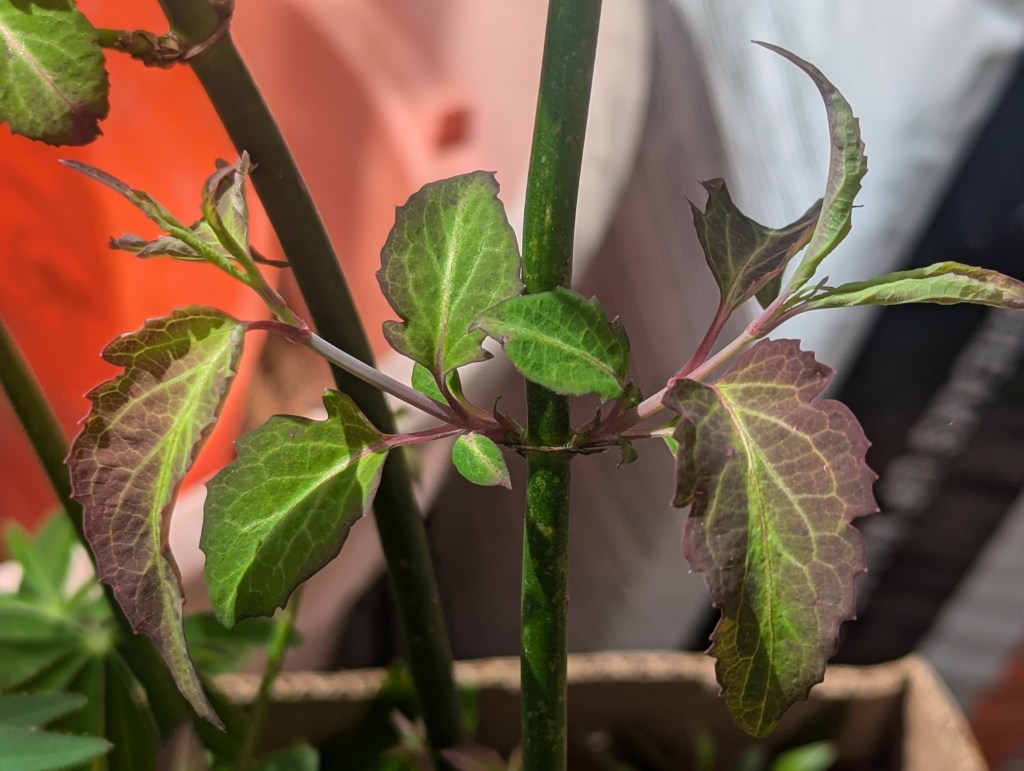
6. Lupinus, lupine is regifted and unidentified. I do not know if it is annual or perennial. Because it was grown in a can rather than merely shared as seed as annuals should be, I suspect that it is perennial. I will find out. This one can contains several swell seedlings.

This is the link for Six on Saturday, for anyone else who would like to participate: https://thepropagatorblog.wordpress.com/2017/09/18/six-on-saturday-a-participant-guide/
 Tony Tomeo
Tangly cottage has many temptations! Thanks for your id of the plum tree – it is in blossom now and looks wonderful.
LikeLiked by 2 people
You are welcome, but the picture that I saw in your Six on Saturday post is not a purple leaf plum. I believe that it is in your garden, while the earlier picture shows a different tree in your daughter’s garden. The garden of Tangly Cottage Gardening contains SO many different species and cultivars of those species. I have obtained so many copies of so many of those species and cultivars that they are more abundant in my own garden than what was already in my garden! Just about everything in my garden has ‘history’, and is very important to me because of its history (and also because it is so pretty). These important acquisitions will inhabit my garden at least as long as I do.
LikeLiked by 1 person
Wow, what a fun trip and what cool souvenirs! We actually grow a lot of lupine here, although we are a bit far south in the frozen north for them to do really well–they are one of those perennials that really shine in very cold places. I have seen them at their best in Maine and Colorado, for example. So it will be interesting to see how they do for you.
A couple of those other plants–sneezeweed and globe thistle–will also grow for us. Everything else, not so much, except perhaps the honeysuckle. They’re putting just about every kind of honeysuckle on our invasive plants list. It may be overkill, but I think they’re trying to be thorough. The native one–diervilla–they omitted.
LikeLiked by 2 people
Many species of Lupine are native to California, and particularly to mild coastal regions. This particular lupine looks just like sky lupine or arroyo lupine, both of which are native here. I really do not know what it is though. Since it came from Washington, it could be a species from a cooler climate. Although Himalayan honeysuckle is related to honeysuckle, it is a different genus. It is supposedly naturalized in some regions with cooler winters. If I believe that it has potential to naturalize at home, I will plant it and enjoy it at work. I seriously doubt it could be a problem at home though.
LikeLiked by 1 person
I think it is described as a river lupine? Does that sound like a possibility?
LikeLiked by 2 people
Oh yes, Lupinus rivularis! It is a perennial, but because it is purplish rather than blue, it should not go into the Blue Garden. I should put it near the stream that flows into the pond where the Louisiana iris are.
LikeLike
Both Acanthus and Leycesteria are invasive here, I have the Acanthus and can’t get rid of it; I had the golden form of Leycesteria but it is long gone and won’t be allowed back. It’s a shame, both are good plants in other respects.
LikeLiked by 2 people
That is why they will likely get planted at work first, and may never come to my home garden. So far, we can not get the common Acanthus mollis to get established. A variegated cultivar is barely surviving. This new Acanthus spinosus will get a bit more sun, so should perform better, although likely more docile than Acanthus mollis typically is.
LikeLike
By the way the reason I had the acanthus potted up is because I had to move the big clump when I cut a new path through that bed. It had stayed in one big clump and not run around and reseeded. Which isn’t to say that a good plant can’t turn bad. 🙂 My Persicaria bistorta Superba was a wonderful and well behaved plant that is suddenly on the run through a big garden bed!
LikeLiked by 1 person
Even if it goes bad, I doubt that it can be as bad as common Acanthus mollis, which really is not so bad where we put it. I am more likely to grow Acanthus spinosus at home than Acanthus mollis, even though I am very fond of Acanthus mollis.
LikeLike
I love to try new things. The thistles are memorable, I have a few here. I have always wanted Lupines, hope to see your flowers.
LikeLiked by 2 people
The lupines are quite young, so may not bloom until summer. Native lupines are blooming now, and other species bloom a bit later. Maybe this is one of those later species.
LikeLike
The guy who gave me the lupine is all about northwest native plants.
LikeLiked by 1 person
Yes, I will assume that it is Lupinus rivularis, which is a splendid perennial.
LikeLike
I’ve confused you. Today’s plum blossom is from my garden and white. The one in my daughter’s garden is a purple ish colour!
LikeLiked by 2 people
That is sort of what I figured, but was not certain.
LikeLiked by 1 person