Only six of ten elderberries here were selected for “Six on Saturday”. Four were omitted:
Sambucus canadensis ‘Nova’ and ‘York’ American elderberry
Sambucus caerulea, blue elderberry
Sambucus nigra ‘Black Tower’ European black elderberry
I would have liked to include all of them, but realistically, American elderberry and blue elderberry are not much to see, and I was unmotivated to take a picture of ‘Black Tower’ European black elderberry. Although it is my favorite of the European black elderberries here, taking its picture after neglecting to do so while there earlier yesterday would have necessitated a short drive and a long walk. These six are in the storage nursery, either as cuttings, or because they were not installed into a landscape yet.
1. Sambucus racemosa, red elderberry is a gift from Skyler of Tangly Cottage Gardening. They are a group of four seedlings, so can pollinate each other, as well as a more recently acquired ‘Lemony Lace’. The species is native and grows wild in Tangly Cottage Garden.

2. ‘Lemony Lace’ is a cultivar of red elderberry that I acquired with three European black elderberry cultivars, in a manner that is not illegal. I am very pleased that it is a progeny of ‘Sutherland Gold’, which I had been coveting in the garden of The Random Gardener.

3. ‘Black Lace’ is the cultivar of Sambucus nigra, European black elderberry, that started it all. It was here before my time. I was not so keen on it, but learned to like it because so many admired it in the landscape. I procured ‘Madonna’ as a pollinator, and kept going.

4. ‘Madonna’ and ‘Black Lace’ are so MTV in 1989. This ‘Madonna’ is not so exciting. Its chartreuse variegation looks sickly while it is small. I know it will be prettier as it grows. It arrived two years prior to the three other newly acquired European black elderberries.
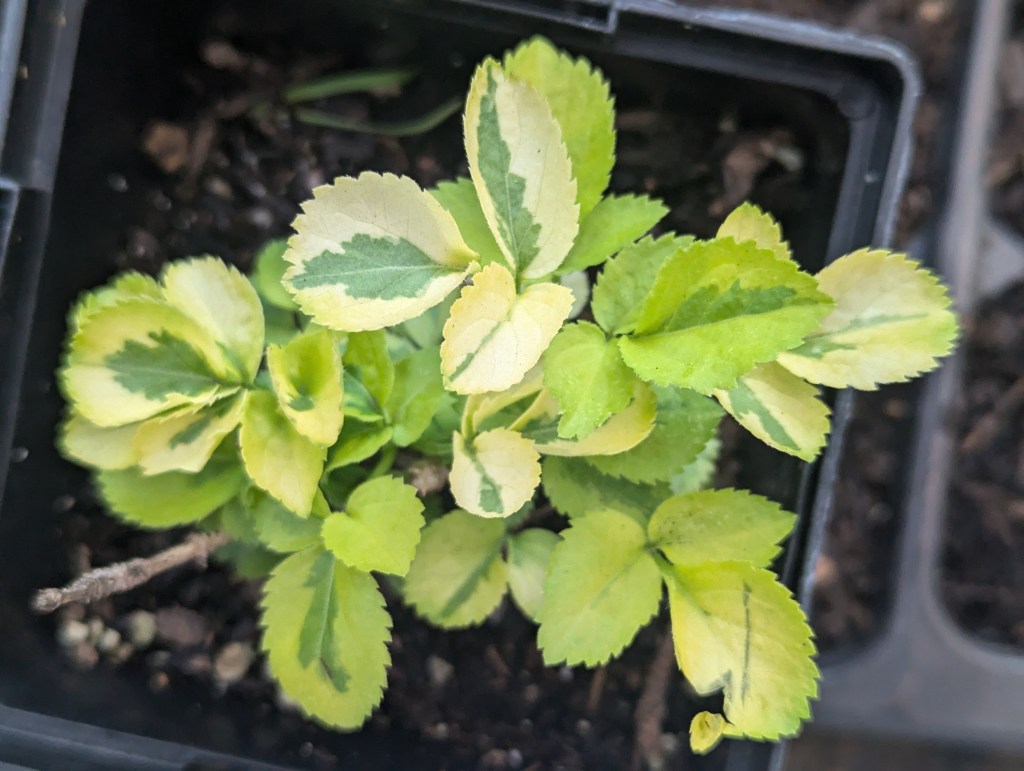
5. ‘Purpurea’ is one of the three recently acquired cultivars of European black elderberry that arrived with the ‘Lemony Lace’ red elderberry. I am unimpressed by its bland foliar color, but will learn to appreciate it if I work with it long enough. I like its foliar texture.

6. ‘Albomarginata’ was the European black elderberry cultivar that I initially wanted as a pollinator for ‘Black Lace’, but it was unavailable two years ago. I prefer its creamy white variegation and larger size to the chartreuse variegation and compact size of ‘Madonna’.

This is the link for Six on Saturday, for anyone else who would like to participate: https://thepropagatorblog.wordpress.com/2017/09/18/six-on-saturday-a-participant-guide/
 Tony Tomeo
Wow, great selection, I didn’t realise there was such variation in leaf. Love the MTV reference. 😀
LikeLiked by 1 person
Most of the ornamental cultivars are of European black elderberry, which I would not have grown if ‘Black Lace’ had not already inhabited one of the landscapes. I wanted to get it a pollinator, and ended up with four. American black elderberry cultivars, which are not pictures, are for fruit production rather than ornamental. As far as I know, there are no cultivars of blue elderberry.
LikeLike
It is amazing how many different elderberries are available. My favourite is ‘Black Lace’ but I had a lovely one in my previous garden called ‘Black Marzipan’. It had huge flowers which were supposed to smell like marzipan.
LikeLiked by 1 person
‘Black Lace’ is what started this whole mess. I did not like it at all when I first met it, but put it in a landscape to get rid of it. People who saw it liked it, which made me like it, and then get a pollinator for it, . . . . and now we have this.
LikeLike
That’s a lot of elderberry! They’re native here as well, several species, including one that I also feature today 🙂
LikeLiked by 1 person
There should be only two species that are native there, Sambucus racemosa and Sambucus canadensis (which some know as Sambucus nigra). However, there are many cultivars, particularly of Sambucus nigra, European black elderberry.
LikeLiked by 1 person
So many elderberry varieties. I have so many elderberry all from my single Sambucus canadensis. I grub out the seedlings, but of course the plant wants to send up new plants several feet away. Pull up the plant ant the root goes back to the mother. I have to keep on top of it to keep it in check – the mower in chief keeps suggesting I remove the berries before they ripen. But that is part of the beauty of the plant and some birds may eat the berries. I love the flowers too.
LikeLiked by 1 person
That is how I got my red elderberry seedlings; from Tangly Cottage Gardening. They grow a bit too wild there. Although supposedly native here, I had never seen it before seeing it at Tangly Cottage Gardening.
LikeLike
Love the varieties, Tony. I grow a few here, but the natives grow the best and offer the most for our feathered friends. Black lace was so overplanted here some years back, and rarely did people realize how huge it gets. Have a good week!
LikeLiked by 1 person
Huge? Ours stays less than ten feet tall (I think). I prune it aggressively though. The original succumbed to gophers, so we put a new replacement in the same spot.
LikeLike
I have never seen a yellow-leafed elderberry before. It is very attractive. Are the flowers white, and does it produce many berries?
LikeLiked by 1 person
The flowers are white, but I do not know how productive it is in regard to berries. I have never grown it before. It will make no berries this year because it is blooming, but its pollinators are not. Actually, the only elderberry fruit that I have ever seen here is the native blue elderberry.
LikeLiked by 1 person
These are rad. Fantastic foliage. I have never seen any of them..are they shrubs? Do they bear fruit?
LikeLiked by 1 person
Did you just say “rad”?! Oh my! How 1989! I do not suppose you remember Madonna in black lace? All of these elderberries are shrubs, and should produce fruit. However, when ‘Black Lace’ was the only cultivar of its species here, it produced no fruit without a pollinator.
LikeLiked by 1 person
Yes, I remember Madonna and would not associate her with Elderberries!
LikeLiked by 1 person
I associate her with hydrangeas.
LikeLike
Wow, thanks for this post about several of the Elderberries. I don’t know much about them, so learning about them and seeing the foliage is a treat. Great post. 🙂
LikeLiked by 1 person
You are welcome, but these are merely pictures. If they were more popular here, I would write more interesting articles about them.
LikeLike