Bark was actually not Rhody’s suggestion. It was simply a convenient theme while it was difficult for me to get out to take other pictures. These are six trees that I worked around yesterday. I could recycle this theme for native species.
1. Sequoia sempervirens, coastal redwood is the Official State Tree of California, and the tallest tree species in the World. Although native, this particular specimen was grown in a nursery, and is the cultivar ‘Soquel’. It was installed into its landscape likely after 1989.

2. Metasequoia glyptostroboides, dawn redwood is the only of three species of redwood that is not native to California. It is also the only deciduous redwood. Sequoia gigantea, giant redwood, is also represented by a young tree, but I did not get a picture of its bark.

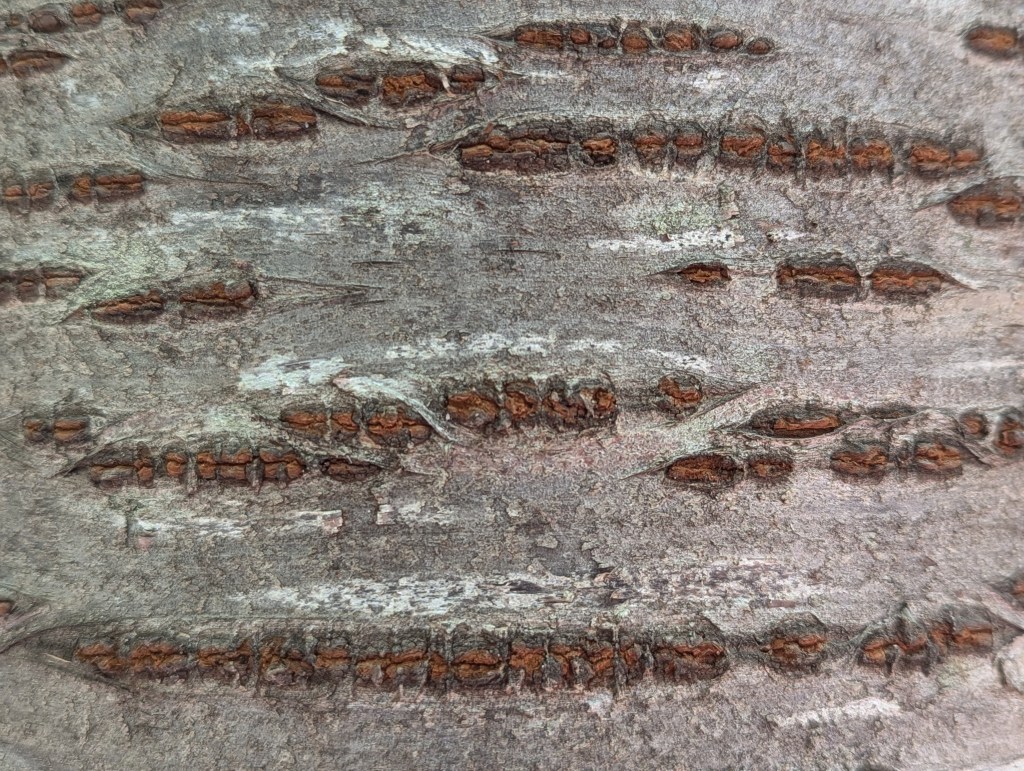
3. Prunus serrulata, flowering cherry seems to be the cultivar ‘Kwanzan’. Perhaps shade from surrounding redwoods, birches, sweetgums and dogwoods interfere with its bloom profusion. Individual flowers are a bit smaller than they should be for typical ‘Kwanzan’.
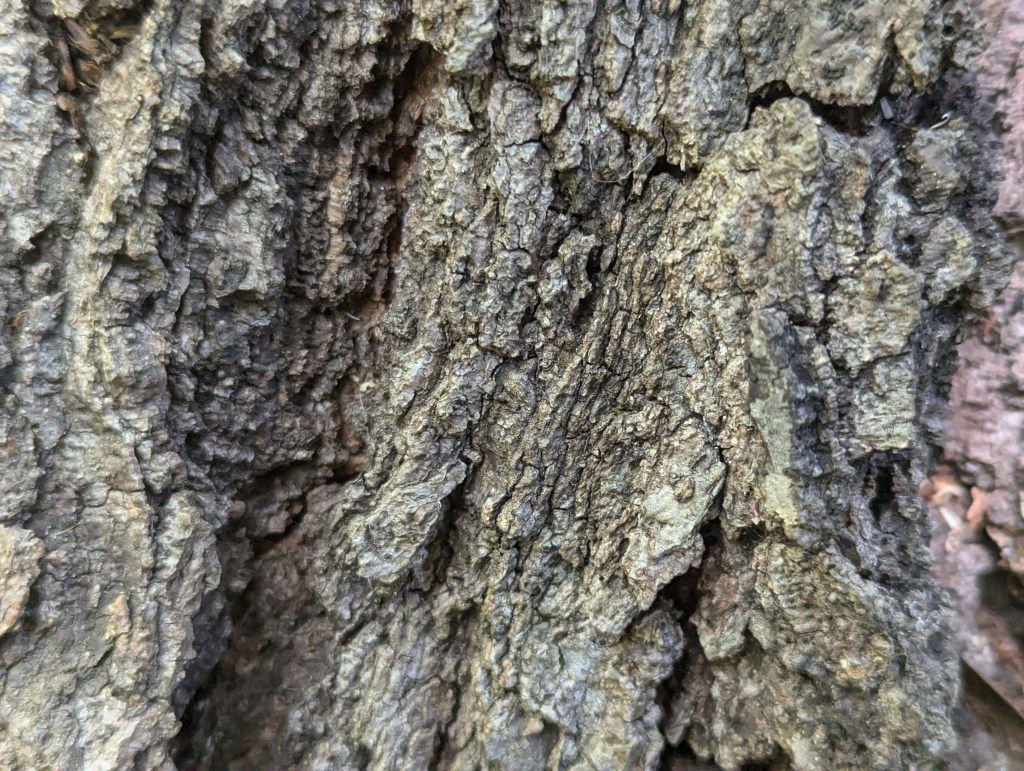
4. Betula pendula, European white birch has distinctly white bark, but also exhibits dark brown or black furrowed bark at the bases of large trunks. I tried to take pictures of both for contrast, but the white bark seemed too gray. I could have gotten both in one picture.
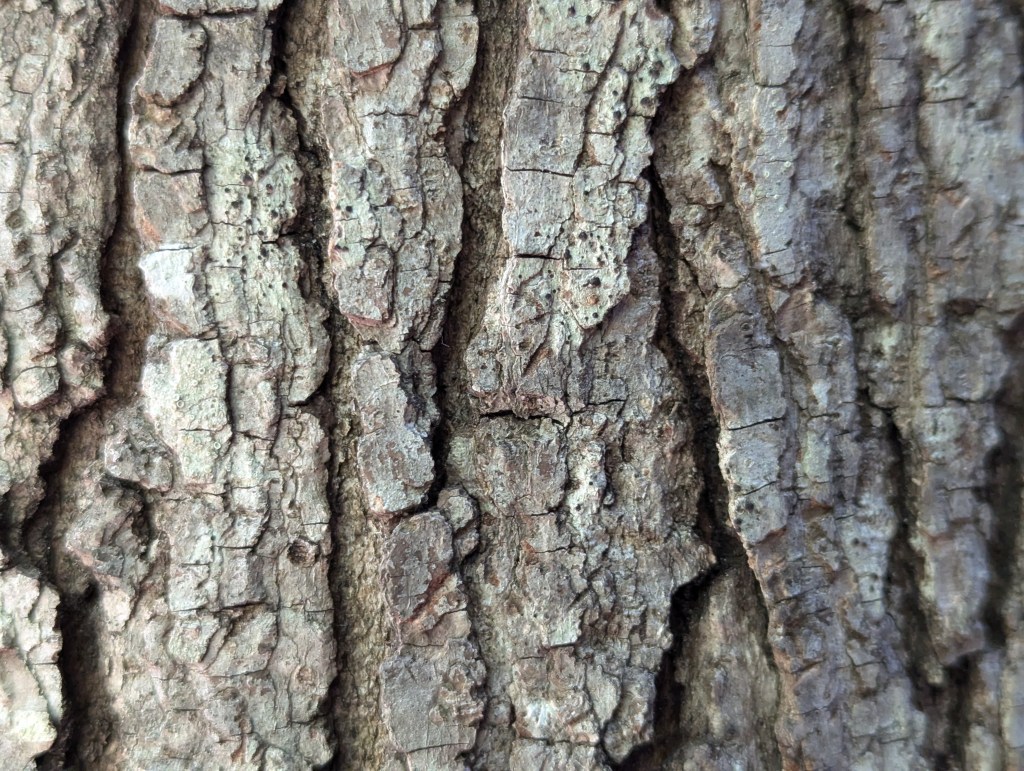
5. Liquidambar styraciflua, sweetgum bark goes through different phases as it matures. Young twigs initially exhibit smooth bark. Then, their smooth bark develops corky wings that grow as the stems grow. Somehow, mature bark shows no evidence of former wings.
6. Cornus florida, flowering dogwood is supposedly easy to identify by its ruff bark. I do not get it, though. Of these Six, only flowering cherry has more finely textured bark. This particular tree does not bloom so well, but produces spectacular foliar color for autumn.

This is the link for Six on Saturday, for anyone else who would like to participate: https://thepropagatorblog.wordpress.com/2017/09/18/six-on-saturday-a-participant-guide/
 Tony Tomeo
Good idea to have focused on barks !
LikeLiked by 1 person
Thank you. Redwood has distinctive bark (although it is common here). I should have gotten a picture of the bark of the giant redwood also.
LikeLiked by 1 person
That’s very unusual bark on number 3. It looks as though you’ve taken it sideways. I find bark patterns very interesting. Do you have “Scribbly gums” over there?
LikeLiked by 1 person
Yes, the flowering cherries have those distinctively horizontal striations. Many species of Eucalyptus have been introduced here, but not scribbly gums.
LikeLiked by 1 person
Nice to find another bark enthusiast. That is the joy of mature trees, they all have wonderful bark. I love sweet chestnut with the swirling furrows and eucalyptus and plane trees with blotchy bark. Mature walnut tree trunks remind me of elephants. Ridges and furrows are good, but I like cherries too with their horizontal lenticels.
LikeLiked by 1 person
Red twig dogwood and red twig Japanese maple have interesting bark only while young, which is why we pollard and coppiced the red twig dogwood. Redwood has the best bark, even if it is common here.
LikeLike
A great collection, worth a fortune I’m sure if they were abstract art in a gallery! The birch is my favourite.
LikeLiked by 1 person
That is unexpected for European white birch, which should be, well . . . white. I like how the contrast makes the white seem whiter.
LikeLiked by 1 person
I love bark. My favorite tree near my office is a huge cottonwood with deeply craggy bark. It is majestic and I do not normally wax emotional over a cottonwood. Next we have an oak not far from where I live that has a plaque proclaiming it the 8th largest oak in the state. It it a lovely, shapely tree. When I lived in SoCal, it was Manzanita that I adored. As a kid, playing in the canyon behind my house, I would seek them out and caress the smooth reddish bark. I also love the eucalyptus along Telegraph Canyon Road in Chula Vista. So huge now, and the ones there really have folds in the bark where branches formed that looks like wrinkles in skin when limbs are bent at the joint. I cannot stop myself from caressing those smooth barked trees either. I am excited as my baby Physocarpus matures to see its bark which is a nice warm cinnamon color now, but will peel and reveal different colors, brown, grey, yellow…Nice post! It is easy to focus on the pretty frilly colorful flowers, but there are so many sources of beauty in the natural world!
LikeLiked by 1 person
Cottonwood bark makes big trees seem older than they really are. They can be as distinguished as old oaks, and just as grand. The Eucalyptus with smooth bark and wrinkles were likely lemon gum, Eucalyptus citriodora. Alternatively, they might have been a species of Ficus.
LikeLike
Yes, I think you are spot on on the eucalyptus. I found a picture of them planted along an avenue and looks exactly like what I remember. Haven’t been back since 2022, but hopefully soon.
LikeLiked by 1 person
Now that I look at them, I can see that the most prominent of the various species of Eucalyptus on Telegraph Canyon Road are Eucalyptus citriodora, lemon gum. The other species are not as prominent, and do not exhibit such strikingly smooth white bark.
LikeLiked by 1 person
Nice to see some old friends from the woods. Except the Sequoias! My father had a Dawn Redwood he adored.
LikeLiked by 1 person
I am not so keen on ours, firstly because the species was a fad in the 1990s and 2000s, and secondly, because it is such a pretty redwood that seems to die every autumn.
LikeLiked by 1 person
My father had a fossil plant garden..ginkgos, redwoods, etc.
LikeLiked by 1 person
It would be nice if our dawn redwood truly was a fossil.
LikeLiked by 1 person
Nature’s way of making the bark of each species a little different. Thanks for sharing!
LikeLiked by 1 person
These are more than a little different. The two redwoods, as well as the third that I did not get a picture of, are the most similar.
LikeLiked by 1 person
This is a wonderful post. Bark is certainly fascinating and you’ve inspired me to study it more. Thank you.
LikeLiked by 1 person
Thank you and you are welcome. I did not expect such response. Perhaps I should do another six with this theme. I did it before sometimes in the past.
LikeLike