Ferns are an odd bunch within home gardens. They lack floral color and fragrance. They produce no fruit or vegetables. The few that are deciduous lack autumn foliar color here. With very few exceptions, they provide no shade. There is quite a bit that they do not do. Yet, they are notably popular for their lush foliage, intricate textures and distinctive forms.
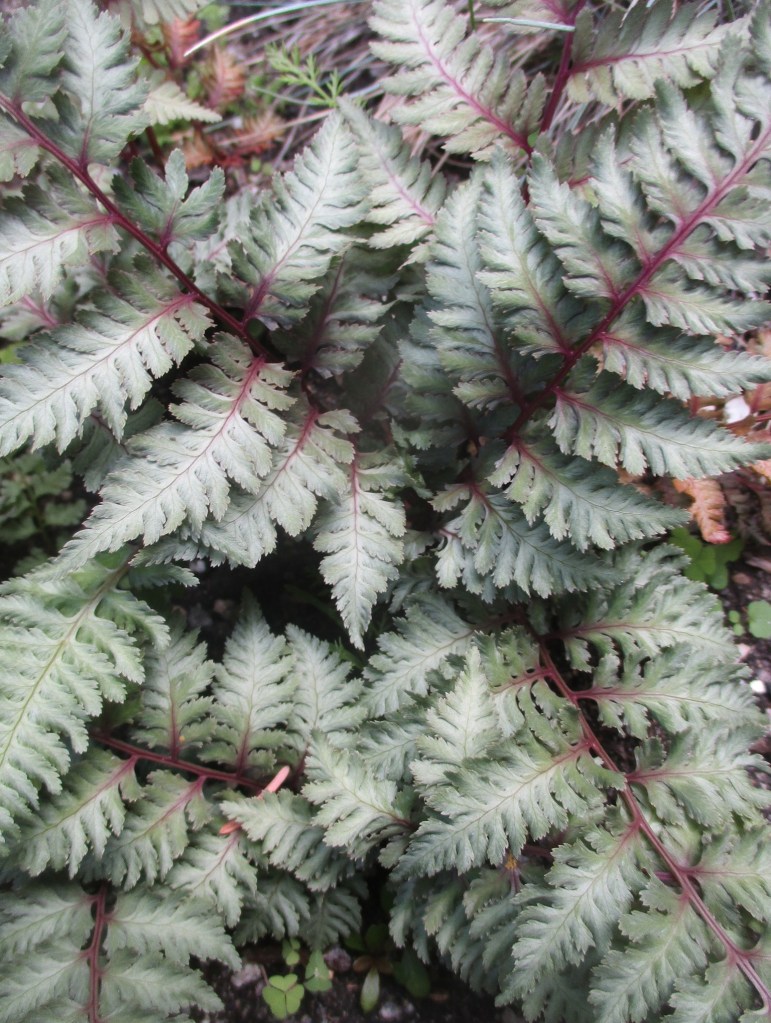
Almost all ferns are a rich deep green. Some are vibrantly lighter green. A few are silvery gray or exhibit intricate silvery patterns. Most exhibit lacy textures. Several are finer than most. Several develop relatively coarse textures. Bird’s nest fern has large but undivided and glossy fronds. Holly fern exhibits coarse texture of fronds that resemble holly foliage.
Most ferns that are popular here are evergreen foliar perennials. They are therefore tidier with occasional grooming to remove deteriorating old foliage. Some extend new foliage above old foliage as the old foliage lies down. Some regenerate lushly after the removal of all their foliage prior to their growing seasons. Deciduous ferns are uncommon locally.
Ferns do not develop stems or trunks like some other vegetation does. They sprawl over the ground with fleshy rhizomes. Tree ferns grow upward only by extending roots into the deteriorating rhizomes below. Such roots are quite strong and wiry, and form what seem to be trunks. Fern roots are rather fibrous. Fern rhizomes grow in length but not diameter.
Because of their fibrous roots, ferns are complaisant to confinement within pots. Several are splendid houseplants. Boston fern is an old fashioned but familiar example. Rabbit’s foot fern, maidenhair fern and bird’s nest fern are also popular as houseplants. Staghorn ferns are weirdly epiphytic. They can grow outside on vertical boards rather than in pots.
Most popular ferns are understory species. That means that, within their natural habitats, they live in the shade of larger vegetation. It also means that, within home gardens, most tolerate partial shade. A few actually prefer it. Most ferns also prefer systematic irrigation. Although, native Western sword fern tolerates both partial shade and lapses of irrigation.
 Tony Tomeo