Horticulturists are by nature, nonconforming. I happen to find it difficult to conform to what makes us nonconforming. Trends are fleeting. Old technology that has worked for decades or centuries is still best. Although I am not totally against chemicals, I find that almost all are unnecessary for responsible home gardening. Pruning is underappreciated, and fixes many problems.
My Six on Saturday post this morning linked to this three year old article, which describes how the historic flowering cherry trees have been deteriorating for quite a while.
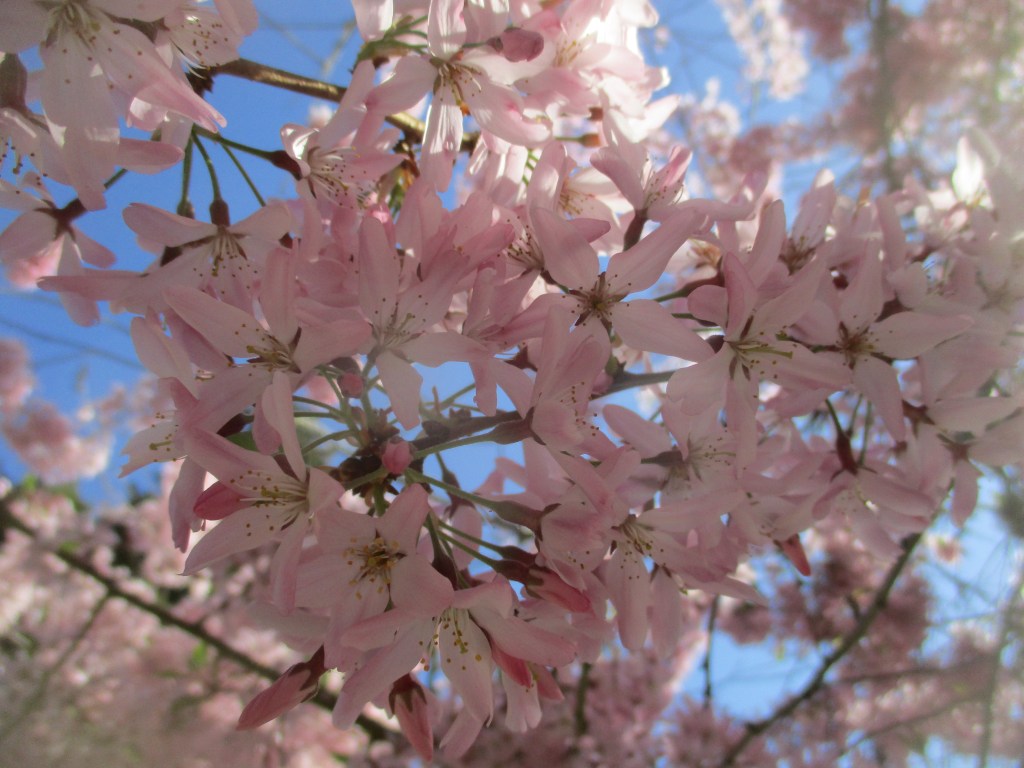
I would say that this is our own private Cherry Blossom Festival, but it really gets a crowd. These two old trees are at the edge of the main roadway through town, so several people driving by stop to take pictures. They may not seem to be very impressive compared to healthier flowering cherry trees, but they are what we have, and we are happy to get the bloom.
Decades ago, fruiting cherries were some of the more common orchard trees in the Santa Clara Valley. Flowering cherries were only somewhat popular in home gardens, and might have been less popular without the Japanese influence. They are more popular in cooler climates, not only because they are happier in cooler climates, but also because those who live where winters are harsh have a better appreciation for bloom that so happily celebrates the end of winter.
Beau prefers French. I do not know why. He was born in Missouri. His name is derived from ‘Hobo’ (‘HoBeau’). Since vehicles here are traditionally named after places, he may believe that his name was derived from ‘Boulder Creek’ (‘Beaulder Creek’) or Bonny Doon (‘Beaunny Doon’). Nonetheless, there is nothing French about Beau. I do not argue. Nor do I argue with Rhody if he insists that Beau is a Pontiac rather than a Chevrolet. If he believes that we ride in that kind of style, it is just fine with me. Anyway, after last Saturday, some wanted to see Beau.
1. Two years after we intended to remove this pair of historic flowering cherry tree, they get to bloom one last time. Sadly, their demise can be delayed no longer. Their trunks are too rotten.
2. Three similar flowering cherry trees down the road have been recovering from foliar disease during the same two years. They are neither as pretty nor as distinguished, but have potential.
3. Adjacent to #2, this most garish flowering cherry tree is the most prominent. Unfortunately, like #1, it is deteriorating, so will also be removed after bloom. Half of the canopy is necrotic.
4. This one should succumb instead. To me, weeping flowering cherries look weird. This one was in bad condition when I met it. Unfortunately, my efforts to renovate it have been effective.
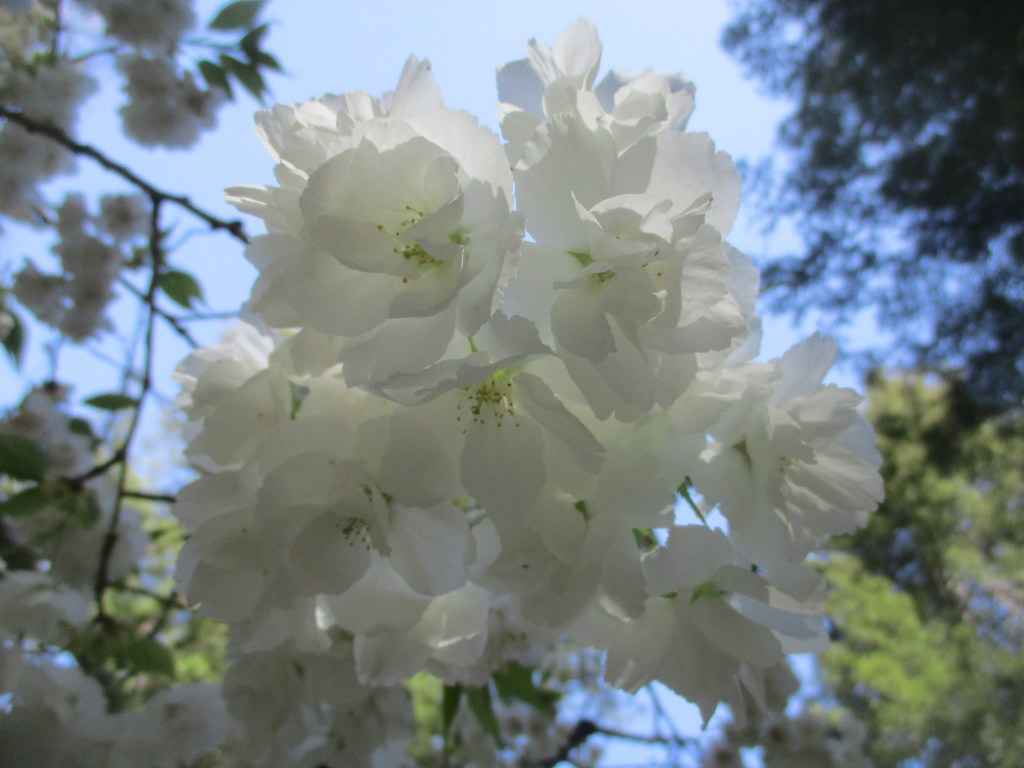
5. Oh, my favorite. The flowers are double, but not as fluffy as those of #3. It really is as white as it looks, without any blush. The tree is disfigured and shaded by redwoods, but blooms well.
Even after so many pretty shades of yellow, red, pink and and white have been been developed, the natural orange of the native California poppy, Eschscholzia californica, is still the best. That is probably why they all eventually revert to orange after reseeding. Although native, they do not reseed everywhere, and actually seem to be more reliable in unrefined and unamended areas of the garden than in rich soil with generous irrigation. However, a bit of watering can prolong sporadic bloom until autumn. Bloom otherwise ends before warm summer weather.
California poppy is grown as an annual because the perennial plants get tired rather quickly. They fortunately self sow prolifically. Flowers are typically about two inches wide, with four petals. The intricately lobed leaves are slightly bluish. Foliage is not much more than half a foot deep.
While it was busy naturalizing in Australia, South Africa and southern South America, the California poppy was getting forced out of parts of its own native range by more aggressive exotic plants that were also busy getting naturalized. Technically, any plant that is not native is exotic. Any exotic plant that becomes naturalized in a foreign environment is able to proliferate without any help, as if it were native. Naturalized exotic plants that get too aggressive become invasive weeds.
Weeds are plants where they are not wanted. This is a very broad definition that includes plants ranging from simple little dandelions in urban lawns to humongous bluegum eucalyptus in forests. Naturalized exotic weeds can be much more problematic than weeds that can only proliferate where they get watered in gardens and landscapes, because they can get established where they are not expected.
Water hyacinth that clogs the Sacramento and San Joaquin River Delta is not often a problem in terrestrial landscapes. However, giant reed, pampas grass, Acacia dealbata and blackberry brambles can infest home gardens just as easily as they infest wild lands. Because they do not need to be watered, they can get established and grow quite large in unused parts of the garden before anyone notices.
Many naturalized weeds somehow seem to much more aggressive and problematic than even the most prolific of native plants. Even the common native lupines are relatively docile compared to annual oat grass. Native blackberry may seem impossible to eradicate, but is actually neither as persistent nor as unpleasant to handle as the exotic Siberian blackberry!
Young weeds are easiest to pull now while the soil is still evenly damp, and young roots are only beginning to disperse. They will be more difficult to pull after roots are dispersed and soil hardens. Tree weeds and large perennial weeds that were cut down last year instead of pulled will likely need to be dug. Bermuda grass is a relatively low perennial grass that always seems to be difficult to dig. Mowing or cutting down annual grass weeds with a weed whacker will not eliminate them, but limits the development and dispersion of seed for the next generation. Burclover, sowthistle, bindweed, purslane, spurge and the various oxalis are some of the other common weeds that really get going this time of year.
This is not really a sequel to the recycled article that posted last Wednesday. It just happens to be of the same theme, which was prior to the development of Horridculture meme on Wednesdays.
As the Certified Pesticide Applicator working for the ‘landscape’ company that I wrote about earlier ( https://tonytomeo.wordpress.com/2018/03/18/shady/ ), I assumed several responsibilities pertaining to the pesticides and other chemicals that the ‘landscape’ company used. Among other things, I needed to inventory all the chemicals, monitor their use, submit use reports to the Department of Agriculture for each of the nine counties in which we used these chemicals, and provide MSDS binders for all of the ‘landscape’ company offices and vehicles within their fleet.
MSDS is for ‘Material Safety Data Sheet’. They are actually several pages each. Each MSDS binder contained two copies of the MSDS for every chemical the ‘landscape’ company used, or even had on site, whether it was actually used or not. One MSDS was in American English. The other was in Mexican Spanish.
So every office and every facility and every vehicle in the fleet of the…
Spring seems to develop suddenly, and without a very precise schedule. Star magnolia, Magnolia stellata, which can bloom as late as early in April, is already finished blooming in most regions. It should be no surprise. Technically, it can bloom before March. Foliage does not compete with bloom on otherwise bare stems. It appears as bloom deteriorates.
The bright white flowers are about three inches wide, and lavishly profuse. Cultivars with pale pink bloom are increasingly popular. Their pink color may be variable, according to the weather. Flowers have more than a dozen narrow tepals. Some are fluffier with twice as many. Fragrance is mild. Stems can be cut and brought inside just as buds pop open.
Star magnolia is more of a deciduous flowering shrub than a small tree. It should not get much taller than six feet, although it can eventually get to be nearly twice as wide. Partly shaded specimens can reach ground floor eaves. The lime green leaves darken through summer, turn pale yellow for autumn, and finally defoliate to reveal sculptural gray stems.
No one really hibernates here. Well, ground squirrels might, but they are unlikely to be a problem in refined home gardens. Winter weather is sufficiently mild for most of the most troublesome vermin to remain active, even if somewhat subdued. Some are more active in autumn before food gets scarce. They store food for later, and eat more to gain weight.
Now that it is spring, vermin are more active than they are at any other time of year, even autumn. Gophers, squirrels, rats and mice want to party like it is 1999; well, like spring of 1999. Although they all fattened up last autumn, and stored plenty of food for winter, they now want to exploit abundant spring vegetation. So do raccoons, skunks and opossums.
Generally most vermin, which most prefer to describe more politely as ‘wildlife’, are not a problem for home gardens. Some might be beneficial. Skunks may trench into lawns, but only because they want the grubs that would otherwise cause more damage from below. They also eat snails and slugs. Opossums eat snails and slugs too, as well as baby rats!
However, skunks and opossums can do more harm than good. They eat vegetables and fruits as they ripen, and pet food. Raccoons cause more significant damage, and can be very dangerous to pets. These three types of vermin are nocturnal, and therefore difficult to dissuade or confront directly. Fortunately, they are not very common in urban gardens.
Conversely, squirrels are everywhere except the harshest desert climates. Although they cause significant damage to new spring growth, and will later damage developing fruits, they are more tolerable than other vermin. Some people actually feed them to draw them to their gardens! Rats and mice are less tolerable, probably because they lack fluffy tails.
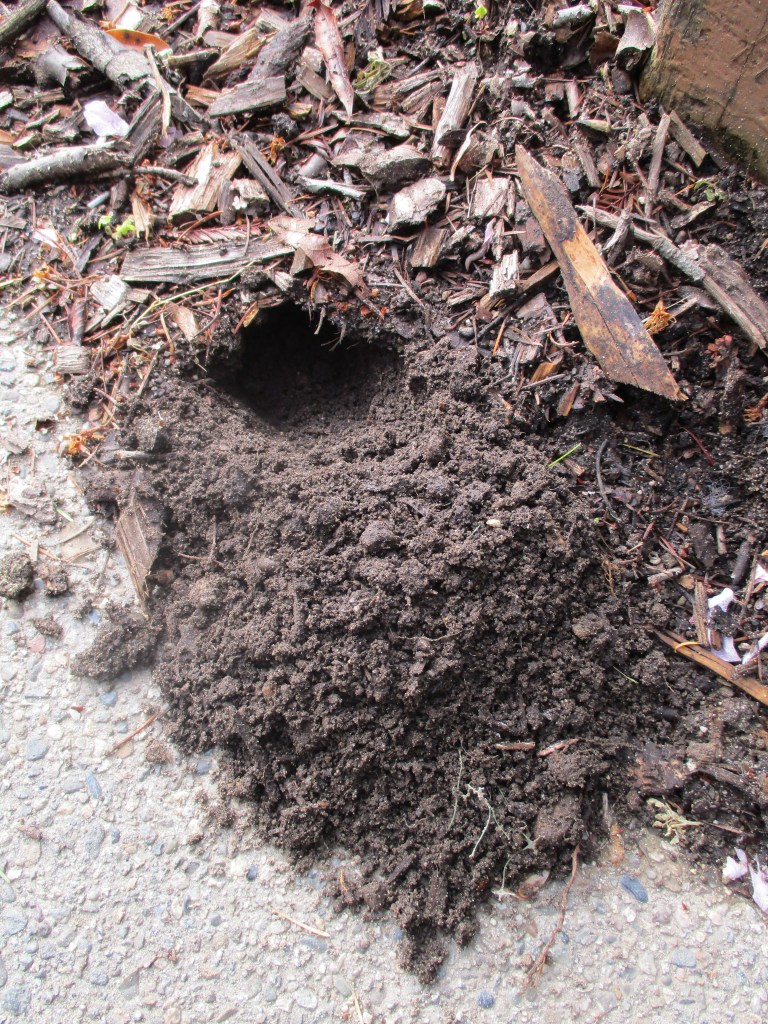
Gophers are likely causing more damage than other vermin now. Their growing families voraciously devour many of the fresh roots that disperse in spring. Now that their tunnels are not too muddy, gophers are remodeling to expand accommodations. Young gophers do not live with their parents for very long, so will eventually infest new adjacent territory. Lawns and vegetable gardens are most preferable.
Strangely, deer are not a problem in the landscapes at work. It is not as if their damage is minimal. There is NO damage. No one know why. They certainly damage home gardens in the neighborhood nearby.
After all these years since Timmy left home, I would actually be pleased to find a stub where I had been waiting for a rose to bloom, . . . but only ONE!
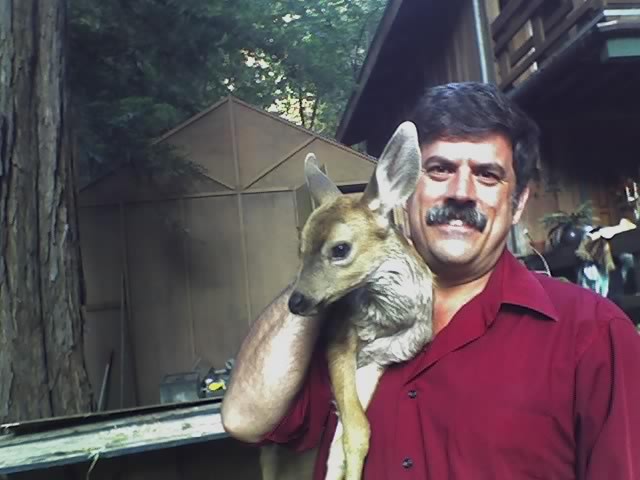
Tim Buck II, pronounced like ‘Timbuktu’ in Mali, but known simply as ‘Timmy’, came to live with us while he was just a baby fawn. Mr. Tim Buck Senior left Mrs. Buck to raise little Timmy alone as a single mother. Mrs. Buck then vanished, leaving little Timmy enfeebled on the side of Highway 9 south of town. No one knows what happened to Mrs. Buck. She might have been hit and killed by a car. She might have been eaten by a Mountain Lion. Somehow, she was not there to raise little Timmy.
Traffic was stopped on Highway 9 as little Timmy staggered about, either anemic, or starving from the absence of Mrs. Buck. He could barely walk, and certainly could not bound up or down the steep hillsides to leave the Highway. Most of us who stopped knew that he would not survive, and just accepted it as…
After this article posted three years ago, someone explained the genetics of the weirdly bred poppies mentioned in the last paragraph. That comment must have been in a subsequent article, since it is not here.
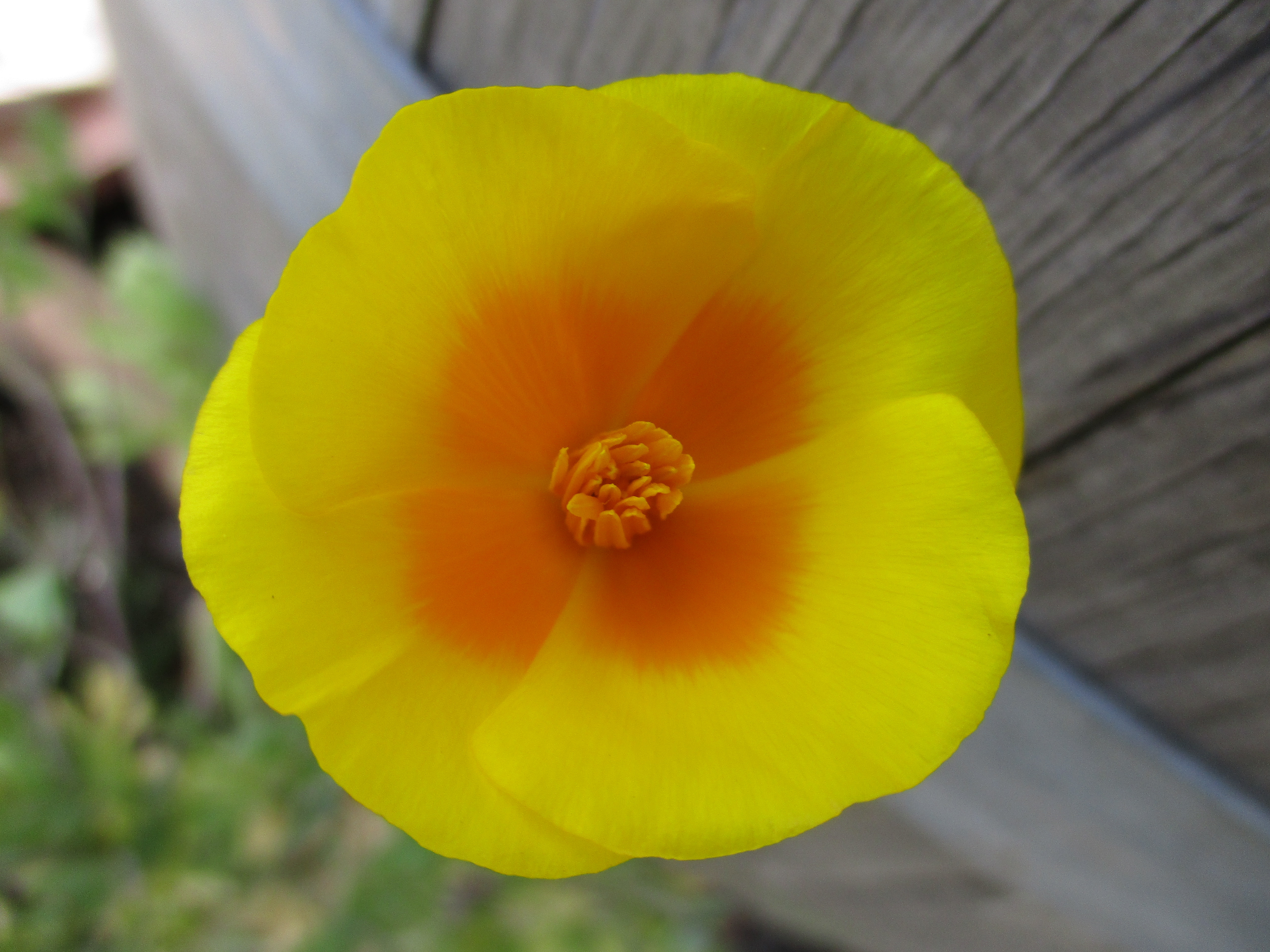
This one is different though. It is not the characteristic homogeneous bright orange that California poppies should be. The orange in the middle is what the entire flower should look like. The outer yellow hallow is not typical.
California poppies used to much more common than they are now. Not only did they grow wild, but they grew wild in abundance. Some of the East Hills were blushed orange with them when poppies bloomed this time of year. The lower hills just to the east of Highway 101 to the south of San Jose were more than blushed. There seemed to be almost as much orange as there was green. By the spring of 1985, those same hills were neither south of San Jose, nor quite so orange. They were within the suburban sprawl of San Jose, and were mostly green with invasive exotic grasses. Only wispy swaths of orange…
Beau is as old as I am. For a Chevrolet, that is quite elderly. He does not get around like he used to, and is no longer expected to go any farther than he can get towed back from if necessary. However, I needed his help in San Jose this week. He was pleased to oblige, but unfortunately could not get started after parking at the Post Office in Los Gatos so that I could grab my mail. It was actually not his fault. I neglected to replace his very old battery. Anyway, because of the delay, I was unable to return in time to get pictures from the landscapes or gardens, so instead got a few random pictures from where we were stranded. Technically, they are horticulturally oriented, but only slightly so. I should have gotten a picture of Beau as well as Rhody of course.
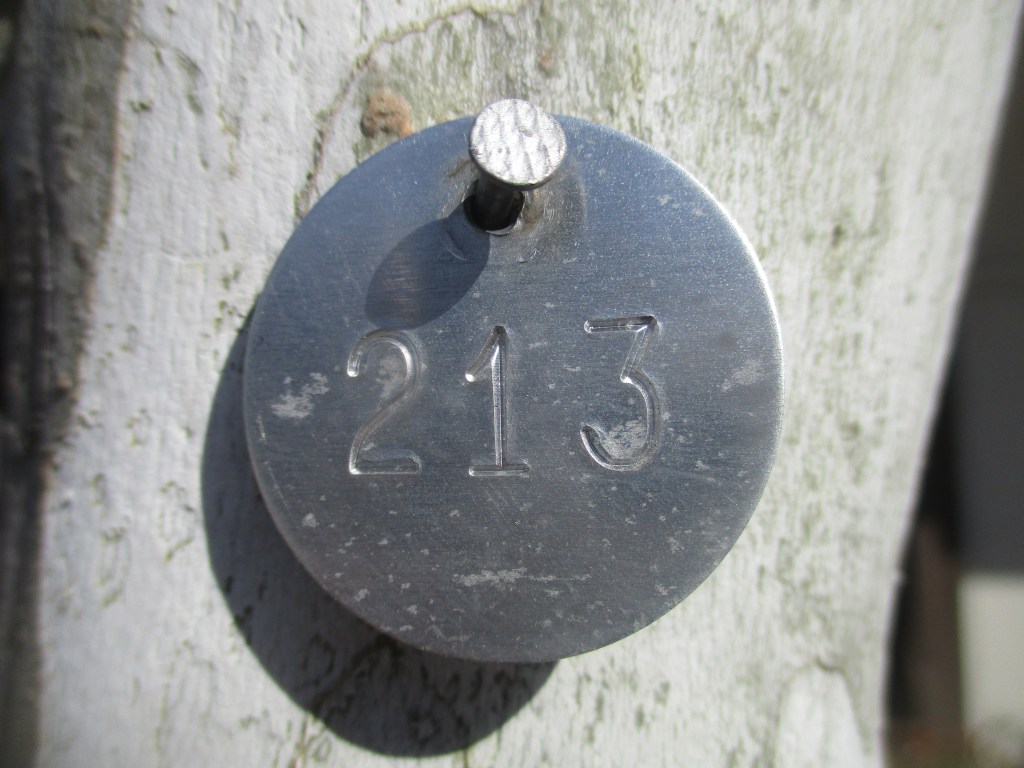
1. London plane 213 lives just behind the curb at the parking space next to the Post Office where Beau failed to start. He saw it all. This license plate is how the Town Arborist identifies him.
2. Tomato cages that my maternal grandfather made in the 1980s have been riding around with Beau for days. They are bits of wire mesh otherwise used for reinforcing concrete pavement.
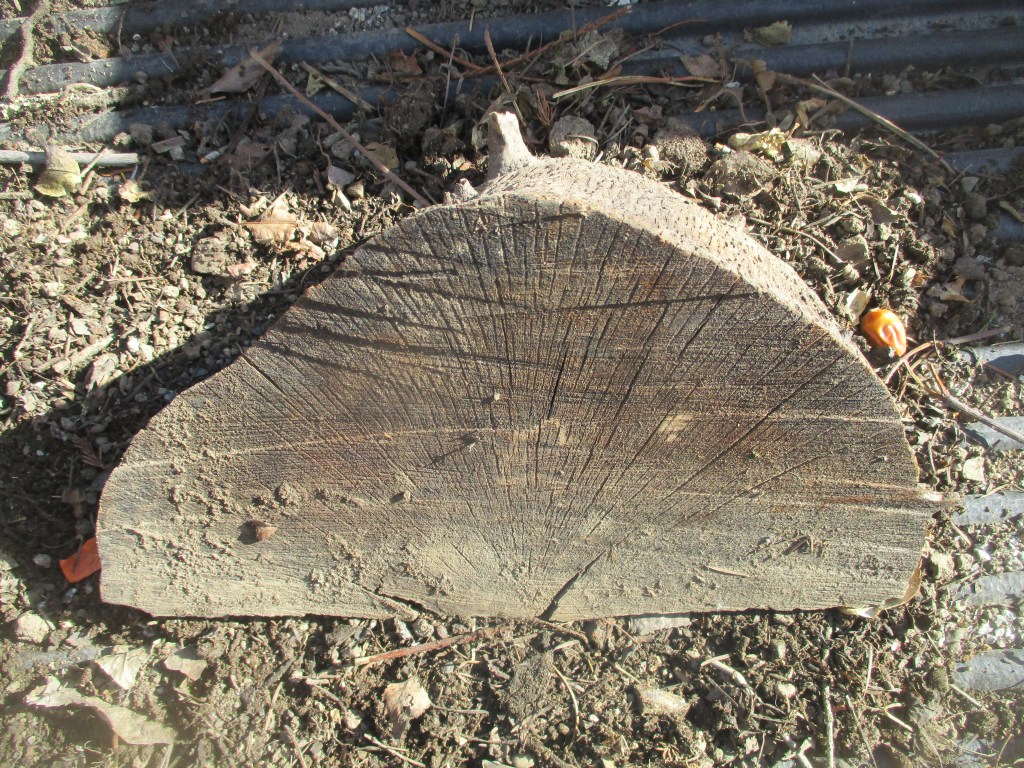
3. Arborists and lumberjacks cut wedges (notches) like this out of tree trunks, to direct their fall when cut down. This one is from a coast live oak. Now, it is an extra parking brake for Beau.
4. Peach trees are not expected to produce for more than twenty five years. I planted this one thirty five years ago in December of 1985. It exceeded its life expectancy significantly like Beau.
5. After thirty five years, I cannot yet bear to put the dead peach tree trunk on the woodpile. It has been riding around with Beau longer than the tomato cages. The stump of the tree was not completely dead, but needed to be dug out. I buried it somewhere else, with a big basal stem standing up like a new tree. I hope it grows like a bare root tree. I tried for years to root cuttings.
6. I left Beau to cross the street to the hardware store for this. I do not know what it is, but I suspect that it is an Eastern red cedar. I am not sufficiently familiar with the species to dislike it.
This is the link for Six on Saturday, for anyone else who would like to participate:

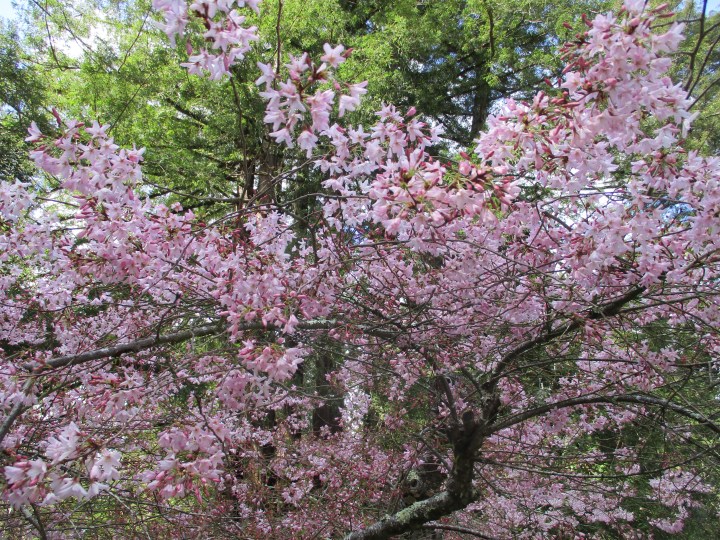 I would say that this is our own private Cherry Blossom Festival, but it really gets a crowd. These two old trees are at the edge of the main roadway through town, so several people driving by stop to take pictures. They may not seem to be very impressive compared to healthier flowering cherry trees, but they are what we have, and we are happy to get the bloom.






 This one is different though. It is not the characteristic homogeneous bright orange that California poppies should be. The orange in the middle is what the entire flower should look like. The outer yellow hallow is not typical.