Common or Soft Rush

Physiologically, common rush is more interesting than it looks.

There was nothing common or soft about Rush, the innovative hard rock band of the seventies and eighties. Juncus effusus is only known as soft rush because the spiky and sharply pointed ‘foliage’ appears to be stiff, but is actually quite soft. It is common because in has such a vast natural range, including North America, Europe, Asia, Africa and Australia. It does not like hard rock, but instead prefers rich and moist soil, and will even be happy in soil that is too damp for other plants. Common rush tolerates a bit of shade but prefers good exposure. Because winters are too mild to freeze it back to the ground naturally, overgrown or discolored common rush can be cut down and then left to regenerate as winter ends.

The distinctive ‘foliage’ is not actually foliage. The minute leaves are unimpressive brown scales that do not do much at the base of each of the many upright green stems that function like foliage. The top six inches or so of each of these spike like stems is actually a bract that extends above the dangling but uninteresting tan or dingy yellow flowers that hang to the side. Collectively, the stems and bracts form distinctively sculptural clumps that radiate upward and outward. Healthy clumps are not much more than three feet high and wide.

Know How To Procure Firewood

Firewood from tree services might be an unknown mix.

Fireplaces and wood stoves simply are not as common as they were only a few decades ago. Because of modern building codes, most that get damaged by earthquakes get removed or replaced by pellet stoves. The orchards that once provided so much inexpensive firewood while they were being cleared for urban development are now gone. The wood yards in the relatively arboraceous outskirts of town are farther away. Many municipalities have established ordinances to limit smoke, although this is not a problem if well seasoned wood gets burned properly, and only means that fireplaces can not be used on ‘spare the air’ days.

Firewood can be purchased from tree services that need to dispose of wood anyway. Because it is only a byproduct of tree work, it will likely need to be stored and seasoned the year before it is needed, just like orchard wood. (Firewood from wood yards gets seasoned before it gets sold.) Some types of wood that are often mixed in leave a bit more residue in chimneys, necessitating more frequent chimney sweeping. Realistically though, chimneys should be cleaned regularly anyway.

Because firewood is perishable, it should be obtained annually, in quantities that will be used in a single winter. It can rot if stored outside too long. If stored in a shed or garage too long, it can get infested with rodents. Besides, too much firewood occupies quite a bit of space.

Synthetic logs (made from compressed wood byproducts and fuel) are an effective, clean and efficient alternative to real wood that do not need to be seasoned. Each log burns about as long as several real logs, and produces about as much heat, so only a few go a long way. They are always available from supermarkets, and can be brought home with the groceries. Pellet stoves that consume fuel pellets that look like stove food are even more efficient. However, there is no substitute for a fire with real wood in a real fireplace or wood stove.

New Year & Old School

Okay, so this one barely complies with the Wednesday ‘Horridculture’ meme, and only because it involves a naught pine that would not conform to a landscape that requires conformity. It is an old article for New Year’s Day of 2018, so is reblogged here noncompliantly two days early.

tonytomeo's avatarTony Tomeo

P80101Little kids were allowed to walk to school back in the early 1970s. The youngest had to walk with older siblings or neighbors who made them look both ways and hold hands to cross the streets, and stay back from the roadway. Once through the open gate into the schoolyard, younger kids could leave their slightly older chaperones to meet up with their friends and eventually go to their respective classrooms.

It is scary to think of how carefree we were back then.

The east side of our schoolyard was hedged with alternating Monterey pines and Monterey cypress, with a few random deodar cedars, redwoods and even a California pepper tree and a Canary Island date palm just inside the hedge. The random trees were somewhat mature, so were likely remnants of a landscape of a home that was on the site before the school was built there. The hedge…

View original post 910 more words

Plum

Plums are better fresh than dried.

Only recently, and only to be more marketable, dried prunes attained the status of dried plums. Prunes and plums are actually two different types of fruit. Prunes are European fruits that dry nicely, but are not popular as fresh fruits. Plums are Japanese fruits that are best while fresh, but do not dry well at all. Because plums have less of a sugar content, they are likely to mold before they dry.

Plum is of the genus Prunus, just like prune and the other stone fruits. Stone fruits all contain large seeds, which are known as stones. Plums are ‘clingstone’, because the flesh of the fruit clings to the stones within. Prunes are ‘freestone’. Their stones separate easily from the flesh. The most popular plums are purplish or burgundy red. Others are blueish purple, red, orange, yellow or green.

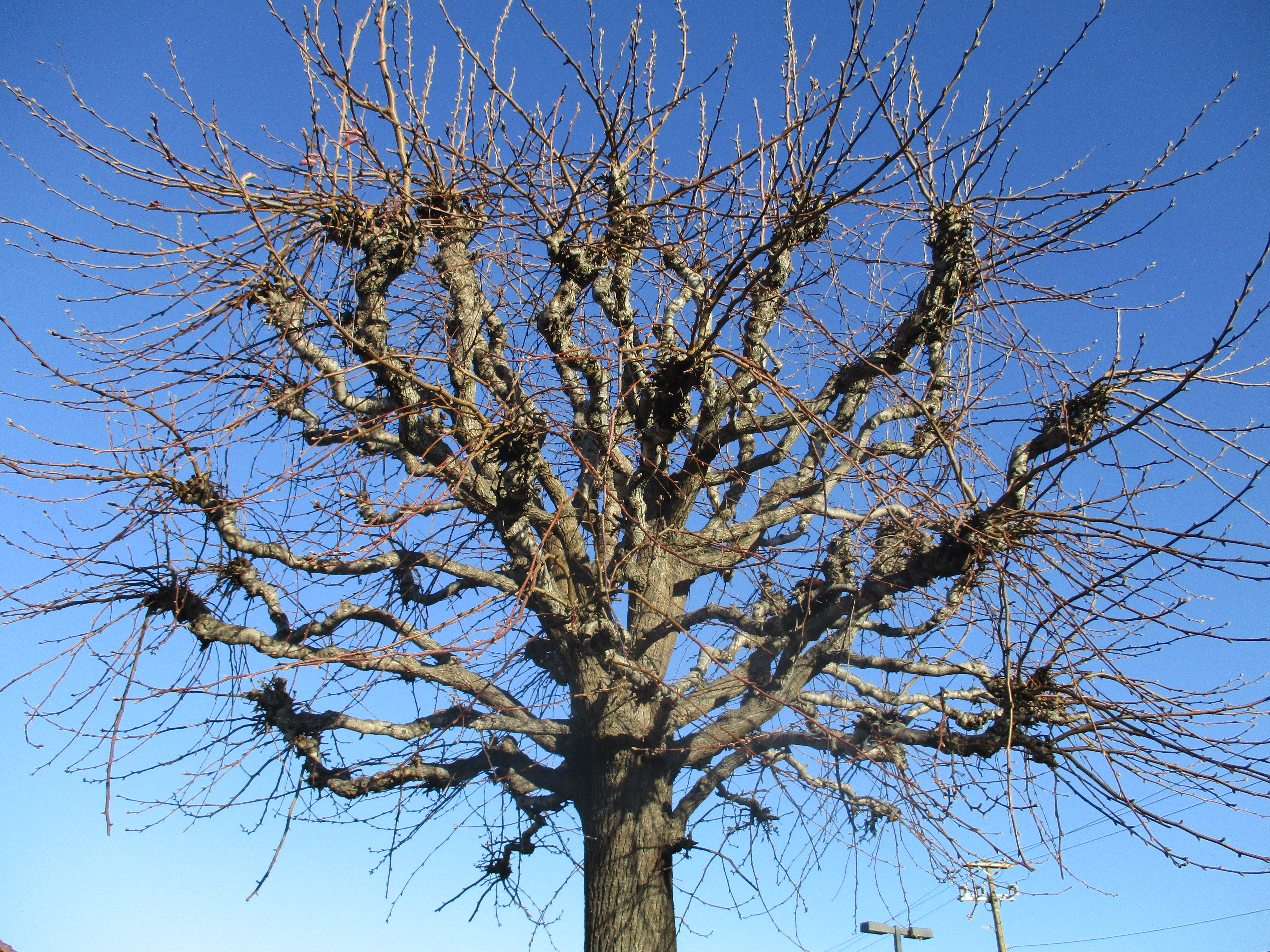
Plum trees grow fast while young, and require aggressive pruning while dormant through winter. Otherwise, they get overwhelmed with fruit, and too tall to facilitate harvest. Even semi-dwarf trees can get almost twenty feet tall. They are spectacular in prolific white bloom. Small bare root trees that are now becoming available adapt to a new garden more efficiently than larger canned trees.

Deciduous Fruit Trees Need Pruning

Prune now for better peaches later.

Many plants should get most of the pruning they need while they are dormant in winter. Such pruning is less stressful because it happens while plants are naturally sedated. Some plants that need aggressive pruning during their winter dormancy may need no other pruning until the following winter. Most deciduous fruit trees conform to this category. Their pruning is rigorous and specialized.

The innately aggressive pruning that deciduous fruit trees require may seem to be brutally unnatural, but is very justifiable. It is necessary to compensate for unnatural production. After centuries of selective breeding, most deciduous fruit trees produce more fruit than they can support. Their fruit is unnaturally abundant, unnaturally bulky, or both. Such improvement has distinct consequences.

Unlike their wild ancestry, many modern deciduous fruit trees would not thrive for long without intervention. The weight of their fruit eventually breaks and disfigures limbs. Such breakage exposes sensitive bark to sun scald, and leaves wounds open to decay. Insect and disease pathogens proliferate in deteriorating growth. Furthermore, messy excess and unreachable fruit attracts vermin.

Pruning improves the structural integrity of deciduous fruit trees so that they can support their fruit. It also concentrates resources into fewer fruits of superior quality, rather than allowing production of inferior surplus. Invigorated vegetative growth is more resilient to pathogens. Proper pruning removes dead, dying, damaged and diseased growth, the ‘four Ds’, as well as unreachable growth.

The main categories of deciduous fruit trees are stone fruits and pomme fruits. Stone fruits are of the genus Prunus. They include peach, nectarine, apricot, plum, prune, cherry, their hybrids, and almond. (Almonds are the ‘stones’ of their fruits.) Pomme fruits are apple, pear and quince. Peaches need more aggressive pruning than cherries, simply because their fruits are so much bigger.

Pomegranate, persimmon and fig also need specialized pruning while dormant through winter.

Arboriculture: Deep Space Nine

Here we have some three year old horticultural sci-fi.

tonytomeo's avatarTony Tomeo

P71231The “Poly” in Cal Poly is for “Polytechnic”, as in there are multiple schools within “California Polytechnic State University” at San Luis Obispo. There were seven school when I was there between 1985 and 1990. I was a student of the “School of Agriculture”. “Horticulture” was my “Major”, or major realm of study within this school. Within this major, I selected “Floriculture and Nursery Production” as my “Concentration” of study. That certainly is a lot of quotation marks.

While majoring in horticulture at Cal Poly, I studied with students whose concentrations of study were within “Landscaping” or “Floral Design”. Withing the School of Agriculture, we studied with students who majored in “Crop Science” or “Animal Science” and so on. Like horticulture, each of those other majors was divided into other concentrations.

Then there were all those students of the other six schools, which I will not even get into because…

View original post 600 more words

‘Rain’

Chaparral humor from three years ago may be wasted on those who are familiar with ‘real’ winter.

tonytomeo's avatarTony Tomeo

P80103+Like something from an old fashioned science fiction movie, this anomaly appeared in a roadway overnight. There are several more in other roadways and elsewhere about town. They are quite wet. In fact, they are composed almost completely of water. What is even weirder is that the water that they are composed of actually fell mysteriously from the sky overnight as many countless droplets all over town! Many of these droplets migrated into low spots such as this one to form what we now see in this picture.

People in other climates where these mysterious droplets are not so rare might be familiar with this sort of phenomenon. The droplets of water are known as ‘rain’. They precipitate out of the atmosphere as it cools and can not contain as much water vapor as it did when it was warmer. As the droplets migrate into low spots in roadways and…

View original post 171 more words

Six on Saturday: Flowery Bits III

Merry Christmas! Okay, perhaps not. This posted at midnight, precisely as Christmas Day ended. These are not exactly Christmas flowers anyway. They are not even Christmas colors. The pictures are actually from the previous week. I knew then that I would not likely want to go out to get pictures last week. Until now, Christmas was the priority. There was no work to go to.

My six are very limited this week. There are only two genera and three species. There could be more if the Osteospermum have species designations. I know them only as ‘hybrids’. If there are any cultivar names, I do not know what any of them are.

1. Lantana montevidensis – grows as a ground cover. The color range of the bloom is limited. This color is common, but I thought that individual flowers more commonly have white centers.

2. Lantana camara – is the ‘other’ lantana. It is shrubbier and better foliated. Floral color is more variable and generally more brightly colored. Bloom is not as extensive, but is more prolific.

3. Lantana camara – likes this particular landscape where I got these pictures. Another solitary specimen down the road and at a lower elevation already looks shabby from cooling weather.

4. Osteospermum – within this landscape are all modern hybrids. If anyone knows who their parents are, they do not share such information anymore. I think this color might be ‘lavender’.

5. Osteospermum – looks more purplish than the previous picture. I am no good with colors. Despite the attributes of modern hybrids, I still prefer old fashioned Osteospermum fruticosum.

6. Osteospermum – colors are not easy to describe. Is this one light burgundy red or ruddy pink? There might be six or so cultivars here. This unidentifiable color happens to be my favorite.

This is the link for Six on Saturday, for anyone else who would like to participate:

https://thepropagatorblog.wordpress.com/2017/09/18/six-on-saturday-a-participant-guide/

Scotch Moss

Sctoch moss resembles Irish moss, but is lighter yellowish green rather than dark green.

Too much water can be as much of a problem as not enough. Too much direct sun exposure can likewise be as much of a problem as not enough sunlight. Scotch moss, Sagina subulata ‘Aurea’, wants regular but not excessive watering, and only a bit of shade without darkness. To propagate, pieces with roots can be torn from healthy plants and ‘plugged’ (planted) as new plants where more are desired in early spring or autumn.

The remarkably finely textured and dense foliage makes a nicely refined ground cover for confined spots, or fills in the spaces between stones in a wall or walkway. It gets only about an inch deep, with tiny and obscured stems that get no longer than four inches. Stems develop roots where they touch the ground to creep any farther. The tiny and narrow leaves do not get much longer than a quarter inch. Tiny white flowers that bloom late in spring may not get noticed. What distinguishes Scotch moss from richly deep green Irish moss is that it is instead yellow or almost chartreuse.

Prune Fruit Trees While Dormant

Dormant fruit trees should be pruned aggressively.

After centuries of breeding for abundant production of unnaturally large fruit, deciduous fruit trees have become dependent on specialized pruning while they are dormant through winter. Without pruning, most eventually become overgrown and overwhelmed by their own fruit. The weight of excessive fruit disfigures and breaks limbs. Pathogens proliferate within distressed foliage, crowded fruit and surplus fruit that falls to the ground.

Pruning not only improves the structural integrity of the limbs, but also limits the production and weight of the fruit that will be produced. Limiting production concentrates resources, so that there are fewer, but considerably better fruits, instead of too many inferior fruits. Concentrating the growth of the fewer new stems that develop in spring promotes vigorous growth that is more resistant to pathogens. Ideally, pruning also limits the height of fruit trees, so that much of the fruit develops closer to the ground.

Peaches, nectarines, apricots, plums, prunes, and cherries are all relates ‘stone’ fruits (of the genus Prunus), so require various degrees of similar pruning. Peach trees produce the heaviest fruit, so need the most aggressive pruning. Cherries trees produce significantly lighter and smaller fruit, so get pruned relatively minimally. Almonds (which are actually the ‘pits’ of a similar type of stone fruit) get shaken from their trees, so there is no advantage to keeping production close to the ground.

The ‘four Ds,’ which are ‘Dead, Dying, Diseased and Damaged’ stems should be pruned out first. Then the vigorous stems that grew last year should be thinned and cut back, but not removed completely. They are the stems that will bloom and develop fruit the following year. Pomme fruits, such as apples, pears and quinces, develop on similar newer stems that should likewise be pruned down, but many also develop on lower ‘spur’ stems that elongate so slowly that many spurs may never need to be pruned.

Most young deciduous fruit trees will need more pruning each year as they grow. Fortunately, pruning becomes more familiar with experience. Because pruning fruit trees is so specialized and important, it is worth studying more thoroughly.