Six on Saturday: More Gopher Problems


Even underground, gophers must know what time of day or night it is. Otherwise, they would not know when to “lie awake at night, thinking up evil plans” (Micah 2:1). Why do they bother being so sneaky with their exploits? They know that there is not much I can do to stop them. Why are they so creative with their damage? Is it just to flaunt their ability to get away with it? Gophers enjoy this too much.

1. Only the Heavenly bamboo to the right in the background is standing upright to show off its red new foliage. The other four (with two in the background) are suspiciously flopped forward.P00229-1

2. It was as if they were just set on the surface, with no roots to hold them down. Removing their carcasses was like picking up litter. They flopped forward because of wind a few hours prior.P00229-2

3. This is all that remained of the roots. It is amazing that the foliage was as fresh as it was. This much damage did not happen just recently. Foliage should have started to desiccate already.P00229-3

4. The worst of the four demonstrates how thorough the damage was. It was like a mean prank. It seemed as if someone pulled them up, whittled the roots away, and plugged them back in.P00229-4

5. Yarrow gets partially eaten by gophers too, but somehow survives. Supposedly, only the thick tap roots get eaten, while lateral roots are ignored. Gophers do not seem to be so discerning.P00229-5

6. Daffodil is how I should end this mostly unpleasant six. No one eats them. Many are still blooming. I probably should have posted pictures of flowers, instead of what gophers are killing.P00229-6

This is the link for Six on Saturday, for anyone else who would like to participate:

https://thepropagatorblog.wordpress.com/2017/09/18/six-on-saturday-a-participant-guide/

Barrel Cactus

50225
Barrel cactus spines are serious business!

‘Echino’ translates to ‘spiny’; so the genus name of barrel cactus, Echinocactus grusonii, means ‘spiny cactus’. Duh! The nearly spherical and furrowed (ribbed) plants are completely covered with stout and dangerously sharp spines. The most popular variety, known as golden barrel cactus, has pale amber yellow spines. Another variety has white spines. Tan or ruddy spines are rare.

Growth is quite slow. It takes many years for plants to get to three feet tall. Only plants that are quite mature bloom in spring or early summer with bright yellow or orange flowers that develop in a circle, like a halo around the top of the plant. Pink or red flowers are rare. Old plants typically develop a few pups (side-shoots), which may likewise take many years to bloom.

Like most cacti, barrel cactus wants a warm and very sunny location, and very well drained soil. If they do not get watered too much, they can stay potted for many years. However, because they are so nasty, they are not too welcome on porches or patios where most potted plants live. Because they are so heavy and difficult to handle, they are not as portable as they should be.

Cacti Have Bite Without Bark

50225thumb
Cacti exhibit unique and striking form.

The most inhospitable spots in the garden that no one wants to put any work into seem to be the domain of cacti, whether or not any cacti actually live there. “Oh, I will just put some cactus there!” is cliché in regard to shadeless and dry spots that get too hot with glare from a south-facing wall. Yet, such spots typically continue to be neglected, and the cactus never get planted.

Why are such distinctive and interesting plants considered to be so lowly that they should be banished to the badlands? Why should they be expected to endure what not other plants are expected to endure? After all, there are so many other distinctive xeric plants, like yuccas, agaves and some aloes, that are just as resilient, and according to some, just as lowly.

Cacti really are not as independent as commonly believed. New plants should actually get watered occasionally until they disperse their roots. If they get watered regularly, they need coarse soil that drains very well. Cactus plants that were grown in sheltered spots really can get scaled if planted where they are too harshly exposed during hot weather.

The main problem with cactus is their nasty spines. Simply planting small plants without getting poked is a challenge. Moving big potted specimens or removing overgrown cactus plants without getting seriously perforated can be daunting. So, even though they might do well in the harsh exposure at the curb, they do not belong in such a high traffic area.

Without foliage or conventional stems, cactus are either awkward to prune, or can not be pruned at all. Barrel cactus have only one or very few round stems. If one of these stems gets to wide, it can not be pruned back. Prickly pear cactus is easier to accommodate only because it has enough stems to spare those that grow out of bounds.

What makes cacti so excellent is their distinctive form. Some have strictly upright stems that resemble those of the organ pipe cactus. Some grow as clumps of short and fat stems. Others grow upward and outward with rounded and flat stems like those of the beaver tail cactus.

Horridculture – High & Mighty

P00226-1
Camellias are pretty this time of year, but . . .

Camellias have been blooming for a while now. I typically get rather good pictures of them. The pictures are nothing too artistic, of course, and are intended to merely exhibit the floral color and form. A bit of the glossy foliage in the background is nice.

The picture above is not so useful for exhibiting much of the floral characteristics. Even the pink color is muted by the sloppy background and gray sky above. Zooming in would not have corrected the positioning of the flowers. I simply could not get close enough to do any better.

That eave in the lower right corner of the picture is above a two story building. That is where all the blooms of this particular camellia shrub are located. With so much of the lower growth shaded out and gone, this shrub is more like a small tree. The bloom is too high up to be appreciated. The picture below demonstrates what it all looks like without zooming in.

If there were windows facing this big camellia shrub or tree, I would likely prune it only a bit lower, just to keep it below the eave and within view of the windows. Without windows, I know that I really should prune the tall trunks back to what little lower growth remains, in order to promote more growth and bloom closer to ground level where it can be appreciated.

The difficulty I have with pruning it back is that this big camellia shrub or tree is so impressively big and sculptural, and all the glossy foliage looks so good in the foreground of the rich dark brown wall. I do not know what is more important here, the sculptural limbs and rich green foliage that lasts throughout the year, or the colorful but seasonal bloom.

P00226-2
There is not much to see from this distance.

Sword Fern

00304
Sword fern looks like Boston fern.

This is not the native Western sword fern of forested and riparian regions here on the West Coast. This sword fern, Nephrolepis cordifolia, is native to Northeastern Australia, Southeastern Asia and Hawaii. It is naturalized in many regions beyond its natural range, and is considered an invasive exotic species in some regions. Its resiliency and reliability are appreciated in local gardens.

If it resembles the popular houseplant, Boston fern, it is because this sword fern is of the same genus. It just happens to prefer to be out in a garden rather than inside a home. Much or even most of the light green foliage stands more upright, rather than cascading from pots or elevated planters. Foliage of mature plants can get almost three feet high, with an even broader horizontal reach.

In fact, sword fern is notorious for sneaking around the garden and spreading wider than just a few feet. It is not particularly aggressive about. It creeps slowly but steadily until someone eventually notices that it has gotten a bit too prolific. Their abundant runners are wiry and strangely hairy, and produce small round tubers. Foliage can be yellowish if not watered enough in sunny situations.

Frost Is Now Old News

00304thumb
Minor frost can cause major damage.

Frost was something of a nonissue for some of us this winter. For those of us in milder climates, in rarely is. Those who limit selection of what grows in their gardens to species that are resilient to frost need not be concerned with it. Those of us who enjoy gardening a bit too much are more likely to grow a few marginal species that would prefer to be somewhere with milder winter weather.

Protection from frost might have been a concern prior to the onset of cold weather. Then, there was more concern for the few plants that might have been damaged by frost. Grooming and pruning of damaged foliage and stems needed to be delayed until after the threat of subsequent frost. Now that it is so late in the season, subsequent frost is very unlikely. It is safe to clean up any mess.

Pruning and grooming of foliage and stems that were damaged by frost is delayed for two main reasons. Firstly, the damaged material, although unsightly, helps insulate undamaged foliage and stems below it from subsequent frost. Secondly, premature removal of damaged material stimulates premature development of new foliage and stems that are more sensitive to subsequent frost.

Not only is it now safe to prune and groom frost damaged plants, but such procedures should not be delayed while affected plants recover. The same frost damaged material that provided a bit of protective insulation earlier would now interfere with the healthy development of new stems and foliage. Pruning can now promote new growth that was preferably delayed through colder weather.

Because the weather has been so pleasantly mild for quite a while already, new growth may already be developing among some frost damaged plants. Damaged material should be removed as carefully as possible to limit damage to such new growth. Many perennials that were not damaged this year might be pruned as if they were, to remove tired old growth, and promote new growth.

Many of the dormant spores of fungal and bacterial pathogens that overwinter in old foliage will be removed as such foliage gets groomed away.

Expiration Date

P00223-2
All those palm seed . . . and saguaro cactus.

This is worse than the various seed that I happen to collect at work. It is worse than the seed of various species that I brought back from Oklahoma. These are seed that I purchased online and then misplaced . . . for a few years . . . or actually several years. Some were already old at the time, so are about a decade old now. There are leftovers from seed that were sown in 2010.

There was not much expense involved. Back then, they were even less expensive than they would be now. Those that I got a significant volume of were purchased mainly because they were so inexpensive. I figured I could find homes for the surplus that grew from them later. Most of the seed were purchased from eBay. Some were randomly collected for free from my job sites.

With few exceptions, these seed are not remarkably rare. Some are common within the regions from which they were obtained. Some are in small batches of only a few, while there are more than a hundred or a few hundred of others. There are seed for several palms, many yuccas, all but one of the North American firs, and all of the North American spruces. Not all are pictured.

P00223-3
Some seed are in significant quantity. That is more than 300 Yucca aloifolia, and 500 balsam fir.

Neither the expense nor the scarcity of these misplaced seed is a problem. What bothers me is that after so much effort to acquire them, and after so many others put the effort into sending them to me, and after the parent plants put their effort into producing all these seed, they were wasted. As I mentioned about the palm seed yesterday, few are likely viable after a decade.

Nonetheless, all will be sown. Even if none germinate, it will be more tolerable than discarding them without trying.

P00223-1
These actually look as good as fresh. I will find out.


Norwegian Wood

P00222K
Isn’t it good?

This is really getting to be a problem. Too many feral plants that we find at work get canned as if they will eventually be installed back into a landscape somewhere. The small nursery where they recover until their relocation is getting crowded. Although many are practical and appropriate for such recycling within the landscapes here, some are not, so may be with us for a while.

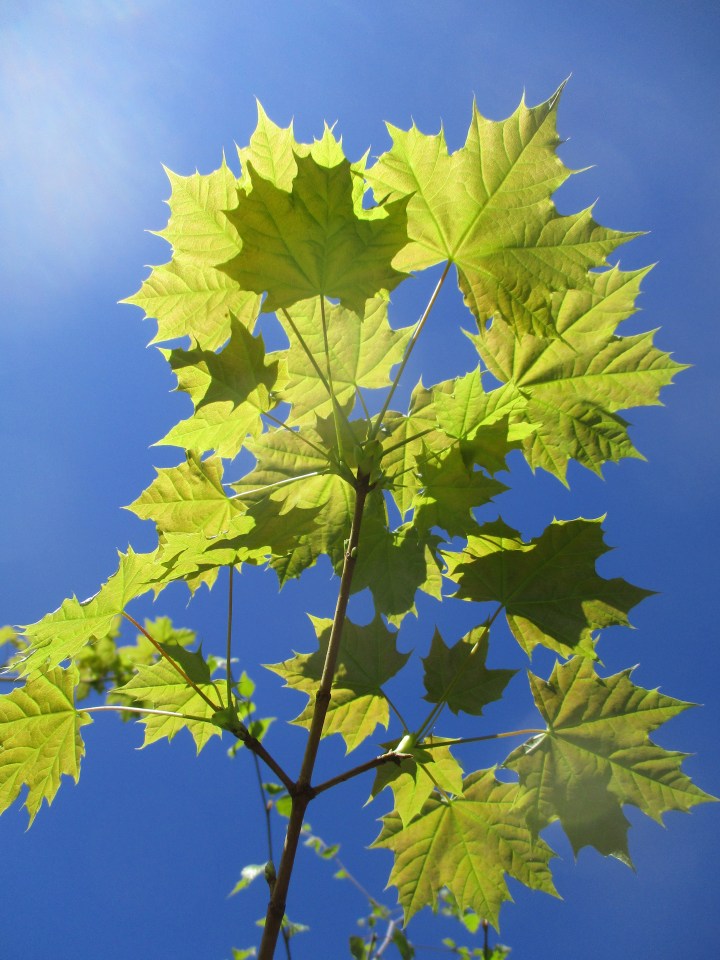
Five feral Norway maple saplings were found in one of the landscapes where mature trees were pruned for clearance from a roof. We could not just leave them there. They eventually would have been overwhelmed by the rest of the forest, or grown too close to the same roof that we pruned other trees away from. They were very easily dug, so came back to the nursery with us.

It was too late to prune them as necessary. They are tall and lanky trunks, with too many comparably lanky branches. As much as I am instinctively compelled to prune them while they are bare and dormant, I will refrain until later in spring or summer, when they will not bleed so much. They look ridiculous. They seem happy though. Their buds are beginning to swell already.

We have no idea where they will go from here. After pruning, they should develop into exemplary specimens. As goofy as they are now, their trunks are remarkably straight. I happen to be fond of Norway maple, and would be pleased to find an application for them here. The problems is that there are too many trees here, and the forests and landscapes continue to make more!

Horticulture in a forest can be like that. It seems like there is plenty of space out there, but so much of the space is too shaded or too crowded.

Six on Saturday: Talk To The Palm


That is how horticulturists say, “Talk to the hand.” During the past three and a half decades that I have been working with landscape designer, Brent Green, I have deduced that there is not a specimen of Washingtonia filifera in the Santa Clara Valley, or anywhere else for that mater, who is any more interested by what I have to say than he is. Nonetheless, I appreciate palms.

1. Rats! I thought that was who chewed on a petiole of my favorite young windmill palm from Western San Jose. However, this picture shows several small slices made with a straight blade!P00222-1

2. Pleats of an aging fronds of the same windmill palm demonstrate that surfaces exposed to the south deteriorate before those exposed to the north. The frond was tilted up for this picture.P00222-2

3. Windmill palm seedling is one of a few that I pulled from a landscape nearby, but could not bear to discard without at least trying to find a home for them; as if we need another palm here.P00222-3

4. Hesper palm is more interesting. I brought two here while they were nearly dead. The other did not survive. This one tried to recover, died back again, and is now trying to recover again.P00222-4

5. McCurtain scrub palm seed that I was so pleased to procure earlier is what is obscured just below the surface in this flat. I am concerned that the compost might not have been ready.P00222-5

6. Seed of other odd species of palm were found in a package that had been in storage for a few years. As if we need another palm here, all will get sown. Sadly, few are likely to still be viable.P00222-6

This is the link for Six on Saturday, for anyone else who would like to participate:

https://thepropagatorblog.wordpress.com/2017/09/18/six-on-saturday-a-participant-guide/

Cymbidium Orchid

50218
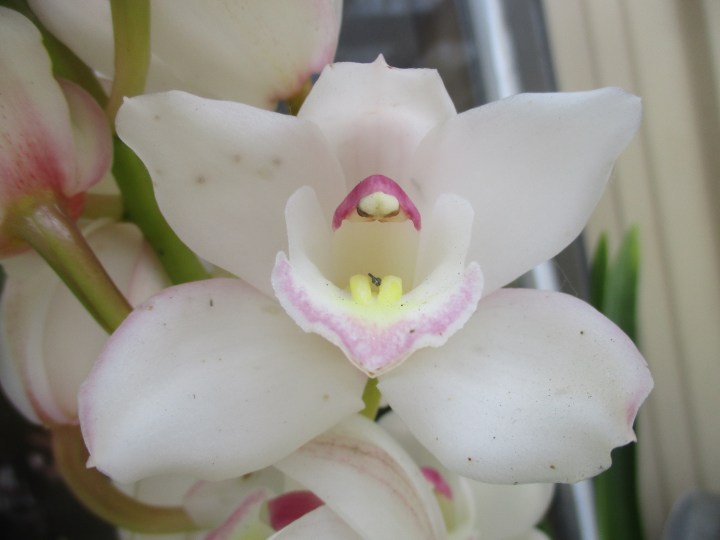
Cymbidiums are the most familiar orchids.

Of all the many and varied orchids, cymbidium orchids are the most popular because they are the easiest to grow. They are naturally terrestrial, so can be grown in the ground if the media (soil) is coarse and rich enough. (epiphytic orchids that naturally grow in crotches of trees want coarse bark in well drained pots.) They are also more tolerant of cool weather than tropical orchids are.

Plants with slightly yellowish leaves tend to bloom better. If the foliage is too dark green, it may not be getting enough sunlight. Regular application of fertilizer may promote bloom, although some plants do not seem to be too demanding. Watering may need to be as frequent as every three days through summer.

The arching flower stalks that begin to appear over winter may bloom for two months. They can be three feet tall, so stand well above the strap shaped leaves that get about two feet tall. Each stalk has many waxy flowers that can be two or three inches wide, in almost any color but blue. Most flowers are pastel hues of pink, lavender, yellow, orange, chartreuse, tan or white, and are intricately spotted and blotched.