Yes, this is another sequel; and yes, this is my second Six on Saturday post for today. So far, no one has told me that posting twice is against the rules.
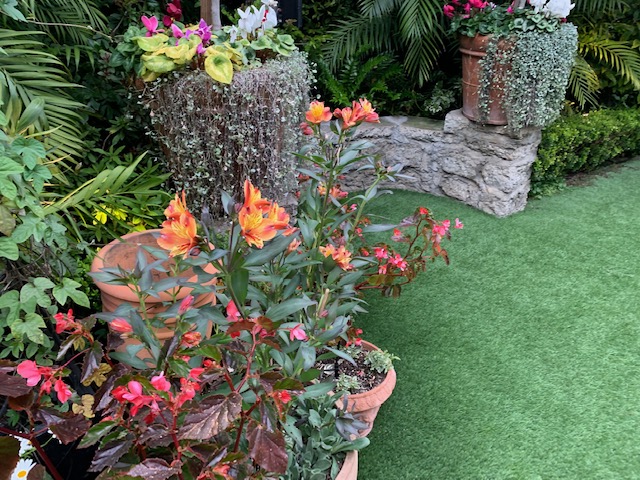
These are six more of the many pictures that my colleague, Brent Green, sent to me. They are of his home garden in Mid City Los Angeles, which is much more interesting than my utilitarian sort of garden. I explained the situation in more detail with the first post last week, and briefly mentioned it in the other Six on Saturday post just prior to this one.
The other Six on Saturday for today was posted here: https://tonytomeo.com/2019/04/06/six-on-saturday-brents-garden/
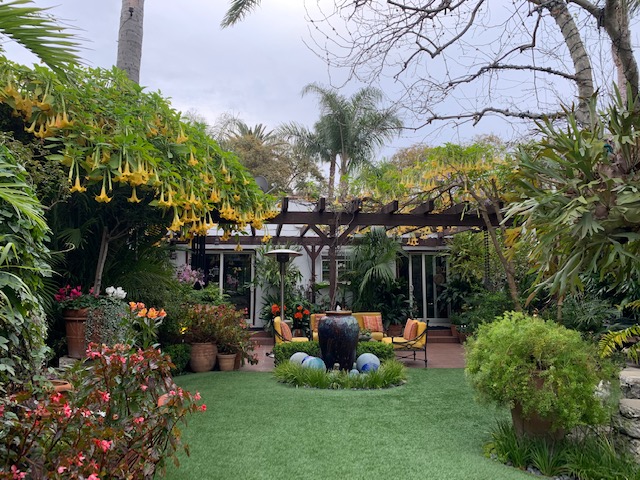
1. This is the small elevated porch-like patio at the rear of the garden from which the first of the six pictures in the previous post was taken. (This picture was taken from the back porch seen in that picture.) You can see how it, and the low wall to the left, were constructed from the broken concrete of the old driveway. The very edge of the new driveway is barely visible at the left edge of the picture. More on that with the fourth picture.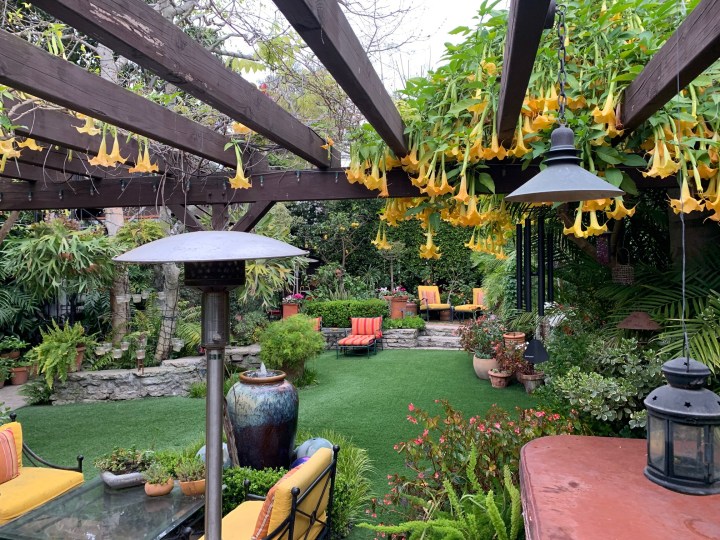
2. You can not see the most interesting feature of this picture, which is just to the left of the previous picture. Right there in the middle, completely obscured by vegetation, there is a small garage that was converted to an office with a deck on the roof, where I camp out when I go to Los Angeles. It is like sleeping in a tropical jungle with a view of the ‘HOLLYWOOD’ sign, which by the way, is different from sleeping in a redwood forest.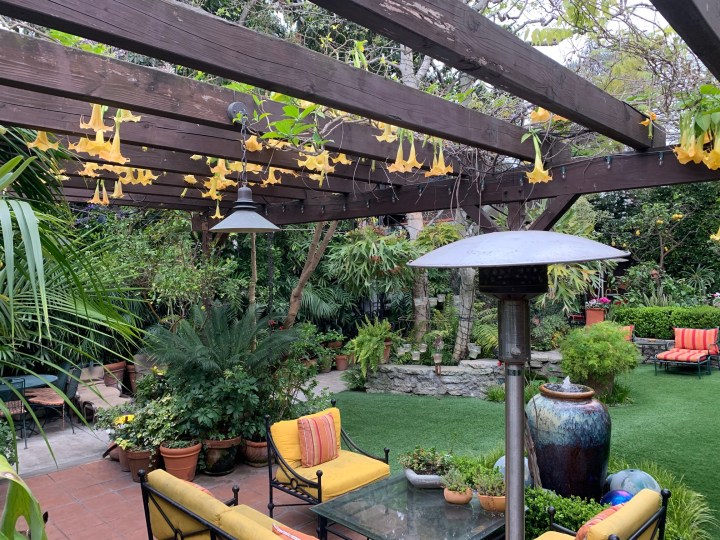
3. Just to the left of the previous picture, the ‘driveway’, which I will explain next, extends from the garage that is now an office to the street out front. In the narrow space between the driveway and fence, this overgrown mess of pink jasmine on top of a ficus hedge behind a thicket of bamboo palms obscures the house next door. All this jasmine is VERY fragrant all day and into evening when the angel’s trumpet gets powerfully fragrant too.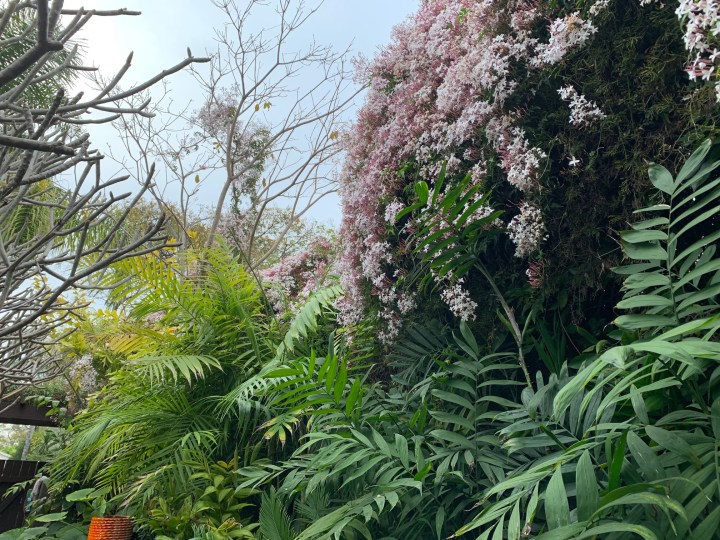
4. Now the driveway. The old pavement was removed and recycled into other features. The new pavement replaced it . . . but was never used as a driveway. The gate seen here is wide enough for a car to fit through, but is never opened. A car couldn’t get through all this vegetation anyway. A French door from the dining room opens up onto a wide spot where that weird orange fountain in the middle is. It all became more nice patios space.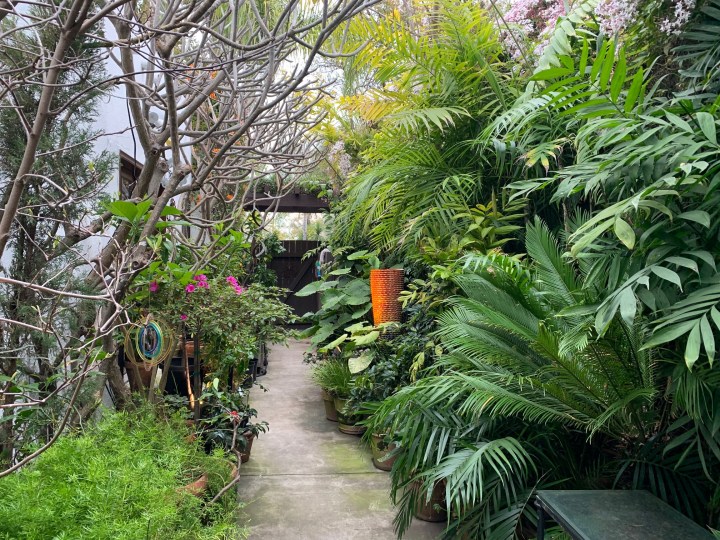
5. Coming back around to the back patio from where the first two pictures (of these six) were taken, we can see how thoroughly the garden space is enclosed by vegetation. No outside structures are visible. You would never guess that this garden is about a block from the Santa Monica Freeway, and that it is surrounded by other homes and apartment buildings. Even the utility cables out back are hidden. Fountains obscure ambient noise.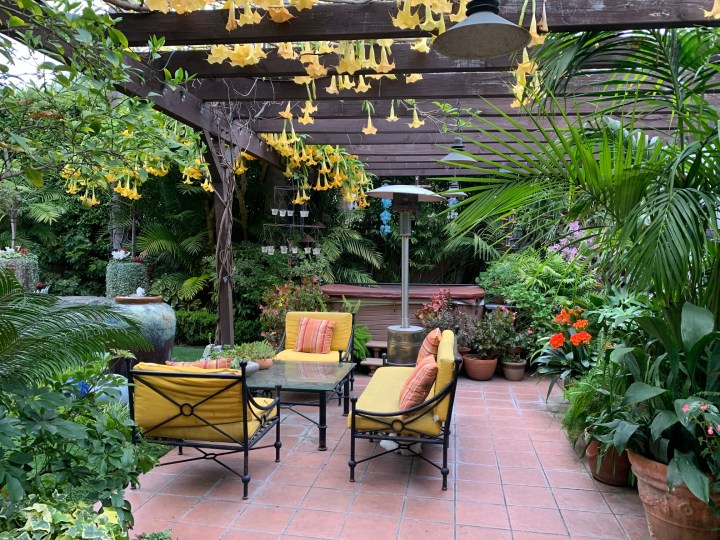
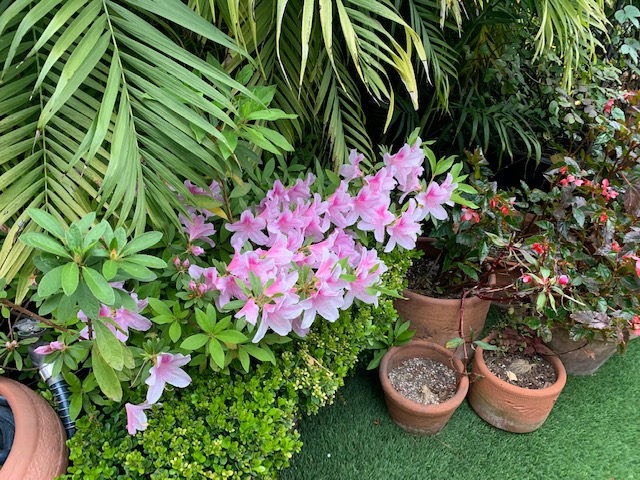
6. Way back in the corner on the right of the previous picture, behind the kentia palm and past the glass door of the master bedroom, we find another blooming azalea, like the specimen in the third of the six pictures posted earlier. For Southern California, this is an impressive specimen. The big staghorn fern above and behind it is really getting monstrous. I have no idea what that weird twisted purple plastic device is. Brent has such bad taste.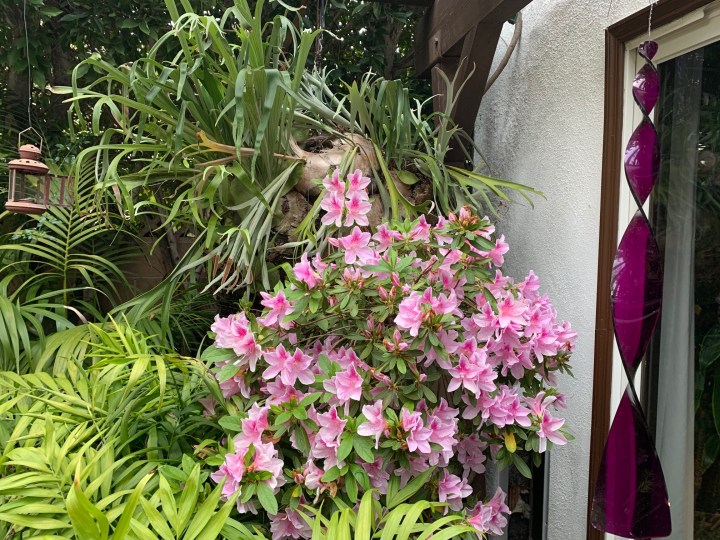
This is the link for Six on Saturday, for anyone else who would like to participate:
https://thepropagatorblog.wordpress.com/2017/09/18/six-on-saturday-a-participant-guide/

 Actually, it is a fruit. It contains seeds. Tomato, Solanum lycopersicum, is one of the most popular vegetables in American gardens. Most are red. Some are yellow or orange. A few weird varieties are pink, green, dark purple, brownish or creamy white. The largest tomatoes can get more than four inches wide. Tiny clustered ‘grape’ tomatoes are less than a quarter inch wide. There are literally thousands of varieties!
 Compared to replacing cool season annuals with warm season annuals, the replacement of cool season or ‘winter’ vegetables with warm season or ‘summer’ vegetables is not quite as traumatic. Most of the cabbage, broccoli and cauliflower plants finish in time to make room for new vegetable plants anyway. Unlike flowering annuals, they make it obvious that they are done for the season.
 In this situation, the point is that all those pointed tips of the leaves of this awkwardly floppy century plant, Agave americana, are extremely sharp, extremely rigid and EXTREMELY dangerous. Those shorter teeth on the margins of the leaves are just as sharp and rigid, and are curved inward to maximize injury to anyone trying to get away from an initial jab. With tips that impale, and marginal teeth that slash, this is one very hateful perennial!
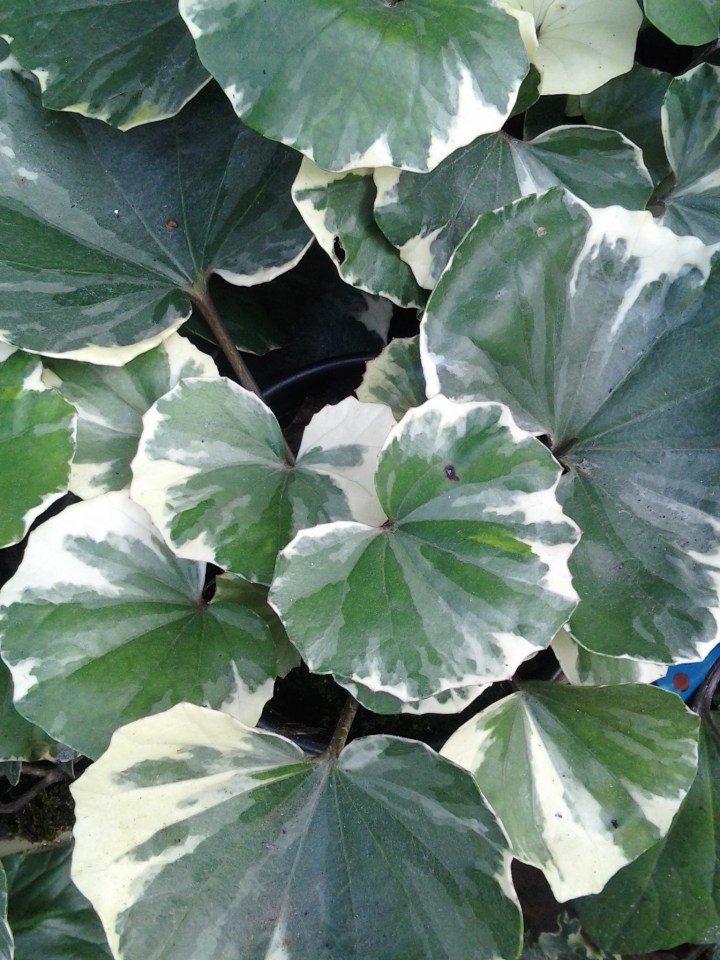 As an understory species that naturally grows under forest trees in its native environment in Japan, leopard plant, Farfugium japonicum, can be quite happy in parts of the garden that are too shady for other plants. If it does not get too warm or dry, it can tolerate full sun. It likes rich soil and frequent watering. Fertilizer should be applied moderately, since too much can cause foliar burn.
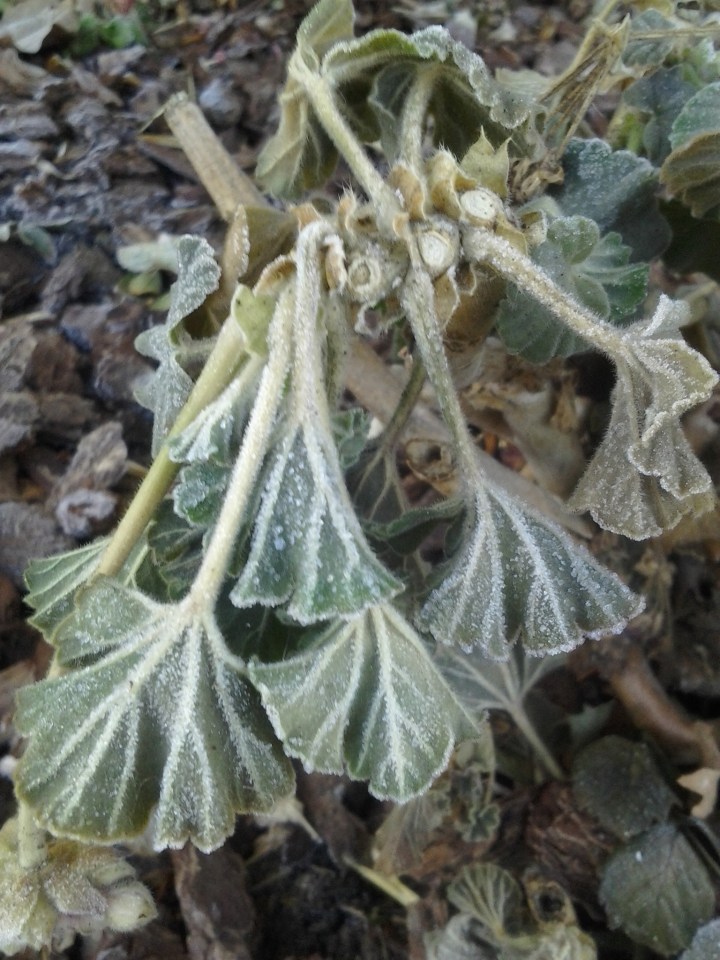 Scheduling of gardening chores is as important now as it ever was. We plant warm season vegetables and annuals in time for spring and summer. We plant cool season vegetables and annuals for autumn and winter. We pick flowers as they bloom. We harvest fruits and vegetables as they ripen. We watch the seasons change on our calendars, as well as in the locally specific weather.
 After decades of spectacular spring bloom, this pair of flowering cherry trees in the picture above must be removed. They have been deteriorating for a very long time. Below the limber blooming branches of the tree on the right, there is not much more than a bulky rotten trunk, one rotting limb, and a short stub of a limb that was cut back to a bit of viable twiggy growth last year. The tree to the left has only a few more viable but rotten limbs.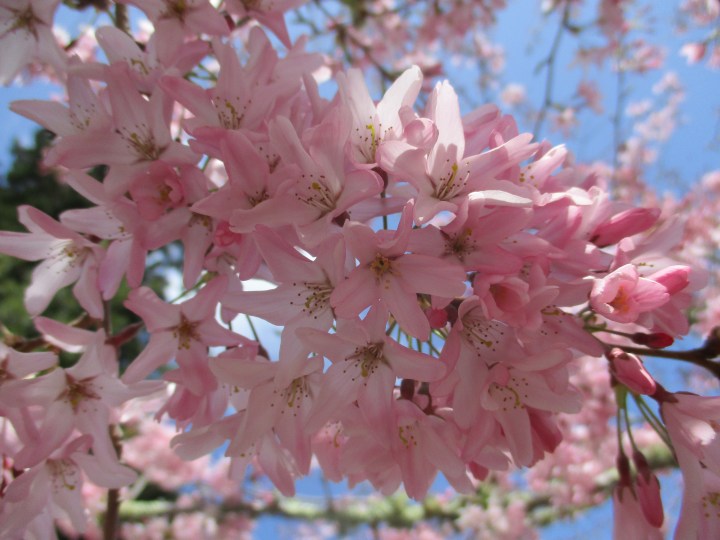

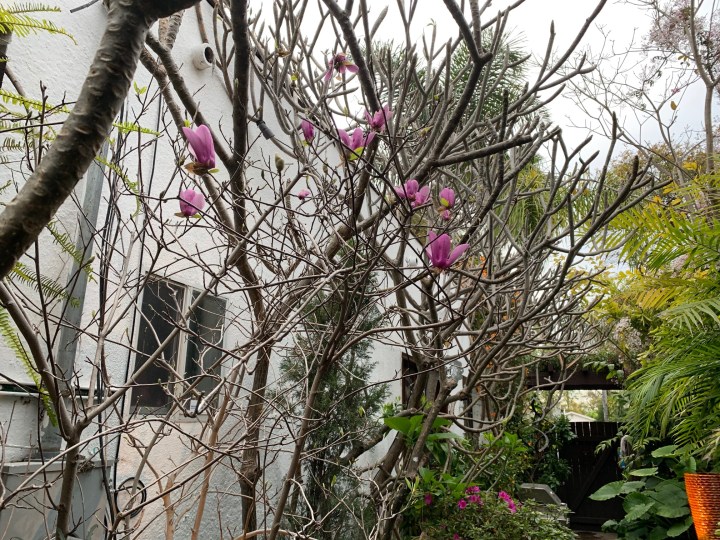 This is why one should not ask someone else who is very vain to take a picture of something important. The vain only take good selfies. Others subjects are too unimportant to them to bother getting a good picture of.