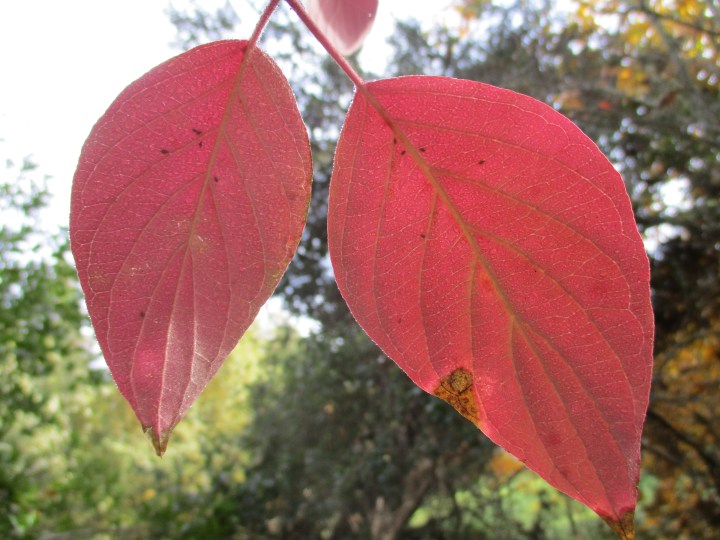
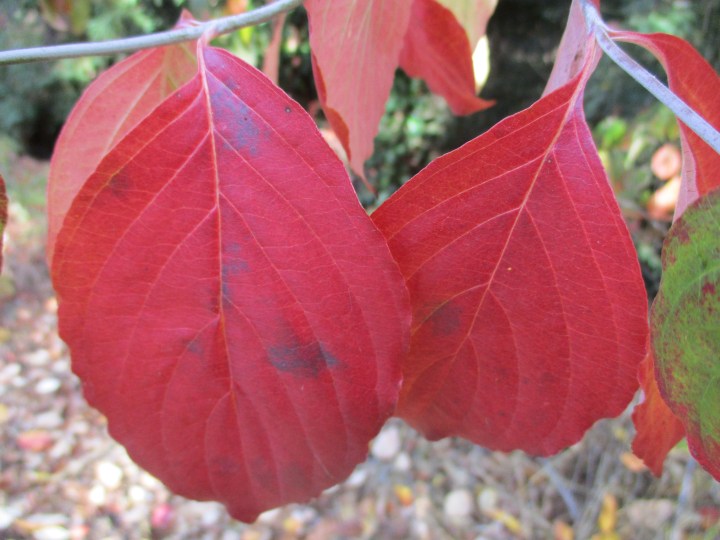
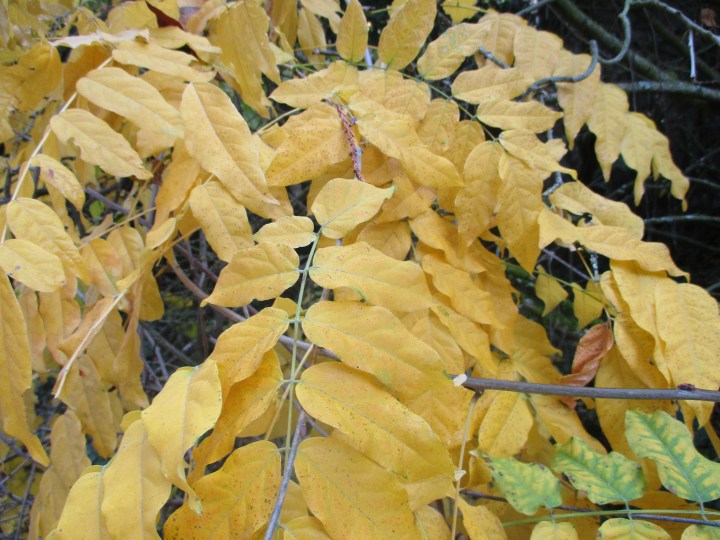
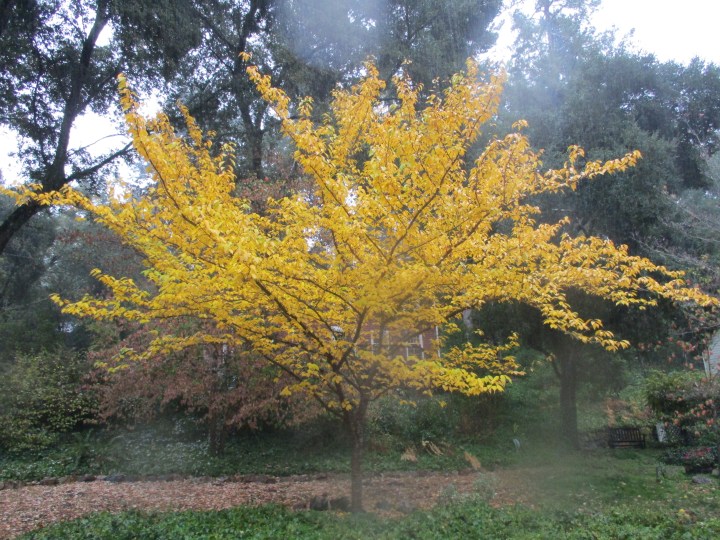
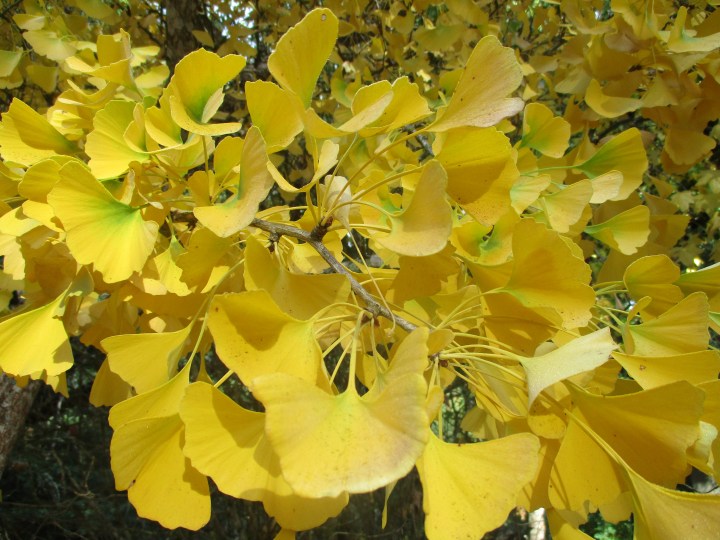
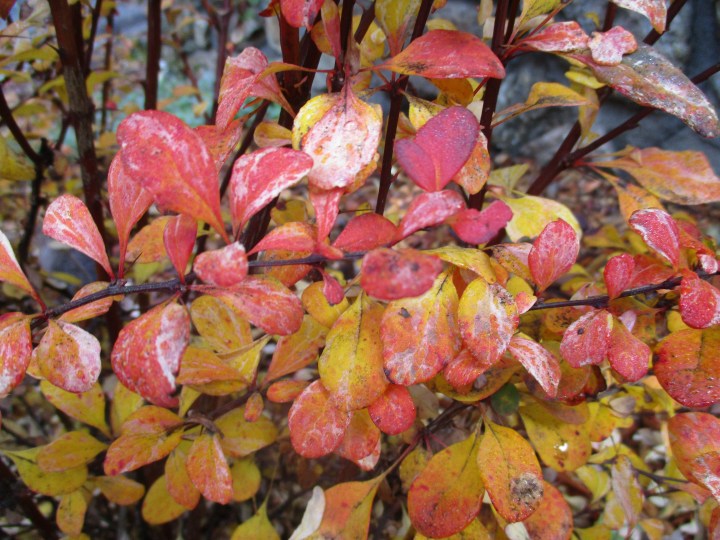
These are the last six of the twenty four pictures of autumn foliar color that I got before the rain knocked so much of the foliage to the ground more than a week ago. #2 is the only picture of foliage that is on the ground instead of still suspended on the stems that produced it. The fallen birch leaves were just too pretty on the stone wall to not get a picture of them.
1. Japanese maple is not my favorite species, but it does have certain attributes. There happen to be several at work just because they happen to work well there. Some that do not typically develop good color got remarkably colorful this year. I believe that this particular Japanese maple is the common ‘Bloodgood’. It had been dark reddish bronze through summer, and then turned brighter red for autumn.
2. European white birch is grown for the elegant white trunks that contrast so nicely against the deep green of the redwoods. This autumn foliar color, although brief, is an added bonus. These trees were already starting to defoliate before the rain.
3. Hydrangea is not known for autumn foliar color, and as you can see, turns only pale yellow. Yet, it is striking in the shade, and contrasts nicely with the rich green of redwood and English ivy foliage.
4. Spirea is likewise not grown for autumn foliar color, or at least no so much in our mild climate. There are more than a dozen of them here, and none are doing very well. They will get cut back and groomed now that they are bare. I do not know what cultivar this particular spirea is.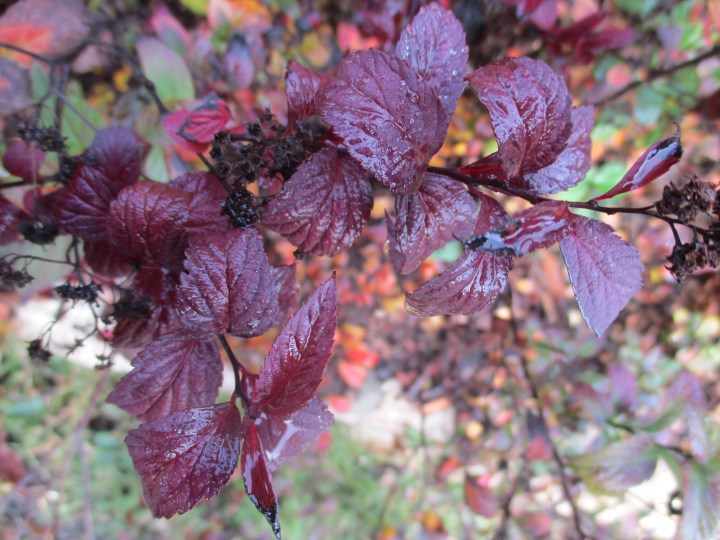
5. Golden weeping willow was not only golden with autumn foliar color, but is still golden with the yellow bark on the twigs. So far, I am not too impressed with the yellow twigs. It is still a small tree, and growing in a mild climate that may not stimulate much color. Regardless, I happen to like weeping willows. This one happens to be in a swampy spot where it is quite happy.
6. Bald cypress is rare here, but there happens to be two at work. One was supposed to be a dawn redwood, but was obviously mislabeled. Fortunately, it just happened to be planted on the bank of a small creek where it gets plenty of water. The other was planted in an area that is too swampy for other trees. Both are doing quite well. When they defoliated, they covered the ground with finely textured needles that would have been impossible to rake up.
This is the link for Six on Saturday, for anyone else who would like to participate:
https://thepropagatorblog.wordpress.com/2017/09/18/six-on-saturday-a-participant-guide/


 The softest and laciest of the asparagus is the asparagus fern, Asparagus setaceus. The extremely small ‘leaves’ (or ‘cladodes’) are less than a quarter of an inch long. The tiny and mostly unnoticed pale white flowers that bloom sporadically in warm weather make it obvious that asparagus fern is not really a fern. (Ferns do not bloom.) If any green berries develop, they are toxic.
 All around town, there are Italian stone pines, Canary Island pines, Monterey pines and Aleppo pines that are much too big for the home gardens that they live in. Some are too close to pavement or foundations. Others are under utility cables. Many are shading or crowding out other more desirable plants. What most have in common is that they started out as living Christmas trees.
 This is a recycled picture that still annoys me. There was another that I did not want to use because it happens to be from a landscape that I sometimes work in.
 It seems like not so long ago when the only African daisy that was commonly available was the trailing African daisy that makes such a nice relaxed ground cover for small spaces. The simple white flowers have navy blue centers, and are occasionally joined by mutant light purple flowers. The cultivar that blooms only in light purple was not as popular. Things have certainly changed!
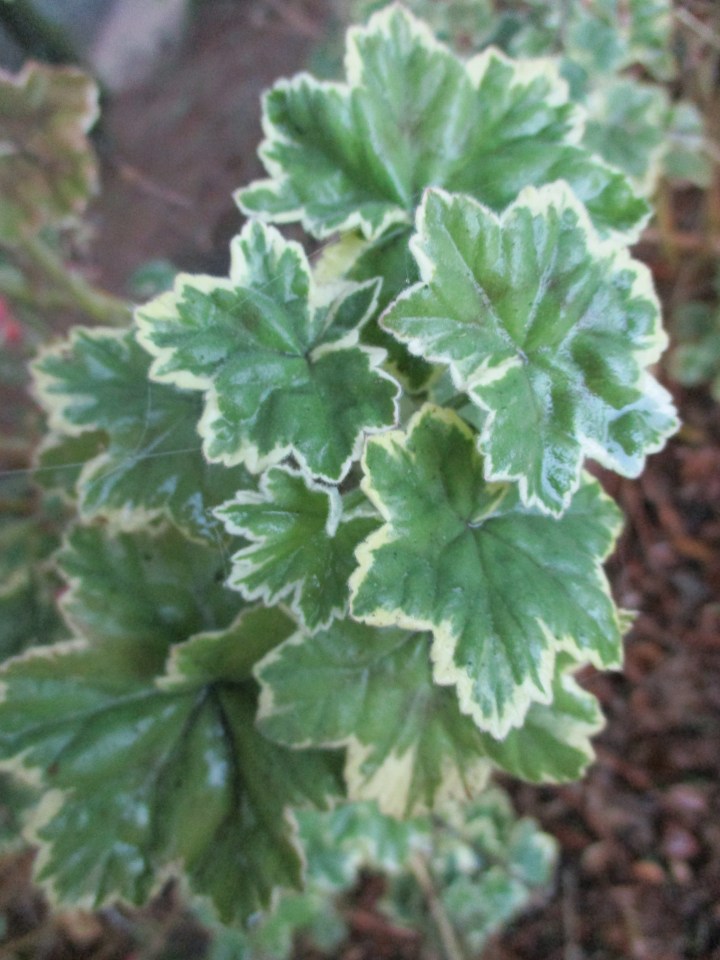 Dilemmas are common in gardening. Should summer vegetables that are still producing be removed so that winter vegetables can get started on time? What about replacing summer annuals that are still blooming with winter annuals, and then replacing winter annuals with summer annuals half a year later? Should tender perennials be regarded as annuals, or get a second chance?
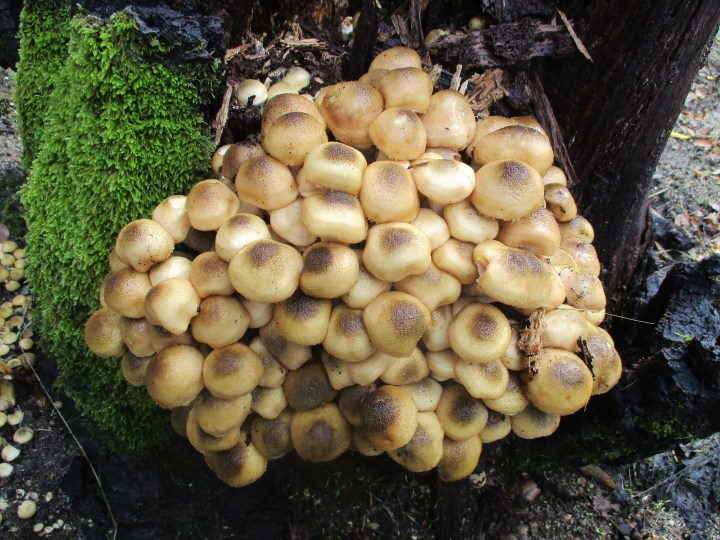 Is this Armillaria mellea, the dreaded oak root rot fungus? I really do not know. All the elements are here. The stump is that of a coast live oak. Bellow the stump there are the remains of roots. Those necrotic roots are undoubtedly decomposing as a result of rot. That rot is undoubtedly associated with this fungus. Furthermore, it fits the description of oak root rot fungus. The toasted spots were probably caused by weathering as the mushrooms started to develop while the weather was still warm and dry.
 It is certainly not my favorite small tree. Actually, in most situations, I rather dislike it, which is why I sometimes accidentally spell it without the first ‘e’. It is a cop out; a micro tree that too often ends up where a larger and more respectable tree would be more appropriate. They are not shade trees. They are not not big enough for freeway landscapes or to be street trees on wide boulevards. They are not immune to diseases and insect infestations; and they commonly drop honeydew from aphid or scale infestation, and lose their bloom to powdery mildew. They are not ‘low-maintenance’, and really should be pruned more than they are, but will get you in trouble with the neighbors if you prune them as aggressively as they should be pruned.