Bulbs Now For Summer Bloom

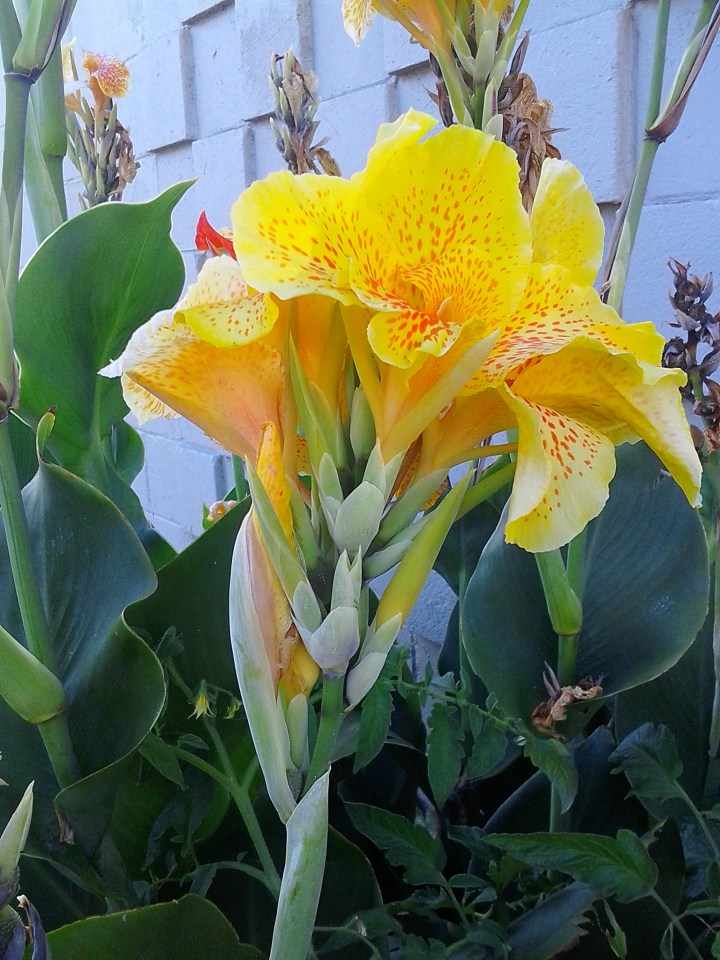
60203thumbLike a timely sequel, bulbs are back. Spring blooming bulbs were available in nurseries earlier, so that they could get planted and disperse their roots through winter, and get ready for their early bloom. Since then, Christmas trees came and went as they were replaced by bare root stock. Now that bare root stock is selling, summer blooming bulbs are arriving for late winter planting.

Summer bulbs are not on the same schedule as spring bulbs. Most of the earliest spring bulb bloom while their foliage is still developing. A few daffodil, grape hyacinth and crocus are already blooming prematurely. Summer bulbs start to grow a bit later and grow a bit slower, and then bloom only after their foliage has matured. Some may not bloom until late summer or early autumn.

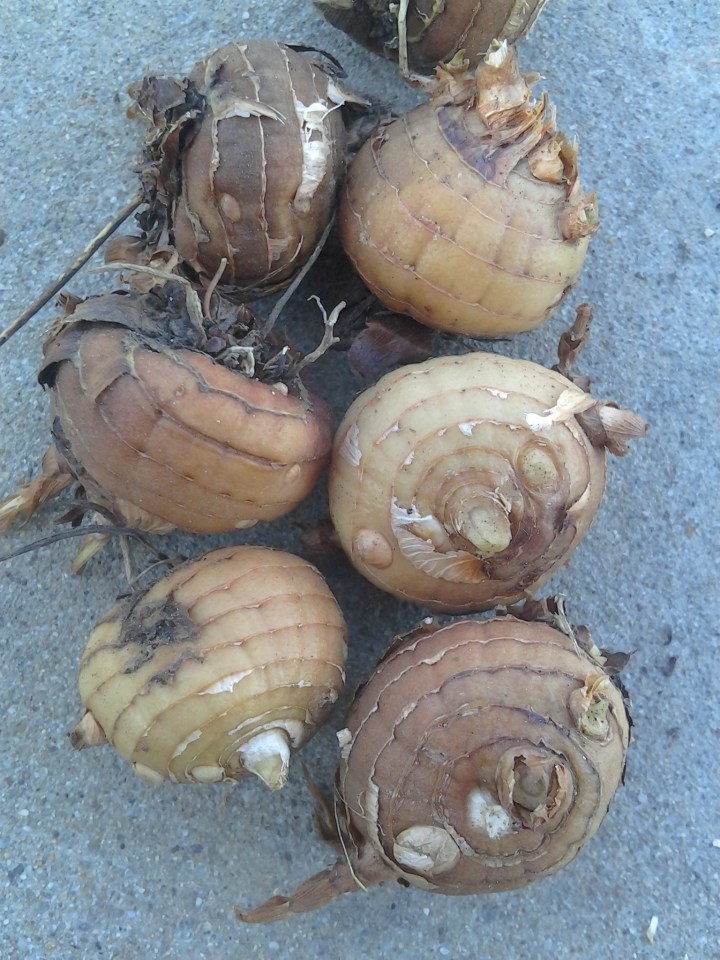
There are a few similarities between spring and summer bulbs though. Both groups include plants that develop corms, rhizomes, tubers or tuberous roots instead of bulbs. All are known as ‘bubs’ for convenience. Although very different physiologically, they all function about the same way, by storing resources through dormancy so that they can regenerate within their particular season.

Another similarity is that after spring and summer bulbs bloom, and their spent flowers get pruned away, their foliage should remain until it withers. This foliage is what sustains the bulbs below while they replenish resources to survive through the next dormancy. (Actually, most bulbs replace themselves with new bulbs.) This foliage will want water and fertilizer like any other perennial.

Unfortunately, even with regular watering and fertilizing, the most popular spring and summer bulbs are not really as reliably perennial as they are purported to be. Except for the few types that thrive and naturalize like daffodils (spring) and crocosmia (summer), most bloom very impressively only in their first year, and then bloom meagerly in their second year, if they bloom again at all.

Crocosmia, dahlia, hardy orchid (Bletilla), canna and classic big white calla are the most reliable summer bulbs. Smaller colorful callas are not as easy, but are worth trying. Gladiolus, tuberous begonia and the various lilies are so spectacular that no one minds if they bloom only for one summer. Astilbe, liatris and various alliums work nicely behind where summer annuals will go later.

Plant Bare Root Plants Properly

90206thumbCompared to canned (potted) nursery stock, bare root plants have a few advantages. They are less expensive, easier to handle, more conducive to pruning into a desired form, and they disperse roots and get established more efficiently. One more advantage that is not often considered is that they are easier to install into the garden. For some, it is as simple as poking a stick in the mud.

Perhaps the only disadvantage of bare root plants is that they must be planted immediately, so that they get their roots soaked and settled into the ground into which they will disperse new roots. If planting must be delayed, roots can soak in a bucket of water for only a few days. Unless they are to live in big pots, potting for a season only delays and interferes with efficient root dispersion.

Only bare root trees that need root barriers (to divert roots from pavement) or mesh gopher baskets (to divert gophers from roots) will need planting holes that are as big as those for canned nursery stock. Otherwise, planting holes need be only as wide as the bare roots, and should be no deeper. If soil is loosened too deeply below, new plants will sink as loose soil settles. Graft unions must remain above grade.

Well flared roots can be spread over a cone of soil formed at the bottom of the planting hole. Conversely, cane berries, after their roots get loosened, can simply be dropped into slots formed by sticking a shovel into the ground and prying it back.

Soil amendments that are useful for providing a transition zone between potting media of canned nursery stock the surrounding soil are not so important with bare root stock. Bare root plants only want a bit of soil amendment if the soil is too sandy or too dense with clay. Otherwise, too much amendment can actually inhibit root dispersion by tempting roots to stay where the richest soil is.

Once planted, trees can be pruned as desired. Most come with superfluous stems to provide more options for pruning, and some stems will be damaged in transport. Fertilizer need not be applied until growth resumes in spring.

Conifers Have A Woodsy Style

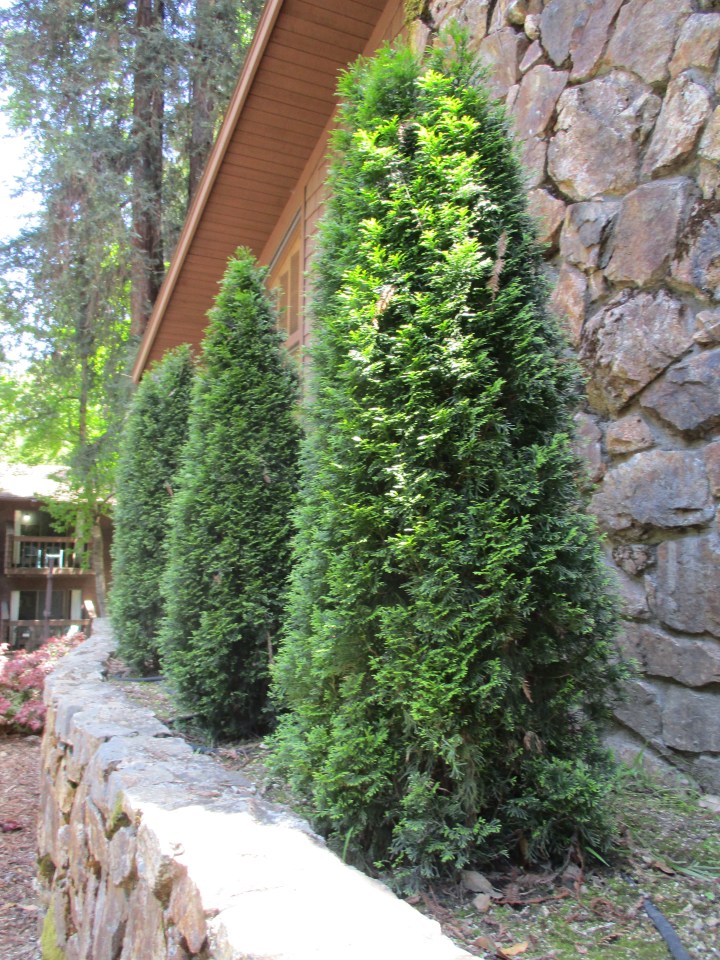
81205Conifers are the most prominent forest trees in North America, but are notably scarce in home gardens. Except for compact varieties of juniper (which were probably too common years ago) and arborvitae, most conifers are trees that get too big for residential gardens, and few adapt to regular pruning that might keep them contained. Almost all are evergreen, so block sunlight in winter.
Gingko (maidenhair tree), bald cypress and dawn redwood happen to be deciduous conifers; but gingko is typically thought of as a ‘broadleaf’ (not coniferous) tree, and bald cypress and dawn redwood are quite rare. The various podocarpuses are useful coniferous trees that happen to be very complaisant to pruning, but like gingko, they are typically thought of as broadleaf trees.

Junipers and arborvitaes are just as practical for home gardens as they ever were, and the many modern varieties that have been introduces over the years are even more interesting than the old classics. Modern arborvitaes are more compact. Modern junipers exhibit more colorful foliage, and more distinctive forms and textures. Foliage can be lemony yellow or blue like a blue spruce.

Simply speaking, conifers are cone bearing plants. They are typically outfitted with needle or scale leaves. Of course, it is not that simple. Juniper seeds are contained in fleshy structures that resemble berries. Gingo and podocarpus seeds actually come with a squishy mess. So, ‘cones’ are not always as easy to recognize as pine cones are. Neither are the wide ‘needles’ of gingko.

Redwoods, pines, cedars, cypresses, Leyland cypresses, spruces and firs are the more familiar of the larger coniferous trees. Bunya bunya, Norfolk Island pine, western red cedar, incense cedar and the various yews and chamaecyparises are somewhat rare. Larch and hemlock are very rare because they do not like the climate here. With few exceptions, these larger conifers have dominant central trunks that can not be pruned down without ruining the structure of the trees as they develop.80516

Winter Pruning Of Fruit Trees

90130thumbThe vast orchards of the Sacramento and San Joaquin Valleys might make the impression that production of fruit is easy. The trees naturally bloom in spring, and develop fruit over summer, as if they do most of the work prior to harvest. In reality, those trees have been so extensively bred to maximize production that they need, among other maintenance, very specialized pruning in winter.
Without pruning, deciduous fruit trees produce more fruit than they can support. The weight of the fruit breaks and disfigures limbs. Excessive fruit production exhausts resources so that, although more fruit is produced, it is of inferior quality. Diseases and insects proliferate in crowded stem growth that lacks vigor. Unharvested fruit that is beyond reach in upper growth may attract rodents.

Well pruned deciduous fruit tree produce fruit of much better quality, and are able to support it on well structured limbs that are reasonably within reach. They are less susceptible to diseases and insects. Such pruning seems severe to those who are unfamiliar with it, but it is necessary, and the trees appreciate it. Because it is so severe, it is done while trees are dormant through winter.

Different types of fruit trees need distinct types of pruning. Furthermore, different cultivars of each type may need different degrees of the same type of pruning. All should get the ‘four Ds’, which are ‘dead, dying, damaged and diseased’ growth, pruned out of them. Because figs produce early and late crops, they can be pruned less for more early figs, or more severely for more late figs.

Most of the deciduous fruit trees are either stone fruits or pomme fruits. The stone fruits include apricot, plum, prune, nectarine, peach and cherry, which are all of the genus of Prunus. Pomme fruits are apple, pear and quince. Because the winter pruning of deciduous fruit trees is so specialized and so intensive, it is worth studying, preferably before planting the fruit trees that require it.

Some Plants Impress With Bark

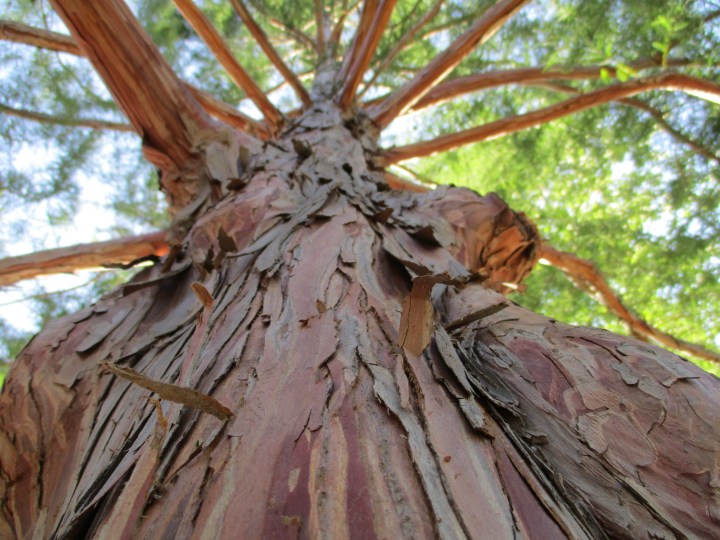
P80805Lemon eucalyptus, ‘Marina’ madrone, cork oak and all sorts of melaleuca trees are known more for their interesting bark than for their foliage or flowers. It helps that their distinctive trunks and branch structures are ideal for displaying their unique bark. Color and texture of bark is remarkably variable, and tends to get noticed more in winter while blooms and foliage are lacking.
Bark of sycamores, birches, elms and crape myrtles that had been so handsome throughout the year is more visible now that it is not partially obscured or shaded by the deciduous foliage that is associated with it. Trunks and limbs of European white and Jacquemontii birches are strikingly white. ‘Natchez’ crape myrtle has distinctively blotched bark, (although the white flowers are pale.)

Because of their other assets, English walnuts, figs and saucer magnolias are not often grown for their bark. Nonetheless, their pale gray bark shows off their stocky bare branch structure nicely, especially in front of an evergreen backdrop of redwoods or pines. The smooth metallic gray bark of European beech is much more subdued, but is what makes big old trees so distinguished.

A few deciduous trees and shrubs get more colorful as winter weather gets cooler. Instead of white or pale gray, their bark turns brighter yellow, orange or red. Some plants, like sticks-of-fire, do not need much cool weather to develop good color. Others get more colorful in colder climates, and contrast spectacularly to a snowy landscape. Locally, they should be well exposed to chill.

As the name suggests, the coral bark Japanese maple (‘Sango Kaku’) develops pinkish orange bark. It can get ruddier in colder climates, but may get yellowish here. Unlike other Japanese maples that get pruned to display their delicate foliage and branch structure, the coral bark Japanese maple sometimes gets pruned more aggressively to promote more colorful twiggy growth.

Osier dogwood is a shrubby dogwood that lacks colorful bloom, but compensates with ruddy brown, brownish orange or pale yellow bark in winter. (Dogwood bark . . . There is a pun there somewhere.) Because it lacks colorful bloom, it can be pruned aggressively after winter. Older canes that do not color as well can be pruned to the ground as they get replaced by new canes.

Prune Now For Roses Later

70524thumb+The main problems with roses locally are not related to climate, soil, insects or disease. Warm and semi-arid climates of California happen to be some of the best places in the World for roses. Sure, many roses have problems with insects such as aphid, and diseases such as powdery mildew, but primarily because such pathogens proliferate among roses that are not pruned properly.

Yes, the main problems with roses are a direct result of improper pruning. Without adequate pruning, roses become overgrown thickets that shelter the pathogens that afflict them, but also lack the vigor to be resistant to damage. Like so many other domesticated plants, they were bred for maximum production of unnaturally big flowers, at the expense of natural resistance to pathogens.

Pruning eliminates superfluous growth and improves air circulation, which interferes with the proliferation of most types of pathogens. Most pathogens overwinter in fallen foliage that should get removed in the process. Pruning also concentrates growth of the next season into fewer new stems, which stimulates vigorous growth that hopefully grows faster than the pathogens that infest it.

Roses should be pruned while dormant in winter, after defoliation, and before buds start to swell at the end of winter. Hybrid tea, floribunda and grandiflora roses should be pruned back to only about three to six canes that grew from the base during the previous year. Older canes should be removed. Remaining canes should be only about two feet tall, and cut just above a healthy bud. Any growth below the graft union (where the basal canes originate) are genetically different suckers (from the understock or rootstock) that must be removed.

As growth resumes in spring, well pruned plants will produce fewer stems and blooms that are significantly more vigorous than those of inadequately pruned plants. Overgrown and inadequately pruned plants must spread their resources thin amongst more but significantly weaker stem growth that is much more likely to be damaged by pathogens. Aggressive pruning now pays off later.

Arborists Really Know Their Trees

7bd6It is no surprise that there are many different types of physicians within the medical industries. Pediatricians, surgeons, cardiologists, dermatologists, and all sorts of ‘doctors’ are all recognized for their particular medical specialty. Yet, almost all horticultural professionals are known simply as gardeners or landscapers, even though many never work directly in gardens or landscapes.

Production nurserymen grow horticultural commodities (plants). Other nurserymen maintain these commodities while they are marketed. Landscape designers develop the landscapes that many plants inhabit. Only after the involvement of various less familiar horticultural professionals, landscapers install the landscapes, and gardeners maintain them. Somehow, they get too much credit.

Arborists really deserve more credit. They are the physicians of trees, who specialize in arboriculture, which is the horticulture of trees. Much of their work is out of reach to gardeners, and is very distinct from the sort of work that gardeners should be expected to perform. Trees are the most substantial features of a landscape, so really should get the proper attention that they deserve.

The International Society of Arboriculture, or ISA, certifies professional arborists who have passed an examination of their arboricultural expertise, and continue to demonstrate proficiency with discriminating arboricultural standards. Continued involvement with ISA classes, educational seminars and workshops is required to maintain arborist certification. It demands serious dedication.

Besides assessing the health, stability and structural integrity of trees, ISA certified arborists are the most qualified to prescribe any necessary arboricultural procedures, and to direct those who perform these necessary procedures. Most local municipalities require a report from an ISA certified arborist to accompany an application for a permit to remove any protected ‘heritage’ tree.

The website of the ISA, at www.isa-arbor.com, Is an excellent resource for finding certified arborists, and the tree service businesses with which they are affiliated. Arborists can be found by name directly, or regionally by ZIP code or city. The website is also a great resource for information about proper arboriculture and trees, and can help those who are not arborists with selection of trees.

Bare Root Season Is Now

80124thumbAutumn really is the season for planting. That is the general rule. One generalization about general rules is that they generally do not apply to all of the specifics. In other words, there are likely certain exceptions. In this case, there are some types of plants that should not be planted in autumn. The next best season for planting is probably winter, which happens to be ‘bare root season’.

Just before the last of the Christmas trees were being sold, and relinquishing their space in nurseries, bare root stock started moving in. Some bare root stock is prepackaged with its otherwise bare roots in bags of moist sawdust. Nurseries that provide large volumes are likely to heel in unpackaged bare root stock into bins of moist sand, from which it gets pulled and wrapped as sold.

As the term ‘bare root’ implies, bare root stock was dug as early as the onset of dormancy in late autumn, and deprived of the soil that it grew in. Because it is dormant, and the weather is cool and damp, it does not mind much, if it even knows at all. As it emerges from dormancy next spring, it resumes growth, and disperses roots into the new soil that it got planted into while dormant.

Bare root stock is significantly less expensive than canned (potted) stock because it lightweight and does not take up much space in the nursery. It is also more efficient, since it only stops briefly in retail nurseries, on its way from growers to its final home destinations. New plants start dispersing roots right away, instead taking time and effort to recover from earlier confinement of roots.

Deciduous fruit trees and roses are the most familiar of bare root stock. The bare root fruit trees include the stone fruits of the genus Prunus, such as apricot, cherry, plum, prune, peach, nectarine and almond, as well as pomme fruits, such as apple, pear and quince. Figs, pomegranates, persimmons, walnuts, mulberries, grapevines, currants, gooseberries, blueberries, cane berries, strawberries, rhubarb, asparagus and a miscellany of deciduous blooming but fruitless plants are also available.

Fireplaces Are A Rare Luxury

51028thumbThere are fewer fireplaces after every significant earthquake. Removal of a damaged chimney is probably more practical than repair, particularly if the fireplace does not get much use anyway. Wood stoves sometimes get removed simply because they are in the way. Modern building codes forbid their return once they are gone, and also forbid them in new construction.

The few surviving fireplaces and wood stoves do not get used as regularly as they used to. It seems that no one is around the home long enough to tend to a fire. Orchards that provided so much affordable firewood as they were being removed for urban development are gone now. The outskirts of town, where trees and woodlots might be found, are now more than a short drive away.

Firewood can still be purchased from tree service businesses that must dispose of the wood that their work generates. Because such firewood is a byproduct of urban forestry, it is an unpredictable mix of all sorts of urban trees, and must be procured early in the year to be seasoned by autumn and winter. It is now much too late to purchase green firewood for this winter.

Almost all types of urban firewood are comparable to more traditional types. A few types deposit more residue in chimneys, so that chimneys need to be cleaned more frequently. Firewood from woodlots can be surprisingly more expensive; but it burns cleaner, and is already seasoned. Many woodlots would be pleased to deliver firewood that is ready to burn now.

Firewood is perishable, so only slightly more than enough for one year should be procured annually. Any leftovers can rot if left out in the weather too long. Firewood last longer in a shed or garage, but takes up too much space, and can be attractive to rodents.

Synthetic logs from the supermarket happen to be more efficient than real wood, and do not need to be seasoned. A single log burns longer and cleaner than a few real logs, and produces as much heat. However, they are individually very expensive, and are just not the same as real firewood.

Potted Plants Are Living Things

90109thumbCut Christmas trees really are the way to go. There is no obligation to take care of them after Christmas. They do not need to planted out into a garden that will be too small for them as they grow. They do not need to be maintained in a pot, only to get disfigured or partially defoliated before next Christmas. They simple get removed from the home and composted or otherwise disposed of.

Potted living Christmas trees may seem like a good idea, but they are not as sustainable as they seem to be. Only the smaller and more compact types of conifers can be confined to big pots or planted into compact garden spaces. Rosemary shorn into small cones happens do well either in big pots or out in the garden, and if preferred, can be allowed to assume its natural bushy form.

Many other potted plants that are popularly brought into the home for Christmas decoration are easier to accommodate but take a bit of effort. Poinsettias are the most familiar of these. They can grow as houseplants for years, and might hold their colorful bracts for months. In mild climates, they can be planted in the garden, but will never look like they did originally. Most get discarded.

Hollies and azaleas are more sustainable, but are not as popular. Of these, hollies are the easiest. They can be planted in larger pots or directly into the garden later, when the worst of winter is over. Azaleas will eventually drop their flowers, and will likely look very distressed for a few months, but if watered regularly, can regenerate new foliage that is adapted to their new environments.

Christmas cactus happens to be a delightful houseplant regardless of the season. It will also drop its flowers, but will generate appealing pendulous foliage that cascades nicely from hanging pots. It can bloom annually, although timing of bloom is quite variable. It can do the same outside, if sheltered. Amaryllis also prefers to stay potted. It will replace its tall flower stalks with a few leaves that sustain the bulbs until dormancy next autumn, and can bloom again next winter if given a chance.