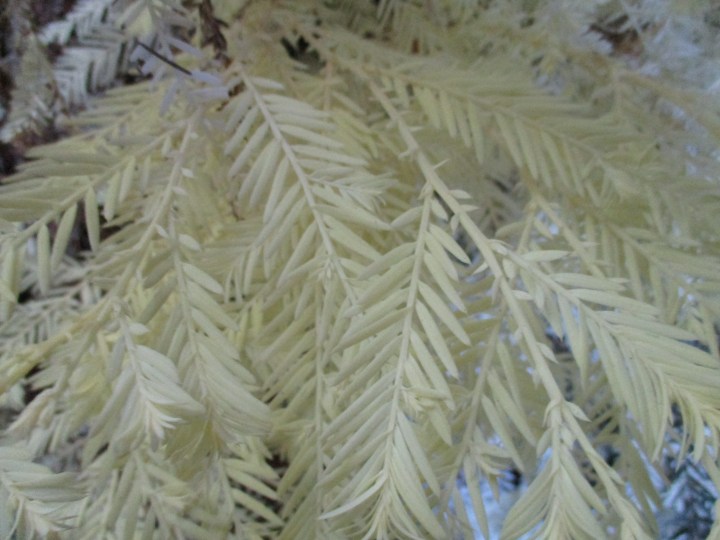
 How Italian! Red, white and green! A coastal redwood with a white albino sport (mutant growth) amongst otherwise deep green foliage. Actually, it is very Californian. Coastal redwood is endemic to California with only a a few north of the border on the extreme southern coast of Oregon.
Such sports are quite rare. Back in the late 1970s, an article in World Magazine mentioned that only five of these albino ‘trees’ where known to exist. There were actually more, even back then, but others were not documented. (They were WithOut Papers – WOP.) The specimen in the picture is at a home that is about a century old, so it was known about for a very long time, although not documented.
Albino foliage is a lethal mutation. It lacks chlorophyll, so can not sustain itself. It only survives because it originates as basal watersprouts that remain attached to the original green trees that produce and then sustain it. Attempt to graft albino grown onto other green trees has been unsuccessful.
Albino growth looks pretty in pictures, and is provides striking (although very perishable) cut foliage that is even more striking with black flowers, but does not make such a nice tree. It stays shrubby at the base of the originating tree, without developing distinct trunks or substantial branches. It does not shed old foliage as efficiently as green growth does, so always looks grungy. To make matters worse, albino foliage is more sensitive to frost, so gets killed back every few years or so, and then is slow to shed the dead foliage and stems.
Coastal redwood is one of the most fascinating trees in the World. It is the tallest, and among the biggest and oldest. It is no wonder that it is the state tree of California.
Six on Saturday: Bits and Pieces II
It has been a while since I posted a sequel to anything like I used to do so commonly. I am only doing it now because I do not have six pictures that fit a particular theme. There are not six different camellias or six different rhododendrons blooming at the same time. There is not a new landscape with six different newly installed plants to show off. Instead, I merely found a few amusing or silly pictures from work for this week. I sort of like #5 because it is interesting even to those of us who are familiar with it. I will actually elaborate a bit more on that later at noon.
I know these Six on Saturday posts do not fit with my other articles, but hey are fun for those us who participate. You can see other Six on Saturday posts by other writers at the link at the bottom of the page. You might even want to give it a try and participate yourself.
1. This might look like a signs at the Generic Aroboretum, or the Arboretum for the Horticulturally Disinterested, but the signs really refer to buildings that are named after trees. Almost all of the buildings in the neighborhood are names after flora of some sort.
2. Woodpecker pantries are often constructed in old coastal redwood trees with soft bark. It seems silly to me; but it must be effective. Otherwise, woodpeckers would not put so much effort into stocking them. Woodpeckers deposit single acorns into the holes bored into the bark, in order to store the acorns for later. Some of these holes are very old, so have stored several acorns over several years. At lest one woodpecker guards the pantry from squirrels while the other woodpeckers are out and about collecting acorns. Such pantries are typically in trees that are isolated from others, so that squirrels can not enter from other trees, and then raid the pantry from above. The only access to the squirrels is from the ground. This panty does not seem to be active at the moment, but discarded acorn shells at the base of the tree indicate the it was active in recent history.
3. Coastal redwood trees are very efficient at regenerating from stumps of harvested trees. This tan oak wanted to give it a try too. It did not really regenerate from the stump of course, but merely grew from an acorn in the detritus that collected on top of the stump, and rooted into the rotted wood. The fractures visible at the bottom of the stump are caused by expanding tan oak roots.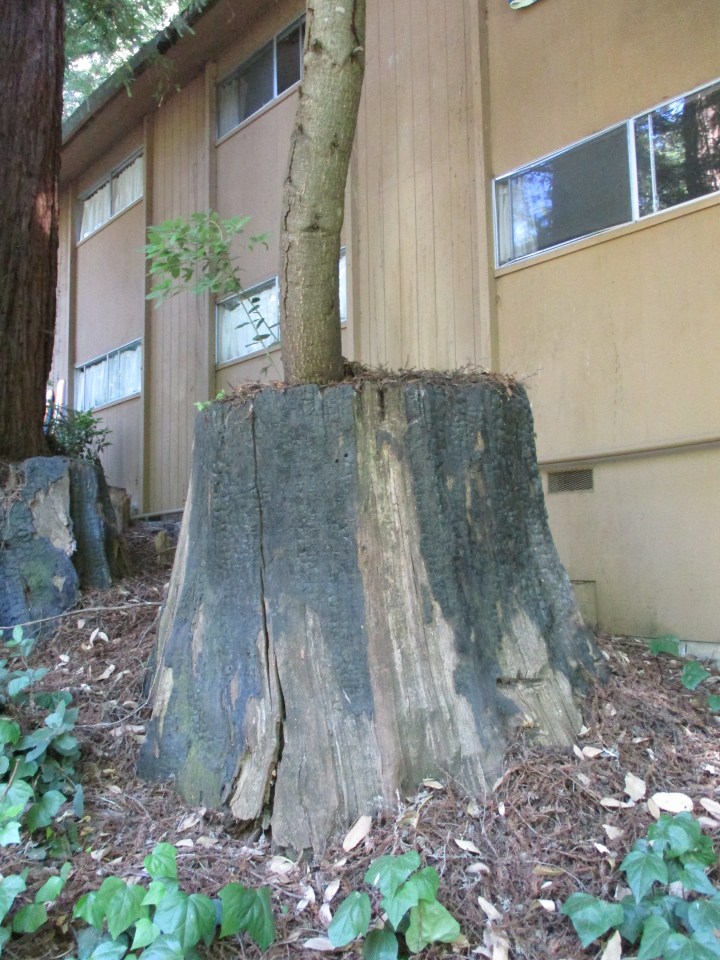
4. Which of these things does not belong here? Do you remember that from Sesame Street? Blue hydrangeas are not common here, although we have quite a few that are fertilized to be blue. I thought that these looked silly together because they are so similar in color.
5. Albino coastal redwoods are so fascinating. The white foliage can not survive without chlorophyll, so must remain attached to the original green tree that produced the white mutant growth. This takes a bit of explanation, so I will write a bit more about this about noon.
6. Finally, we have two silly looking tiny weds that grew in a crack in the big rock that I wrote about earlier in Rock Concert. https://tonytomeo.com/2018/04/07/six-on-saturday-rock-concert/ They are not much to look at, but this looks like one of those artistic pictures that other writers take.
This is the link for Six on Saturday, for anyone else who would like to participate:
https://thepropagatorblog.wordpress.com/2017/09/18/six-on-saturday-a-participant-guide/
Horridculture – Neapolitan
 Baldness was not yet cool while Brent and I were studying horticulture at Cal Poly in San Luis Obispo back in the late 1980s. Nor were hairpieces yet tacky. Consequently, some middle aged men work toupees. As these men aged and grayed, their formerly well matched topees did not.
Hedges of Pittosporum tobira ‘Variegata’ are notorious for developing green sports (unvariegated mutant growth). https://tonytomeo.com/2018/07/04/horridculture-mutants/ Because gardeners do not prune these sports out, they become prominent green blotches in otherwise nicely variegated hedges. Pruning large blotches out would only leave big bald spots. That is why such hedges, as well as similarly blotched hedges of other variegated plants, are known as ‘bad toupee’ hedges.
‘Neapolitan’ hedges are a variant of that concept. They are not composed of formerly identical plants that later challenged their respective identities. ‘Neapolitan’ hedges are actually composed of different plant material that has been shorn together. They sometimes develop as feral plants grow up and into formerly uniform hedges. They are often composed of what should have been distinct plants within a well designed landscape, that were merely shorn collectively by ‘gardeners’ who simply did not care.
This hedge in a median of a driveway into a mall in town is a classic example of the latter. The landscape designer likely intended the deep green Burford holly, Ilex cornuta, to develop naturally as dense and low mounds between the more upright variegated holly olive, Osmanthus heterophyllus ‘Variegatus’. Apparently, it is too much to expect a well paid ‘gardener’ to figure that out. Fortunately, this particular ‘Neapolitan’ hedge happens to look good in this particular application, but would look better if the ‘gardener’ would replace the variegated holly olive that has been missing for years from the gap between two Burford hollies to the left.
Coppice
 Coppiced trees and shrubs are just like pollarded trees, but without the trunk and main limbs. Instead of getting cut back to the same distended knuckles at the ends of disproportionately stout limbs, they get cut back to the same stump just above grade over winter. Some get coppiced annually. Others get coppiced only when they get too big. The coppiced California sycamore in this picture may never get coppiced again.
It was not intentionally coppiced. It had merely been cut down. The trunk was in the middle of where this thicket of secondary growth is now, but all of the canopy was over the adjacent parking lot from which the picture was taken. The tree was so severely and asymmetrically disfigured and leaning that it was unsightly and unmanageable. It really looked ridiculous. Removing the tree and replacing it with a new one would have been more practical than attempting to repair the disfigurement with corrective pruning over many years. Besides, such severe pruning to repair the disfigurement would have caused other disfigurement, and in the end, the tree would still be leaning.
Others California sycamores nearby had been cut down years ago because they were crowded. As the remaining trees continued to grow, those that had been cut down regenerated from their stumps with multiple trunks, and are now getting almost as tall as the others that were not cut down. Some of their smaller trunks will get cut down next winter, leaving them with single, double or triple trunks, but they will not be cut down completely as they were before. Instead, they will be allowed to adapt to their crowded conditions naturally. They are all becoming such appealing trees.
The coppiced but technically cut down California sycamore in the picture will be given the same sort of second chance. While bare in winter, the secondary growth will be pruned to leave only one, two or three trunks to hopefully develop into a new tree on the same spot.
Corndog Orchard
 Urban sprawl replaced the formerly vast orchards of the Santa Clara Valley a long time ago. Nowadays, it is difficult to imagine that they were ever here. Apricots, prunes, cherries, almonds, walnuts and all that the region was once famous for are all now rare commodities.
Only a few minor corndog orchards remain. They survive only because they are not actual orchards that are grown on land that is useful for something else, but instead grow wild on otherwise useless marshland and along the few creeks that flow through the region. Some marshland that could not be converted into usable space was developed into parks, and within many such parks, the remaining marshlands are protected as native habitat.
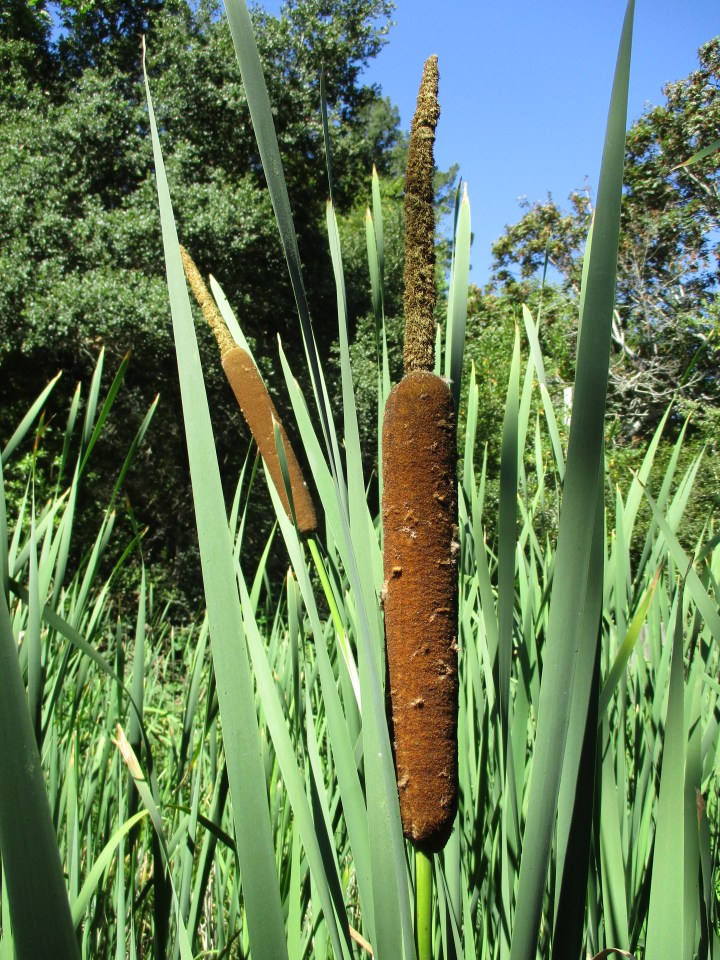
Vasona Lake County Park and the small Vasona Lake within were once a large marshy area that sustained what was probably the biggest corndog orchard within the Santa Clara Valley. It is at the transition where the Los Gatos Creek flows swiftly from the slopes of the Santa Cruz Mountains, and then slows as it reaches its flat alluvial plain within the Santa Clara Valley. Although not nearly as abundant as they were prior to development, corndogs still inhabit the banks of Los Gatos Creek and Vasona Lake. We know them as cattails.
Because they are a native species that had historically been more common locally than anywhere else nearby, and because of their common name that is coincidentally associated with cats, cattails had been nominated to be the official Town Flower of Los Gatos (which is Spanish for The Cats). There are not many natives that would be as appropriate, and the only comparably culturally significant flowers would be those of the old fruit orchards, such as apricot blossoms. No other flower is both native and so culturally significant.
Six on Saturday: Bits and Pieces
There were no major projects this week that were interesting enough to get six pictures of. The best that I could do was get six random pictures of random features of the landscapes. I do not actually do much to cultivate flowers, but they happen to be components of the landscapes. Most are perennials that bloom on their own. Of course, I do not mind taking credit for them.
Some blooms started late while the weather was mild, but were then accelerated as the weather suddenly warmed. It seemed that several different types of flowers needed to be deadheaded at the same time. Zonal geraniums and lily-of-the-Nile are two of the most reliable perennials that bloom on schedule no matter what. Zonal geraniums bloom sporadically most of the time, and only bloom more while the weather is warm. Lily-of-the-Nile may start a bit early or a bit late, but is always in full bloom on the fourth of July. The blooms even look like exploding fireworks. More than two weeks later, their flowers are still in full color but will slowly start to fade. Phlox was a surprise for us.
1. Can you guess what this bloom is?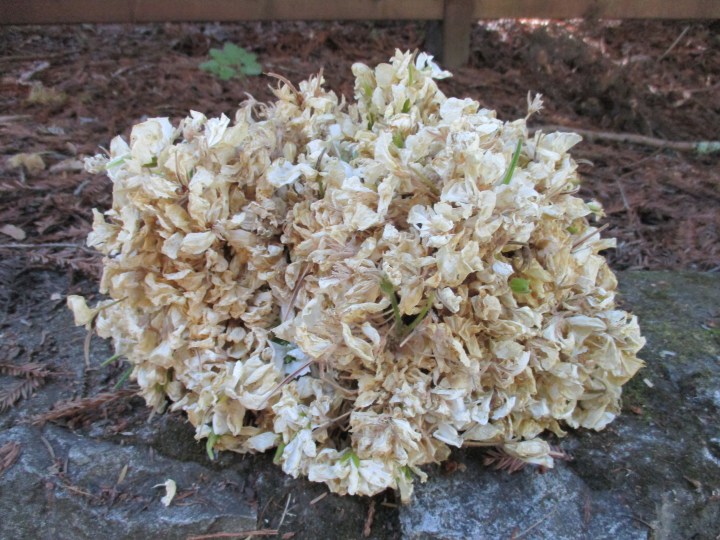
2. You can probably guess that this is phlox. It sure had my colleagues and I perplexed. We had never seen anything like it. Phlox is uncommon here. I would even say it is rare. No one knows why. It just is. I got a picture of it a few years ago only because I was intrigued by it in a neighboring landscape. It took a bit of effort to identify it, although I sort of suspected that it was phlox. It did not look quite like this phlox, and was lower to the ground. No one knows how this one got into the landscape. We suspect it arrived with the ‘fertilizer’ that the horses make for us.
3. Lily-of-the-Nile is still one of my all time favorite summer blooming perennials. I do not care how cheap and common it is. It is one of the first perennials I divided while I was in junior high school. I grew more than eighty new plants from a single old plant that needed to be removed. It was the old fashioned sort, with big blue flowers and big flabby leaves, perhaps bigger than these. I also like the white ones with the same big flowers and leaves, of course, because they are white. All the fancy modern cultivars are nice too, but not as excellent as the originals. I do like seeing the very pale blue ones in other gardens.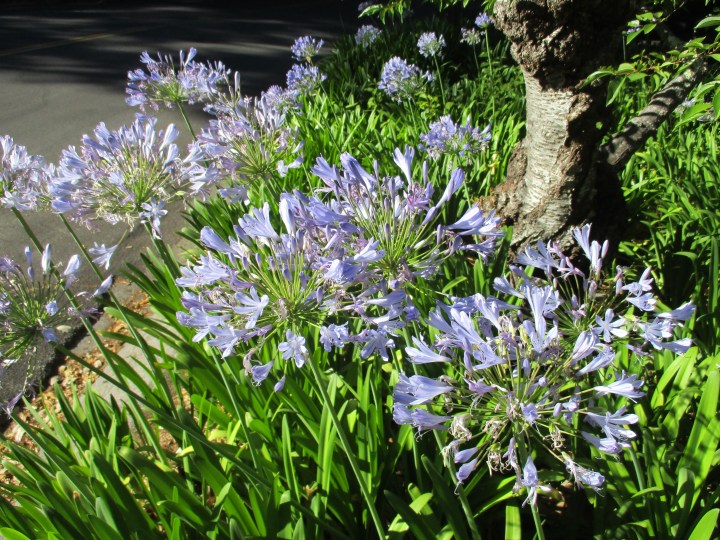
4. This zonal geranium has these small but cheery cherry red flowers, but it is really grown for the weirdly variegated foliage that is blurry in the background. I think that these flowers would look better against simple green foliage. There is another zonal geranium in another part of the landscape, with small peachy pink flowers and foliage that is variegated only with white. I am none too keen on the flower color, and I am not often too keen on variegation, but the foliage of that particular zonal geranium really looks sharp.
5. Himalayan blackberry is one of the worst and most invasive of the exotics weeds here. It develops huge canes that arch over and drop on top of other plants in the landscape. The wickedly sharp prickles (technical term for their thorns) are tortuous when trying to remove the canes. Even picking their berries is nasty business! There are a few berries ripening now, and they happen to be pretty good, but they are sooooooo not worth it.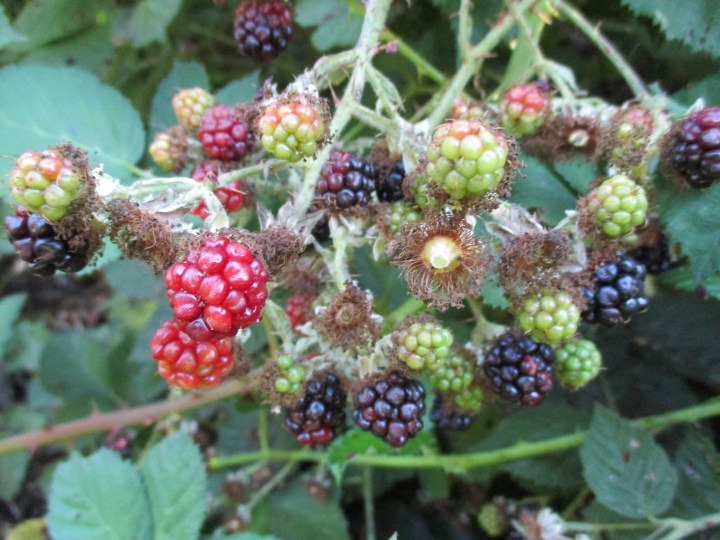
6. Chips needed to be dispersed into the newly landscaped areas that are partially visible in the background of this picture. These chips were free. They are made of recycled wood waste. For our purposes, they are sufficient. However, they include a few large chunks of wood and bits of metal. The chunk of metal in this picture is a short section of rebar. Some of the chips have paint on them. Some seem to be bits of old furniture. It makes one wonder where some of this material came from.
By the way, the bloom in the first picture #1 is merely a fist full of deadheaded white zonal geranium flowers all pressed together. White zonal geraniums do not readily drop their faded blooms like other zonal geraniums do, so they need to be deadheaded.
This is the link for Six on Saturday, for anyone else who would like to participate:
https://thepropagatorblog.wordpress.com/2017/09/18/six-on-saturday-a-participant-guide/
Horridculture – Reputation

I earned it. For several years, back when newspapers were composed of a rather ingenious combination of both news and paper, I was a respected garden columnist, as well as a respected horticulturist and arborist. Of course, I was an a horticulturist and arborist first. I later started writing my garden column because I wanted to do better than what the professional columnists who lacked practical experience with horticulture were doing.
For someone who would have preferred to simply grow horticultural commodities back on the farm, the notoriety was an odd fit. I was often asked to be a guest speaker for all sorts of garden clubs, and to write about their events. For a few years, I was a guest of honor and staffed a gardening question booth at Spring In Guadalupe Gardens in San Jose. It was awkward to walk from where I parked to the booth, past a dozen or so posters with my picture and various quotes on them.
People read my gardening column because they wanted accurate and relevant information. Although I was not proficient at writing, I managed to maintain my integrity as a horticulturist and arborist. My expertise was respected.
Then, a ‘colleague’ who wanted to capitalize on my notoriety convinced me to work for him while he established a website for me. I agreed, along with the stipulation that the website conform to my discriminating standards.
That stipulation was ignored. The website was embarrassingly flashy, with pictures of tropical plants that would not survive as more than houseplants in California. The grammar and spelling were deplorable. Articles were modified to be relevant in any season, just in case, for example, someone was worried about frost in the middle of summer. My ‘manager’ was not at all concerned with horticulture, but was instead more interested in installing advertisement for his products into the website.
About that time, I was invited to install a landscape into the 2009 San Francisco Flower and Garden Show. I would have declined, but was encouraged to compose a landscape to promote the new website. The landscape was ‘adequate’, and did happen to feature an excellent reproduction of an old windmill that my ‘manager’ happened to procure. However, the real priority was showcasing the products that my ‘manager’ was marketing, including a rainwater harvesting system. Within our limited space, we had a big black vinyl water tank! Instead of getting a vendor booth at the show, he used the landscape to pimp his products and services! It was mortifying! The fact that my modified design won awards seemed to make it even worse, as if to justify out extreme gaucheness!
It took a few years and the assistance of an attorney to get the ‘manager’ to close down and delete what was supposed to be my website, but was merely a collection of links back to websites and advertisements for what the ‘manager’ wanted to sell. Otherwise, anyone searching for me online would still be directed to products and services that I want nothing to do with, but seemingly endorse. Even now, these two images above and below would be at the top of the list of a search for images of Tony Tomeo on Google. They are from the 2009 San Francisco Flower and Garden Show, and are now associated with a website with which I have absolutely no affiliation. I want nothing to do with such unethical standards.
The picture above was taken within the landscape just before the Show opened to the public. The black vinyl tank is visible in the background. The picture below was taken during the assembly of the landscape, before I had shaven and gotten appropriately dressed.

Just When You Thought It Was Safe To Go Back To The Park –
 You would think that those who maintain the County Parks would be prepared for anything. They nearly are. They know how to deal with gophers, moles, voles, weeds, flooding, all sorts of unpleasant weather, and of course, spontaneous limb failure of massive trees. They apparently did not plan for this one.
This improvisation with a bit of dirty old plywood and a felt marker certainly does not imply that they could not handle the situation. They merely lacked a sign to warn those in the Park to avoid the area where the now exterminated yellow jackets had started to build their subterranean hive. Some brave person already attacked the hive with a can of insecticide that can be sprayed from a distance, waited for returning yellow jackets to die, and finally dug the hive up. The sign is only there because of the possibility that some yellow jackets might return much later, and that those who could return may not die now that the excavation of the hive mixed soil with the insecticide.
This was NO simple task. Yellow jackets and wasps are NASTY! I found it necessary to exterminate a hive of wasps just last summer. Wasps do not pursue their assailants so aggressively, and the particular wasps that I exterminated were not so numerous. I am certain that it was considerably more risky for whomever sprayed and dug the hive that was below where this warning sign is now.
When yellow jackets and wasps are flying about and annoying people, but their hive can not be located, it is sometimes necessary to put out traps. These traps are particularly useful in trees that are infested with scale or aphid that excrete honeydew that attracts wasps and such. The instructions that come with the traps are rather amusing. They include a rather extensive list of the various species and varieties of wasps and yellow jackets, with pictures of their distinctive coloration and patterns, so that they can be identified. I do not want to get acquainted with them. I just want them DEAD!
Upgrade Today
 This is it; the big day. I will delay it no longer. I said that I would upgrade quite some time ago, but had not yet done so. https://tonytomeo.wordpress.com/2018/06/24/upgrade/
Will this upgrade improve anything? I really do not know. I tried to do a bit of research in regard to the advantages of an upgrade, and could find very little of the information that I was looking for. It seems to me that upgrading will initiate more work for me, but will not necessarily make my articles more accessible or appealing. I will need to make improvements to the presentation of my articles on my own. Upgrading makes these improvements possible, but does not execute improvements without my efforts and direction. Nor does it change the content to improve accuracy for a broader audience. My articles will still be half a year late-or-early for Australia and all other places in the Southern Hemisphere. Harsh summer heat and winter cold will still be topics that will be lacking merely because the climate here lacks such variables. Upgrading can do only so much.
After my minimal research, I determined that the most efficient means by which to determine if an upgrade would be beneficial is to try it.
Something should be done. The newspaper group that I started writing for nearly twenty years ago no longer features my gardening column. Other newspapers that feature it only do so occasionally. Some do it monthly. Some do it when space is available. One of the larger newspapers features it weekly, but only for their online version. It is not easy to justify writing my articles if they are not being distributed like they had been.
By the time you read this, the upgrade will have been initiated. We will see what happens.

Six on Saturday: New Landscape
Yes, we have another new landscape. It is not much bigger than the last one, and is not very far away. In fact, although it is associated with two different buildings, it is located adjacent to the opposite corner of the same building that the last landscape was constructed for. https://tonytomeo.wordpress.com/2018/04/07/six-on-saturday-rock-concert/
These six pictures were taken prior to the installation of wood chip mulch, so ground cloth is visible below. It was quite dry and dusty at the time. All of these six plants were newly installed after being procured from nurseries, so none were relocated from other landscapes, or from our storage nursery. They were blooming nicely when installed, but are actually not blooming so nicely now, and some were damaged by the sudden warmth immediately after installation. They would have been fine if only the warmth did not arrive so suddenly, or if it had arrived a few days later. Well, we can not control the weather.
Large stones and bare soil prior to the installation of the landscape were shown in this previous Six on Saturday post, https://tonytomeo.wordpress.com/2018/06/16/six-on-saturday-rock-on/
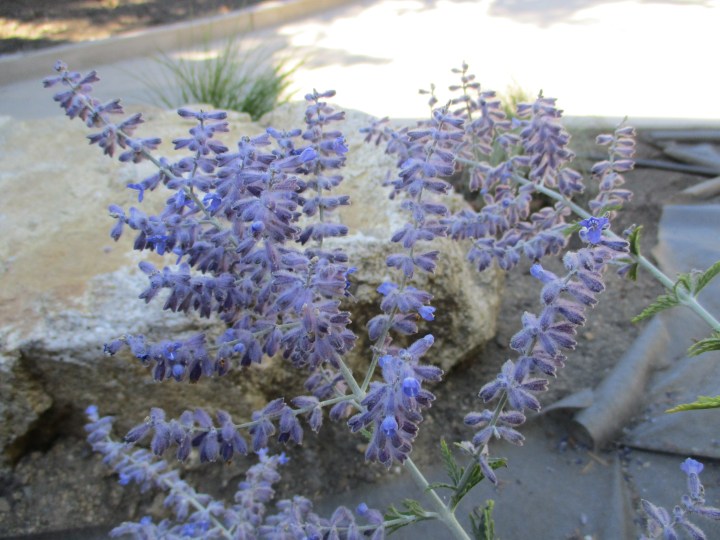
1. fernleaf yarrow, Achillea filipendulina, Most of these are white. A few are rusty red. A few are yellow like this one, which might be ‘Moonshine’. These did not show symptoms of heat stress right away, but have since gotten rather crispy. I could not find a picture like this one now. Fernleaf yarrow has been popular here for as long as I can remember because it supposedly does not need much water, although most get watered regularly. 2. Russian sage, Perovskia atriplicifolia, That sounds like ‘piroshki’. These and the rockrose #4 were 5 gallon plants, so are somewhat bigger than most other plants in the new landscape. They were not bothered by the change of the weather. Their faded denim blue flowers continue to bloom nicely. This is a plant that has been popular for a while, but that I have never grown. I tend to avoid trendy plants. However, my colleagues do not.
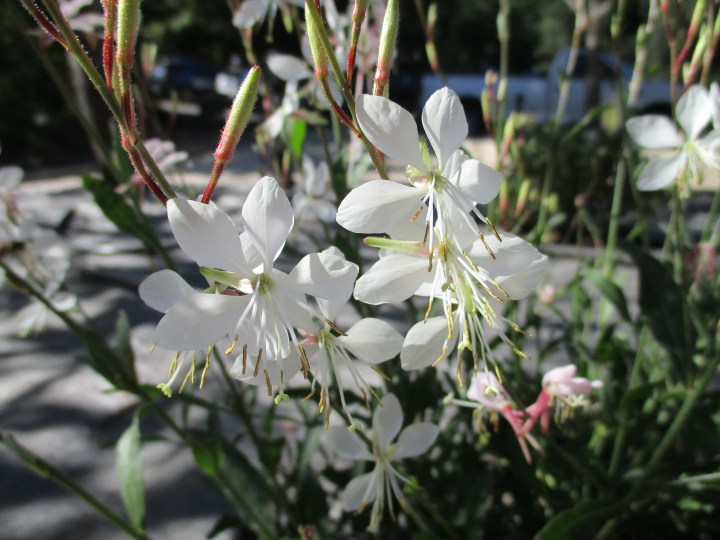
 3. gaura, Gaura lindheimeri, The common name is ‘white gaura’, but some are pink and some are darker pink that is almost red. I do not know if they are merely cultivars of ‘white’ gaura, or different specie. It seemed appropriate to omit ‘white’ from the name. Besides, that is how I learned it. This one can self sow enough to be an annoyance. Individual plants do not live very long, so a few feral seedlings can be selected to replace them.
 4. rockrose, Cistus cretisus, When I learned about rockrose back in the 1980s, we learned only two specie. One was white rockrose. The other was pink rockrose; and the pink rockrose did not look like this one. Now, there are too many to remember. Most do not have species name, but merely cultivar names. I really do not know if this really is Cistus cretisus. It just happens to look like it. I suppose I should have looked at the label.
 5. chocolate coreopsis, Coreopsis ‘Chocolate’, As I implied for #4, nomenclature is not what it used to be. It was standardized to simplify things, but is difficult to keep track of now with all the breeding and hybridizing, and botanists wanting to make a name for themselves by changing a name to something supposedly more accurate. I really do not know the species name of the chocolate coreopsis. It is known merely by the cultivar name.
 6. milkweed, Asclepias tuberosa, This one wilted rather badly in the warmth, but did not get roasted too much. The shriveled flowers in this picture are the worst of the damage. It is blooming more profusely now, and is developing strange seed pods. Milkweed is another trendy plant that caters to the butterfly gardening fad. I am not certain if I like the idea of planting something that is expected to get munched. It sure is colorful for now.
 This is the link for Six on Saturday, for anyone else who would like to participate:
https://thepropagatorblog.wordpress.com/2017/09/18/six-on-saturday-a-participant-guide/

