Six on Saturday: Cherry on Top


The flowering cherry trees are like something from Washington D C. They are remarkably happy in our particular location. The air is a bit cooler and a bit more humid than in the Santa Clara Valley. The redwood forest protects them from wind. These pictures were taken last Monday. Bloom is finishing now. The trees in the first picture are already mostly green with new foliage. Bloom was excellent while it lasted.

Azaleas are still in full bloom in the same area. Some are farther along. Others still have buds opening. They seem to be a bit late this year.

The Dutch iris is interesting because it is so uncommon here. In other locations, it blooms well only once, and then does not get adequate chill to bloom the following year. These Dutch iris are doing quite well near the ‘Kwanzan’ flowering cherry in the third picture, and have been blooming reliable for several years.

The pansies, which are actually easy to grow here, did not do as well as other plants that should not have done as well as they did. A few bare spots are evident. However, because they are partly shaded and cooled by the redwoods, pansies can stay in this spot near the flowering cherries in the first and second pictures until the weather gets too warm for them in summer. In other places not so far away, they would have been replaced by warm season annuals already.

1. flowering cherry – Some know them as ‘Yoshino’. Others think they are ‘Akebono’. I really need to find out what they are so that we can add more before these deteriorating old trees get removed.P80414
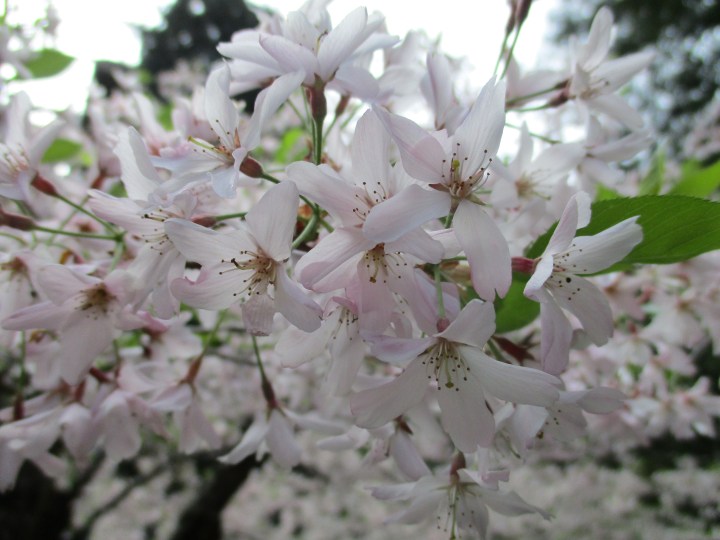
2. flowering cherry – Double flowers are not my favorite, but the clear bright white is. Again, we do not know what cultivar this is.P80414+
3. flowering cherry – This one is obviously ‘Kwanzan’.P80414++
4. azalea – This red azalea should be easy to identify, but no one really cares what cultivar it is.P80414+++
5. Dutch iris – In our climate, this is impressively reliable bloom.P80414++++
6. pansies – Yes, I know they are cliché; but they happened to be blooming near the flowering cherries, so I could not just ignore them.P80414+++++
This is the link for Six on Saturday, for anyone else who would like to participate:

https://thepropagatorblog.wordpress.com/2017/09/18/six-on-saturday-a-participant-guide/

Mower

P80411After all the years it was out there, someone, somewhere must have gotten good pictures of it. I never did. Nor did anyone I know. It was something of a famous landmark in Santa Clara.
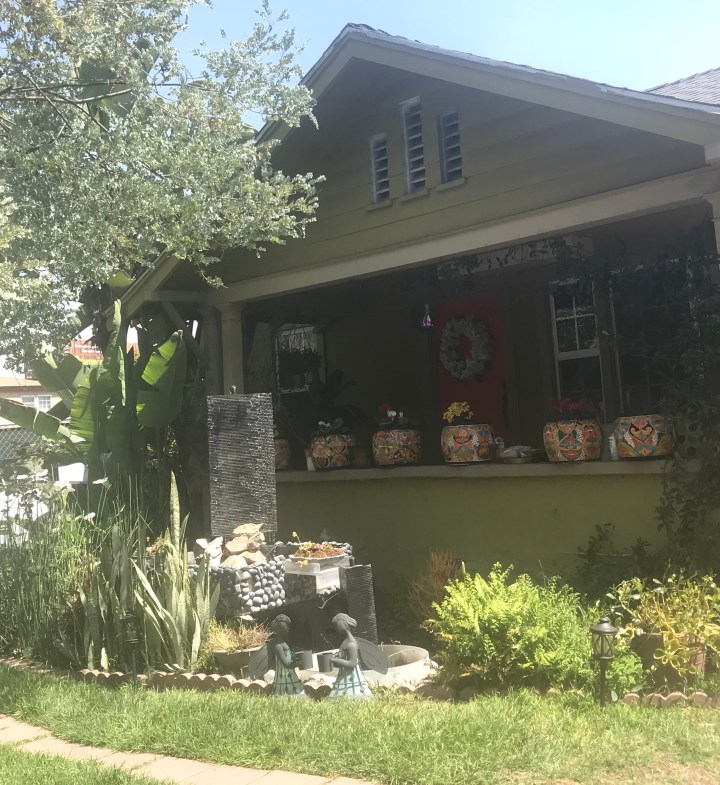
First, I should explain these pictures that my niece sent from here Mid City Heights neighborhood in Los Angeles. As you can see, this is a well kept middle aged home with minimal setback from the sidewalk. It is in a delightfully tree shaded neighborhood of comparable homes.

What are those black and white silhouettes of city skylines on those two plastic panels in front, you ask? They are a fence. Seriously. There are several similar panels around the perimeter of the front yard, at the edge of the sidewalk, and up the sides. They depict a variety of familiar landmarks, such as the Golden Gate Bridge, the Space Needle, the Eiffel Tower, the Tower Bridge and so on. They are all jumbled together so that landmarks from cities that are thousands of miles apart can share the same skyline. Mount Rushmore is depicted on the gate, adjacent to a city skyline that features both the Gateway Arch and the Sydney Opera House. Someone actually paid a lot of money to get this fence constructed and installed around the front garden of their otherwise well tended home. But wait; there’s more.

The picture below shows what lurks behind the fence. It was actually worse before the fence was built, when it was in full view. As tacky as the fence is, at least it obscures it. ‘It’ is a fountain; but not just any fountain. This picture does not do it justice. It really should be viewed at night, when it lights up with disco lights and emits eerily illuminated water vapor. It sometimes plays music. Yes, someone really though it was a good idea to put this in the front yard, where, before the fence was built, it was visible to anyone in the vicinity.P80411+

Now, getting back to the mower. It did not work. It probably worked at one time. It was an old mower, from before the mid-1960s or so. The person who owned it apparently did not like using it, but did not want to get rid of it either.

He had it bronzed. Yup. Bronzed. The front garden of his mid-1950s tract home in Santa Clara was paved with exposed aggregate concrete, with a big pedestal in the middle, on which, the bronzed mower was proudly displayed. The concrete was of exceptional quality, and would have made a nice patio if it had a bit of landscaping around it. Instead, it was surrounded by only a simple but tasteful low iron fence with tan slumpstone pillars. The fence surrounded the perimeter of the front garden, at the edge of the sidewalk and up the sides. There was no plant material in the front garden. None.

The mower debuted sometime about 1970. The kids of my generation do not remember it not being there, so it was there as long as any of us can remember. Some of our parents believe it might have been there as early as 1964. The home and paved front yard were always impeccably maintained.

Tacky? Yes, of course.

Crazy? Maybe.

It gets worse.

In about 1995, the home sold. It actually sold rather quickly because it was in such good condition. Everyone thought that whomever purchased it would remove all the pavement and the mower, and landscape the front garden. But no. They moved in, painted the home a different color, and maintained the front garden as it had always been maintained. What is the point of living in such a nice home in such a nice neighborhood with such nice soil and in one of the best climates on in the World if the garden is paved?!

Only a few years ago, the home was sold a second time, and those who purchased it finally removed all the concrete and bronzed mower, and outfitted the home with a simple but presentable landscape that is more compatible with the rest of the neighborhood.

The funny thing is that everyone in that neighborhood had lived with the bronzed mower for so long that it was somewhat saddening to see it go! We all knew why it needed to go, and that the home looks so much better without it, but it was familiar. It was cool in a weird sort of way. It was defiant. It certainly was unique. It was environmentally responsible, and about as drought tolerant as it gets.

It is still impossible to imagine that the black and white plastic ‘city skyline’ fence and steamy disco fountain within will ever be so appreciated; but who knows?

Squirrel!

P80408Wildlife and domestic animals seem to follow me everywhere I go. When Brent and I lived in the dorms at Cal Poly, our room was known as the Jungle Room, not only because of all the greenery, but also because every little bird that got knocked out while trying to fly through the big windows at the dining room was brought to our room to recuperate. A baby squirrel that weaseled into my jacket while I was out collecting insects for an entomology class lived with us for a while. There were two baby ducks that need a bit more explaining.
When I moved south of town, where my roommates boarded horses, the horses worked diligently to open their gate to come to the house to eat my rare plants. The neighbor’s cattle sometimes did the same! When it rained, creepy crawdads came out of the ditch at the railroad tracks and up to my porch.

When I moved to Los Gatos, it seemed that every stray dog in town eventually arrived at my home. In fact, my home was ransacked by the FBI just because their bloodhound who was supposed to be pursuing a suspect of a crime wanted to come by! Again, that takes a bit more explaining. Birds flew through freely. A pair of some sort of small bird nested in my shower, and before I realized it, started to raise a family . . . and finished. Pigeons tried to nest repeatedly in the same spot on top of the refrigerator, but got evicted. A squirrel moved into the guest room, and refused to leave. It sometimes tried to join me for breakfast.

Then, at my second home, there was Timmy the baby deer, two feral cats, skunks, coons, squirrels and more neighborhood dogs than I can remember, as well as Bill the little terrier who actually lived there. I could go on. https://tonytomeo.wordpress.com/2018/03/14/timmy-in-the-garden/

Squirrels are a common denominator. They are everywhere.

My home in town was in the Live Oak Manor district, which, as you can guess, was dominated by huge old coast live oaks as well as comparable valley oaks. The valley oak next door was supposedly the largest in the Santa Clara Valley. Squirrels were everywhere and very well fed!

The east facing window over my desk would have had a good view of Mount Hamilton if the view had not been so cluttered with utility cables. The wildlife that used the cables could get annoying at times. Crows made their annoying noise. Pigeons just stared at me stupidly. Squirrels scurried by with bits of fruits and vegetables that they stole from the garden, and sometimes stopped to cuss at me. I sometimes cussed back, but also reminded them to be careful as they jumped from the high voltage cables into the tops of the neighbor’s hedged redwood trees below. The redwoods sometimes grew dangerously close to the high voltage cables between clearance pruning.

As you can imagine, the unimaginable but obviously predictable happened. I do not know if he was coming or going, but I would guess that he was jumping from the tree to the cable. I only heard a loud ‘ZAP’ and subsequent ‘FIZZLE’. By the time I looked out, the unfortunate squirrel was a swinging charred carcass with a death grip on the cable he was reaching for. The death grip was impressive. He stayed there for a long time, swinging in the breeze. Silent sparks could sometimes be seen at night, where his tail brushed against the tip of the redwood shoot. I do not know if a crow finally got him, or if he just fell into the neighbor’s yard. Either way, he did not get a proper burial.

Dingo

P80407K

Dogs and humans have been in a symbiotic relationship longer than history can document. Dogs naturally became more domesticated as humans did, and have been more or less selectively bred for a few thousand years.

Dingos are different. No one knows for certain how domesticated they were when they first came to Australia. They probably had been domesticated enough to come on boats with the first humans to migrate to Australia. After arriving in Australia, they became feral, although still symbiotically migrating with humans. They are now considered a native species of Australia.

Many species of plants have lived symbiotically with humans as well. As long as humans have been living with dogs, they have been domesticating and breeding plants. As plants were more extensively bred, they became more dependent on humans for their perpetuation. Some are so overly bred that they are sterile and unable to perpetuate without human intervention to propagate them vegetatively. Others, although unnaturally productive in regard to what humans want from them, are too weak or otherwise inferior to survive in the wild.

However, there are some extensively bred plants that escape their domestic lifestyles, and perpetuate feral descendants who retain some of the domestic characteristics of their extensively bred ancestors. They are not quite like naturalized plants that were merely imported in a more or less natural state from other regions, or those that naturalize and revert to a natural state. Characteristically, they are between wild plants and extensively bred and selected domestic plants. They have developed their own stable but feral lineage that can perpetuate in the wild.

For example, the purple leaf plum has been developed as an ornamental tree for a very long time. Several vegetatively propagated cultivars are now available. The ancestors were likely discovered as mutants with darker bronzed foliage. These primitive mutants were more or less genetically stable, and were likely able to perpetuate naturally. It is difficult to say for certain. From these ancestors, seedlings with even darker foliage were selected, and bred to find more seedlings with even darker foliage, and so on. Because of this selective breeding, purple leaf plum trees grown as domesticated ornamental trees now have darker foliage they would naturally in the wild. They are propagated vegetatively because some are so overly bred that they are sterile, and seedlings from those that can produce viable seed would be likely be more genetically stable, and therefore less genetically ‘developed’. This is why feral seedlings from purple leaf plums that can produce viable seed are not as dark purplish bronze as their parents. Seedlings from the seedling trees are even lighter bronze. They may never be completely green, but they will not be dark purplish bronze either. They are feral purple leaf plums, like dingoes.

Six on Saturday: Rock Concert


Designing a landscape is too artistic for me. I am just a horticulturist. I just grow things, and sometimes tell others how to grow them in a landscape.

Rocks sometimes get in the way when I grow things. They are not something that I often consider to be an asset to the sorts of landscapes that I typically work with; although I have worked with some landscapes in which boulders and stones work very well. I happen to think that they work well in this landscape. I did not design it of course. I merely helped with the installation of new plant material, and the salvage of old plant material.

1. The Rock Stars! It was not easy getting them here!P80407
2. The Concert Venue: This is not a big landscape, but happens to be in a prominent location.P80407+
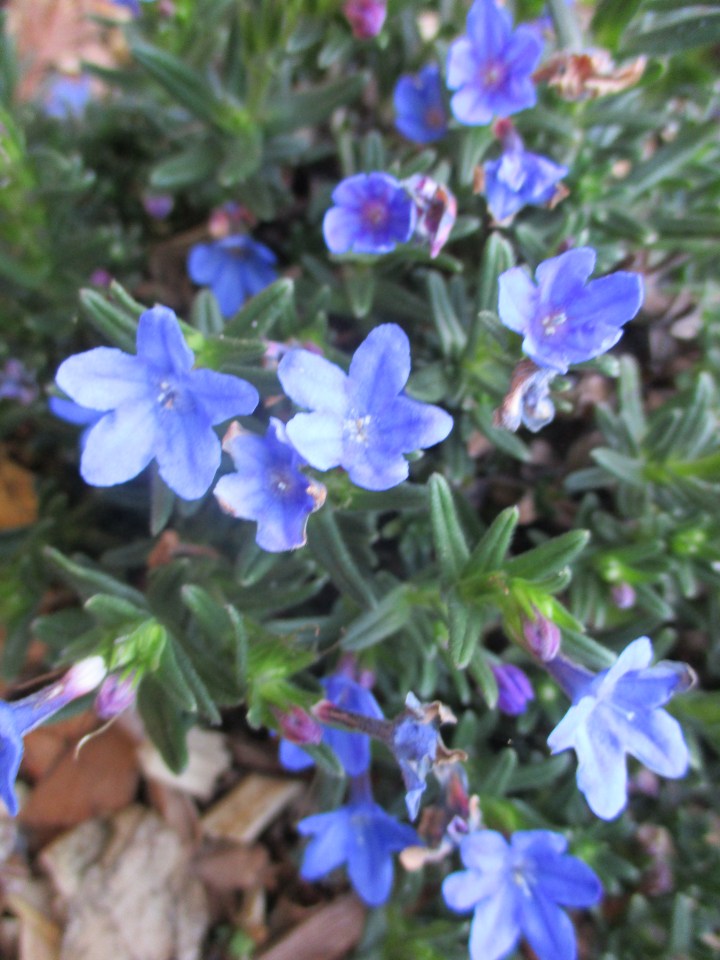
3. Blue flowers were added in front, off the left edge of the previous picture. I do not remember what species this is, but it is common nowadays.P80407++
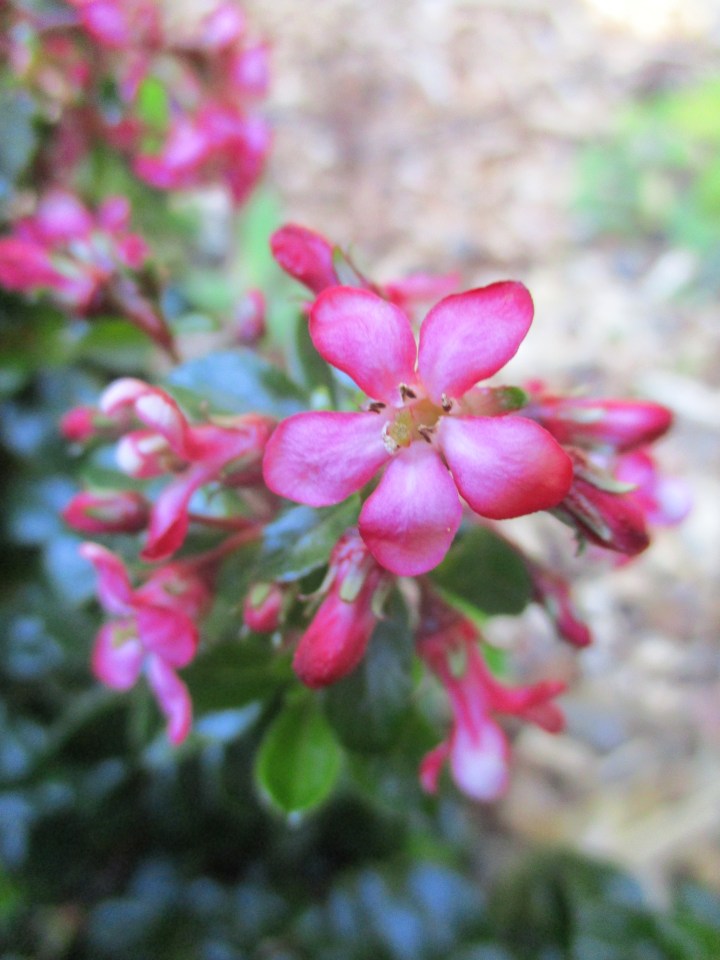
4. Escallonia was added just behind the blue flowers in the picture above. I do not remember what cultivar this escallonia is.P80407+++
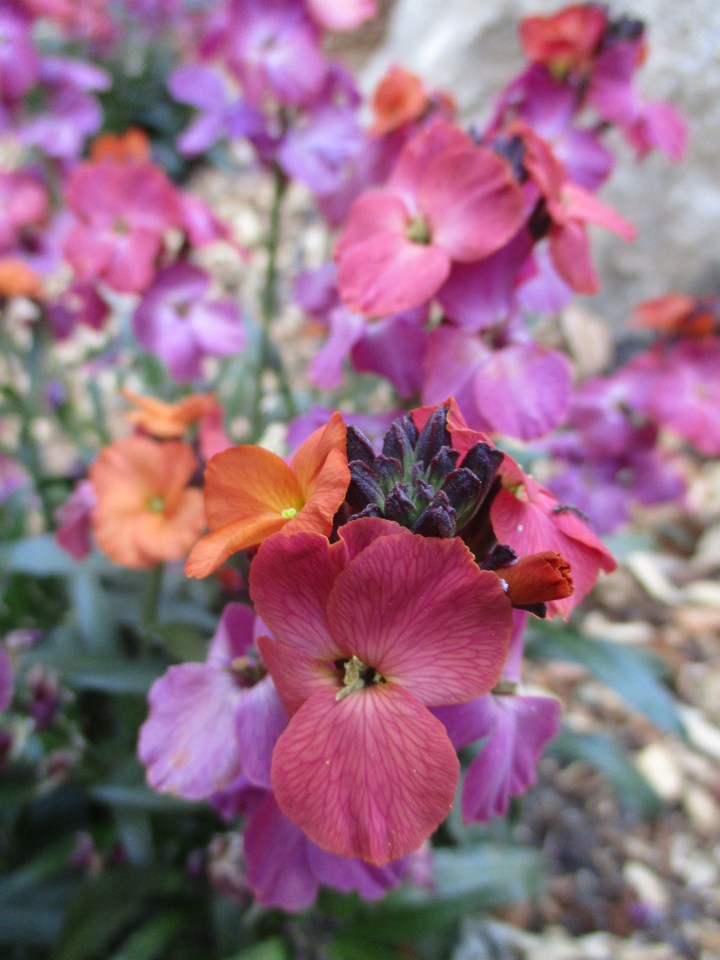
5. ‘Winter Orchid’ Wallflower was added in front of the Rock Stars, just off the left edge of the first picture. It might be ‘Winter Party’. I do not remember.P80407++++
6. Yellow Freesia is a remnant from the original landscape. There are red freesias too. We like them too much to remove them.P80407+++++
This is the link for Six on Saturday, for anyone else who would like to participate:

https://thepropagatorblog.wordpress.com/2017/09/18/six-on-saturday-a-participant-guide/

High Fashion

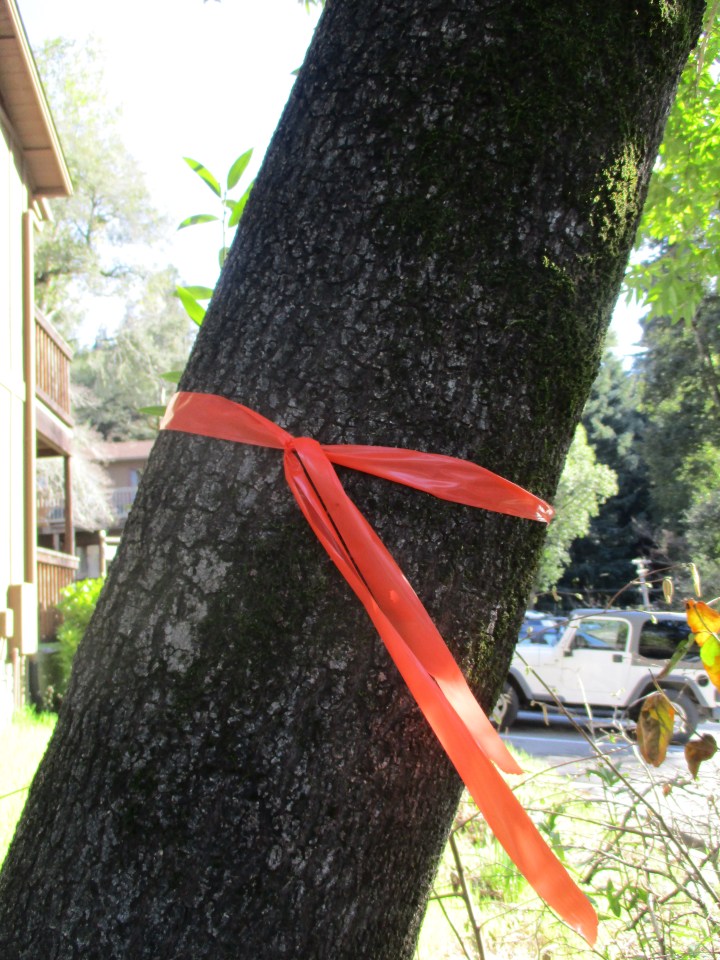
P80404This exquisite yet elegantly simple persimmon orange cravat is to die for! See how distinguishing it is for the Umbellularia californica sporting it! The brilliant color is so appropriate for a tree that needs to stand out in a crowd! How else would the arborists coming to cut it down find it? Yes, it is to die for!

This sort of high fashion is not normally so high. Trees that are tagged by surveyors are typically more discretely tagged with spray paint down near the ground. We just used this orange tape because we were only hastily marking a few or our own trees for removal, and nothing else.

The problem with tape in other situations is that it can be removed and applied to another tree. One of my colleagues sent his crew to cut down a street tree downtown that had been marked with orange tape, only to find later that the wrong tree had been cut down. The client had procured a permit for the tree that the arborist had tied the tape onto, but not another tree next to it that he wanted removed also. After the arborist marked the tree to be removed with tape and left, the client removed the tape, and tied it onto the tree that was to be preserved. Of course, the crew cut down the tree with the orange tape. The sleazy client did not want to pay for the removal because the wrong tree had been cut down, and then hired another tree service to legally remove the tree for which the removal permit had been issued, while leaving the first arborist liable for cutting down a protected tree without a permit. Fortunately, a neighboring merchant knew what the client was up to, saw him move the tape, and reported the incident to the responding code enforcement agents. The arborist got paid. The client got two huge fines; one for removing the tree without a permit, and one for the value of the rather valuable tree.

Tape works fine in the nursery because there is no one there to do anything sleazy. Besides, paint would be messy. Many years ago, we used red tape for stock that needed to be disposed of, orange tape for stock that needed to be shifted into the next larger size, and blue tape for stock that was sold and needed to be moved to a holding corral or loaded onto a delivery truck. Of course, different nurseries might use different colors and a different code.

For the sort of tree work that I was involved with, orange or red paint was used only on trees that were to be removed. It would not have been appropriate to tag good trees with paint! We usually marked trees for removal with a circled ‘X’ or just an ‘X’, in a very visible manner.

Surveyors use paint in a more discrete fashion, with single dots or other small markings of paint down near the ground. They use a variety of colors and a standardized code system. The paint is not permanent, and weathers away after a year or so. Some trees get tagged for pruning for clearance from utility cables. Some get tagged for clearance above roadways and sidewalks. A few that are hazardous or in need of such severe pruning that they will be ruined in the process get tagged for removal. Each color of paint means something different. Each specific tag is a message to whomever is responsible for the prescribed procedure. Some who are responsive to the coded messages work for the respective municipality. Others work for a utility company of some sort. They may not know what all the tagging means, but they recognize the meaning of the tags that are addressed to them.

That is why, when a client asks me what a particular tag on a tree means, I can only say that I do not know. I know what tags my associates use, and I can guess what a prominent circled ‘X’ or an ‘X’ means because I know of so many arborists who use that tag. I do happen to know what the bright orange tape around the bay tree above means because my associate put it there. However, I do not know what a blue dot, green dot, yellow dot, orange vertical line or red horizontal line mean.

Happy Easter!

P80401Happy Easter!

This is one of those holidays when no one should work, which is why I wrote this a few days ago, and scheduled it to post today. I hope you are not reading this today. You have more important things to do. Lent and the forty days of fasting that goes with it are over, so you can eat all the Easter eggs and anything else you want.

The only work that should be done today are chores that can not be delayed until tomorrow. With the weather warming (at least in our region), watering might be one of those chores. For most parts of the garden, this might be the first watering since autumn. Although the rain has been meager, cool weather had kept things damp until now. Resuming watering is typically an easy task. It sounds simple enough. Water is water – right?

I get all sorts of unexpected questions in my work. In autumn, I sometimes get asked about trees that were planted in spring or summer that are suddenly turning yellow and dropping leaves; and must explain that the seemingly sickly trees are merely deciduous and defoliating for winter, which can be a major disappointment if evergreen foliage was needed. Then there are the questions about the five pound kumquat that is actually a shaddock fruit on an overgrown sucker (understock from below the graft).

About this time, many years ago, I got a call about a sad #5 (5 gallon) pistache street tree that had been planted while bare during the previous autumn. The client who planted it wanted to do what was best, so planted it in autumn so that it could settle in slowly while dormant through winter, and get an early start dispersing roots in spring. Generous rain that year provided more water than the tree needed through winter. As the rain ran out, and the weather warmed, buds swelled and began to pop. The client who planted the tree was very careful to water it when she thought it was necessary, but the new foliage immediately started to get discolored and distorted. Her remedy was to give it more water, but the health of the tree continued to decline as quickly as it was trying to foliate.

I asked all the typical questions about the tree, but only determined that it was not lacking water, and probably was not getting too much water. The symptoms exhibited by the foliage suggested soil saturation and poor drainage, but the soil drained well, and the roots seemed to be firm. I was baffled, until the client mentioned something very unexpected. I had to ask her to clarify.

She loved the tree so much that she wanted to give it the best water she could obtain. Every day, on her way back from downtown San Jose, she stopped at the Cathedral Basilica of Saint Joseph to procure a gallon of Holy Water to water it with!

That was a new one. I then had the sad duty of explaining to her that her devotion to the tree was what was killing it. The Holy Water that she had so diligently been giving it was saline. After Holy Water is blessed, some gets stored for upcoming baptisms, and the rest gets blessed salt mixed into it, mainly for sanitation. It was this salinity that was so toxic to the tree.

After a lot of fresh water was rinsed through the root system, the tree started to recover almost immediately, and eventually resumed healthy growth. The client telephoned the following autumn as the tree was coloring to inform me that it had been restored to good health, and grown through summer as if nothing had ever happened.

Scofield Tree Update – Spring 2018

P80331KNot much has happened since the last update on Christmas Eve. https://tonytomeo.wordpress.com/2017/12/24/scofield-tree-update/ The Scofield Tree has been bare all winter, and is only now developing new foliage.
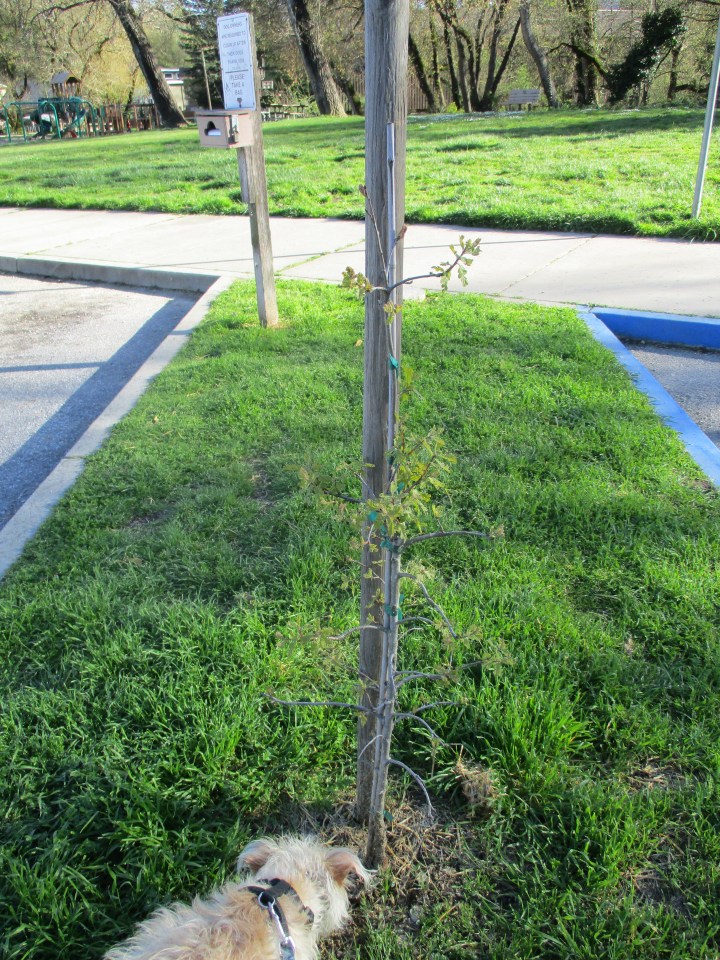
It was planted more than two years ago, but had been set back by some serious damage from an altercation with a weed whacker. Unbelievably, after emphatic explanation of how dangerous weed whackers are to such young trees, and an unfulfilled promise that the tree would be outfitted with a tree guard, a ‘gardener’ attacked the tree with a weed whacker AGAIN! Fortunately, the tree had previously developed enough scar tissue to not be damaged by this latest assault.

It will certainly be pampered this year. It really needs to grow. The bark at the base needs to be tough enough to survive an even more aggressive weed whacker attack. The trunk must be resilient to someone bumping into it, or a dog getting a leash tangled around it. Eventually, the trunk will be resilient to a car bumping into it, which is a possibility in the parking lot in which it is located. The canopy must eventually grow up and above the height of parked cars and those getting into and out of those cars. Ideally, it should be out of reach of gardeners with cutting tools that they do not know how to use properly.

The old lodgepole stake will be replaced because it is likely rotten at the base. The binding stake will also be replaced because it has warped in the last two years. Such binding is not horticulturally correct, but is necessary to correct disfigurement, as well as to help protect from more damage. Fertilizer should accelerate growth.

The first article about the Scofield Tree was posted back on October 6. https://tonytomeo.wordpress.com/2017/10/06/small-tree-in-a-big-park/P80331K+

Six on Saturday: New Leaf


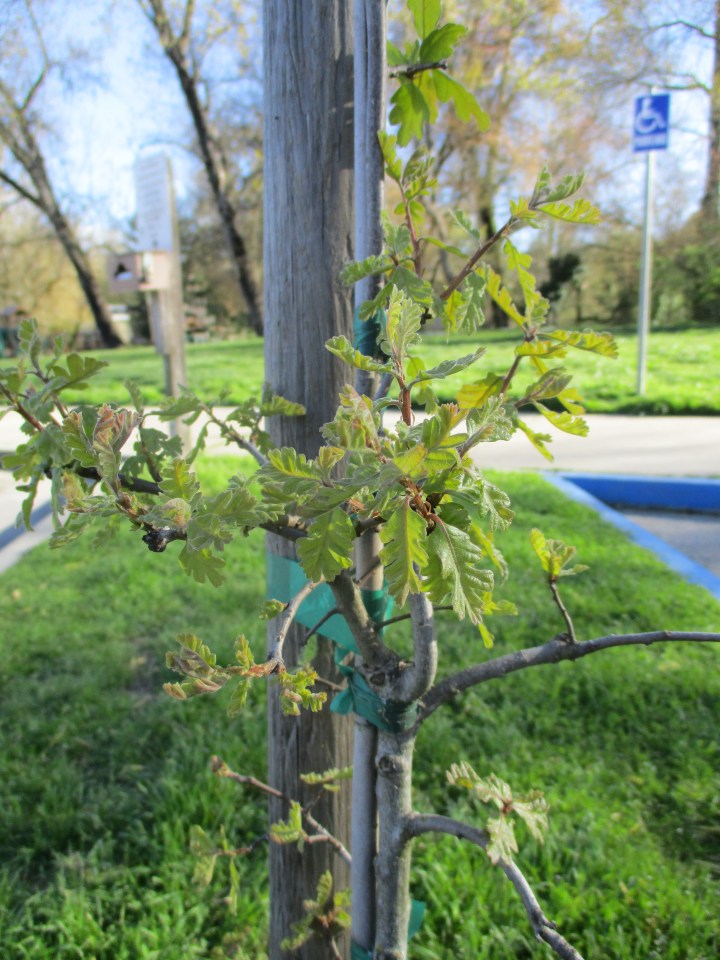
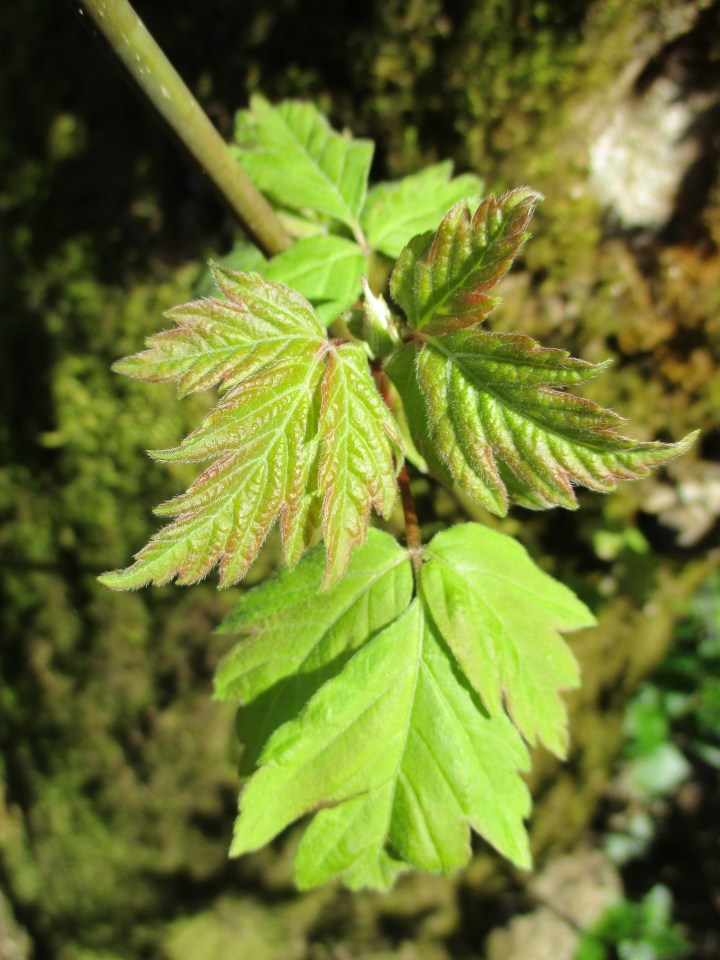
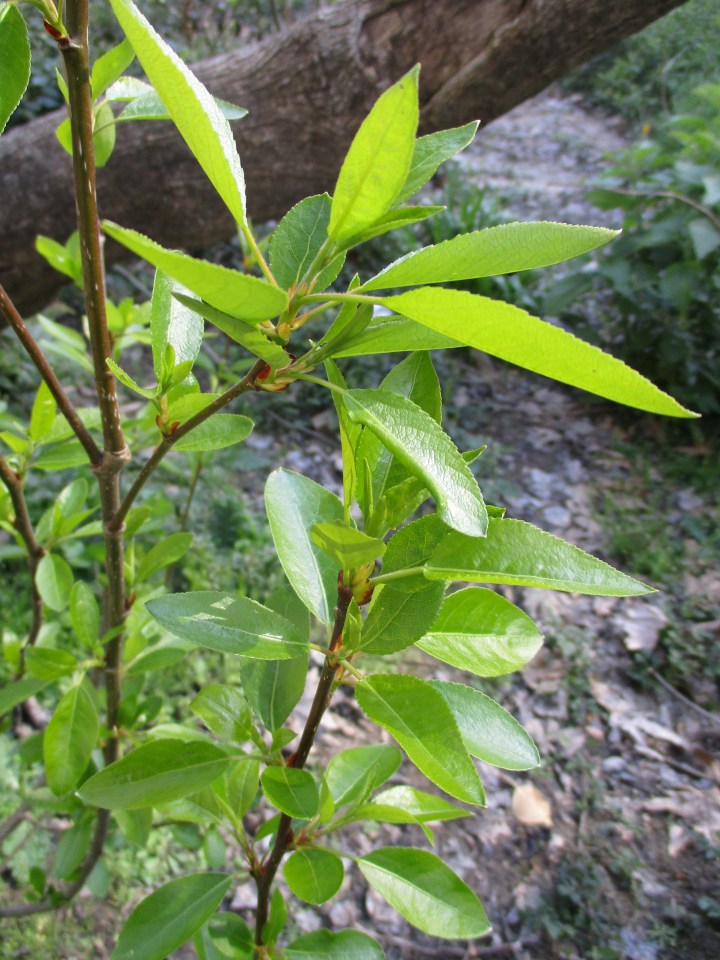
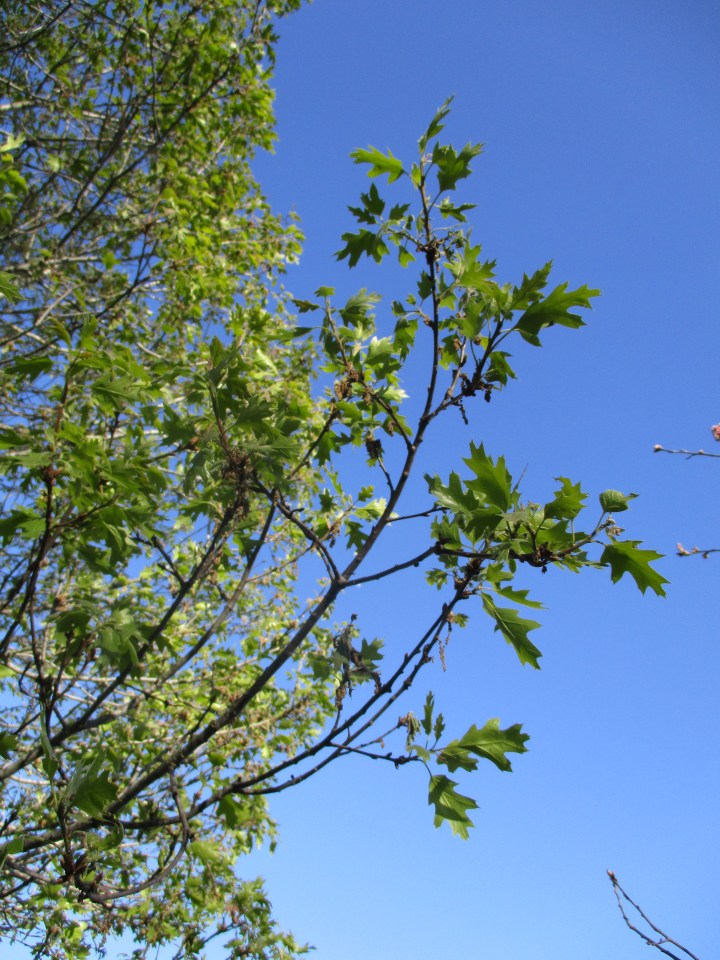
New foliage develops immediately after the earliest spring flowers. All six specie shown here are locally native to the San Lorenzo Valley in Santa Cruz County of California. With the exception of #4 (California) black oak, these specie are riparian specie found near the San Lorenzo River, which is the wet thing in the background behind #3 red willow. #4 (California) black oak naturally prefers drier situations a mile or so away, but happens to be in the area. #6 gooseberry is unidentified, and could have a color in the name like most of the others. #1 box elder has no color in the name, and is not related to #5 blue elderberry. Nor are #2 black cottonwood and #4 (California) black oak related to each other. #5 blue elderberry really is blue, unlike the black elderberries of eastern North America and elsewhere, which incidentally, are related to neither #2 nor #4. This is getting confusing. #3 red willow is also known by a few other names.

1. box elderP80331
2. black cottonwoodP80331+
3. red willowP80331++
4. (California) black oakP80331+++
5. blue elderberryP80331++++
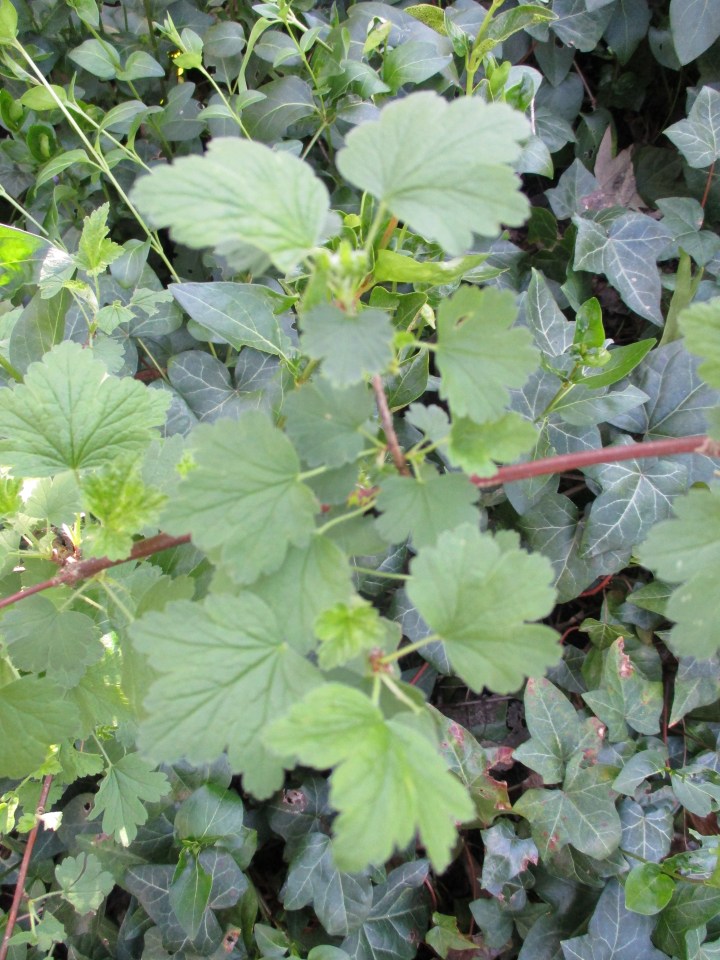
6. gooseberryP80331+++++
This is the link for Six on Saturday, for anyone else who would like to participate:

https://thepropagatorblog.wordpress.com/2017/09/18/six-on-saturday-a-participant-guide/

Hanging Gardens of Babylon

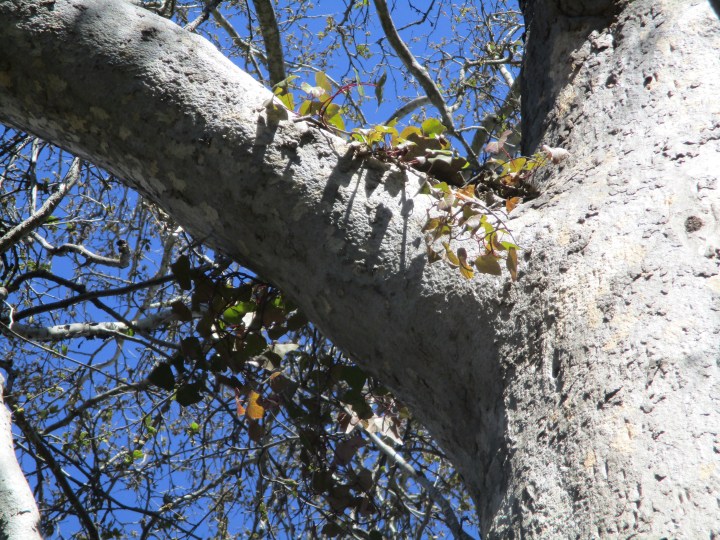
P80328The ivy in this sycamore did not just climb up from the ground to hang over this big limb. If you look closely, you will see no vine coming up from the ground. This small patch of ivy as well as a small pyracantha, are growing in a decayed cavity on top of the big limb. The ivy may have climbed up a long time ago, and then rooted into the cavity before the original vine was somehow removed. Alternatively, the ivy might have grown from a seed that was dropped by a bird or ivy vines that are higher up in nearby box elder trees. It is impossible to say now.P80328+It is also difficult to say why there is such a large cavity on top of the limb. It could have originated as a large scar incurred from the impact of another large limb that fell from above. There are a few cavities higher up that were caused by large limbs breaking away. Although unlikely, the cavity could have developed from sun scald damage, after the upper surface of the big limb suddenly became exposed by the loss of limbs higher up.P80328++This other aerial patch of ivy hangs from a smaller cavity higher in the same tree. Oddly, among sycamores, such cavities on upper surfaces of large limbs are not uncommon. Sycamores often drop large limbs from high in their canopies, exposing or damaging lower limbs below. Their lightly colored bark is very susceptible to sun scald if suddenly exposed after always being shaded. It is also not very resilient to heavy impact. Of course, more typical cavities develop on trunks where significant limbs broke or were pruned away. Other plants can grow in these as well, as demonstrated by the ‘epiphyte’. https://tonytomeo.wordpress.com/2017/11/15/epiphyte/