Fertilizer

P80325‘Fertilizer’ is a polite term for ‘recycled vegetation’.

‘Recycled vegetation’ is a polite term for something else.

This is not a synthetic type of fertilizer that gets tossed about or poured on. It gets added to compost and allowed to compost some more before being spread out as a mulch over the surface of the soil, just before chipped vegetation gets dispersed over the top. Alternatively, it sometimes gets mixed into the soil. It is quite useful. You can’t beat the price.

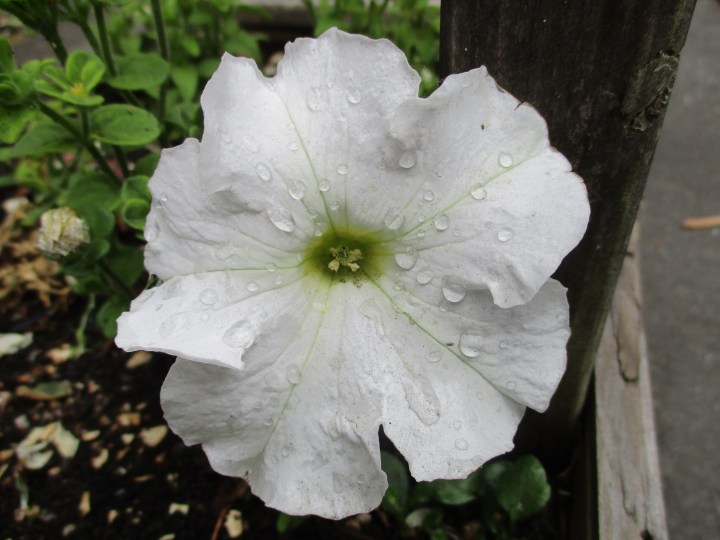
It is recycled differently from the compost or chipped vegetation (from a brush chipper). It is recycled through a horse, or more specifically, two horses. As the picture above suggests, it begins at the front of the horse, and ends at the rear of the horse, which is not pictured.

The horses happen to be quite efficient at recycling vegetation. They do it all the time. They are probably doing it right now. I would describe the process, but I do not know how it works.

Three times weekly, on Mondays, Wednesdays and Fridays, some poor sucker must go to where the horses live and work to collect the binned ‘fertilizer’, and deliver it to the compost pile. By the time it gets mixed into the compost, and composted more, it is not recognizable. Otherwise, it might be a problem in the parts of the landscape where it gets dispersed with the compost.

The landscape seems to like it. Only a few plants with special needs get any sort of synthetic fertilizer.

This sort of recycling is not new technology. It has been around as long as horses have been serving humans. In fact, it was not even invented by humans. Horses were doing it long before humans merely discovered, refined and took the credit for it.P80325+

Cherry Blossom Festival

P80324KI would say that this is our own private Cherry Blossom Festival, but it really gets a crowd. These two old trees are at the edge of the main roadway through town, so several people driving by stop to take pictures. They may not seem to be very impressive compared to healthier flowering cherry trees, but they are what we have, and we are happy to get the bloom.

Decades ago, fruiting cherries were some of the more common orchard trees in the Santa Clara Valley. Flowering cherries were only somewhat popular in home gardens, and might have been less popular without the Japanese influence. They are more popular in cooler climates, not only because they are happier in cooler climates, but also because those who live where winters are harsh have a better appreciation for bloom that so happily celebrates the end of winter.

These particular trees are unfortunately deteriorating. They are quite old, and the trunks and main limbs rot and die back a bit more each year. No one wants to cut them down because they are such a familiar landmark this time of year. Few people can remember when the trees were not there.

We are grateful for the bloom this year because the weather could have easily ruined it. It was so warm earlier in winter that bloom could have very easily been accelerated, and happened just as frosty or rainy weather resumed. The trees seemed to know what time of year it was, and waited for the right time. It did happen to rain just prior to when these pictures were taken, but the blossoms had just opened, so were resilient to the rain. Weather should be milder for the next few days, until these trees are finished with their bloom.P80324K+

Six on Saturday: Vegetation Management


It sounds so unglamorous; probably because it is. We had been working on this project for three weeks, and just finished on Thursday. Most of the work was cutting back thickets of native (but installed) redtwig dogwood. It was neither coppicing nor pollarding, but something in between. They could not be coppiced completely because they are in trafficked areas where they might be tripping hazards until they regenerate. They were not quite pollarded because there were no real trunks remaining, just short stubs of canes. We also needed to removed brambles that were mixed with the redtwig dogwood, as well as a few exotic (non-native) plants that had grown in amongst the whole nasty mess. There were a few nice pyracanthas and privets that needed to be removed. In a better situation, they would have been nice specimens. This was not the right situation for any of them. Besides, privets seed profusely and are quite invasive.

1. Now you see it. This is a privet that needed to be removed.P80324
2. Now you don’t. This is the same privet noticeably absent.P80324+
3. Evidence. There really was a privet here.P80324++
4. And there it goes!P80324+++
5. Except for the foliage that just recently developed, this thicket of redtwig dogwood that will not be pruned is what the rest of it looked like.P80324++++
6. This is what it looks like now.P80324+++++
This is the link for Six on Saturday, for anyone else who would like to participate:
https://thepropagatorblog.wordpress.com/2017/09/18/six-on-saturday-a-participant-guide/

Na2CO3•NaHCO3•2H2O

P80321Trona

That is what this seemingly disorganized jumble of letters and numbers represents; the chemical formula for the mineral known as trona. It is what a certain small town in the very northwestern corner of San Bernardino County is named for. Trona is one of a few minerals mined and refined there. Apparently, not much else happens there.

Trona the town is about as out of the way as one can get in the contiguous United States of American. Death Valley to the northeast at least gets tourists. Not much flora survives in the hellish summer heat and caustically saline soil. The athletic field at Trona High School is famous for being grassless dirt. Even the now defunct golf course was dirt. Roofs are more important for providing shade than for keeping the four inches of annual rainfall out. A leaky house is more likely to petrify before it rots. The inertly arid air, roasting heat and acrid drifting minerals seems to sterilize and embalm even abandoned houses. The Google Satellite image shows how boringly uniform the factory tract houses are. Many are now abandoned. Some are missing.

Why am I mentioning Trona here? Because horticulture is so limited in Trona. There might not be many better places in America for a horticulturist who lives amongst dense forests of the tallest trees in the world to go on vacation! There are so few distractions! The vast desert extends for miles in every direction, with only a few plants surviving in home gardens in town. The satellite image shows how empty the gardens are. A single lawn can not be found. Even artificial turf is notably absent, perhaps because no one wants to go outside in such horrid weather.

I suppose that I will never know until I go there.

Shady – MSDS – (yes, another sequel)

P80318+

As the Certified Pesticide Applicator working for the ‘landscape’ company that I wrote about earlier ( https://tonytomeo.wordpress.com/2018/03/18/shady/ ), I assumed several responsibilities pertaining to the pesticides and other chemicals that the ‘landscape’ company used. Among other things, I needed to inventory all the chemicals, monitor their use, submit use reports to the Department of Agriculture for each of the nine counties in which we used these chemicals, and provide MSDS binders for all of the ‘landscape’ company offices and vehicles within their fleet.

MSDS is for ‘Material Safety Data Sheet’. They are actually several pages each. Each MSDS binder contained two copies of the MSDS for every chemical the ‘landscape’ company used, or even had on site, whether it was actually used or not. One MSDS was in American English. The other was in Mexican Spanish.

So every office and every facility and every vehicle in the fleet of the ‘landscape’ company was equipped with an MSDS binder. Every binder was equipped with two copies of the MSDS for every chemical even remotely associated with the ‘landscape’ company. That is a whole lot of MSDS!

It’s the law.

I was required to provide all of this literature in languages spoken by anyone and everyone in the workplace, for all vehicles and facilities. Okay, so we’re clear on all that.

However . . .

There is no law requiring those using chemicals to be literate.

I certainly do not expect everyone to be literate in American English. They do not need to be able to read or write it. That is why there were copies of all the literature in Mexican Spanish. I could translate field notes from those who wrote them in Mexican Spanish. That would not have been a problem.

The problem was that many of those using the chemicals could neither read nor write in ANY language! At first, I though we could improvise. I instructed the accounts managers to inform their technicians to merely write down basic information, like the identification number of a chemical being used, the volume of the chemical used, and so on. Most of it involved copying information from the label, and the location from the work order provided to the accounts managers. It sounded simple enough. Sadly, it was not. Copying such information was too much to expect from those handling these potentially dangerous and polluting chemicals. The literature in the MSDS binders that I had so dutifully printed and provided was merely used as napkins and toilet paper.

By the time I could no longer be affiliated with this particular ‘landscape’ company, I had no idea where all of the inventoried chemicals ended up or how they were applied.

Shady

P80310+++++Shady applies to more than trees. It applies to many of those who are hired to maintain trees and landscapes. In my career, I have worked for some of the best arborists, nurserymen and other horticulturists. In fact, some of my colleagues, particularly a landscape designer, two nurserymen and at least three arborists, happen to be legendary. I would say that I don’t mean to brag, but that would be inaccurate. I will write about some of them sometime. This here is not about them.

Sadly, I have had the misfortune to work with some really shady characters and businesses. They may seem to be more professional than the real professionals who take their professions very seriously, but it is all for show. I can tell you all about the brochures, and use all the buzz words, but it is all a lie. From sustainability and planting natives to save water, to diagnosing problems before they become serious, they are all lies. Their objective is to take money; as much money as possible, for as little effort as possible.

Even their contracts were not considered to be sustainable. I once informed an operations manager that the oleanders that were planted below a sign were not the dwarf oleanders that they were supposed to be, and that in order to prevent them from obscuring the sign, they would need to be pruned and deprived of bloom. He was not concerned, and told me that we have no idea who will be taking care of the landscape by the time that happens.

Sure, they would plant garden varieties of native ceanothus, supposedly to save water, but then water them so much that they would rot and die. In fact, they would put so much water on lawns that many established trees would rot and die. They would then charge a lot of money to remove the dead trees, and then charge more money to plant new ones, even though they were responsible for killing the originals.

I was once instructed to go look at a ‘Marina’ madrone that was a street tree in what had been the old Fort Ord, where some of the old homes, buildings and landscapes were in the process of being salvaged or renovated. I was only informed that the tree was in bad condition. Upon arrival, I found the single madrone in a well matched row of others, on a curving street. I was quite annoyed that the tree was so distressed from severe aphid infestation that it could not be salvaged. The subject looked as if it had been healthy for many years, but only recently became infested with aphid within the previous two years. The other ‘horticultural professionals’ at the site should have noticed the problem before the tree had deteriorated as much as it had. Now, removing the tree was going to compromise the conformity of the evenly spaced and well matched row of street trees. I wrote the report prescribing removal.

I needed to visit the site for another problem a few weeks later, and when I drove by where the tree should have been removed, I noticed that it was still there, and very dead. Interestingly, a tree next to it was missing. That made me wonder. I radioed in, and was informed that the tree had been cut down. You can guess where this is going. They had cut down the wrong tree; a perfectly healthy ‘Marina’ madrone. Why didn’t the crew removing the healthy tree question the removal of such a healthy tree next to a dead tree? Who knows. I wrote another report prescribing the removal of the dead tree, which was removed the second time around.

The client was charged for the removal and replacement of BOTH trees, the dead tree, and the healthy tree that was removed by ‘mistake’! The replacement trees were large boxed trees that better matched those that were removed!

For those who do not know, madrones should be planted while young, and will rather efficiently grow to match the others. Boxed trees get too distressed from the transition to recover right away, and wait around for years before they resume growth. By the time a big boxed tree starts to grow, a smaller tree would have already gotten established and grown larger. Boxed madrones are really for those who want to charge more money than they could get for smaller trees that cost much less.

So, the landscape company charged a lot of money to maintain the landscape, so that trees would not die from negligence. Then, they charged not only for the removal and replacement of a tree that died as a result of their negligence, but also a tree that was killed by their stupidity. As if that were not enough, they charged for the the most expensive replacement trees available. They were shadier than the trees that they killed.

Poppies . . . again

P80317+This one is different though. It is not the characteristic homogeneous bright orange that California poppies should be. The orange in the middle is what the entire flower should look like. The outer yellow hallow is not typical.

California poppies used to much more common than they are now. Not only did they grow wild, but they grew wild in abundance. Some of the East Hills were blushed orange with them when poppies bloomed this time of year. The lower hills just to the east of Highway 101 to the south of San Jose were more than blushed. There seemed to be almost as much orange as there was green. By the spring of 1985, those same hills were neither south of San Jose, nor quite so orange. They were within the suburban sprawl of San Jose, and were mostly green with invasive exotic grasses. Only wispy swaths of orange bloomed down low and near the top of the western slope. Those same hills are now devoid of orange, and are part of an urban neighborhood.

California poppies just do not grow naturally like they used to. Those who want them must sow seed for them. Their environment is so different from what it once was.

Even the flowers are different. They were naturally the most perfect orange, with perfectly simple petals. When we could find pale yellowish white or lavender poppies (known as purple poppies), they were something very rare and special.

California poppies are now readily available in a variety of colors, including the once very rare pale white and lavender, as well as various hues of yellow and red, some with swirled patterns. Some have fluffier double flowers. It all seems to be so unnatural for a flower that needed no improvement.

Six on Saturday: Infirmary


Some of the plants that get recycled at work go to a small nursery next door to the shop until they find a new home. Many are out of season annuals that are really perennials. Some were not performing adequately, so got replaced. Some just needed to get out of the way for something else. Because most plants must recover from transplant, or whatever happened to them out in the landscape, the nursery is more of an infirmary. Only a few plants were recently purchased at a nursery for installation into a new project.

1. Primrose blooms in many colors besides white – the sequel to the sequel – https://tonytomeo.wordpress.com/2018/03/03/six-on-saturday-my-favorite-color-ii-the-sequel/P80317
2. African daisy works well in the sunnier parts of our unrefined landscapes.P80317+
3. ‘Sunset Gold’ breath of Heaven is a new acquisition for a newly landscaped area; but was not my choice. This picture makes it look even worse than it really is.P80317++
4. Wallflower will go with the ‘Sunset Gold’ breath of Heaven.P80317+++
5. Forsythia is rare here. Besides this one, there is only one other in the landscape. This picture was taken earlier, while the forsythia were still blooming.P80317++++
6. ‘Black Lace’ elderberry is starting to foliate. I really want to try the berries from this ornamental cultivar, if it fruits, to see how they compare to the native blue elderberry.P80317+++++
This is the link for Six on Saturday, for anyone else who would like to participate:

https://thepropagatorblog.wordpress.com/2017/09/18/six-on-saturday-a-participant-guide/

Timmy in the Garden

P80314

Tim Buck II, pronounced like ‘Timbuktu’ in Mali, but known simply as ‘Timmy’, came to live with us while he was just a baby fawn. Mr. Tim Buck Senior left Mrs. Buck to raise little Timmy alone as a single mother. Mrs. Buck then vanished, leaving little Timmy enfeebled on the side of Highway 9 south of town. No one knows what happened to Mrs. Buck. She might have been hit and killed by a car. She might have been eaten by a Mountain Lion. Somehow, she was not there to raise little Timmy.

Traffic was stopped on Highway 9 as little Timmy staggered about, either anemic, or starving from the absence of Mrs. Buck. He could barely walk, and certainly could not bound up or down the steep hillsides to leave the Highway. Most of us who stopped knew that he would not survive, and just accepted it as part of nature. However, we could not just leave him there with a few concerned children also stopped in the traffic with us. I loaded him into the back seat of the pick up and took him with me so that the children would think that he would be taken care of. I expected him to be deceased by the time I got home.

Instead, like a scene straight out of ‘Tommy Boy’, Timmy survived. He got up and was looking at me in the rear view mirror. Now what? Barbecue? I took him home to ask the neighbors.

That was too much help. They gave Timmy goat milk and groomed him of ticks, and a within a few hours, Timmy was bounding about the yard and playing with Bill the terrier, and Melly and Chewy the two cats. By nightfall, the entire herd wanted to sleep in my bed!

Timmy grew very fast and consumed quite a bit of goat milk. He craved more than milk though, and started eating my roses. (This was later in spring.) When I yelled at him to stop, he just looked at me quizzically, and continued eating. The roses did not last long. Timmy then ate the leaves off the fruit trees. Then he ate some ornamental grasses. There was not much that Timmy would not eat. When I tried chasing him off to eat in the forest, he just came right back to play with his friends and eat more of the garden. When I kept the door closed, he just came in the cat door and found his way to my bed. When I took him across the creek and down the road a bit, he just followed me back.

The funny thing is that everyone liked Timmy! He was so nice and polite, even as he destroyed the garden. That was a very bad year for gardening!

By the following spring, Timmy was spending almost all of his time out in the forest. He had depleted everything in the garden, so needed to go farther out to find vegetation within reach. He had grown very fast into a tall and lanky young buck. I slowly resumed gardening in early summer, with only minimal nibbling.

I sometimes wonder how Timmy is doing. I am pleased that he is no longer in my garden. I can enjoy growing roses again. The only thing I enjoy finding in the rose garden more than a nice healthy rose is a bitten off stub where there was about to be a rose.

Bat

P80311KHe or she; let’s just go with ‘it’ – has no name that I am aware of. It might be an acquaintance of Pepe. ( https://tonytomeo.wordpress.com/2018/03/04/pepe/ )

It showed up in a conference room at work, and needed to be removed. The young lady who found it motionless on the floor did not want to handle it, so I took it outside and laid it on top of a utility panel, hoping that it might fly away. After only a few minutes, it was gone. I did not see a cat or anyone else who would have eaten it; so I am hopeful that it flew into a nearby riparian area to find some insects to eat, and to recover from being trapped inside.

I have no idea what happened to it, or how it ended up in such a bad situation. It was on the floor below a skylight window, like a dazed bird who crashed into the glass while trying to fly through the window. However, bats do not try to fly through closed windows. Their sonar informs them that the glass is there, even if they do not see it. Someone I was working with at the time said that it might have been trying to find a way out near the window just because of the sunlight there, and because it was higher than the other windows. Perhaps it just got exhausted while flapping around trying to find an exit.

Bats are mysterious here. I do not even know what kinds of bats live here. They are nocturnal, like Pepe, so they do what they do while most of us are not up and about or outside to see them doing it. Even those who are out at night do not see much of what bats do because nighttime is rather dark. I think that is what makes it nighttime. Bats are dark too, so are not easy to see without sunlight.

I know that the small bats like this one eat mosquitoes. Since mosquitoes follow people about, and bats follow mosquitoes, bats seem to follow people. We see them every once in a while as they dart about. Yet, almost all of their activity goes unnoticed, even if it is only a few feet away. They are small, dark, silent and fast. Even if we are not aware that they are about, and they are not very concerned about us, they make our time in the garden after sundown a bit more tolerable by eliminating so many of the otherwise bothersome mosquitoes.

In other regions, and perhaps here as well, bats interact with plant life as well. Some eat soft fruit, such as prickly pear, and distribute the tiny seeds within. They do what birds do for brightly colored berries. Since bats are not impressed with bright colors, the fruits that want to attract them use sweet fragrance and flavor. Unlike small brightly colored berries that birds eat whole, fruit that is designed for bats is large and squishy, with tiny seeds dispersed somewhat homogeneously throughout the pulp, so that small bats can eat the seeds just by taking small bites of fruit.

Bats also pollinate some types of flowers. Many types of cacti that live in desert regions bloom at night while their flowers are less likely to be desiccated by harsh desert weather, and also while nocturnal pollinators are active. Flowers that rely on moths are smaller and paler, although they are brightly colored and patterned with ultraviolet color that moths can see. Those that rely on bats for pollination are wide and faced upward so that bats can land on them if they want to take their time eating the abundant sweet nectar. Sweet floral fragrance is easy for bats to follow.P80311K+