Fire!

P71018Fire is part of life here. It is a risk that those of us who live in the Santa Cruz Mountains must accept. We live in forests full of abundant vegetation fuel, where fire crews and equipment have limited access. The horrible Tubbs Fire that recently burned an urban neighborhood in Santa Rosa demonstrates how destructive, risky and unpredictable fires can be. That neighborhood was in town, outside of forests, where fire is not such a commonly accepted risk.

This morning, October 17, on the anniversary of the Loma Prieta Earthquake, our community woke to a fire of our own. The sunrise looked more like a colorful sunset, with orange and tan smoke everywhere. The ash that had fallen from the sky made it seem like there had been a cremation party last night. It is getting to look like Pompeii around here. The fire started last night as a house fire near Bear Creek Road outside of Boulder Creek, and moved into more than a hundred acres of forest. Crews from as far away as San Jose responded quickly, and seem to be containing it. The region was evacuated, and Bear Creek Road was temporarily closed. The fire is only 5% contained as I write this before noon. Fortunately, the humidity is up, and the temperature is down.

Fire is more than a part of life for us. It is part of nature. Although almost all fires here are caused by human activity now, fires had been burning forests and wildlands long before humans arrived. There certainly were not as many fires, but without anyone here to suppress them, they burned much larger areas for much more time. A fire started by lightning early in summer could burn for hundreds of miles until extinguished by a storm the following autumn. A single such fire could easily burn more area than all unnatural fires now burn each year. There were likely several such fires annually. That is why old photographs show that California was historically not as densely forested as it is now. Forests simply burned more regularly.

Many plant species know how to work with fire. A few, such as the giant redwood and coastal redwood, survive fire by being relatively noncombustible. They only burn if other vegetation around them gets extremely hot. Most of the pines do not mind burning because their cones open to disperse seed after getting cooked by fire. The seed germinate quickly the following winter to reforest the area that was just cleared by fire. If they are fortunate, they grow up and dominate the forest before other vegetation does, only to burn again a few decades later.

Then there are a few plants that take this technique a step further. Monterey pine is innately sloppy. By that, I mean that it holds much of its old dead limbs instead of shedding them. Lower limbs collect significant volumes of fallen needles, instead of letting the needles fall to the forest floor. Consequently, when a Monterey pine forest burns, it gets hot enough to incinerate competing vegetation and its seeds. Monterey pine cones do not burn completely. They insulate the seeds within just long enough to survive the quick and hot fire, and then open afterward to disperse seed. This is a significant advantage to the Monterey pine, even though they get incinerated too. Not much more than their own seed survives to dominate the forest.

California fan palms (and the related Mexican fan palms) collect long and very combustible beards of dead fronds. When they burn, they likewise incinerate everything below them. The single terminal buds of the palm trees remain safely insulated inside their thick trunks, and will regenerate later as if nothing every happened.

This tactic sounds violent, but it works for the trees that use it. However, enhanced combustibility is not such an asset in home gardens. That is why it is so important to either plant combustible plants at a distance from homes and buildings, or to maintain them so that they are not allowed to collect fuel.

If palms are allowed to wear their beards long enough to reach the ground, other combustible plants should not be allowed to get too overgrown around them. Alternatively, palms can be allowed to wear long beards if the lower portions are pruned up and away from other combustible plants.

Just like there are several plants that are not notably combustible, there are some that are notably combustible. Pines, cypresses, firs, spruces, cedars, junipers, acacias and eucalypti, although useful and appealing in the right situations, all happen to be notably combustible.

Redwoods

P71014It is hard to beat redwoods. Seriously! There are only three specie, which are now three different genera; but one is the biggest tree in the world, one is the tallest tree in the world, and the third is one of only a few conifers that are deciduous. The biggest and the tallest are both native to California. The deciduous redwood is from China.

Dawn redwood, Metasequoia glyptostroboides, is the deciduous redwood from China. (See the picture above.) It was discovered relatively recently, in 1944, so is not nearly as popular in landscaping as the other two redwoods are. Ironically, it is actually better for urban gardens because it does not get as tall as other redwoods. The tallest forest trees (that need to compete with other tall trees) are a mere two hundred feet tall. More exposed urban trees rarely get half as tall. Also, dawn redwood is adaptable to a broader range of climates than the others are.

Giant redwood, Sequoiadendron giganteum, is the biggest tree in the world. It lives in isolated groves in the Sierra Nevada, where old trees can get to be more 3,500 years old. The tallest are more than two hundred and fifty feet tall, with trunks more than twenty five feet wide near the ground. The trees are so massive that they could not be harvested without shattering much of the wood within. Of course, wild trees are now protected from harvest. They protect themselves from wildfires with thick bark and by branching so high above other vegetation.

Coastal redwood, Sequoia sempervirens, gets about half as old, but about a hundred feet taller than the giant redwood. It lives on the coast of California, from Oregon to Monterey County. It has been extensively harvested because the wood is so resistant to rot and insects. Harvested trees regenerate quickly from roots, forming families of several genetically identical trees. Coastal redwood groves are dense enough to exclude other trees, and produce enough debris to prevent seeds of other specie from germinating. They are less combustible than other trees, and protect themselves from wildfires with thick bark. Their foliage regenerates efficiently if burned.

I grew up only a few miles outside of the natural range of coastal redwood, and now live amongst them. I never get tired of them. As majestic as they are, the trees that were harvested earlier were even bigger. I build an outhouse and a shower out of two hollow burned out stumps of coastal redwood. Another nearby stump is big enough build into a shed. It only needs a roof on top. Even after a century, the burned old growth stumps are still intact. They rot very slowly.

The area burned in the 1950s only because so many other more combustible trees grew back with the secondary growth after extensive harvesting of the old growth trees. Much of the secondary growth that was burned while only about half a century old recovered, and is now about a century old. Trees that grew after the fire are now about half a century old. As the forest thickens, firs, oaks, madrones, maples and bay trees get crowded out. Redwood really know how to manage their forest.

Rhody

P71019

It was not easy for me to start this blog. I do not mean that getting it set up and operating was difficult. That part was a breeze. I mean it was not easy for me to go along with the crowd and do something that is so hip, trendy and popular. I never liked trends, and I certainly do not like trends that use the internet and computers. Well, at least I get to write about gardening and horticulture. It is a topic that I happen to be good at writing about. I do not need to post pictures of puppies, kittens, babies, what I cooked for supper last night or where I went on vacation.

This is Rhody, in the picture above. He is a puppy. He is terrified of kittens, barks at babies, will eat anything that I cook for supper, and will go anywhere we might go on vacation. He can not write my blog for me because he can not type. Besides, he does not speak American English, or any other human language. He does not help in the garden much. As I said, he is a puppy.

So, there I did it. I started a blog, and posted a picture of a puppy.

Well, getting back to Rhody. He is a terrier, which literally means that he is terrestrial, or associated with the soil. In other words, he digs. His kind were bred to exterminate rodents, particularly in the soil. Rhody is just now starting to figure this out, but still needs to work on his technique. He has not started to dig for gophers, and actually seems to be more interested in getting more closely acquainted with them when they emerge from their holes and stare at him for more than a few seconds. Rhody just stares back. Perhaps his is in telepathic communication with the gophers, and is negotiating their relocation to a better home on a nearby vacant hillside.

I do not mind. It is bad enough that gophers dig in the garden. I do not need Rhody digging in the garden too.

It is the terrestrial part that Rhody does not seem to understand. He already knows that he dislikes all other rodents above the surface of the soil, such as squirrels, rabbits, deer and horses. The squirrels are not much of a problem, but the rabbits eat big patches of iceplant and other succulents, and have eaten the foliage and buds of several small potted plants. Rhody chases them off every morning.

We still need to work on Rhody’s concept of what a true ‘rodent’ is. The deer had been eating leafy plants in the garden, but have been notably absent since Rhody chased them away only a few times. I do not like him to chase the deer because I am afraid that he might actually catch one. Fortunately, he does not see them until they are already fleeing. Rhody also needs to learn to not bark at horses.

Rhody is not allowed far from the house because coyotes, bobcats and mountain lions live in the surrounding forest, and sometimes come close to home. None of them are known for pursuing dogs, but could get nasty if chased by one. I would be pleased if Rhody worked only in the garden, which happens to be close to the house.

So, in summary, posting a picture of puppy who does what he can to protect the garden from vermin is not completely irrelevant to gardening.

The Trees Know

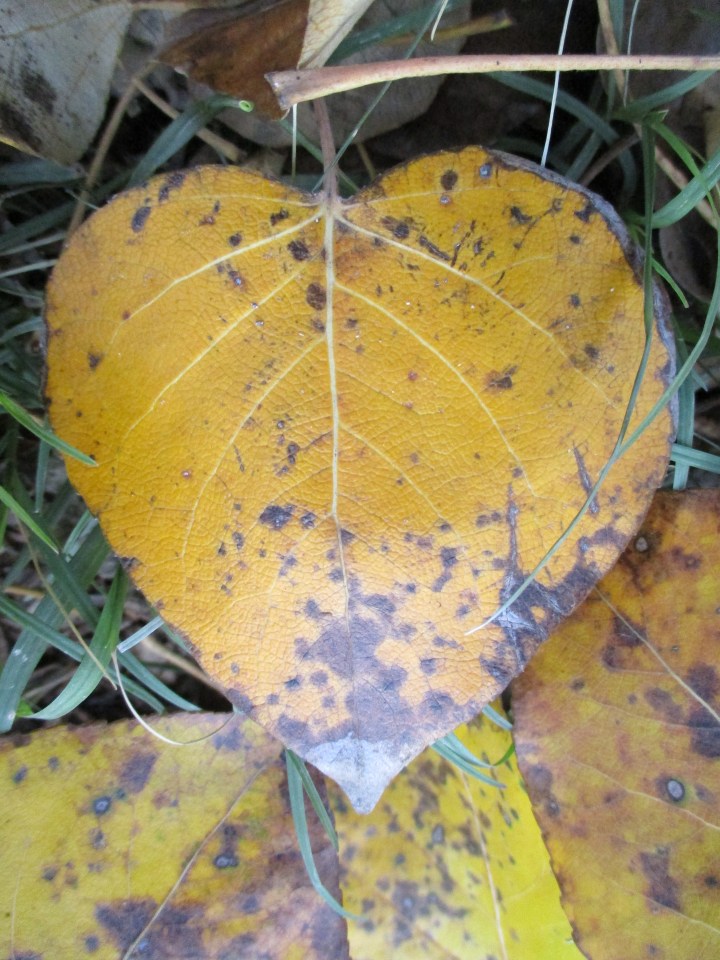
P71014The trees look spooky now. Box elders, honeylocusts and alders, and even some of the sycamores, have dropped so much of their foliage since that weirdly hot weather a few weeks ago. The smoky sky as a backdrop enhances the spooky factor. The trees do not seem to be too distressed. They just dropped their leaves a bit early to conserve resources. If they had not dropped foliage by now, they would be dropping it soon anyway.

Trees are not stupid. They know what they are doing. Otherwise, they would not survive as long as they do out in the elements. Sometimes, they seem to know what the weather will do before it does it; like dogs, cats and horses that start to get their undercoats early before a cold winter.

Deciduous trees and other plants defoliate for winter for a few reasons. Those from farther north probably see no need to work so hard to collect sunlight while sunlight is so minimal. Up north, days are shorter, and sunlight is diminished as it passes through so much of the atmosphere at a lower angle. Deciduous plants from colder climates shed their foliage because they know that if they do not, it will get frozen anyway. Those from snowy climates do not want foliage to collect heavy snow that can break limbs. Defoliation also eliminates much of the wind resistance that can break limbs during winter storms. There are a few advantages to being deciduous.

In California, we have a native California buckeye, Aesculus californica. In chaparral conditions, it can be ‘twice-deciduous’. It does not need to be so in less arid regions, such as the Santa Cruz Mountains. It really depends on the weather.

As a twice-deciduous plant, the California buckeye develops new foliage in spring like other deciduous plants do. It stays foliated as long as it wants to; but if things get too dry and warm in the middle summer, the foliage shrivels and falls. To a casual observer, the trees seem to die. However, between the first autumn rain and the first winter frost, California buckeye develops a second phase of autumn foliage to briefly compensate for summer dormancy. This foliage stays late until it gets frosted and falls. Winter dormancy is just like that of any other deciduous tree. In spring, the process starts all over again.

Where There’s Smoke . . .

P71012

Do not work in the garden today if you happen to be in a region inundated by smoke from wildfires. The air is too toxic. The picture above was copied from the East Bay Times yesterday. It shows smoke obscuring much of the view of northern San Jose from the East Hills. It might be Milpitas. It is difficult to recognize.

The news says that this is the worst air quality recorded in the Santa Clara Valley, even worse than when we had smog back in the 1970s, and even worse than when there were serious fires much closer to home in the Santa Cruz Mountains. Even the smoke from the Lexington fire in 1985 was not so thick.

If you must work in the garden, do not use machinery that might ignite vegetation near wildlands. Something as simple as a weed eater striking a stone can make a spark that can ignite overgrown grass. Barbecuing out in the garden is something that should be postponed for better weather.

The breeze that might move some of the smoke out of the area also accelerates fires that continue to burn, and increases the fire danger. Any new fires that get out of control are very likely to spread very rapidly. All the rain last winter enhanced the proliferation of vegetation. Recent unseasonably warm and arid weather desiccated much of the vegetation. Now, there is an abundance of vegetative fuel everywhere.

Wildfire is part of life in California. Many of us know how fire is an important part of the ecosystem, and how many plants in the wild benefit from it. However, none of this is any consolation when so many homes have been burned.

Bastards!

P71011Palm trees did not impress me much when I was young. Although striking in the right landscapes, they did not ‘do’ much. They made no fruit. They made no firewood. Only the big Canary Island date palms made any significant shade. What they did make was a big mess that was difficult to rake. They were expensive to maintain. They sheltered rats and pigeons. Their seedlings came up in the weirdest places.

Back then, the only two palms that I was really familiar with were the Canary Island date palm and the Mexican fan palm. Windmill palms were common too, but because they are so much less obtrusive, they did not get my attention. Queen palms had not yet become a fad, so were mostly in older neighborhoods outside of my world. I was aware that there was an odd type of Mexican fan palm, but never gave it much thought.

Then I went to college . . . and met Brent, from Southern California, where palms are more appreciated. I also met more palms that I had either ignored earlier, or had never seen before. After a while, Brent showed me around coastal Southern California, including the Pacific Coast Highway and Santa Monica, where I saw palm trees at their best.

I will never forget turning onto Bedford Drive in Beverly Hills, where the Beverly Hillbillies drove when they came to town. I had never seen Canary Island date palms and Mexican fan palms like that before. They were so majestic! They were so tall! They were so uniform! It did not change what I already knew about palms, but it did give me a different respect for them.

That odd Mexican fan palm that I mentioned earlier was actually the California fan palm, or the desert fan palm, which is classified as a distinct specie. It gets about half as tall, but twice as stout, with fluffier foliage. Because it is shorter and stouter, it stands straight, without bending like the taller and lankier Mexican fan palm does. It is also more genetically variable because it naturally grows in isolated oases rather than a contiguous range.

After seeing the California fan palm growing wild outside of Palm Springs, around the springs that Palm Springs is named for, it became my favorite palm. It is very stately in the right situations. It lines North First Street at Saint James Park in San Jose, and flanks the Palm Driveway at the Winchester House. Unfortunately, it really prefers to be out in the aridity and warmth of the desert. It looks rather sickly if it gets too much water.

While cruising around the Los Angeles area, Brent pointed out a few ‘bastards’, which are hybrids of California fan palm and Mexican fan palm. Apparently, they are not distinct specie, but rather subspecie. In other words, they hybridize freely. Each parent has attributes; and the bastards get the best of both.

Mexican fan palms, whether I like them or not, are very tall, elegant and graceful. They are exquisite skyline trees, with leaning or bowing trunks that can move casually in the wind. California fan palms are stout, stately and formal. If not watered too much, their straight and uniform trunks, and canopies of fluffy foliage, work nicely where conformity is desired. Bastards have trunks that are just thin enough to be elegant, but just stout and straight enough to be stately. Their canopies are more ‘lush’ than fluffy like those of the California fan palm.

Until recently, bastards were solitary trees that grew randomly from seed. They were not available in nurseries. If they had been, they would have been very variable because of their random breeding. However, someone took notice enough to cultivate what seems to be a cultivar known as Washingtonia X filibusta. (Washingtonia X filibusta is derived from the names of California fan palm, Washingtonia filifera, and Mexican fan palm, Washingtonia robusta. The ‘X’ designates it as a hybrid.) They are becoming the new alternative to the formerly all too common Mexican fan palm.P71011+

Politically Incorrect Horticulture

P71008Landscape Designer, Brent Green and I are both very professional at work. Brent is particularly well dressed, well groomed and well spoken. I happen to be simpler and plainer, but it works for the clients who respect my expertise. What our clients do not see is how we interact with each other. It would be very easy to be offended. Yet, we consult with each other almost daily, usually when Brent is driving somewhere . . . alone. We get loud, obnoxious, rude, crude, potty mouthed and just plain nasty!

Years ago, when Brent got his telephone connected to the stereo in the car, he made the mistake of driving up to a drive through window at a fast food establishment while talking to me. I listened to him place his order, and then shouted, “THIS IS A HOLDUP! GIVE ME ALL YOUR MONEY!”.

Last year, while stuck in traffic on southbound Highway 17 with the top down in the old Chrysler, I took a call from Brent. I was using some weird hands-free device at first; but when Brent started rapping about some very objectionable subject matter, I just had to share. I disconnected the device so that the call was coming through on the stereo, and turned the stereo up very loud. I just sat there calmly and tried to look as if I did not know where all the commotion was coming from, although it was obvious. I just didn’t care. Neither did Brent. He was 350 miles away.

However, not all of our nonsense is so senseless. We have developed quite a bit or our own private vocabulary and horticultural slang. It works for us because we share so much common experience. Much of the slang applies to ‘ethnic horticulture’, which refers to the gardening styles of particular ethnic groups. Brent’s favorite ethnic group to invent ethnic horticultural slang for is of course mine. Although I am only halfway of Italian descent, I can really identify with Brent’s observations of the gardening habits of people of Italian descent.

My ancestors have been here so long that the ‘old country’ refers to Sunnyvale (California). Yet, somehow, some traditions continue through many generations. My great grandfather grew many of the plants that are very stereotypical of Italian American gardening. My pa is more cosmopolitan, but he and I still enjoy some of what we learned from my great grandfather.

This is some of the slang that Brent developed for some of what I grow in my garden:

  • dago pansy – nasturtium
  • dago begonia – geranium
  • dago sunflower – dahlia
  • dago rhododendron – oleander
  • dago tomato – tomato (duh)
  • dago wisteria – grape
  • dago plum – fig
  • dago berry – olive
  • dago spruce – Italian cypress
  • dago firewood – any fruitless tree
  • dago ghetto grass – Astroturf (not in my garden)
  • dago groundcover – red lava rock or white moonrock

Dago Pansies

P71007You can say what you like about nasturtiums. My landscape designer colleague, Brent Green certainly did when he named them ‘dago pansies’. They are still one of my favorite flowers, and just might be my favorite, even though none are convincingly white. They were my first. I discovered them when I was very young. They were growing near an old English walnut tree in my great grandfather’s garden. He noticed that I liked them, so found some seeds underneath to send home with me.

I did not know what to do with seeds, so I poked holes into the ground and dropped the seeds into the holes just like my great grandfather showed me to do. A few days later, small round leaves appeared where I had put the seeds. The leaves expanded and looked just like those of the nasturtiums in my great grandfather’s garden. Yellow, orange and even a few red flowers were blooming within a month. I was so impressed when the flowers first appeared, but was then briefly saddened when the first flowers to bloom faded.

I say that I was ‘briefly’ saddened because of what happened next. Where the flowers had been, I discovered what appeared to be the same sort of seeds that my great grandfather had given me! I still did not understand how these things worked; but I took the seeds and stuck them into the ground in other areas . . . anywhere I thought nasturtiums would be nice. They grew, bloomed and provided more seeds, which I took and planted elsewhere . . . and everywhere! To this day, my pa considers nasturtiums to be invasive weeds because of how they overwhelmed the garden that he thought was his.

In my kindergarten classroom, we had ‘color boards’ on a wall. Red, yellow and blue were the tree primary colors. Orange, green and purple were the secondary colors. There were also boards for pink, brown, black, white and gray. We could bring small disposable artifacts from home for our teacher to tape to the various boards. The artifacts were mostly bits of fabric, colored paper, pictures from magazines, Legos, buttons, or really anything we could find that could be taped to a wall. Of course, I had to bring yellow, orange and red nasturtium flowers, and a green nasturtium leaf. Our teacher probably did not want to tape them to the wall, but did anyway. They turned brown, but stayed there. I bragged about them for the rest of the school year.

I still grow descendents of those old nasturtiums. I also try new varieties just because I enjoy them so much. I still like the classic ‘Jewels mix’ because they have every color. They are smaller than wild nasturtiums at first, but are more prolific. After a few years, they revert to the common yellow and orange. Renee’s Garden Seeds at https://www.reneesgarden.com/ has some very interesting varieties, including a few old classics. The climbing types do not bloom as much, but are fun anyway. I probably have not tried them all yet, but I would if I could. I have history with dago pansies.

Small Tree In A Big Park

P71006How did the Featherstone Tree survive? (See: https://tonytomeo.wordpress.com/2017/10/05/big-tree-in-a-small-town/.) It was planted on the edge of a busy highway where heavy loads of lumber were driven by oxen, at a time when society was more interested in harvesting trees than preserving them. Yet, after more than a century, it is still here.

The Scofield Tree is a very small valley oak in an island of a parking lot at Felton Covered Bridge Park, just across the San Lorenzo River from the Featherstone Tree. In a few centuries, it might be comparable to the big valley oak that was recently cut down across the road (See https://tonytomeo.wordpress.com/2017/09/11/goodbye-to-an-old-friend/.) It is a good choice for this location because it develops a remarkably complaisant root system for such a large tree, and it is a native, so does not need to be watered.

However, it is the fourth tree to be planted here. The original California black oak that was planted when volunteers from the Community built the park years ago did not last long before getting run over by a car. It was not replaced until a small Eastern redcedar was planted on New Year’s Day of 2013. That tree was dead and crispy by summer. A bigleaf maple was planted the following winter, and sort of survived through the year, only to die the following winter. It was too late in winter to plant anything new that year, so the tiny valley oak was planted late in 2015.

Although tiny, it had a nice root system, which was more than the two bare-root trees before it had. The hope was that if it could survive getting peed on by dogs long enough to disperse roots, it would be fine. It started to foliate the following spring, only to get much of the bark gouged away by a ‘gardener’ with a weed whacker. The poor tree nearly died, but somehow survived and started to recover. However, it did not recover fast enough to get ahead of the dog pee. It really seemed to be struggling through this year, and is now getting ready to defoliate for autumn. It really needs to get some height next year. Small trees are just too vulnerable to all that goes on in a park.

Each of the redwood trees around the perimeter of Felton Covered Bridge Park is a memorial tree, sponsored by friends or family of the deceased. An additional sweetgum tree is a memorial tree for a French bulldog. Some of the trees are outfitted with memorial plaques. The tiny valley is named the Scofield Tree for an old friend of the Community, Jeff Scofield, who passed away in the spring after the tree was planted; but it is really a memorial tree for a few people who passed away within a few years of that time. The Scofield Tree was sponsored and planted for the deceased by Felton League, an informal group of displaced and socially disadvantaged people of Felton, and their friends. Their Facebook page can be found at https://www.facebook.com/Felton-League-520645548069493/.

Perhaps what is written now about the Scofield Tree will eventually become part of the history of Felton, and be summarized on a plaque like the one on the Featherstone Tree. It would be excellent enough if the Scofield Tree simply does what good treed do in a park for a few more centuries.

Big Tree In A Small Town

P71005Trees get planted all the time. Apparently, nature does not do the job adequately. Trees get put into specific locations to provide shade, produce fruit, enhance a landscape, obscure a view, or for any of a vast number of reasons. It is amazing that they are as accommodating as they are. It is rather presumptuous for us to think that they actually want to live with us in our synthetic environments as much as we want to live with them.

The coastal redwood is the tallest tree in the world. It can live for thousands of years. An individual tree can produce enough lumber to build a small house. It is no wonder that they are so impressive to anyone who sees one for the first time.

Many towns within the natural range of the coastal redwood were established for the redwood lumber industry. Felton, in the Santa Cruz Mountains, is one of those towns. George Featherstone of Ottawa came to Felton in 1888, and was so impressed with the coastal redwood trees, that he planted one in the middle of town only a few years after his arrival. This tree was only a teenager when redwood harvesting increased to supply lumber to rebuild San Francisco after the Great Earthquake and Fire of 1906, and then to develop the rest of the San Francisco Bay Area.

More than a century later, the Featherstone Tree is still here, and is the biggest thing in the small downtown. The Community Deck was built around it by volunteers from the Community many years ago. It is not as tall as trees in the forest are, but only because it does not need to compete with them. It is shorter and stouter, and really seems to enjoy being the center of town. It is quite the celebrity.

Mr. Featherstone had no idea of how important the tree he planted would become. It would be nice if we all could do such nice things for our communities, but then the world would be much too shady.

P71005+(‘ninties’ means the 1890s.) This Redwood Tree was planted in the early ninties by one of Felton’s early settlers, George Featherstone, a man who knew the wonder and beauty of these trees. Born in Ottawa, Canada in 1872, he came to the San Lorenzo Valley on March 17, 1888. He died on September 27, 1947.