Bad Wine

P00719
I believe that this is a young Chilean wine palm, although I am not certain.

Italian Americans, particularly Californians, are expected to be experts in regard to wine. I am not. I can not explain it. I dislike wine, especially the best of it. It smells and tastes like rotten grapes. When I learned that Chilean wine palms were, and might still be, decapitated for the collection of their sap, from which wine is made, I learned yet another reason to dislike wine.

This little Chilean wine palm, Jubaea chilensis, pictured above, lives just a block or so away from the bad date palm that I wrote about last Sunday. No one here will try to make wine from its sap. The utility cables that seem to be too close in the background actually pass with plenty of clearance to the right, so will not be a problem in the future. This young palm should be safe.

Although I have encountered too few of the species in my career to be completely certain that this little palm is a well bred Chilean wine palm, it is very convincing. I see no indication that it is a hybrid of another species. About half of the Chilean wine palms that I encounter are hybrids. Most of these are hybrids of queen palm. Others are hybrids of pindo palm. Both look weird.

Of course, well bred Chilean wine palms are not much better. The specimen pictured below demonstrates that, regardless of how bold and striking they are, they are still rather weird palms. That is probably why they are so rare now. They were rare even during the Victorian Period, when weird species were trendy. Yet to many, their distinctive weirdness is part of their allure.

I can not help but wonder where this Chilean wine palm came from. Someone must really appreciate it to put it here.

P00719-2
Chilean wine palm is not a good houseplant.

Fine China

P00718K-1
Before: There was not much hope for the Chinese maple underneath this mess.

It will be just fine. The Chinese maple that I mentioned earlier this morning sustained surprisingly minimal damage when part of a bay tree fell onto it. The situation initially seemed hopeless prior to the removal the heavy debris that was pressing the diminutive Chinese maple downward. Yet, the little tree somehow regained its composure, and is expected to recover.

The little Chinese maple was always rather sparse in the shade of the surrounding forest. Also, it exhibited an asymmetrically sculptural form. That is likely normal for the species within its natural environment, where it lives as an understory tree (within the shade or partial shade of larger forest trees). The distinctive form and open canopy were part of its allure.

As the debris was removed, most of the stems of the Chinese maple sprang back into their original positions. Only two major limbs were fractured and needed to be pruned away. Some of the minor twiggy growth was groomed in the process. The main trunk was somewhat destabilized, but not too detrimentally so.

It probably should be no surprise that the little tree was so resilient to the altercation. It is, after all, an understory tree. Within its natural environment, it likely contends with the same sort of abuse. Chinese forests are likely just as messy as forests here are. Gravity pulls all that mess in the same direction.

The little Chines maple may not look like much now that it has been groomed and pruned to be even more sparse than it originally was, but it should be fine. By this time next year, foliar density should be comparable to what it was prior to the incident. The form will remain sculptural, as it grows away from the shade of the forest, and out over the stream below.

P00718K-2
After: After a bit of grooming, this little Chinese maple is not so badly disfigured.

Six on Saturday: Timber! III

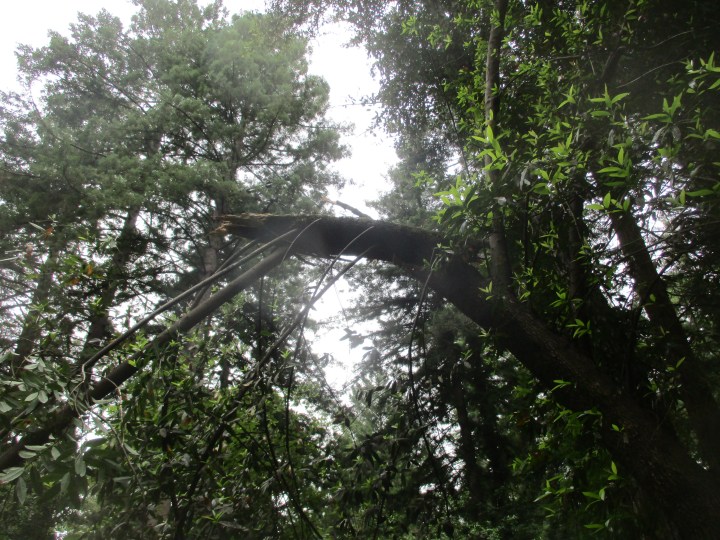
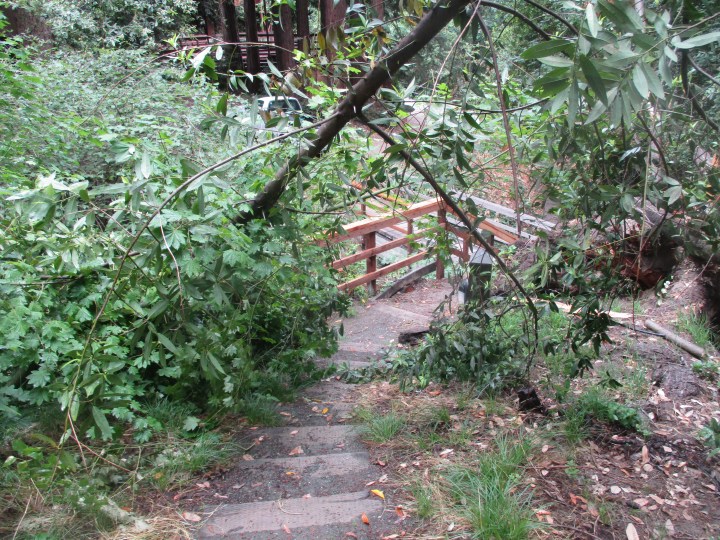
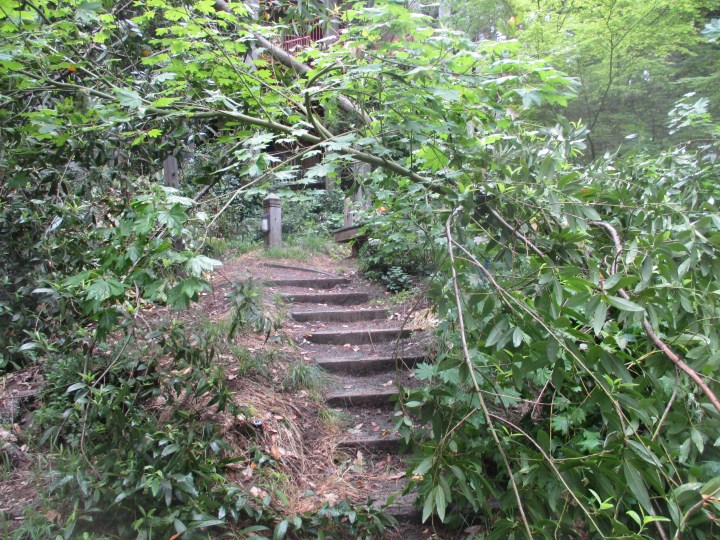
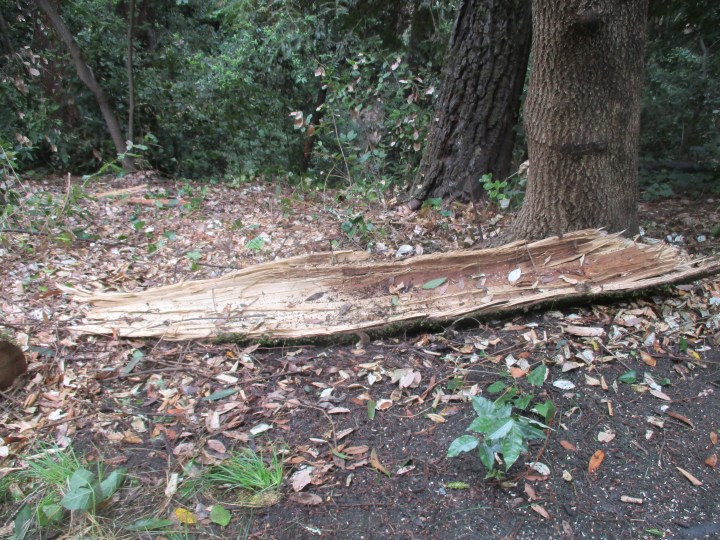
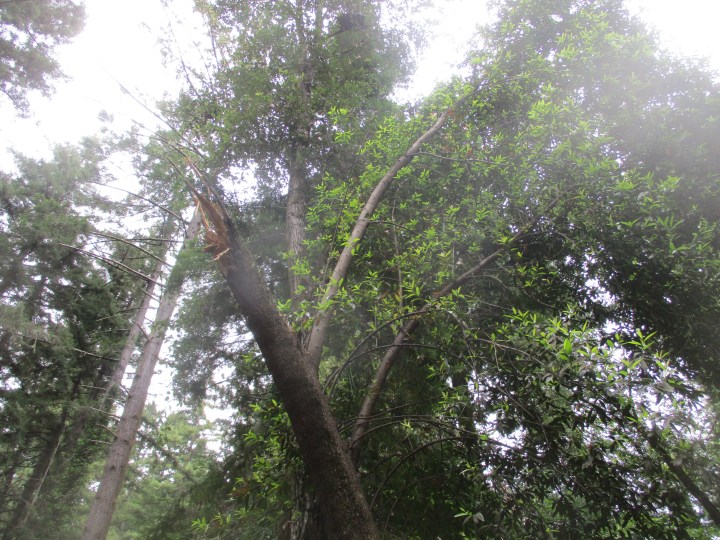
At the end of May, Six on Saturday – Timber! II, ended with a precariously disfigured bay tree. Timber!, on May 10, mentioned that most of the tree had previously broken apart and fallen on top of a big Douglas fir tree that had fallen earlier. Prior to this big mess, the bay tree had been leaning on the Douglas fir tree. Now, it just continues to deteriorate. The precariously disfigured limb that remained last May was the most recent victim of gravity. Not much of the tree remains.

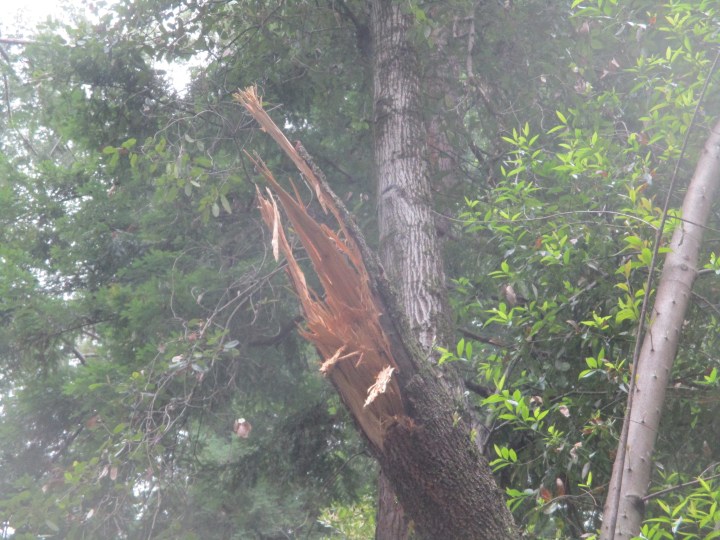
1. This was what we were concerned about. The disfigured and fractured trunk twisted from leverage exerted onto it by an upper limb, which is now extended downward instead of upward.P00718-1

2. Damage was impressively minimal. An exemplary specimen of Chinese maple sustained a direct hit from the main limb of the bay tree, but also sustained only minor structural damage.P00718-2

3. The trail somehow remained passable, although closed because of the big fallen limb dangling above. As the limb was dismantled, the fractured portion of the trunk broke away and fell.P00718-3

4. This big piece of the twisted and fractured portion of the trunk looks like a canoe, and is about as big. This was suspended more than twenty-five feet up, which is why the trail was closed.P00718-4

5. What remains of the bay tree is still severely disfigured, but is not so dangerously structurally compromised. It can remain until another arborist can get here to remove it and other trees.P00718-5

6. It looks worse up close. Nonetheless, there is not much we can do about it now. The limb to the far right originates from the same trunk. The big gray trunk in the background is a tan oak.P00718-6

This is the link for Six on Saturday, for anyone else who would like to participate:

https://thepropagatorblog.wordpress.com/2017/09/18/six-on-saturday-a-participant-guide/

Horridculture – Solar Power

P00715
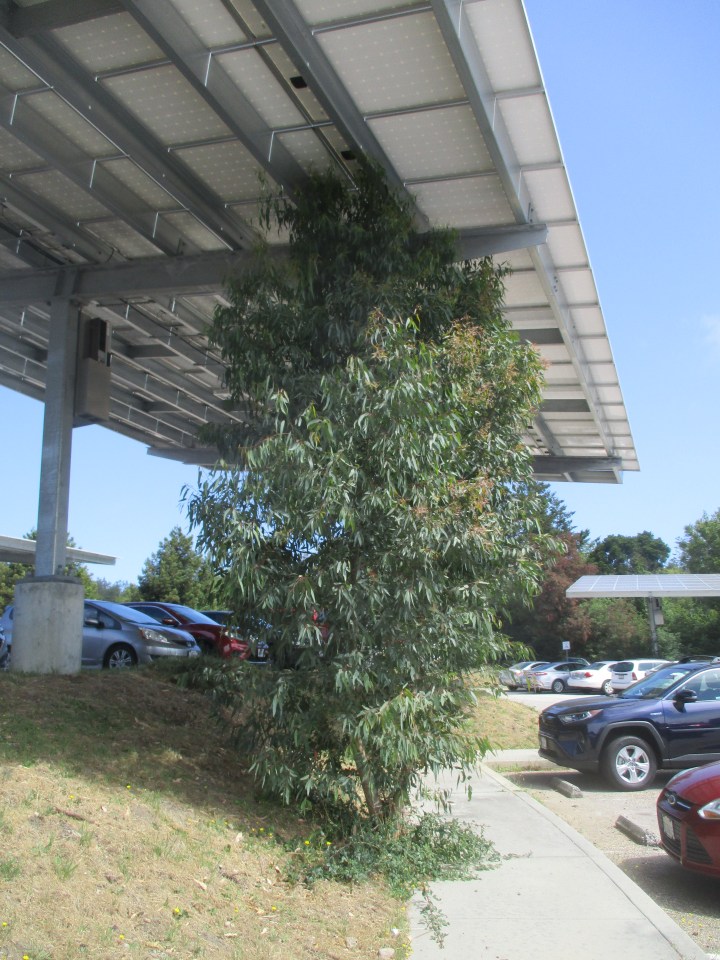
This gives a new meaning to ‘shade tree’.

Leaves are the original solar panels. They collect solar energy, and convert into useful resources. Some of those resources get converted into other resources that are good for human consumption, such as fruit, vegetables, lumber, firewood and oxygen. However, one resource that leaves do not produce is electricity.

That is why the big solar array pictured above was installed over a big parking lot. There are a few of these arrays in this parking lot, and more in other nearby parking lots. Many trees were cut down to accommodate them. People who work nearby can use the electricity more than they could use vegetation, or anything that vegetation could produce within this area.

Shade trees are nice over parking lots, but are not necessary over a parking lot that is shaded so thoroughly by such big solar arrays. After parking during rainy weather, an umbrella is only necessary between the solar arrays and the adjacent office buildings. There are no more fallen leaves to clean up. Pavement and curbs will no longer be displaced by growing roots.

The red gum that is also pictured above, under the solar array, is not so impressed. It likely grew from a root of a red gum that was removed so that the solar array could be constructed. Sadly, it must be cut down again, not only because it is under the solar array, but also because it is against the sidewalk. It has clearance problems both above and below.

It is rather ironic that even after all the trees that formerly shaded this parking lot were cut down for the installation of this solar array, this young red gum that is so determined to survive can not stay. I can not help but wonder what this young red gum thinks of green energy.

Bad Date

P00712-1
No one likes a bad date.

Date orchards that were displaced by the expansion of urban sprawl around Las Vegas in the 1990s were the source of the many recycled mature date palms that briefly became popular for large scale landscapes at the time. Most of the trees within the orchards were female, with only a few male pollinators. (Pollinators can live remotely, where they provide pollen for dusting.)

Male trees were undesirable anyway, at least in conjunction with female trees. They are taller and lankier, with less pendulous foliage, so are less visually appealing. More importantly, they pollinate female flowers so that they make fruit. Of course, in orchards, fruit is very important. In landscapes, it is just a mess. Without male pollinators, female trees produce no messy fruit.

Consequently, most male trees were not recycled. Some were installed singly, or in exclusively male colonies, in landscapes that were reasonably isolated from female trees. After decades of dutiful service, this is how they were retired, . . . or not.

During the brief date palm fad, a colony of exclusively female date palms at a mall near here produced a minor crop of dates during its second year after installation. It was not a major mess, but it was perplexing. Eventually, someone realized that a single relatively small male date palm lived just outside of the landscaped areas. It likely grew there from seed as a curb mongrel.

Even though the male tree was too remote to pollinate the female trees sufficiently for a major mess, it was removed. It was not much bigger than the short and clumping date palm pictured above. This tree seems to be a curb mongrel as well, since it was not likely planted there purposely. Furthermore, it will also likely need to be removed. It is too close to the building behind.

Weeds?

P00711K-1
Although I can not be certain, I believe that this is prickly lettuce.

Pretty weeds do not get my attention like they do for others. They look too much like weeds to me. If I want to appreciate them, I must do so with intention. Sometimes, I do actually try. I did happen to notice these two weeds. However, now that I got their pictures, I have no use for either of them. Neither is readily useful for the gardening column. I will just share them here.

The yellow flower pictured above is most likely prickly lettuce. I really do not know. I know it as yellow chicory; but chicory does not bloom yellow. Some people think of it as dandelion, since the flowers are similar. These flowers stand much higher though, with only minimal foliage below. For the picture, I plucked this flower and stuck it in the ground to keep it still in the breeze.

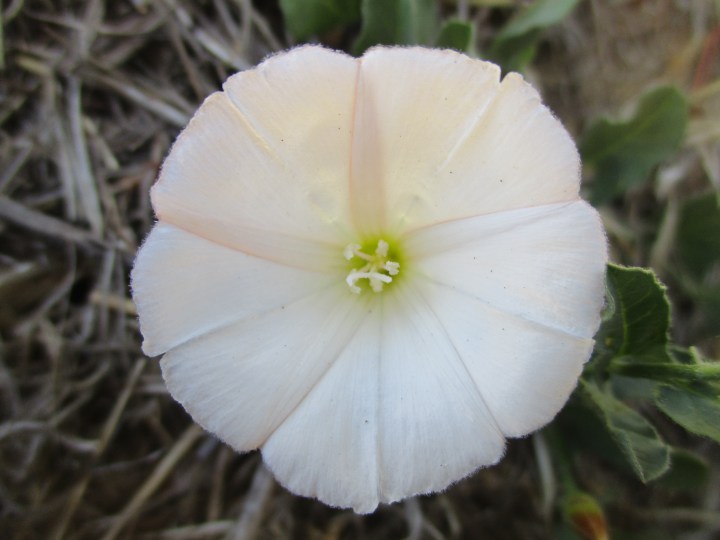
The white flower pictured below is common bindweed. When I was a kid, I knew it as morning glory. In this close up picture, it looks like a fancier garden variety of morning glory, although the flower is much smaller. Real morning glory happens to look good in white, like this one does. If it is fragrant, I have never noticed. It tends to creep along the ground more than it climbs.

It sometimes seems silly to me that others so easily notice how pretty weeds such as these are, especially while there are so many more flowers that are prettier. Then, I realize what others must think of what I consider to be pretty. For example, the pollarded blue gum with aromatic blue foliage that I enjoy so much, is the same species that gives all eucalypti a bad reputation.

Besides, these flowers were the prettiest in the otherwise bare meadow where I found them.

P00711K-2
Bindweed looks like miniature morning glory.

Six on Saturday: Closeups II

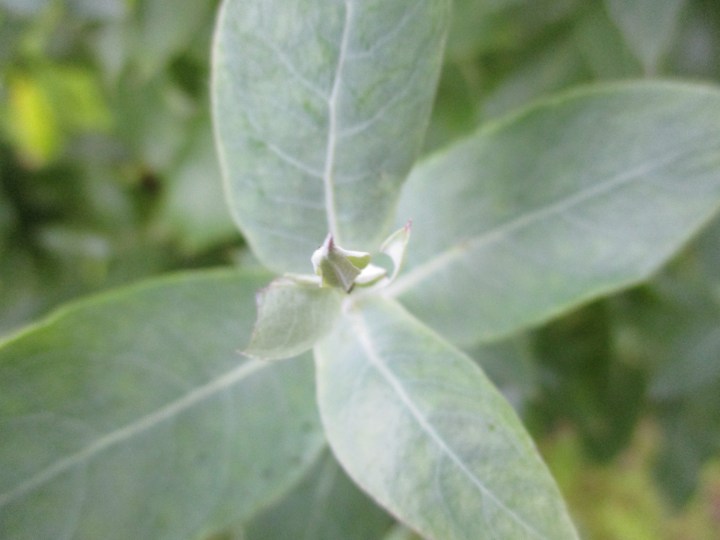
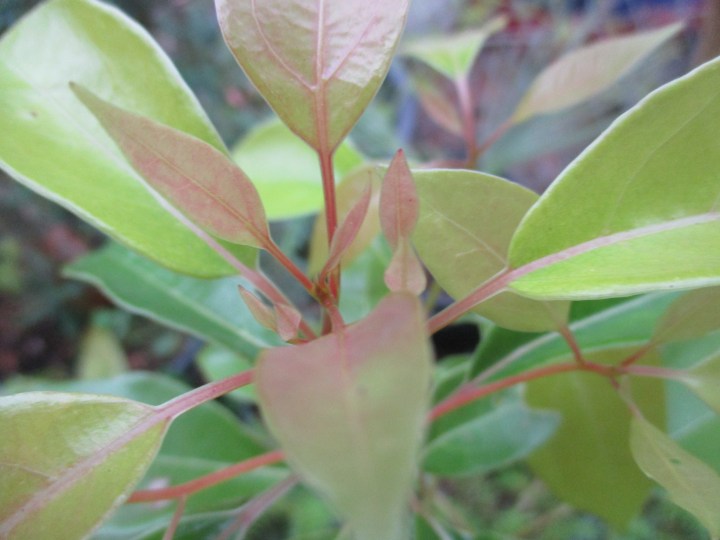
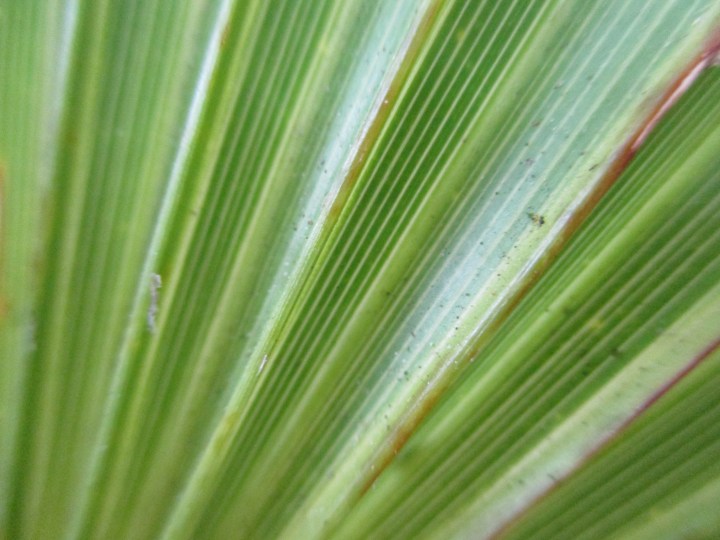
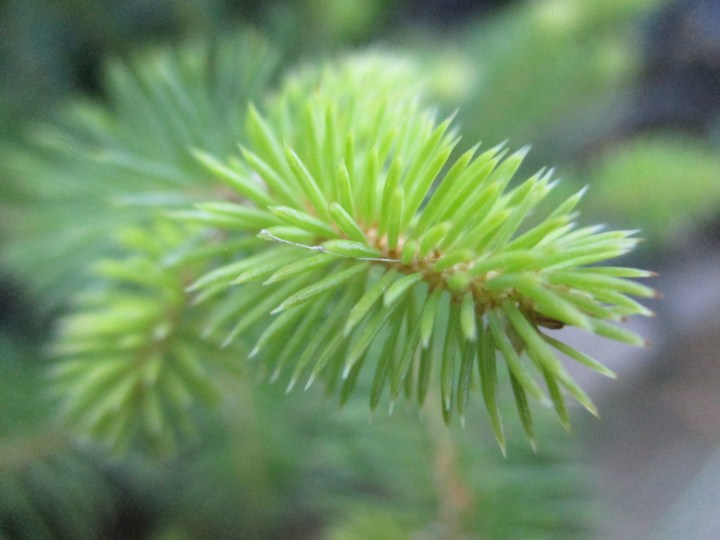
This is the more foliar counterpart to the closeups for my Six on Saturday from last week. Some are closer than others. Some would be more easily identifiable without captions than others. All are quite random. All these subjects are in the storage nursery; but only #1 and #5 will eventually find homes in the landscapes here. The others will likely go into one of my own gardens. I have no idea of what to do with #2.

1. Agave pedunculifera – provided the most abstract picture of the six. The name is only a guess. Someone else might have been able to identify it as something else if more of it were visible.P00711-1

2. Eucalyptus globulus ‘Compacta’ – compact blue gum – was my second choice for juvenile blue gum foliage. It was easier to reach because it is more . . . compact. The other blue gum is tall.P00711-2

3. Cinnamomum camphora – camphor – is light yellowish green most of the time, and then gets slightly blushed with new growth late in spring. This young tree started late in partial shade.P00711-3

4. Trachicarpus fortunei – windmill palm – provided the second most abstract picture of the six. It is more recognizable though. Mediterranean fan palm is darker. Other fan palms are light.P00711-4

5. Picea sitchensis – Sitka spruce – was brought from Smith River, on the coast just south of Oregon. It does not seem to mind being so far from home. The happy new growth is impressive.P00711-5

6. Juniperus virginiana – Eastern red cedar – is my favorite this week because I brought it from Oklahoma. Cedrus deodara – deodar cedar – is the real cedar that provided the background.P00711-6

This is the link for Six on Saturday, for anyone else who would like to participate:

https://thepropagatorblog.wordpress.com/2017/09/18/six-on-saturday-a-participant-guide/

Horridculture – Weed Whackers

P00708
This must be the better half.

This neatly sliced prickly pear is too silly to rant about. There is another just like it. Two others were not sliced, as if, after the first two, someone realized that there was more to the roadside meadow than combustible dry grass. The prickly pear were put out there just last winter. They each extended only a single pad half a foot or so above grade, so were obscured by the grass.

Realistically, the damage is minimal and tolerable here. The priority of the crew who performed the vegetation management was to cut down all the combustibles. They did an efficient job of it. They did not expect to encounter anything that had been intentionally installed out there, or even any desirable vegetation. Besides, this prickly pear will recover as if nothing happened.

Unfortunately, damage caused by weed whackers is rarely so innocuous. Weed whackers are one of the most commonly misused horticultural power tools, and are very often used by those who are not aware of how to use them properly. They are easy enough to operate that minimal consideration is given to the potential for damage that they can cause. It is a bad combination.

Because weed whackers are often and improperly used to cut tall grass that is too close to trees for lawn mowers to cut, they commonly strip off bark and cambium from young tree trunks. A tree can not survive without its cambium, and quickly dies if too much is stripped away from the base of its trunk. That is why it is very important to pull weeds from around trees instead.

For now, there is nothing to do for the two sliced prickly pear. The bud to the upper right corner of the pictured specimen is beginning to develop into a new pad.

Sunburn

P00705-1
Out with the old, . . .

There are two types of horticultural sunburn. Sun scald is what happens to formerly shaded bark if it suddenly becomes too exposed. (As I mentioned in my gardening column for this week, which posted last Monday here, sun scald that occurs during winter in colder climates is caused more by frost than by sunlight.) Scorch is what happens to overly exposed sensitive foliage.

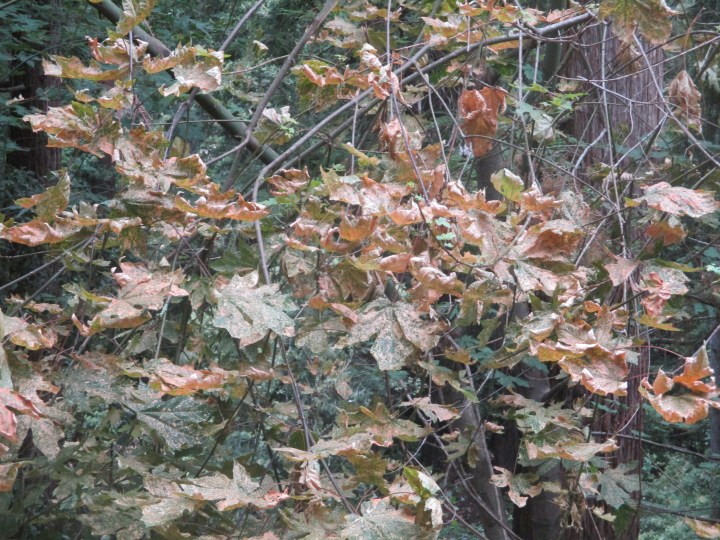
The picture above is an example of scorch on a significant scale. The bigleaf maple was formerly shaded by a big Douglas fir that fell last May, leaving the maple both severely disfigured and very exposed. Such exposure would not have been a problem it the foliage had always been so exposed. The problem was that it developed in shade, so could not adapt to the new exposure.

The exposed foliage survived for a while, but eventually succumbed to warmth, sunlight and aridity (minimal humidity). Deterioration accelerated as the weather became warmer in just the last several days. Because the foliage scorched rather than succumbed to cooling autumn weather as it would have done a few months later, it remains attached to the stems that it grew on.

That is actually an unsightly advantage for the bark of the stems that are shaded below. If the bark suddenly became exposed too, it would be susceptible to sun scald. This tree knows what it is doing. Deteriorated foliage that does not get dislodged by later winter weather will be dislodged as new foliage develops next spring. The new foliage will be adapted to the new exposure.

The picture below shows how new grow that is adapted to the new exposure develops adventitiously from the exposed trunk. It does more than just exploit the increase of sunlight. Ideally, it shades suddenly exposed bark to protect it from sun scald.

P00705-2
. . . and in with the new.

Fourth of July

P00704K
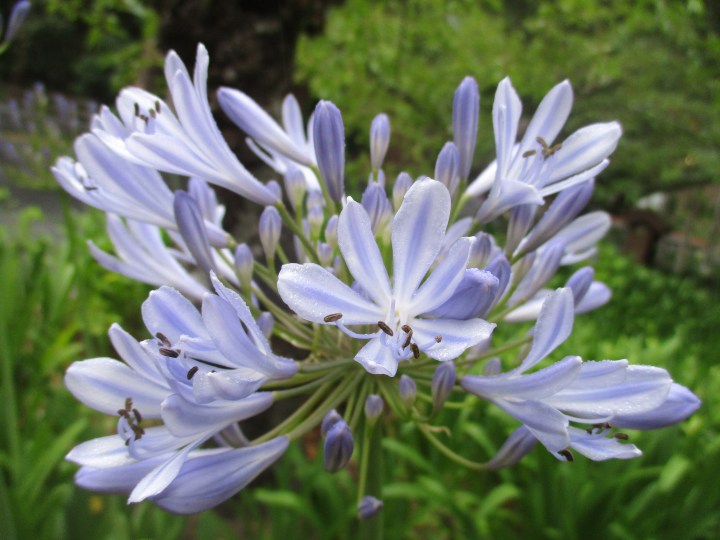
Lily of the Nile are floral Fourth of July fireworks.

Fireworks, Fourth of July parades, and the associated crowds are of course canceled for this year.

Lily of the Nile does not mind. It blooms in time for the Fourth of July regardless of what the rest of us are doing, or not doing. That is one of the two reasons why some of us know it as the ‘Fourth of July flower’. The other reason is that the nearly spherical floral trusses resemble exploding skyrocket fireworks. They are mostly blue, with some white. All that is missing is red.

The bloom in this picture is not exactly exemplary. It would have been larger, rounder, and likely more advanced in bloom if it had developed in a sunnier location. There are enough of them that we do not notice that most are somewhat diminutive. In autumn, many of the overgrown plants will be relocated to a sunnier situation where they can bloom as they would prefer too.

Lily of the Nile was the first perennial that I grew a significant quantity of. While in junior high school, a neighbor instructed me to remove a healthy colony of lily of the Nile that had grown obtrusively large in only twenty years. I could not just discard it, so chopped it into more than sixty pups, and planted it all over the neighborhood. Much of it is still there. A bit of it is here.

Back then, it was known as Agapanthus orientalis. In school, I learned it as Agapanthus africanus. I still do not know if they are two different species, or if one is just a variety of the other. I do know that mine are distinctly different from common sorts, with bigger and rounder floral trusses. The others have straighter stems that support their blooms batter, and finer foliage.