Not So Annual

P00229K-1
These primrose look as good as they did last year.

Among cattle, a cow is a female who has calved. Prior to that, she was a heifer. A bull is an adult male. A bullock is a juvenile male or castrated bull. Most cattle are males who were castrated while young, and are known as steers. Yet, cattle are commonly known collectively as ‘cows’.

Similarly, bedding plants are commonly known collectively as ‘annuals’. Many really are annuals. However, some are biennials; an even more are, to some degree, perennials.

Replacing annuals annually make sense. They grow, bloom and die within one year. Some sow seed to regenerate if and when they get the chance. In the prominent spots of our gardens, not many are likely to get such a chance before they are replaced by other annuals for more immediate gratification within the next season.

The same applies to bedding plants that have potential to perform as perennials. They too get replaced during their off season. Since most are inexpensive, their untimely collective demise is not considered to be too terribly wasteful.

There are a few that are not so easy to part with. Cyclamen will be a topic for next week because it is a cool season perennial that is too expensive to be deprived of its potential to regenerate and bloom next autumn and winter.

These English primrose from last winter were afforded an opportunity to stay in their landscape while they were somewhat dormant through the warmth of last summer, so that they could regenerate last autumn and bloom through this winter. A few from around the edges were moved inward to replace a few that did not survive. Impatiens were planted in front for summer.

The results are not exemplary only because of the shade, but are worth the effort of not putting effort into replacement.

P00229K-2
Two seasons for the price of one.

Six on Saturday: More Gopher Problems


Even underground, gophers must know what time of day or night it is. Otherwise, they would not know when to “lie awake at night, thinking up evil plans” (Micah 2:1). Why do they bother being so sneaky with their exploits? They know that there is not much I can do to stop them. Why are they so creative with their damage? Is it just to flaunt their ability to get away with it? Gophers enjoy this too much.

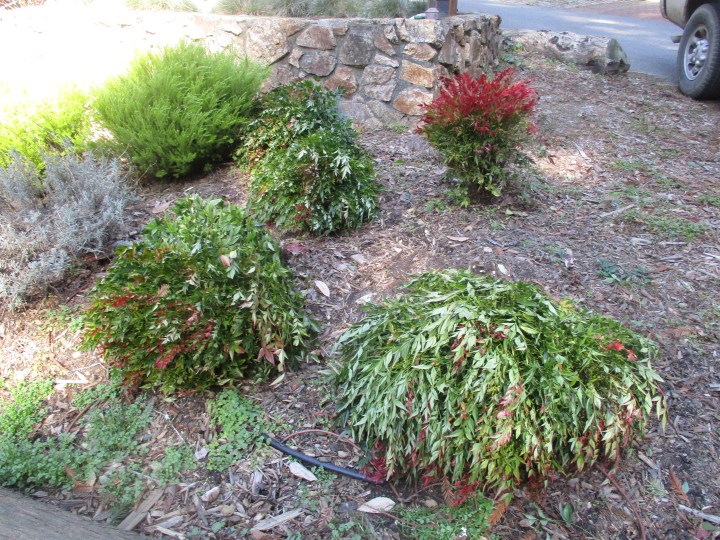
1. Only the Heavenly bamboo to the right in the background is standing upright to show off its red new foliage. The other four (with two in the background) are suspiciously flopped forward.P00229-1

2. It was as if they were just set on the surface, with no roots to hold them down. Removing their carcasses was like picking up litter. They flopped forward because of wind a few hours prior.P00229-2

3. This is all that remained of the roots. It is amazing that the foliage was as fresh as it was. This much damage did not happen just recently. Foliage should have started to desiccate already.P00229-3

4. The worst of the four demonstrates how thorough the damage was. It was like a mean prank. It seemed as if someone pulled them up, whittled the roots away, and plugged them back in.P00229-4

5. Yarrow gets partially eaten by gophers too, but somehow survives. Supposedly, only the thick tap roots get eaten, while lateral roots are ignored. Gophers do not seem to be so discerning.P00229-5

6. Daffodil is how I should end this mostly unpleasant six. No one eats them. Many are still blooming. I probably should have posted pictures of flowers, instead of what gophers are killing.P00229-6

This is the link for Six on Saturday, for anyone else who would like to participate:

https://thepropagatorblog.wordpress.com/2017/09/18/six-on-saturday-a-participant-guide/

Horridculture – High & Mighty

P00226-1
Camellias are pretty this time of year, but . . .

Camellias have been blooming for a while now. I typically get rather good pictures of them. The pictures are nothing too artistic, of course, and are intended to merely exhibit the floral color and form. A bit of the glossy foliage in the background is nice.

The picture above is not so useful for exhibiting much of the floral characteristics. Even the pink color is muted by the sloppy background and gray sky above. Zooming in would not have corrected the positioning of the flowers. I simply could not get close enough to do any better.

That eave in the lower right corner of the picture is above a two story building. That is where all the blooms of this particular camellia shrub are located. With so much of the lower growth shaded out and gone, this shrub is more like a small tree. The bloom is too high up to be appreciated. The picture below demonstrates what it all looks like without zooming in.

If there were windows facing this big camellia shrub or tree, I would likely prune it only a bit lower, just to keep it below the eave and within view of the windows. Without windows, I know that I really should prune the tall trunks back to what little lower growth remains, in order to promote more growth and bloom closer to ground level where it can be appreciated.

The difficulty I have with pruning it back is that this big camellia shrub or tree is so impressively big and sculptural, and all the glossy foliage looks so good in the foreground of the rich dark brown wall. I do not know what is more important here, the sculptural limbs and rich green foliage that lasts throughout the year, or the colorful but seasonal bloom.

P00226-2
There is not much to see from this distance.

Expiration Date

P00223-2
All those palm seed . . . and saguaro cactus.

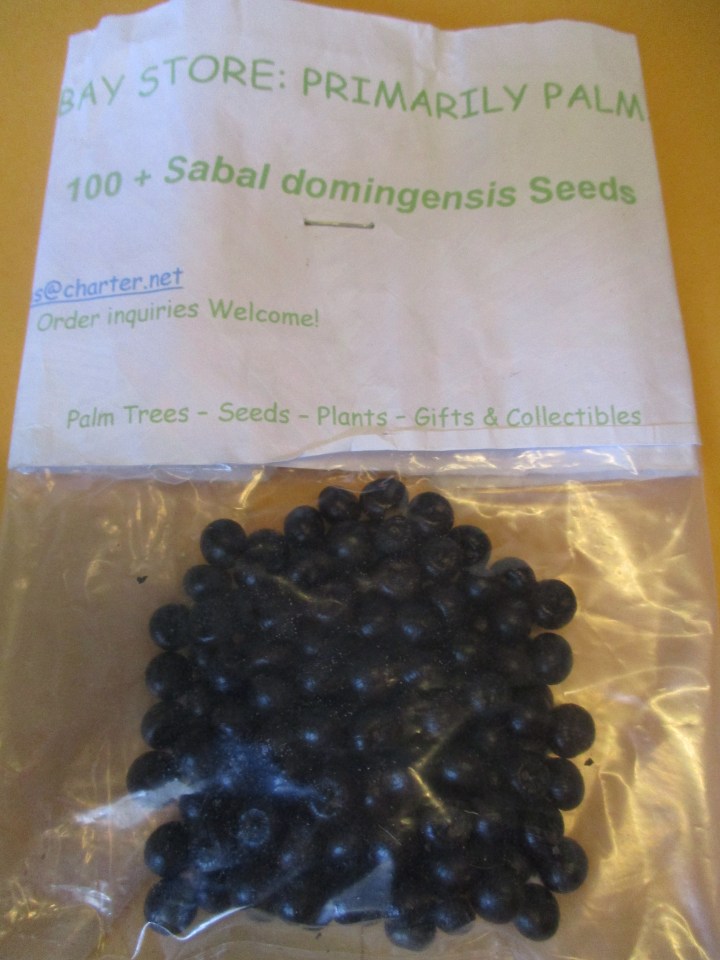
This is worse than the various seed that I happen to collect at work. It is worse than the seed of various species that I brought back from Oklahoma. These are seed that I purchased online and then misplaced . . . for a few years . . . or actually several years. Some were already old at the time, so are about a decade old now. There are leftovers from seed that were sown in 2010.

There was not much expense involved. Back then, they were even less expensive than they would be now. Those that I got a significant volume of were purchased mainly because they were so inexpensive. I figured I could find homes for the surplus that grew from them later. Most of the seed were purchased from eBay. Some were randomly collected for free from my job sites.

With few exceptions, these seed are not remarkably rare. Some are common within the regions from which they were obtained. Some are in small batches of only a few, while there are more than a hundred or a few hundred of others. There are seed for several palms, many yuccas, all but one of the North American firs, and all of the North American spruces. Not all are pictured.

P00223-3
Some seed are in significant quantity. That is more than 300 Yucca aloifolia, and 500 balsam fir.

Neither the expense nor the scarcity of these misplaced seed is a problem. What bothers me is that after so much effort to acquire them, and after so many others put the effort into sending them to me, and after the parent plants put their effort into producing all these seed, they were wasted. As I mentioned about the palm seed yesterday, few are likely viable after a decade.

Nonetheless, all will be sown. Even if none germinate, it will be more tolerable than discarding them without trying.

P00223-1
These actually look as good as fresh. I will find out.


Norwegian Wood

P00222K
Isn’t it good?

This is really getting to be a problem. Too many feral plants that we find at work get canned as if they will eventually be installed back into a landscape somewhere. The small nursery where they recover until their relocation is getting crowded. Although many are practical and appropriate for such recycling within the landscapes here, some are not, so may be with us for a while.

Five feral Norway maple saplings were found in one of the landscapes where mature trees were pruned for clearance from a roof. We could not just leave them there. They eventually would have been overwhelmed by the rest of the forest, or grown too close to the same roof that we pruned other trees away from. They were very easily dug, so came back to the nursery with us.

It was too late to prune them as necessary. They are tall and lanky trunks, with too many comparably lanky branches. As much as I am instinctively compelled to prune them while they are bare and dormant, I will refrain until later in spring or summer, when they will not bleed so much. They look ridiculous. They seem happy though. Their buds are beginning to swell already.

We have no idea where they will go from here. After pruning, they should develop into exemplary specimens. As goofy as they are now, their trunks are remarkably straight. I happen to be fond of Norway maple, and would be pleased to find an application for them here. The problems is that there are too many trees here, and the forests and landscapes continue to make more!

Horticulture in a forest can be like that. It seems like there is plenty of space out there, but so much of the space is too shaded or too crowded.

Six on Saturday: Talk To The Palm


That is how horticulturists say, “Talk to the hand.” During the past three and a half decades that I have been working with landscape designer, Brent Green, I have deduced that there is not a specimen of Washingtonia filifera in the Santa Clara Valley, or anywhere else for that mater, who is any more interested by what I have to say than he is. Nonetheless, I appreciate palms.

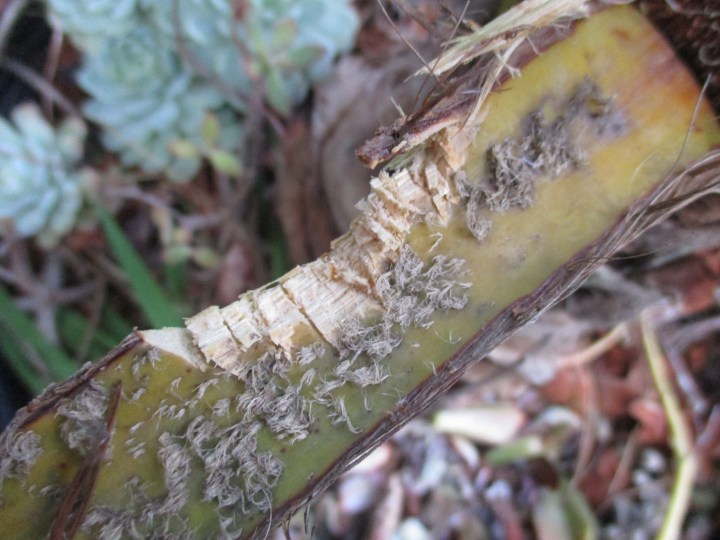
1. Rats! I thought that was who chewed on a petiole of my favorite young windmill palm from Western San Jose. However, this picture shows several small slices made with a straight blade!P00222-1

2. Pleats of an aging fronds of the same windmill palm demonstrate that surfaces exposed to the south deteriorate before those exposed to the north. The frond was tilted up for this picture.P00222-2

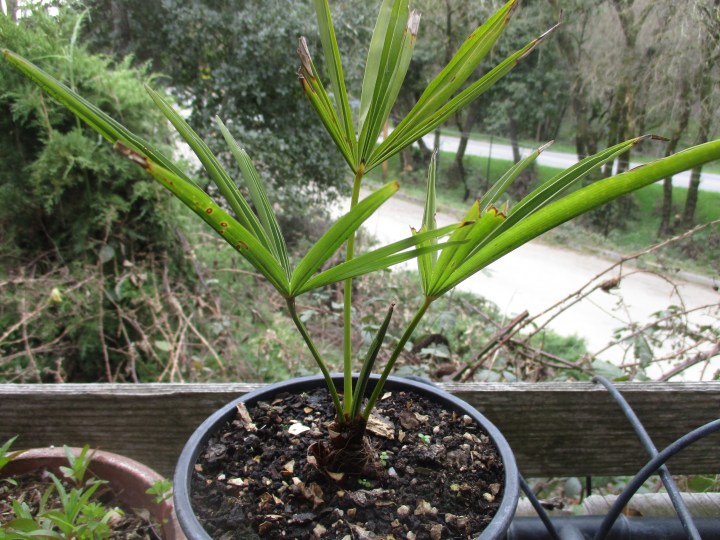
3. Windmill palm seedling is one of a few that I pulled from a landscape nearby, but could not bear to discard without at least trying to find a home for them; as if we need another palm here.P00222-3

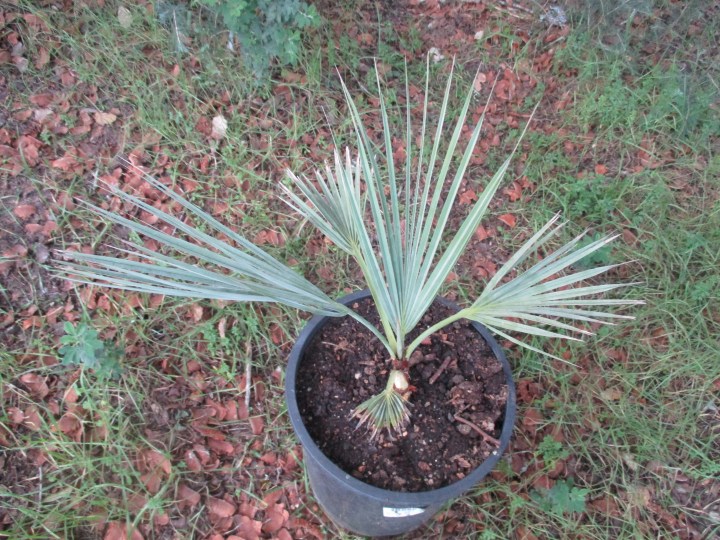
4. Hesper palm is more interesting. I brought two here while they were nearly dead. The other did not survive. This one tried to recover, died back again, and is now trying to recover again.P00222-4

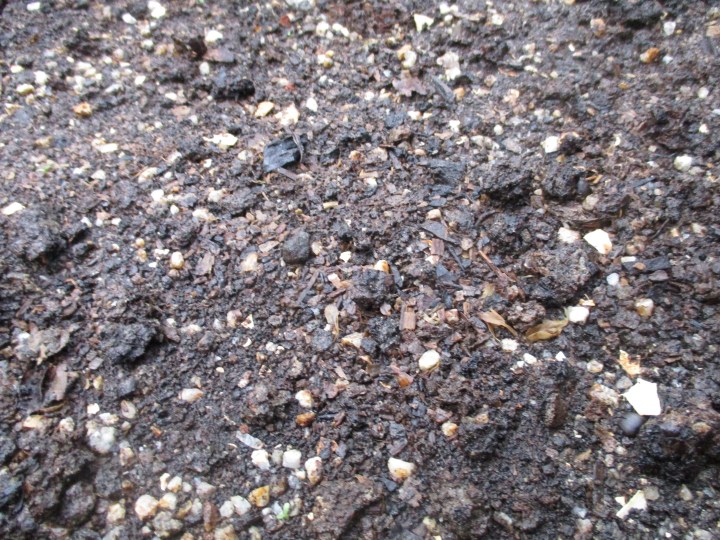
5. McCurtain scrub palm seed that I was so pleased to procure earlier is what is obscured just below the surface in this flat. I am concerned that the compost might not have been ready.P00222-5

6. Seed of other odd species of palm were found in a package that had been in storage for a few years. As if we need another palm here, all will get sown. Sadly, few are likely to still be viable.P00222-6

This is the link for Six on Saturday, for anyone else who would like to participate:

https://thepropagatorblog.wordpress.com/2017/09/18/six-on-saturday-a-participant-guide/

Horridculture – Turf & Surf

P00219
Surfing should be done in the ocean.

No, that is not backward. It refers to a legendarily disastrous incident with artificial turf at the Morgan Hill Outdoor Sports Center. Prior to about 2010, while I was the only horticulturist on a big staff of a big so-called ‘landscape’ company that expressed almost no interest in horticulture, I was summoned to the site to investigate an ‘issue’. I was told nothing about artificial turf.

Upon arrival, it became immediately obvious that this was no horticultural issue. Wind was generating waves in the recently installed artificial turf that were taller than the unfortunate guy who was scurrying about in an futile attempt to nail the turf surf to the ground. I was dismayed. I know nothing about artificial turf. Why was a so-called ‘landscape’ company even involved?

I suppose I should not have been too surprised. It was not as if many of the rest of our collective staff knew any more about horticulture than artificial turf. They seemed to take me way too seriously when I joked about the special farm that grows the artificial seed for the yellow and white stripes and yard line numbers. Otherwise, I would have told them about blue Smurf Turf.

As much as I dislike it, I know that artificial turf is quite practical for particular applications. However, it is most certainly not a horticultural commodity. It is a synthetic turf substitute that works like carpeting for landscapes and athletic fields. So-called ‘landscape’ companies that maintain it should be qualified to do so, with at least some sort of relevant and practical expertise.

That being said, why is it all green? We all know it is fake, so why not have some fun with the color, like the colorful fake snow on flocked Christmas trees in the 1970s? Some of us might like penalty line yellow. Yard line number white would be my favorite color, but would look like snow, and be difficult to keep clean. I think iron oxide red might be nice, or perhaps simple brown.

Heck, why not mix it up a bit? Sky blue with white clouds might be fun. Black and white checkerboard? Purple swirled with orange? Why not make it resemble a made-in-China Persian rug, with patterns of all sorts of colors?! What about a Gothic cathedral labyrinth? Oh, a road map of Route 66! A map of Kansas might work nicely for a small space. The possibilities are endless!

Blow Out

P00216
Wind is messy!

While strong Santa Anna Winds were blowing through Los Angeles four hundred miles to the south, and Storm Ciara was arriving in Scotland and Norway, we were getting some remarkably strong winds of our own. They were not nearly as strong as winds that were causing so much damage in Europe, and involved no flooding rain, but they were dangerously messy nonetheless.

We live and work among dense forests of coastal redwood, the tallest tree species in the World. Beyond the upper edge of the redwood forests are more forests of huge Ponderosa pine. Huge Douglas fir are mixed throughout. Their understory includes trees that would be considered to be massive anywhere else, such as coast live oak, tanoak, Shreve oak, bay laurel and madrone.

Such big trees drop big limb, and in abundance. Furthermore, limbs that fall from such great heights are significantly more dangerous than those that fall from smaller trees that are closer to the ground. They gather major inertia on the way down. They do not necessarily fall straight down either, but can get blown significant distances to where falling limbs may not be expected.

While the winds were blowing through, I could hear crashing of falling limbs and entire trees from the mostly deciduous riparian forest outside. I know that many of the big cottonwoods, box elders, willows, alders and sycamores are deteriorating, but did not expect so many to be blown down while bare. I suspected damage would be worse among the bigger and evergreen trees.

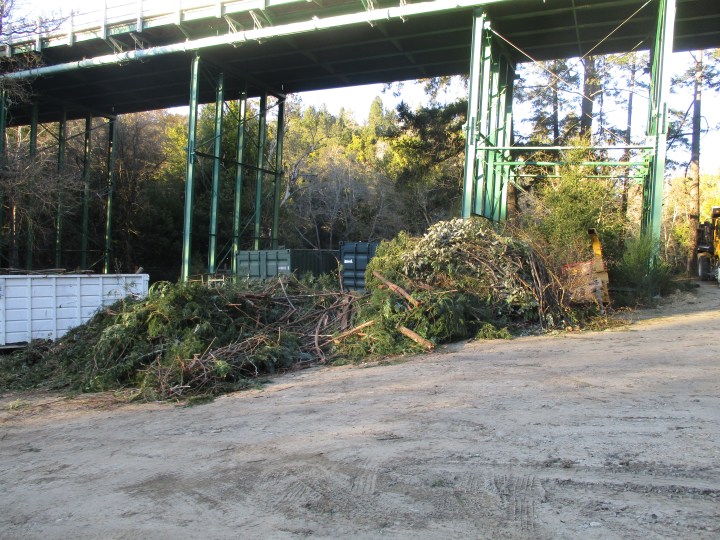
The pile to the left in the picture above is just the debris that was collected last Monday (while I was conveniently not here to help). It is more spread out but at least twice as voluminous as the pile on the right, which is pruning debris that took me several days prior to the wind to collect. The green cargo containers in the background demonstrate how big the piles of debris are.

More debris was collected on Tuesday (while I was still doing other work). The mess was not the worst of it. The roofs of a few buildings were impaled by falling limbs. Some of the damage is significant. Fortunately, the only big trees that fell did so into forested areas where there are no buildings, and electrical service was disrupted for less than a day. No injuries were reported.

Daphne

P00215K
Bloom worthy of a Scooby Snack

Jeepers!! As Daphne Blake’s colleague, Fred Jones, might say, “Looks like we’ve got another mystery on our hands.” What got into this Daphne odora ‘Aureomarginata’?! It rarely performs so well here, particularly so soon after being planted into a new landscape. This particular specimen, and about three others nearby, were planted as they finished bloom less than a year ago.

Since their season began, I have been commenting to those who share pictures of theirs, that such healthy and prolifically blooming daphne is enviable to those of us who do not live within a climate that is favorable to such performance. I know that this diminutive floral truss is not exactly exemplary compared to those of other regions, but for this region, it is almost spectacular.

The aroma is exquisite! It is everything that the rest of us grow daphne for, and is enhanced by the delightful but unseasonably clear and warm weather. Surroundings forests dampened by rain almost a month ago maintain just enough humidity for the fragrance to disperse. If it were not such a distinct fragrance, I would be wondering where it is originating. It is so unexpected.

Those in other regions believe that we can grow a more extensive variety of species here where winters are relatively mild. For some, that might be true. However, there are many climactic factors that limit what can be grown in every region. Species that require sustained chill in winter are not very happy here. For daphne, minimal humidity might be what they dislike locally.

Perhaps daphne happens to be happy in the particular location, next to a stream that enhances humidity much of the time when there is not much breeze. Perhaps the weather happened to be be conducive to such a performance. Perhaps it will remain a mystery.

Six on Saturday: Pretty In (Mostly) Pink


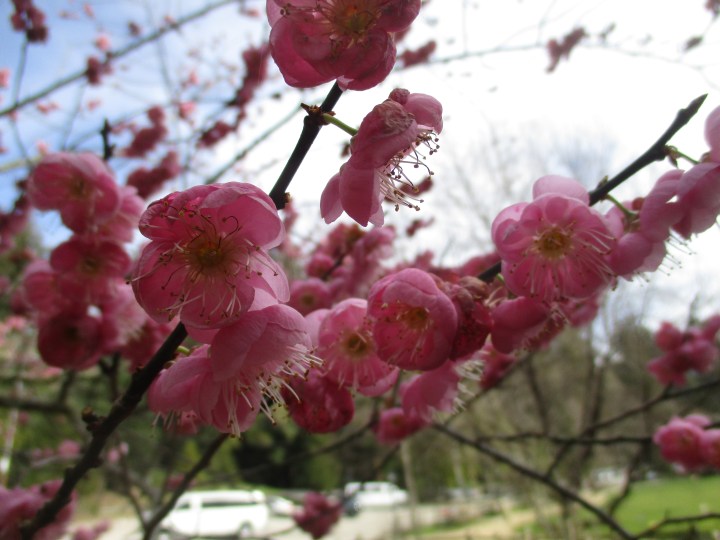
There was no theme for these six. I just took a few pictures of what happens to be blooming presently, and most just happened to be pink, or at least some variation of pink. The first picture of the bloom of the understock of flowering plum is my favorite this week, because it looks something like apricot bloom . . . in pink.

1. Flowering Plum – The flowering plum that was here first got cut down years ago. This tree grew from its understock. It is too pretty to cut down. The fruit is like apricots that never ripen.P00215-1

2. Rhododendron – Not many are blooming yet. This one is typically one of the earliest, but typically does not look so good. It tends to get battered by rain. There has been no rain in weeks.P00215-2

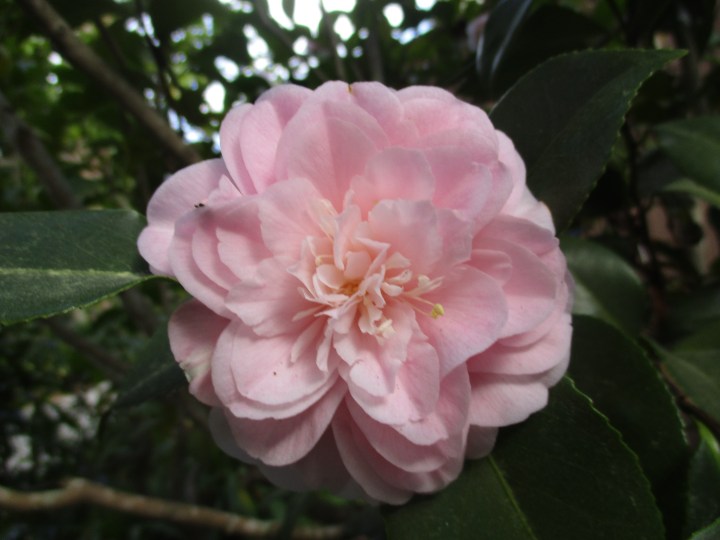
3. Camellia – Most that are blooming now happen to be simple pink like this one. None of the white ones are blooming. The few red ones that are blooming seem to be of just a single cultivar.P00215-3

4. Primrose – This one seemed to be more rosy magenta pink when I took this picture. (I don’t even know if that is a real color.) It certainly looks red here. All of their colors are pretty now.P00215-4

5. Corsican Hellebore – There is nothing pink about this one. It is just as sickly greenish white as it looks. I can not understand the allure. This is the only hellebore that does well for us here.P00215-5

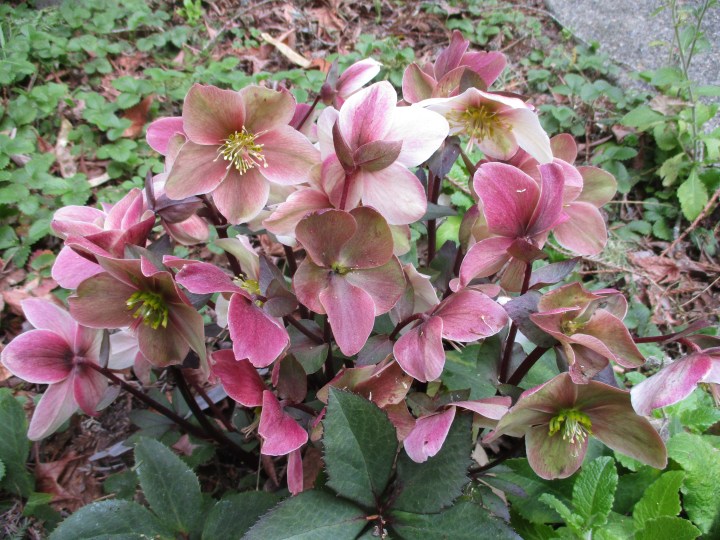
6. Hellebore – Common hellebore is not at all happy here. Many were planted years ago. Many ferals grew from self sown seed. Only this grungy pink one inexplicably blooms so abundantly.P00215-6

This is the link for Six on Saturday, for anyone else who would like to participate:

https://thepropagatorblog.wordpress.com/2017/09/18/six-on-saturday-a-participant-guide/