Horridculture – Tree Preservation Ordinances

P00108
Padding should protect these London plane street trees from minor altercations with machinery that will be used to demolish the associated buildings and construct new buildings.

Much of my work involves inspection of trees to assess health, stability and structural integrity, and subsequent composition of associated arborist’s reports to document such assessments. These reports are necessary for the issuance of permits to remove mature trees within many municipalities. They are only effective for that purpose if they recommend and justify removal.

If there is nothing wrong with the health, stability or structural integrity of subject trees, removal might be justified for other reasons. For example, the removal of superfluous trees might be justified if it would promote healthier development of remaining trees. Trees that disperse roots that are beginning to damage adjacent infrastructure might likewise need to be removed.

It seems like it is too much to be concerned with for something that property owners should not need permission to remove from their own property. For what people pay for property here, they should be able to do whatever they want to with it. However, mature trees are considered to be assets to their respective Communities, and components of the collective urban forests.

These majorly and justifiably controversial concerns are actually not the the only difficulties associated with municipal tree preservation ordinances.

While a young coast live oak in the extreme corner of my garden was not quite big enough to require a permit for removal, I asked the next door neighbor if he would like it to be removed before the roots damaged his driveway. I explained that if we waited any longer, the tree would be protected, and that a permit to remove such an exemplary tree would not likely be issued.

Tree preservation ordinances are often the motivating factor for the removal of trees before they get big enough to be protected! I was fortunate that my neighbor wanted my oak to stay.
Deodar Cedar Migration – Update

P00105-1
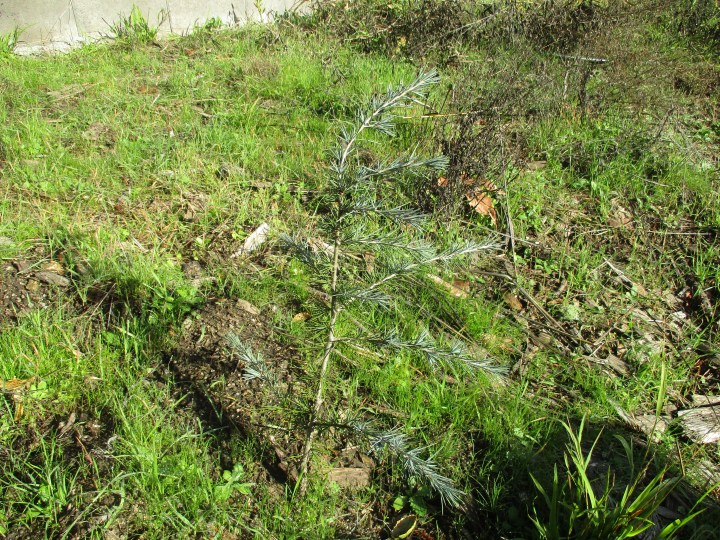
Reassigned deodar cedars have adapted to their new landscape.

Reassignment is in season right now. The brief article about it that posted yesterday links to three other related articles. We have done quite a bit of it here, and intend to do a bit more for useful plants that happen to be in the wrong situations. It should be done before winter ends, to take advantage of both natural dormancy and cool winter rain that settles transplanted roots.

Most plants that get reassigned get dug from situations where they can not stay, and transplanted directly to where they will likely become assets to their respective landscapes. Those that do not get transplanted directly into other landscapes get canned and housed temporarily in the nursery. Some need to recover. Some must wait for landscapes that can accommodate them.

Some reassigned plants are feral descendants of exotic (non-native) species, that grew from self sown seed. Others were originally planted intentionally, but for one reason or a few, are no longer appropriate for their particular situations. Some are overgrown perennials that needed to be divided. On rare occasion, we encounter specimens of native species that get reassigned.

Deodar cedar that were reassigned slightly more than a year ago recovered from the process last spring and summer, so should grow this year as if nothing ever happened. Unfortunately, several were inadvertently killed when the roadside weeds and grasses that they grow amongst were cut down. In other areas, too many superfluous specimens survived, so must be culled.

Those that will be culled out need not go far. They can be plugged back to replace those that were mown down. The second process will be easier than the first. Superfluous specimens were reassigned because we expected nearly half to not survive the process. Except for those that were mown down, almost all survived. If not culled, they will get too crowded in just a few years.

There are plenty more where they came from. The four parent trees are prolific with their seedlings. We can not reassign all of them to other landscapes, and should not waste resources on canning specimens that will not likely be accommodated within any of our landscapes. I will likely can many of them, but not for here. They may become GREEN street trees in Los Angeles.

P00105-2
The four reassigned deodar cedars in this small space are not easy to see in this picture.

If it seems as if the reassigned deodar cedars are too close to surrounding trees, it is only because the surrounding trees will be subordinated and eventually removed as the deodar cedars grow big enough to replace them. One is a dangerously disfigured sweetgum with roots that are displacing pavement above. Two others are disfigured and deteriorating California bay trees.

Reassignment

P00104K
African iris are happily rehomed.

African iris, Dietes bicolor, that I mentioned three weeks ago were finally installed into a new landscape. It may not be permanent. They may need to be relocated again if they happened to land where two of four birch will be installed as the landscape is slowly assembled before winter ends. The installation was done hastily before the last storm delivered a good dose of rain.

It could not be delayed any longer. These African iris had been divided and groomed so long before they were featured on the fourteenth of December that they were likely to succumb to rot or desiccation if installation was delayed any longer. They soaked in buckets of water for days at a time, and were then left to drain for days at a time so that they would not soak for too long.

I do not remember how many times I repeated the process. I knew it was getting risky. Surprisingly, by the time they were installed, only a few of the worst of the rhizomes were beginning to exhibit negligible indications of rot. Now that they are in moist but fluffy and well aerated soil, they can recover and begin to disperse new roots, even if they must be relocated again later.

If relocated again later, the process will be fast and direct. They will get dug and plugged within minutes. Compared to alternated soaking and draining for more than a month, it will be easy.

The formerly feral birch that will eventually be added to this landscape are also being reassigned. Of nine that were removed from another landscape in the neighborhood, five were already plugged directly into a landscape across the road. The other four were canned temporarily until we determine where they will fit into this new landscape. They will arrive before winter ends.

Lauristinus that formerly inhabited this area were already being reassigned as hedges in other landscapes before we planned to reassign extra African iris and feral birch to this landscape. A few got canned to replace any that do not survive the process. So far though, all have not only survived where they were reassigned, but were growing happily before the weather got cool.

Six on Saturday: Two Too Many Redwoods


Redwoods are such admirable trees that no one wants to cut any of them down. On rare occasion, it becomes necessary to do so. Seedlings sometimes grow in situations where they can not stay. They might be too close to buildings or other infrastructure. Sometimes, they are merely in the process of crowding other important plants in the landscape. That was the problem with the young redwood pictured here, and another just like it.

1. There it is, an exemplary specimen barely left of center. The problem was that it would have crowded other trees if left to grow. The dogwood to the left is feral too, but will not get too big.P00104-1

2. This juvenile tree had been cut off at the ground, and regenerated. This meant that I expected it to be more firmly rooted than it would have been if it had not experienced such trauma.P00104-2

3. What a surprise! Roots on one side had already been severed by earlier excavation for a drainage pipe. As I cut a few more roots on other sides, this unfortunate young tree just fell over.P00104-3

4. There were enough roots remaining for this tree to survive if there had been someplace to put it where it could have been irrigated and guyed until it recovered and dispersed new roots.P00104-4

5. Guying would have been difficult though. The young and slender tree was just too tall and flimsy for any downward tension applied by guys. Sadly, this young redwood was not salvaged.P00104-5

6. This is really why I was here. Besides removing two feral redwoods, I dug two Japanese maples that had been stagnating in the landscape for years, and canned them to hopefully recover.P00104-6

This is the link for Six on Saturday, for anyone else who would like to participate:

https://thepropagatorblog.wordpress.com/2017/09/18/six-on-saturday-a-participant-guide/

HAPPY NEW YEAR!!!

P00101-1January 1, 2020! The first day of the Twenties!
The flora in our gardens north of the Tropics must think we are crazy for making such a fuss about it while they are trying to sleep. Even flora south of the tropics does not understand. All flora everywhere is more concerned with how the seasons change according to the position of the Earth around the Sun. Precise dates, times and numbers are meaningless.

It sort of seems odd to me that within each time zone, it is the same time and date both north and south of the Equator, but the seasons of each side are opposite. Today started in sparsely populated regions of the Pacific Ocean, worked its way through Australia earlier, and is somehow still the same ‘today’ that is here now. Yet it is winter here, and summer to the south.

Now, if January can be in the cool time of year here, and the warm time of year in Australia, it seems to me that winter could be both the cool season here, and the warm season in Australia. If the dates are the same, it seems like the seasons should be too. Alternatively, if the seasons are half a year early or late in opposite Hemispheres, it seems like dates should be too.

According to such logic, it could be either winter or July 1 in Australia and elsewhere south of the Equator right now! . . . But would that be July 1 of 2019 or 2021? Too many technicalities!

Well, it is more than the flora in the garden is concerned about anyway. It is winter here now, and summer south of the Equator. It is the beginning of January everywhere that the Gregorian calendar is used, north and south.

HAPPY NEW YEAR!

Note: ‘Horridculture’ will resume next Wednesday. It did not seem appropriate for the first day of 2020.P00101-2

Poison Oak Tree

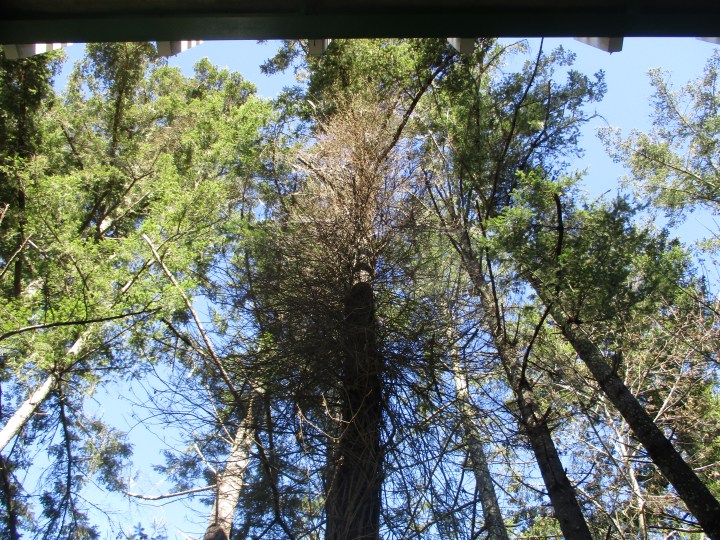
P91229From below, this looks like a shrubby deciduous tree. It is really just a Douglas fir, like those around it. All the defoliated thicket growth is overgrown poison oak. It has likely been climbing the fir tree since it was quite young. Poison oak is not very proficient at climbing bare trunks. It typically climbs into lower limbs, and then into higher limbs before the lower limbs are shed.

No one has bothered to cut this poison oak out of the fir tree because it is not within a landscapes area. That dark margin at the top of the picture is the underside of a bridge, from which, not much of the thicket growth below is visible. The area from which this picture was taken is used for piling greenwaste and parking, where no one is concerned about wild vegetation beyond.

However, now that I sometimes park in that particular parking area, I am finding this mess of poison oak difficult to ignore. There was a similar but even bigger thicket of poison oak up in a redwood tree at the farm, from where it tossed seed into horticultural commodities below. The resulting seedlings added a whole new dimension to weeding the stock. The thicket had to go.

The problem with the thicket in the picture above, although not as serious, is that it too tosses seed into area where people work. Seedlings are likely to grow where greenwaste is processed, and where I sometimes park. Poison oak that grows on the far side of this fir grove will be uncomfortably close to the right field foul line of a ball field that will eventually be restored there.

I have no intention of cutting the poison out of the fir tree. I will merely sever the main trunk at the base, as seen in the picture below. As it deteriorates over several years, no one will mind if it is somewhat unsightly on the industrial yard side. The adjacent fir trees sufficiently obscure it from view from the ball field side. The priority will be preventing seed from proliferating.P91229+

Field Of . . . ?

P91228KThis . . . was a ball field. It might eventually be one again. The old backstop at the upper left corner of the picture is almost completely obscured under a thicket of blackberry brambles and a fallen boxelder. It would need to be replaced. So would the decommissioned irrigation system, all the bases, the basepath, the turf . . . and everything else that goes into a functional ball field.

The turf had naturalized and overwhelmed the basepath long before last year. I collected wild mustard, radish and turnip greens from around the perimeter last spring and summer. By the time they were finishing, the blackberries were ready. I got stinging nettle from the bank of Zayante Creek in the background of this picture. Dock is already regenerating off to the far right.

There are naturalized wildflowers here too. I got pictures of perennial pea, purpletop vervain, Saint John’s wort, four o’clock, calla, narcissus, teasel, common thistle and California poppy, all within the perimeter of this ball field. Native trees include Douglas fir, California bay, California buckeye, bigleaf maple, white alder, cottonwood, coast live oak, canyon live oak and redwood.

The ball field looks like the moon now only because a construction company used it as a parking lot for trucks and machinery. We dumped excess soil removed from landscapes on the infield, where it was evenly dispersed by the machinery before it left. A low mound of road debris remains just past the foul line in the background. Firewood gets stocked out of view to the far left.

Restoring this meadow to a ball field would be like starting from scratch. The only salvageable asset is the flat space. Even though turf would be the most substantial feature of a finished ball field, a restoration project will involve more engineering and construction than horticulture.

Six on Saturday: Tracks


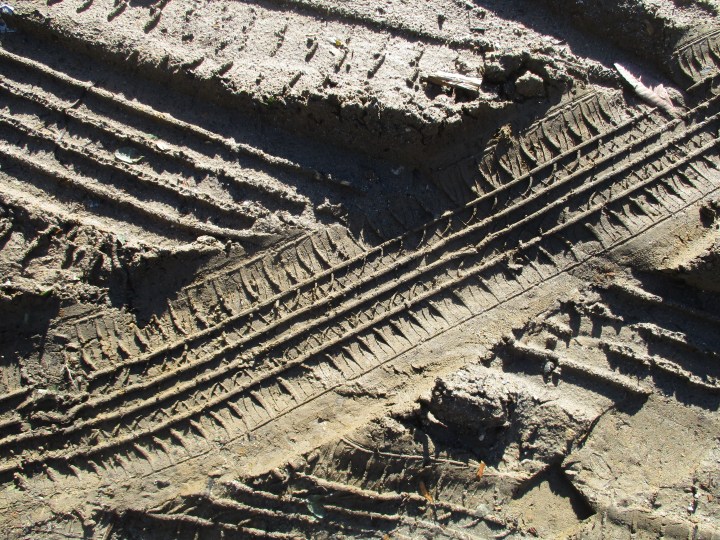
Tracking is not done for hunting here. Anyone who can hunt here would merely wait for deer or turkey to arrive as they so frequently do through the day. I only notice the tracks while they are so visible in the mud and damp soil. Most are from harmless animals. Some are from animals who control unwelcome rodents. Even notoriously destructive deer are not a problem here.

No one knows why deer avoid the landscapes here. There are no fences, so deer can come and go as they please. They are a serious problem for some of the home gardens nearby, but avoid others like they avoid our landscapes. I got these pictures outside of landscaped areas. Bobcats have never bothered anyone except the rodents who are not wanted in the landscape anyway.

I saw no tracks left by raccoons, skunks, turkeys or mountain lions, which is just fine. Mountain lions are rare, so their tracks are rarely seen around areas of human activity. The others are too lightweight to leave well defined tracks that I could get pictures of anyway. Skunks are actually beneficial to the landscapes, by eating grubs and slugs. They refrain from digging in lawns.

Turkeys are only becoming a concern because of their proliferation. The minor damage that they cause while scratching for grubs and pecking at anything colorful is likely to become a major concern when there are more of them shredding flowers, fruit and vegetation. Raccoons are more obnoxious for the messes they make with garbage than for their damage in the landscapes.

1. Deer often leave double prints, with the second set slightly back from the first. This pair seems to be single prints from different hooves that just happened to land right next to each other.00128-1

2. Bobcat prints must have appeared while the weather was still drizzly enough to mute the detail. Bobcats are common enough here for (La Rinconada de) Los Gatos to be named for them.00128-2

3. Coyote prints are fresher. They seem to be too small to be left by a coyote; but fox tracks are even smaller, and rare. Foxes are so lightweight that they leave tracks only in very soft mud.00128-3

4. Human prints are very fresh. I did not notice them on my way out, but found them on my way back. Whoever or whatever left these prints could have been dangerously close at the time!00128-4

5. Chevrolet prints over John Deere prints are also rather fresh. There are prints of Ford, Dodge and even a rare Buick in the area. It must have been quite a herd! I should track that Buick!00128-5

6. Rhody the terrier leaves no more prints than a fox, since he too is so lightweight. I tried to press his paw into the mud for this one, but he did not cooperate. This was the best we could do.00128-6

This is the link for Six on Saturday, for anyone else who would like to participate:

https://thepropagatorblog.wordpress.com/2017/09/18/six-on-saturday-a-participant-guide/

Rain Shadow

P91222Hollywood is famous as the Cinema Capital of the World. Niles was its predecessor. Both are within regions of remarkably diverse scenery that is so important to cinema. Mountains, deserts, chaparrals, forests, lakes and big cities are conveniently nearby. There are not many places in the World with such a thorough mix of geography and climate. California really does have it all.

It is a challenge for gardening though. The stone fruits that grow so naturally in the Santa Clara Valley are not quite as productive just a few miles to the South in the Santa Cruz Mountains. The pears and apples that do so well in the Santa Cruz Mountains are not quite as happy in the Santa Clara Valley. Species that want a good chill in winter do not want to be in Los Angeles.

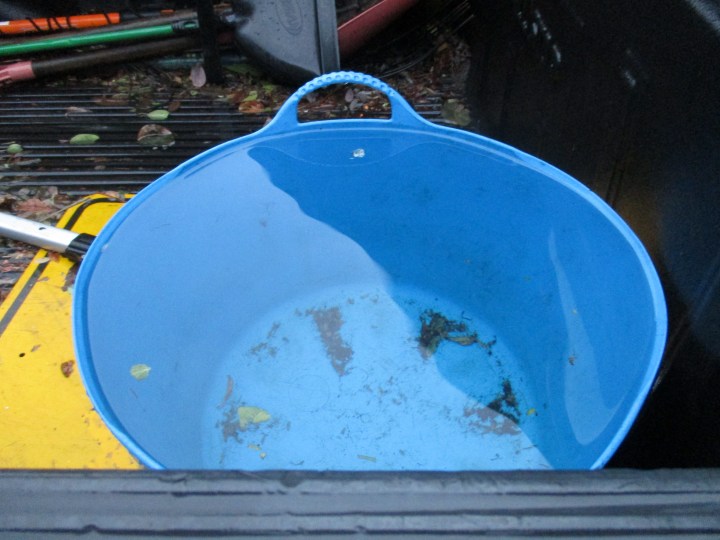
On the coastal side of the Santa Cruz Mountains, just outside of Felton, a few days of rain filled the bin in the picture above. The rain continued just as long throughout the area, including the inland side of the Santa Cruz Mountains and the adjacent Santa Clara Valley. Although the duration of the rain was approximately the same, the volume of precipitation was very different.

The water in the bin is more than a foot deep. That is about the average annual rainfall for my former neighborhood at about this same elevation, but on the opposite and inland side of the Santa Cruz Mountains. Storms must drop much of their moisture to get up and over, but are then able to retain much of the remaining moisture as they drop in elevation on the other side.

The drier inland side of the Santa Cruz Mountains, and adjacent portion of the Santa Clara Valley are in what is known as a ‘rain shadow’.

Growing Problem

P91221KRecycling plant material is practical and gratifying. We do quite a bit of it here. Back in September, I briefly wrote about recycling laurustinus that was removed from an area that was about to be landscaped, and relocated to other sites where it can grow into functional informal hedges. We were able to use something that was a problem in one location as an asset somewhere else.

We will be doing more of this sort of recycling now that the rainy season has started. Right now, the plants that need to be removed are as dormant as they get, so do not mind getting dug as much as they would have while they were still active. Rain helps settle them in at their new locations. A few get canned and stocked into the nursery, to be planted into new landscapes later.

Some of what gets recycled was intentionally installed in the past, but for one reason or another, became inappropriate for a particular site. For example, I will soon be relocating agapanthus that performed well for many years, but eventually became too shaded by growing trees nearby. Forsythia that has already been relocated was too big and awkward for its confined space.

Many plants that get recycled were not intentionally planted, but happened to grow wild in situations where they can not stay. Some are native. Some are descendents of desirable exotics. The laurustinus that I mentioned above are such an example. Just yesterday, I relocated a few naturalized but superfluous birches from an established landscape to an unlandscaped area.

We certainly do not recycle everything that can be recycled. Many plants, both native and naturalized exotic, are just too problematic. Fleabane that I wrote about yesterday is marginal.

Sweetgum happens to be one of those trees that we probably should not recycle. They are splendidly colorful in autumn, and particularly spectacular amongst the deep green redwoods. The problems are that the now overgrown trees here are developing serious structural deficiency, and producing an overwhelming abundance of messy and potentially hazardous maces (fruits).

Nonetheless, I found and canned these four rooted sweetgum watersprouts. They were growing from roots of one of several big and very problematic sweetgums that got removed last year. If they get planted here, they and their associated problems will be located outside of refined landscapes. In the future, thy can drop maces and limbs in the forest without bothering anyone.