There is more time for a late start on a new vegetable garden now. I had planed to take this and next week off from most of my work, to tend to other neglected obligations. However, under the circumstances, I am still unable to tend to many of those obligations! Well, the crew wants a new vegetable garden.
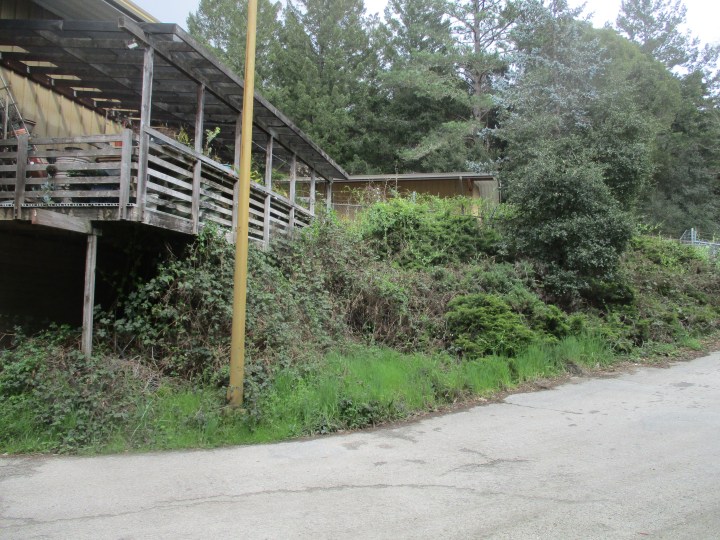
1. Before, the area was overwhelmed with a dense thicket of Himalayan blackberry brambles, that had grown up into the joists of the deck above, and over the adjacent junipers to the right.
2. After, it is not much better. This initial phase took me half a day!! I intended to remove most or all of the junipers, but as they become exposed, it is evident that they are worth salvaging.
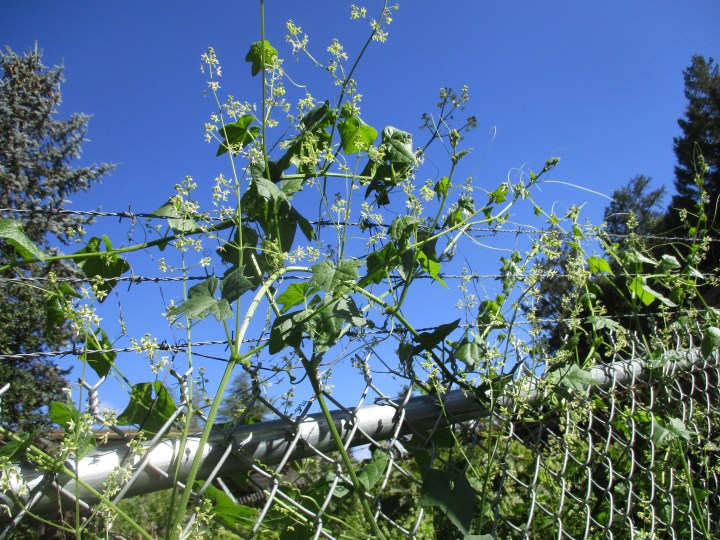
3. I already know I will be sowing seed for the warm season vegetables a bit late; but this wild cucumber feels compelled to remind me. It is already past the top of this seven foot high fence.
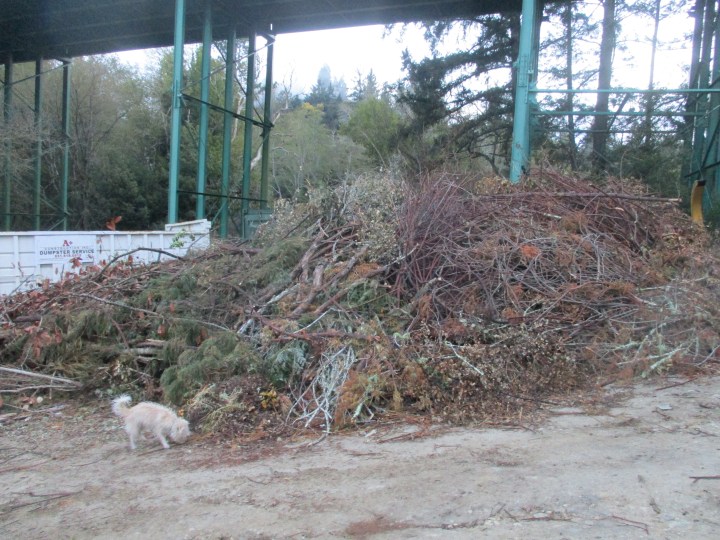
4. This is just some of the debris that I removed. For comparison, the animal to the lower left is a buffalo. Okay, it is really just Rhody. The dumpster is as high as the cargo container though.
5. Okay, so that was a bit of an exaggeration. The pile really is this big, but only the small portion outlined in yellow to the upper right is from the new garden, and is only about two feet high.
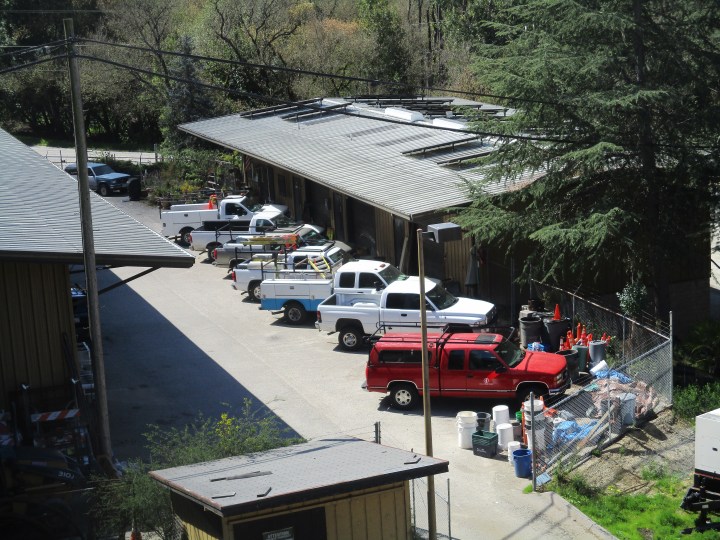
6. While up on the bridge over the debris pile, I got this picture of most of the work trucks that are not at work where they belong. Everyone else writes about it; but I have not mentioned it.
This is the link for Six on Saturday, for anyone else who would like to participate:
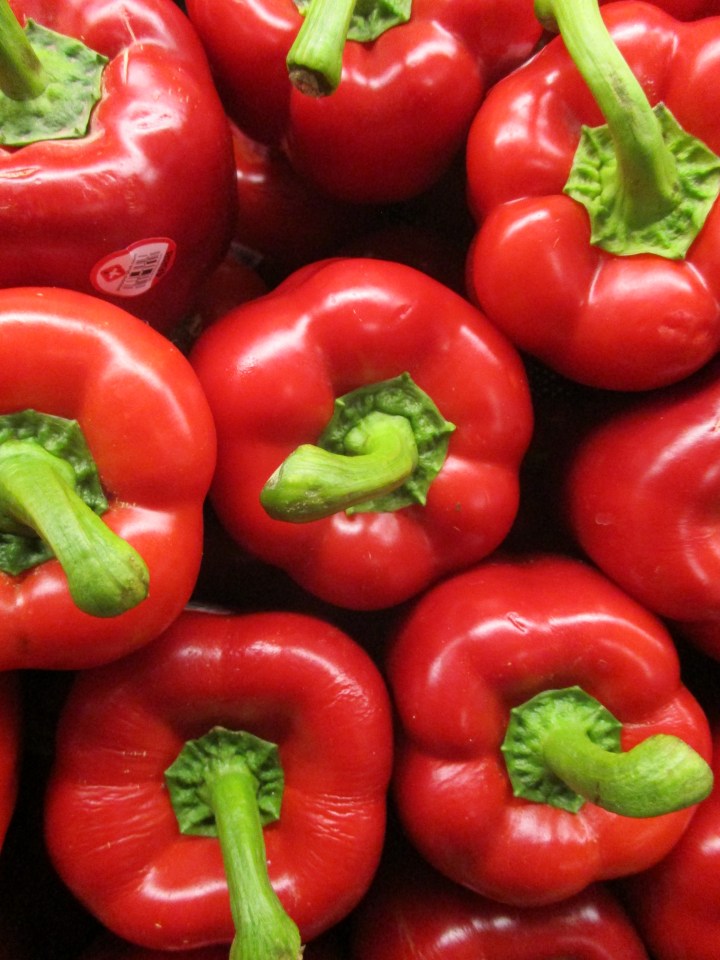
Sweet bell peppers are actually more of a challenge to grow.
This illustration is relevant neither to the topic, nor to that really creepy rock band of the same name. Even though the band has been popular since I was in high school, all that I know about them is that I am none too keen on their music. Embarrassingly, I do not know much more about the topic, and it has been a hot topic much longer than I have been growing my vegetables.
Vegetables make no music of course. I just mean that I am no more familiar with contemporary cultivars of hot pepper than I am with music that I do not appreciate. I happen to appreciate some types of peppers, and some of them happen to be hot peppers. However, I have not bothered to get acquainted with those that are so ridiculously hot that I do not want to grow them.
Why should I? What are they good for? Why waste my time, limited garden space and other resources on something that no one wants to eat or add to any recipe? They are not particularly productive. If they were, they would only make more of something that is just as useless as the few that each plant produces. I can not even justify putting effort into finding a picture of one.
Those who indulge in this fad brag about it profusely. They post pictures of their few tiny hot peppers online, with sensational claims that there is nothing hotter. Some post selfies with their free hand dangling one of their weird peppers over their extended Gene Simmons tongue. Some even post videos of their drunken friends tasting their peppers, as if it can not be done sober.
I suppose that, regardless of how pointless it seems to me, it is one way to enjoy gardening.
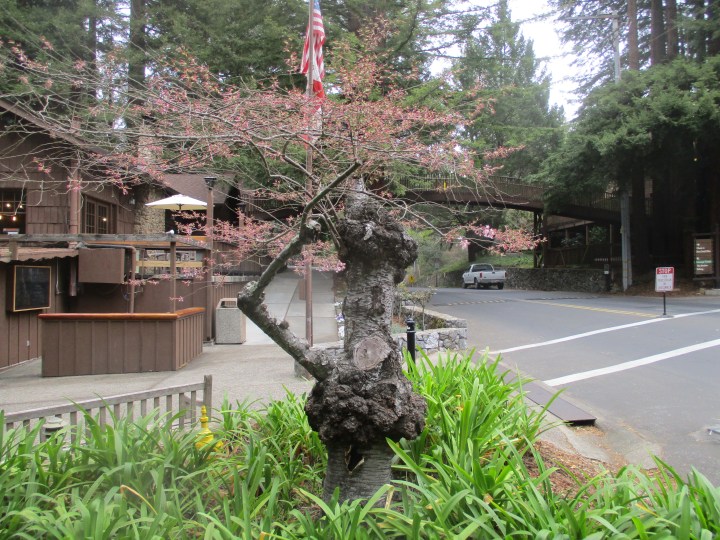
This is the third spring that I got picture of this pair of flowering cherry trees in bloom. I took several pictures last year, ranging from closeup pictures of the flowers, to pictures taken from a distance like the picture above. Fewer pictures were taken during the previous spring of 2018, before these trees were groomed of copious necrosis. Sadly, this picture will be one of the last.
The trees will be cut down this year. They stayed just long enough to bloom this one last season, but will not likely be here much longer. They are deteriorating at such a rate that if I were to prune the necrosis away after bloom, there would not be much remaining. The tree to the right in this picture would be only a rotten stump with a few limber twigs protruding from the top.
Structural integrity has been so compromised by decay that, even without the weight of all the limbs that have been pruned back during the past many years, the trunks could easily break off at the ground. When I remove them, I will likely just push the tree to the right over without cutting it first. If there were any branches left, a kid could knock it over by trying to climb it.
As much as I would prefer for these trees to last much longer, I want to install their replacements as soon as possible. Planting them this spring would give them all summer to disperse roots and grow a little bit before blooming next spring. I know they will not be much to look at for a few years, but many years from now, they might be as spectacular as these two originals were.
Regardless, it will be a saddening task to cut down these distinguished trees.
This tank could use some greenery . . . or maybe not.
The scrub palm incident should have reminded me that there is such a thing as too much of good thing. By the way, I do intend to grow every single seedling that germinates and somehow find homes for them all. I suspect that almost all will live in my own garden, but at least I know they will live in a good home. I have grown surpluses before, and I actually plan to do it again.
For examples, that big herd of cedar seedlings that was partly reassigned into landscapes is just too numerous for all seedlings to be accommodated. Most of what remains will get canned to be installed into landscapes later. Since we planted about as many as we possibly can here, most will likely go to Los Angeles, and installed onto embankments of the Santa Monica Freeway.
That is too many cedars; but I just can not bear to discard them as I should. Nor can I leave them to grow into a crowded and likely rat infested grove. They should be happy in Los Angeles.
Anyway, I was asked to grow a few copies of Boston ivy for a pair of concrete columns that support a pedestrian bridge. Two specimens were already planted on two other concrete columns of the same pedestrian bridge, from which English ivy had been removed. Two other specimens grow on a concrete retaining wall from which Algerian ivy gets removed ahead of its advance.
I should have just plugged a few cuttings into a can, and then separated them and plugged them directly into the landscape as they rooted. Instead, I plugged cuttings into a flat. Well, I could not just plug a few, and leave the rest of the flat empty. I filled an entire flat with a hundred cuttings. I expected a high mortality rate, but alas, almost all of the cuttings are doing quite well.
Now we are finding all sorts of concrete retaining walls and other infrastructure where we can plant Boston ivy. We are also realizing that there is a difference between ‘can’ and ‘should’. As I was dumping greenwaste, I noticed how austere this big water tank looks. Boston ivy would really appreciate all that surface area! There is enough to plant all the way around the perimeter!
Then, I thought of all the reasons why clinging vines are not allowed onto water tanks. They deteriorate the paint, which allows the tanks to rust. They allow rodents to climb up to the top of the tank, which is really not a good place for rodents. They need maintenance, which is not justifiable for landscape features that serve no practical purpose. They need (ironically) watering.
If the tank were in a more prominent location where it should be obscured, it would be best to plant dense evergreen trees, such as cypress trees, around it. Such trees would be planted at a distance, to maintain reasonable clearance. Really though, the tank is in a secluded place, where not many of us see it. It needs no landscaping, so will remain as austere as it has always been.
But, what about the cyclone fence around the water tank? All those surplus grape vines could most certainly make good use of it as a trellis! Okay, I get it. It would take too much work, and there is too much potential from problems . . . rodents, maintenance, watering, damage to the fence, and half of all the grapes would be locked inside where only a few of us could get to them.
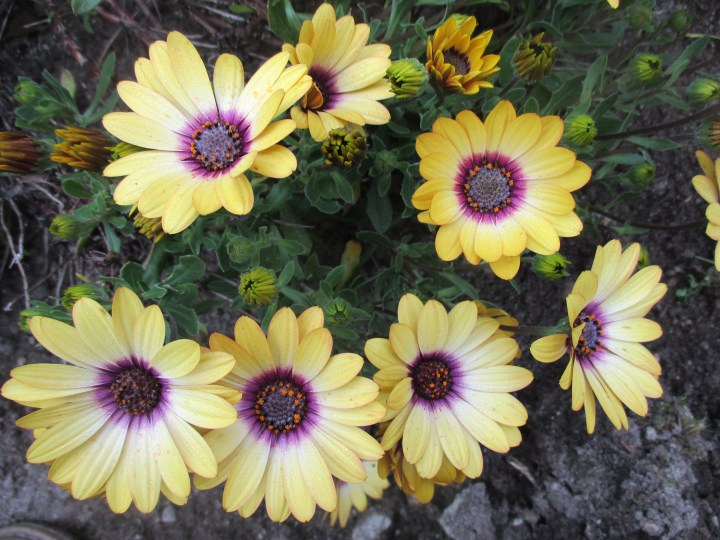
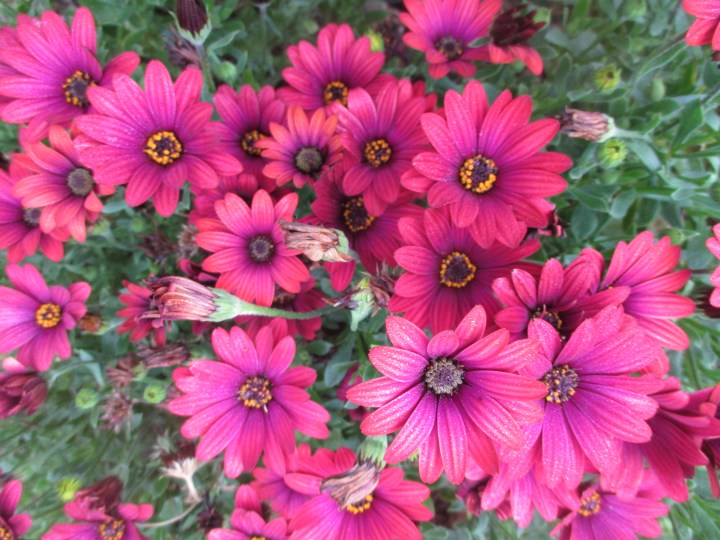
Girls can see more colors. Furthermore, they know all their fancy names. Sometimes, I suspect that they just make up names as necessary. There are four African daisies at work that are odd colors that I can not identify, and another flower that I know is not lavender.
1. Blue is the easiest of these colors. Others might say it is pale, soft or sky blue. Even I can see that it is most definitely not lavender, as some might insist. Is this species so easy to identify?
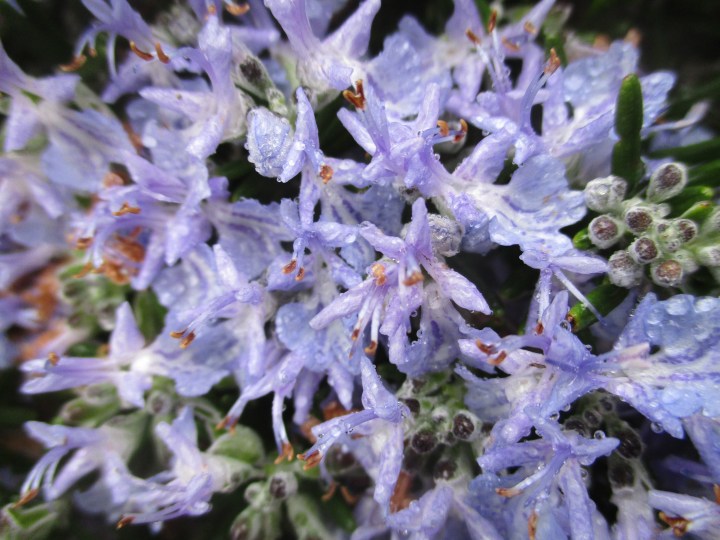
2. Blue is the only color for rosemary. It is more obvious up close in the previous picture. It is easier to mistake it for lavender if that is the color that is expected from the particular species.
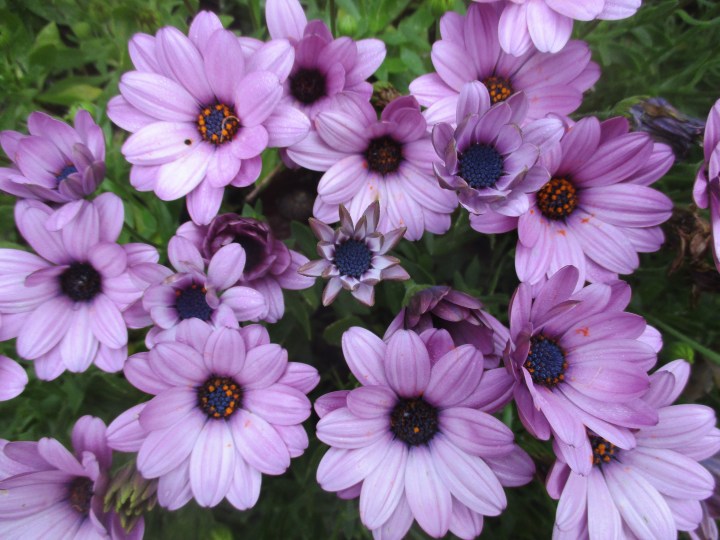
3. Lavender is how I would describe this color. Perhaps it is pale lavender. I have been told that this is lilac or pale lilac. That makes sense, since common lilac blooms with lavender flowers.
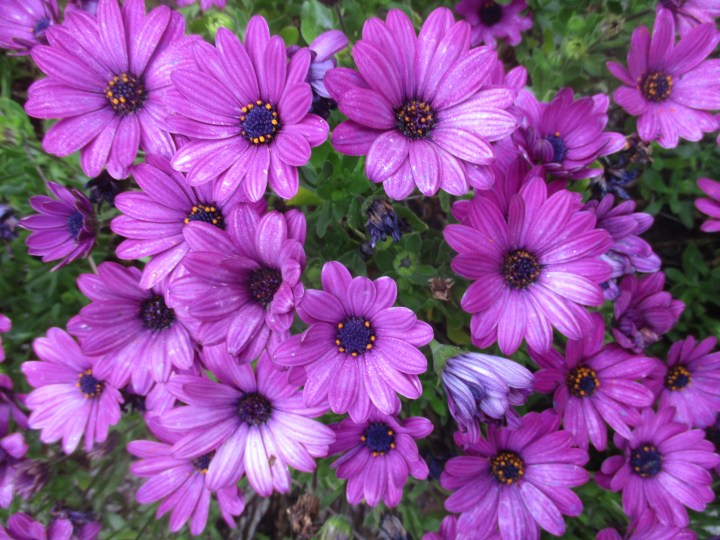
4. Purple or light purple works for this one. Heck, if the previous is pale lavender, this could be lavender . . . that is not pale. Alternatively, it could be lilac, . . . but probably not the pale sort.
5. Yellow or pale yellow should be good enough. I do not know what buff is, but I do not believe that this is it. Nor does it strike me as lemon or butter yellow. I know what colors lemons are.
6. Red should be good enough, although I would believe if this is rust or rusty red. I am open to suggestion on this one. It is quite a distinctive color. I like it, even though I can not identify it.
This is the link for Six on Saturday, for anyone else who would like to participate:
Almost all of the fruit trees that I encounter are or were neglected to some degree.
Many were planted a long time ago by someone who was able to maintain them at the time, and perhaps for many years, but then relocated, passed away, or just got too elderly as the trees grew and required more work.
Many were planted by those who simply enjoy gardening around their homes, and wanted to grow some fresh fruit, but were not aware of how intensive the maintenance of most of the fruit trees is, or how to execute such maintenance properly.
Many were planted by so-called ‘gardeners’ or so-called ‘landscapers’ who had no intention of actually ‘maintaining’ them, or believed that they could ‘maintain’ them with motorized hedge shears and a blower . . . just like they ‘maintain’ everything else.
There is a young but nicely productive ‘Eureka’ lemon tree at work. I would not say that it is neglected. Someone has been maintaining it well since it was installed. However, I remind others at work to take some of the lemons because the tree gets overloaded with otherwise unappreciated and unused fruit.
The tree is strategically located right outside of one of the big cafeteria kitchens, so that those who work in the kitchen could use the fruit. The kitchen probably uses more lemons that the still young tree could produce, but does not seem to use any from the tree.
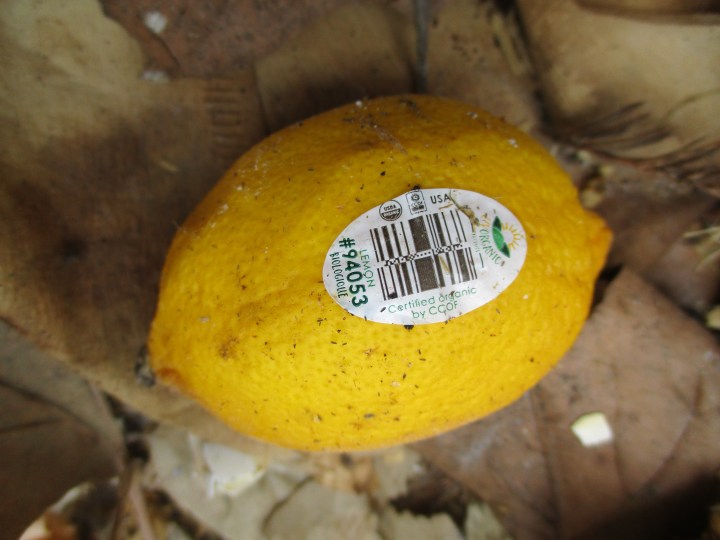
While dumping greenwaste from the kitchen onto the big compost piles, I noticed this labeled but unused lemon. I can not help but wonder why lemons from my tree aren’t good enough, and why this particular lemon wasn’t good enough either. How many of us nowadays would even recognize a lemon tree, or appreciate the fruit that it produces?
This lemon tree right outside of one of the kitchens is loaded with fruit.
Apologies for the lapse of posting articles as typically scheduled at midnight here for this morning and yesterday morning. The article that had been scheduled for yesterday morning posted an hour earlier, at 11:00 p.m. on Sunday night. The article that had been scheduled for this morning posted an hour earlier, at 11:00 p.m. last night. I neglected to adjust the schedule on Sunday for Daylight Saving Time.
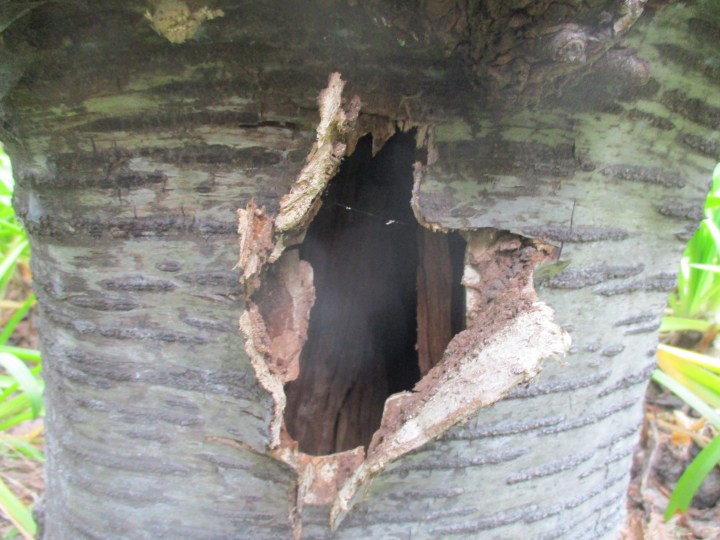
It really looks like something erupted from within!
That was a scary movie back when horror movies really were scary! The first appearance of the baby alien was the creepiest part and one of the scariest scenes! It is too disturbing and gory to describe here. Those who have seen it may have noticed how it might seem to be weirdly relevant to the cavity that opened in the rotting trunk of this deteriorating flowering cherry tree.
With a bit more distance, the rotting trunk looks sort of like an associate of ‘H. R. Pufnstuf’ after an interaction with a baby alien. If you can remember who H. R. Pufnstuf was, you probably shouldn’t. He starred in his own television show for children on Saturday morning in the 1970s. It was disturbingly weird and perhaps even inappropriate for the children it was intended for.
So, it is both rotten and unsightly.
With even more distance, it is obvious that this is nothing to joke about. This is one of two flowering cherry trees that I have been so protective of, and put so much work into temporarily salvaging. Both should have been removed and replaced years ago. This project was scheduled for after bloom in 2018, postponed until after bloom in 2019, and has yet to be done even now.
The problem is that these trees are so popular and so appreciated by the Community. They have been here in the most prominent spot in the neighborhood for several decades. There are not many who remember when the trees were young. No one seems to remember before the trees were here. They are as historical as the older buildings. I can not bear to cut them down.
As you can see, there is no choice now, at least for this particular tree. It is already so decayed that it can barely support its own weight.
As pretty as the bloom is, the disfigured branch structure and trunk are no longer appealing.
These daisies are rarely without some degree of bloom.
There is not as much difference between the seasons here like there is in other climates. It might seem like we get only summer, with a briefly cooler and slightly rainy time of ‘not summer’. I can recognize the changing of the seasons because I am familiar with them. Those acquainted with more normal climate mind find our subdued seasons to be rather boring, and restrictive.
People from climates with more extreme weather and more pronounced seasons might not expect mild weather and mild climate to be restrictive or limiting. They tend to notice what grows here that would not survive out in gardens through colder winters, such as bougainvilleas, tropical hibiscus and so many of the popular succulents. Even more tropicals survive farther south.
What they do not notice are what does not do so well here. Although stone fruit does remarkably well here, and many apples and pears are more than adequately productive, there are many cultivars of apple and pear that prefer more chill than they could get here. Lilac gets sufficient chill to bloom well here, but not enough to bloom as splendidly as it does in the Upper Midwest.
For example, some might be impressed by the perennial daisies that bloom sporadically whenever they want to throughout the year here. These daisies take no time off for winter, and are rarely damaged by frost every few years or so. They are so rarely without bloom that it is not often possible to shear off deteriorating bloom without removing some of the unbloomed buds.
What goes unnoticed is the potentially subdued bloom of the forsythias, which are so reliably prolific where winters are cooler. Some are real duds this year, and all are blooming notably late. This is one of the consequences of a mild climate.
Forsythia, with twigs that are still bare in the background, is not much to brag about.
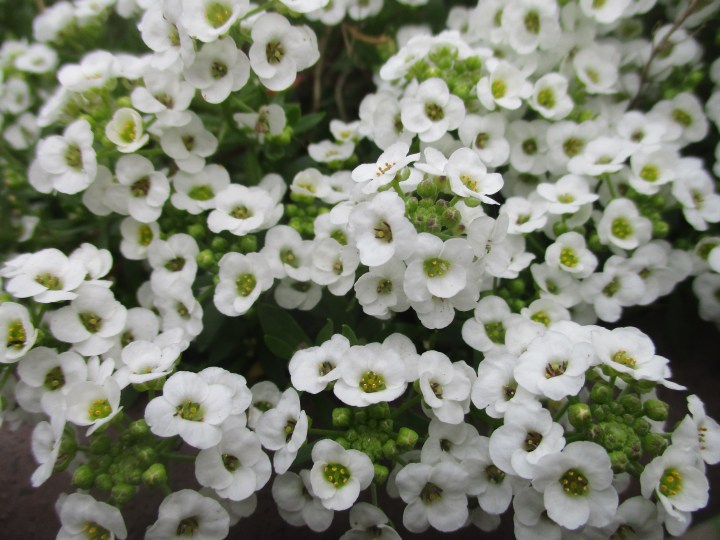
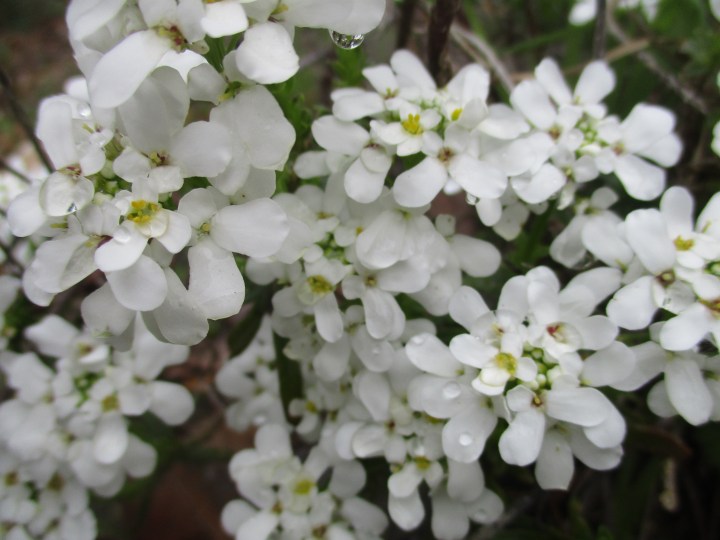
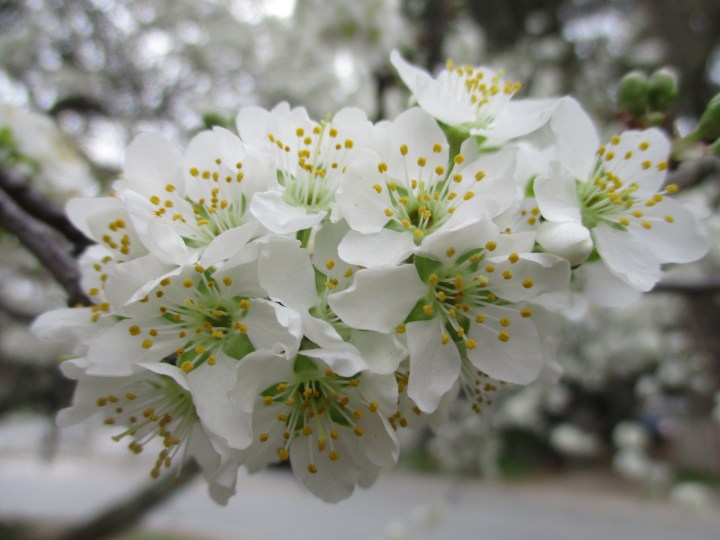
It is a long story. I did not get out to get any pictures until Friday. By that time, I was none too selective. I just got pictures of what happened to be convenient. It really is coincidence that all happen to be white. The first three are from work. The other three are on roadsides in town. 1, 3 and 6 have potential to be colors besides white. However, 1 and 6 are typically white in their feral state as shown here; and only one cultivar of 3 is only slightly blushed.
1. Alyssum – can not decide if it is a warm or cool season annual. A new generation starts to bloom before predecessors finish, regardless of season. All are feral, so none are pink or lavender.
2. Candytuft – is mistaken, by some, for alyssum. It blooms almost as continuously. It really should get cut back about now. Although, no one wants to cut it back while it continues to bloom.
3. Clematis – is evergreen, but was defoliated by harsh winter pruning. It lacks sufficient space to grow wild. Earlier bloom is fading already. The ‘Apple Blossom’ cultivar has blushed bloom.
4. Plum – of unknown origin blooms spectacularly at a gas station in town. Bloom is not quite as delicate as that of other feral American plum that naturalized from old stone fruit understock.
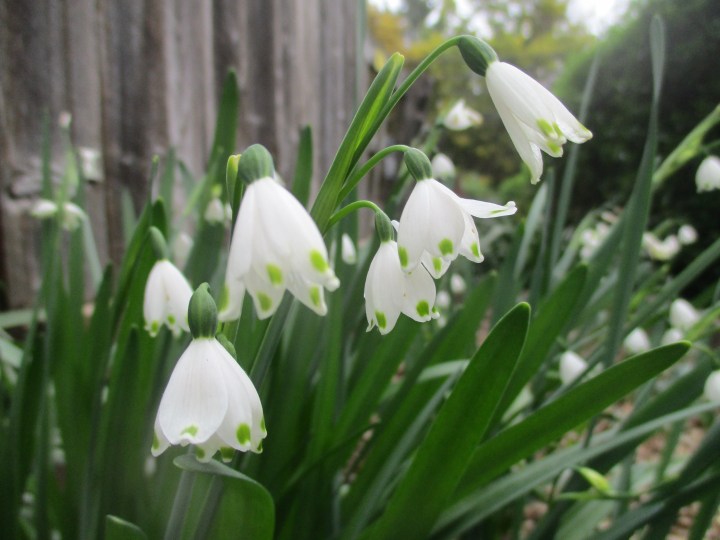
5. Snowflake – grows wild along roadside drainage ditches, but does not seem to be aggressively invasive. Mine bloomed earlier just like this. This is what I grow instead of trendy snowdrop.
6. Calla – is in the same ditch with the snowflake. It is even less aggressive. Weird colorful hybrids do not naturalize at all, probably because they are weaker, and do not produce viable seed.
This is the link for Six on Saturday, for anyone else who would like to participate: