Six on Saturday – II: Six More


Six on Saturday‘ is a popular popular gardening meme that many of us garden bloggers participate in on Saturdays. The link explains how it works. Simply, we post six pictures of what is happening in our gardens or landscapes at the time, along with brief explanations. Mine just posted at midnight. I know I should be done, but I happened to find a few more pictures to share.

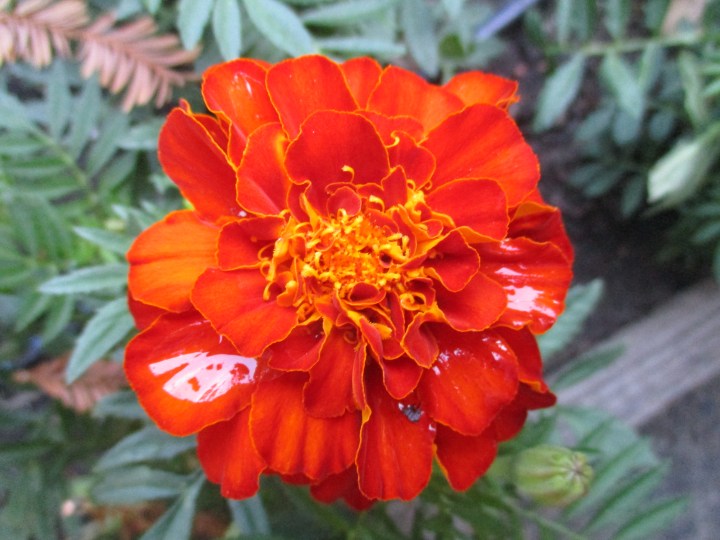
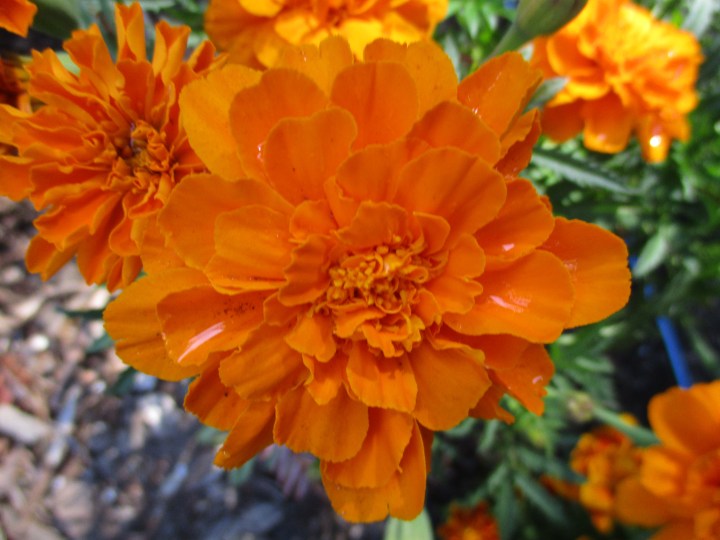
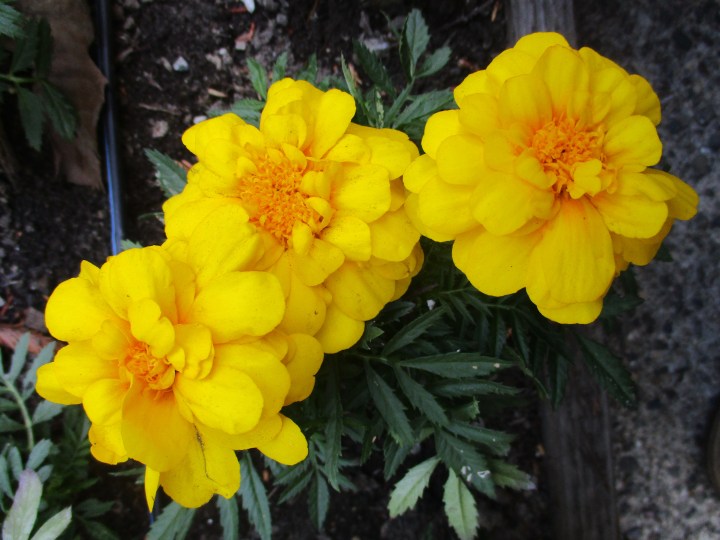
These six pictures of marigolds that were just installed at work are not as interesting as the topic I wrote about earlier, but are just too pretty to be discarded before I show them off. The second and third pictures, as well as the fourth and the fifth pictures, might be redundant to each other if they show the same varieties of marigolds, but I do not care. They are all so pretty.

Marigold will not likely be featured in my weekly gardening column this year, because the bigger but related African marigold was featured last October. These here are the smaller and more traditional French marigold. Their bright yellows, bright oranges and rusty reds suit late summer and autumn like miniature chrysanthemums. Their foliage is so delightfully aromatic.

Although I am none too keen on annual bedding plants, I happen to like marigold. They were more popular when I was a kid. They were not so variable back then; and there were certainly none of those pathetic fake white sorts that are really just pale yellow. They were plain and simple orange, yellow and rusty red, in blends or uniform. We could easily grow them from seed.

Unfortunately, marigolds will not be with us for long. They were planted to replace petunias that did not last long enough. At the end of autumn, they will be replaced by cyclamen for winter.
P90921KP90921K+P90921K++P90921K+++P90921K++++P90921K+++++

This is the link for Six on Saturday, for anyone else who would like to participate:

https://thepropagatorblog.wordpress.com/2017/09/18/six-on-saturday-a-participant-guide/

Six on Saturday: Locust


John the Baptist did not really eat orthopteran insects out in the desert. The locust he ate were the beans of the carob tree, Ceratonia siliqua. They are actually quite nutritious. Supposedly, they are known as locust because they resemble the elongated abdomens of the insects with the same name. A few other related trees that also produce beans are collective known as such.

Robinia pseudoacacia happens to be known as black locust, even though there is nothing black about it, and the tiny and papery beans do not even remotely resemble insects. Supposedly, it arrived with Gold Rush prospectors who wanted something of their homes in Eastern North America. It naturalized aggressively, and is now an invasive exotic species in much of the West.

We tolerate a few at work. They are too pretty to cut down without a good excuse. However, one gave us a good excuse when it fell last winter. It was notably polite about it, by falling into a gap between two roofs that a cat could jump across. Damage was very minimal. Nonetheless, the tree and its destabilizing associates needed to be removed. They are gone but not forgotten.

1. Thorns of black locust only look blurry in this picture. They are wickedly sharp! The sharpest are on the most vigorous stems, which is exactly what the freshly cut stumps here generate.P90921

2. Thickets of suckers (or watersprouts) like these developed where black locust trees were cut down last winter. Most developed on freshly cut stumps. Many emerged from random roots.P90921+

3. More than half of the suckers from the formerly impenetrable thicket around the stump at the center of the picture were removed to relinquish space for the lauristinus in the foreground.P90921++

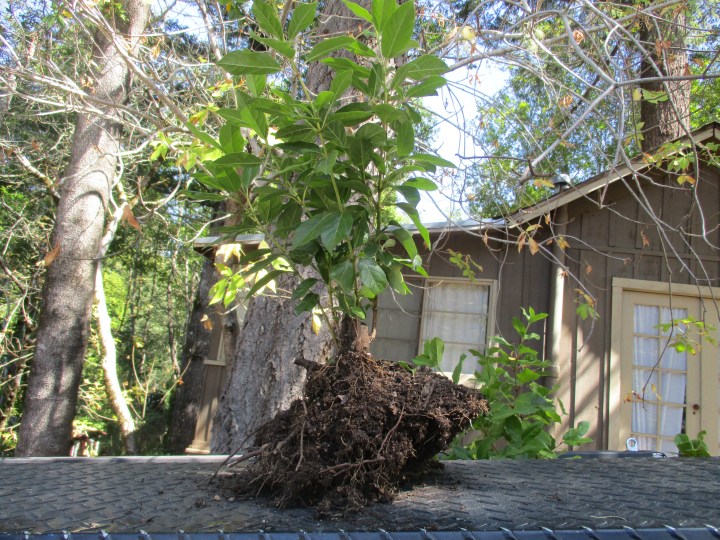
4. A few bay trees got cut down with the black locust trees. I wanted them coppiced, but was away when they instead got VERY badly pollarded. Oh, the shame! (I will coppice them later.)P90921+++

5. As nasty as black locust is, it has a few attributes. Spring bloom resembles that of white wisteria, and is almost as fragrant. This finely textured pinnately compound foliage is quite elegant.P90921++++

6. Their high and open canopies provide nice shade too. It is just enough for warm summer weather, but not too much to exclude turf grass and understory plants that tolerate partial shade.P90921+++++

This is the link for Six on Saturday, for anyone else who would like to participate:

https://thepropagatorblog.wordpress.com/2017/09/18/six-on-saturday-a-participant-guide/

Horridculture – On The Fence

P90522Where I lived in town, the backyard was surrounded on three sides by fences, with the house on the only unfenced fourth side. These were the sort of fences that were common in suburban neighborhoods. They kept children and dogs in or out of adjacent gardens, and probably provided some sense of privacy, although I never understood why we all needed such privacy there.

I mean, if I really wanted significant privacy, I would not have lived in town, where the homes and gardens were all so close together. I enjoyed living there, and I enjoyed my neighbors. We could hear some of each others conversations and televisions, but no one seemed to mind. It was worth living in such an excellent neighborhood so close to everything we could want in town.

Years ago, suburban fences were not too obtrusive. They were only about four feet high. Some of the older homes were still outfitted with picket fences that were only about three feet high. We could still talk to neighbors over them, and sometimes pass over a bag of extra fruit or vegetables, or even flowers, from the garden. Dogs and young children were effectively contained.

Then everyone became obsessed with privacy. At the same time, many of us added onto our homes or replaced them with new homes that occupied more of the allowable space within their compact formerly suburban, but now urban parcels. Smaller remaining garden spaces became more shaded by bigger houses and taller fences. Gardening, as we once knew it, became passe.

What are all these big fences for? What are they keeping out? . . . or . . . What are they keeping in? Why do so many who want so much privacy live so close to so many who crave the same?!

Another Johnny Appleseed

P90330+++++

Just to be clear, I earned the title of Johnny Appleseed before my colleague Brent Green did. While Brent was secretive about our tree planting projects in Los Angeles, I was not so about our similar projects in Los Gatos. While Brent’s neighbors wondered where their new street trees were coming from, mine read about their new park trees in the Los Gatos Weekly Times.

In fact, the exposure from that article is how I started my weekly gardening column in the same newspaper just a few months later, in October of 1998. Los Gatos is a smaller town than Los Angeles is. Secrecy was not an option. Sadly, our projects in Los Gatos, and then in Scott’s Valley, did not continue. We concentrated our urban tree planting efforts in Mid City Los Angeles.

The tree planting projects that I am referring to are our Birthday Trees that I wrote about last January. As I explain in that article, Brent had been wanting to plant trees in the formerly blank and broad medians of San Vicente Boulevard in Los Angeles. I just happened to be able to supply such trees from those at the farm that got a bit too past their prime to be marketable.

I do not intend to be redundant to that article, but want to share this video, Johnny Appleseed. As much as I hate to admit it, Brent is much more entertaining than I am. (I should later share one of my old videos from Gardening By The Yard, so you can compare.) I should probably look through more of Brent’s old videos to see if there are others that would be interesting.

If I had more time, I would write more about Brent’s work to improve the urban forests of the Los Angeles Region.

Mr. McNugget

P90914KWildlife is a topic that is notably lacking from my articles. I mention only that which must be ‘escorted’ out of the landscapes, like Halston Junior. Gophers, racoons, squirrels, rats, skunks, mice, opossums, rabbits, deer, mountain lions, coyotes, rattlesnakes, turkeys, geese, woodpeckers, jays, crows, bees, wasps, mosquitoes, flies and feral boars can potentially be problematic.

There are probably at least a few more. This list does not even include bad neighbors or domestic animals. Nor does it include foxes, just because they eat mice, rats and snails, and do not seem to cause any problems. Butterflies and most birds, except those listed, are quite tolerable. Insects and mites that damage plants deserve their own list. I don’t know where ticks fit in.

Most unwelcome wildlife at least tries to stay out of my way. Others seem to make sport of antagonizing me. Skunks try to be friendly; but I must pass on that. Turkeys are . . . just turkeys.

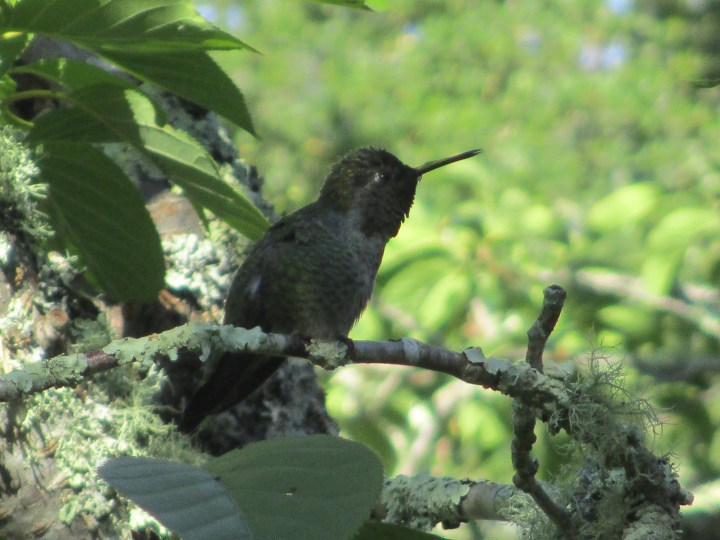
This strangely calm black-chinned hummingbird who watches me from the same spot in a flowering cherry tree is either unaware of my disdain for wildlife, or is merely unconcerned about it. He just sits there . . . silently . . . observing . . . as if plotting or scheming or . . . something. He seems to be harmless; but I really don’t know. He could have sharp talons or another weapon!

I named him Mr. McNugget.

His species is apparently rare. I had nothing to do with that. Even if I believed that he tastes like chicken, I couldn’t catch him anyway. His kind fly at supersonic speed! He might use one of those ‘transporters’ like on Star Trek. Besides, I really don’t want to mess with that. A feral boar would be easier.

Six on Saturday: Recycling Weeds


A weed is a plant where it is not wanted. There are plenty here. There are also a few situations that could use some of the plants that are considered to be weeds in their present situations. Since we are not a ‘landscape’ company that earns more by needlessly disposing of, and installing, as much plant material as possible, we sometimes get to recycle some of our useful weeds.

Laurustinus, Viburnum tinus, which I refer to simply as ‘viburnum’, has politely naturalized here. It is not prolific enough to be invasive. It just has a sneaky way of getting around, mostly in irrigated landscaped areas. It lives in the wild too. It sometimes grows into situations where it is an asset. It sometimes becomes a problem. I don’t mind removing it. I am none to keen on it.

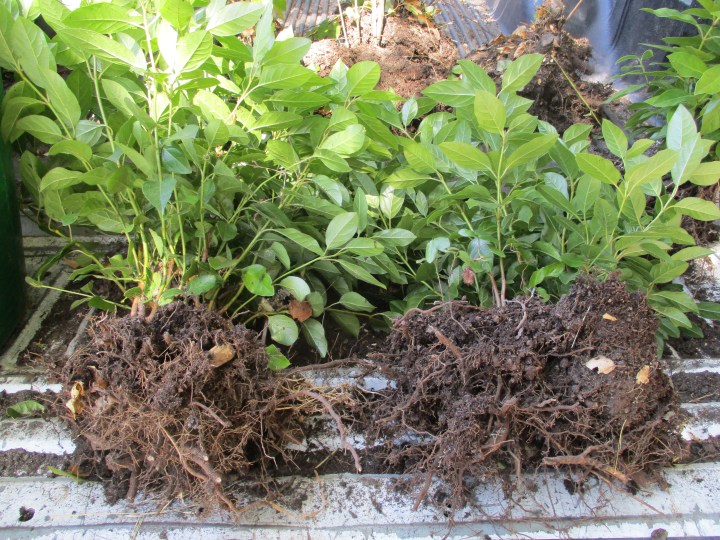
A thicket of viburnum is in the process of being removed from an area that will soon be outfitted with a new and more appropriate landscape. Rather than merely removing and disposing of all of the viburnum, we are relocating it into other landscapes where it will be more useful as informal screening hedges. I would prefer to wait until autumn, but the new landscape is waiting.

For the informal screening hedges that we want, these viburnums will work splendidly. They will fit right into the unrefined and unlandscaped areas as if they belong there. Prettier species that I would prefer would be more conspicuous, and look like something that was planted. I know that these recycled plants will initially not be as uniform as nursery stock, but I do not care.

1. This thicket of viburnum has been here as long as anyone can remember. It gets cut down when it gets too high, and takes a few years to regenerate. A new landscape will be going in here.P90914

2. The biggest and gnarliest specimens get discarded. It would not be practical to salvage them. These mid-sized specimens with relatively compact root systems should be easily relocated.P90914+

3. They clean up nicely, with most of their foliage pruned away, and their long stems pruned back. Some of their roots get pruned to facilitate planting, and also to stimulate new root growth.P90914++

4. Once planted and soaked in, many of the relocated specimens seem to be comparable to what might have been purchased from a nursery. Even with the warm weather, wilting is minimal.P90914+++

5. With two more that are out of view beyond the right margin of this picture, these five make a nice hedge of seven newly relocated viburnum. They are nothing fancy, but should work well.P90914++++

6. This is the view that they are intended to obscure, featuring seven dumpsters and various utilitarian unpleasantries. That’s them in a neat row across the lower right corner of the picture.P90914+++++

This is the link for Six on Saturday, for anyone else who would like to participate:

https://thepropagatorblog.wordpress.com/2017/09/18/six-on-saturday-a-participant-guide/

Horridculture – Fake Media

P90911This is no way to get the dirt on someone. There is no dirt involved. If there were, it would be referred to as ‘soil’. ‘Dirt’ is a term used by those who do not know any better.

Anyway, this is about the media that plants are grown in. It might be called growing media, potting media, potting mix or simply potting soil. Some in the horticultural industries might say that, because it is assembled from a variety of components that do not naturally occur together, growing media is synthetic. Because it lacks real soil, most of us refer to it simply as soilless.

Now, I am aware that not all media are created equal. The medium that we grew citrus in was much sandier than what we grew rhododendrons in. It was purchased already mixed specifically for citrus, and ready for use. The medium for the rhododendrons was mixed on site, with more coarsely shredded fir bark (from local mills), less sand and a little bit of perlite.

What I was not aware of, was just how perishable potting media purchased from retail garden centers are. Rather than drive out to the farm for a bin or two of medium, I purchased a bail of common ‘potting soil’ from a garden center about two years ago. I just happened to be there to pick up something else. The cost seemed worth avoiding an extra trip to the farm.

It actually was worth the cost. It did what I needed it to do for a time. The problem I am noticing now is that plants that were not planted or canned up (into larger cans) soon enough are now lacking the volume of medium they need. They need to be stuffed, which involves sliding them out of their cans to add a bit more medium to set them on top of, back in their cans.

The potting soil decomposed too readily. It is as if it rotted into muck that was rinsed through the drainage holes with watering. I suspect that there was more to the medium that the typical simple components. It probably contained significant volumes of compost derived from recycled greenwaste. I certainly have no problem with that. I just would have liked to know about it.

This little American persimmon seedling can stay in this half empty can until winter dormancy. Once dormant, it can be canned into a #5 (5 gallon) can, to resume growth next spring, before it even realizes that it is lacking medium. It will get a happy ending.

Cortaderia jubata

P90908It is known by a few different common names, including ‘Andean pampas grass’, ‘purple pampas grass’, and simply ‘pampas grass’. ‘Andean pampas grass’ sounds almost like an oxymoron, since the Andes Mountains are in a separate region to the west of the pampas region of Uruguay and eastern Argentina. ‘Purple pampas grass’ is even sillier, since it is devoid of any purple.

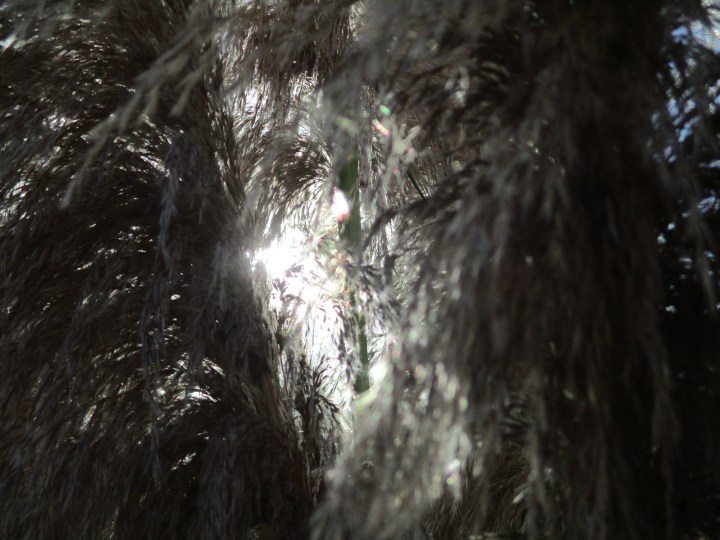
I know it simply as ‘papas grass’. That is just how I learned it. The problem with this common name is that it is the same common name of Cortaderia selloana and its cultivars, which is a distinct species that is, on rare occasion, planted intentionally in landscapes. Cortaderia jubata is one of the most aggressively invasive of exotic species on the West Coast, so is not planted.P90908+

Cortaderia selloana is safe to plant because it is ‘supposedly’ sterile, so can not naturalize. Technically though, it is not really sterile, but merely exclusively female, without male flower parts for pollination. It reproduces by apomixis, which is a fancy way of saying that it produces viable seed without pollination. No one has bothered to explain why that makes it any less invasive.

Cortaderia jubata reproduces by apomixis too, but makes much more of problem with it. It is very prolific with its unpollinated seed! To make matters worse, it will hybridize freely with Cortaderia selloana if it gets the chance. How does that even work?! Pollen is needed for that sort of hanky panky! Nonetheless, the hybrids are almost as aggressive as Cortadera jubata is!P90908++

I just don’t trust any of them. Cortaderia selloana cultivars can work well in large landscapes in urban areas, where they can not escape into the wild. For rural or suburban landscapes that are near wildlands, there are plenty of other less invasive options.P90908+++

White Hydrangea

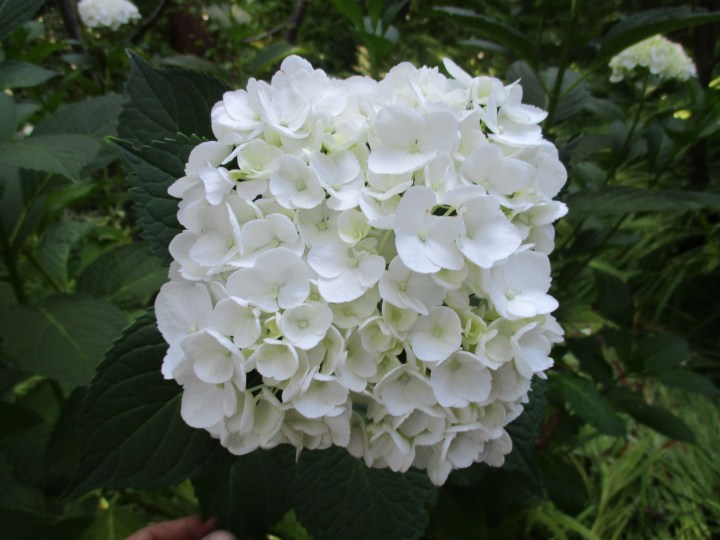
P90907KWhat ever happened to the formerly common white hydrangea? It used to one of the three standard types of hydrangea; and the other two were really variants of the same sorts of ‘pink or blue’ hydrangea that I wrote about in ‘Horridculture – True Colors‘. The few hydrangeas that are white nowadays are lacy, flat-topped, blushed . . . or anything but simple classic white.

This old fashioned simple white hydrangea is just as elegant now as it has always been. It is always white, without pretense of blue or pink. There is no point of giving it something it does not really need just to change its natural color (like those of us in the Santa Clara Valley do to make pink hydrangeas blue; or those of us in the Tualatin Valley do to make blue hydrangeas pink).

The bulky and almost spherically rounded form of this floral truss distinguishes this old fashioned type as a ‘mophead’ hydrangea. Nowadays, ‘lacecap’, ‘mountain’, ‘smooth’, ‘panicle’, ‘oakleaf’ and ‘climbing’ hydrangeas are the more popular types. There is certainly nothing wrong with contemporary types, but there is nothing wrong with the old fashioned ‘mophead’ types either.

When it is time to prune the hydrangeas this winter, we might take cuttings from this particular specimen, in order to grow a few copies of it. Pink and blue hydrangeas, which get fertilized accordingly (to maintain their desired colors), happen to suit the landscapes very nicely here, but a few more white hydrangeas would brighten the rich dark green of the forest splendidly.

Besides, the old fashioned simplicity and elegance of this old fashioned white mophead hydrangea seem to be more compatible with the old redwoods and other mature forest trees than the relative flashiness of modern cultivars that were popularized only in the past few decades.

Six on Saturday: White (but not) Trash


That is, of course, a matter of perspective. Some of us might find some of the six species represented here to be trashy. Some of us might find all six to be appealing. After a slight expression of disapproval of my insensitive designation of my six pictures as ‘White Trash’ last week, I considered that I should perhaps be more tactful with my opinions this week. Then, I got over it.

These six just happen to be rather innocuous, so I have nothing too objectionable to say about them. I am actually rather fond of them. The last comment about #5 refers to the 2-in-1 graft.

1. Oregano, Oringamum vulgare, is civilly naturalized in a few spots. I let it bloom because it is rather pretty. There are plenty of unbloomed stems for anyone who wants a bit of the foliage.P90907

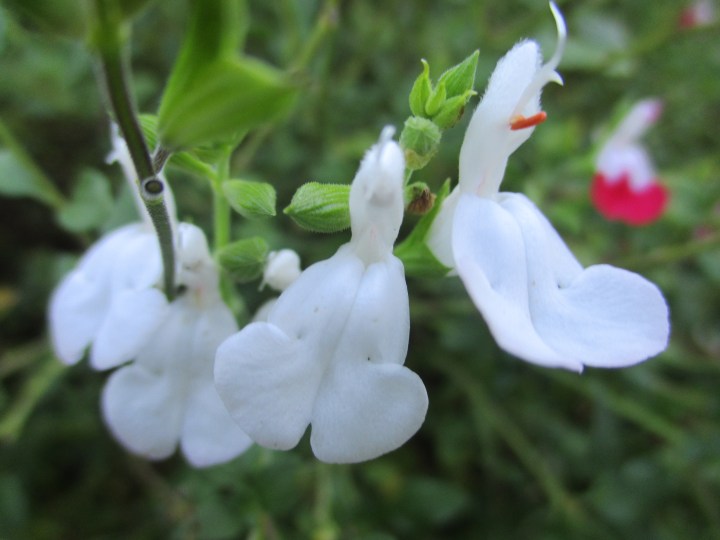
2. Autumn sage, Salvia greggii, with white flowers, developed within a colony that was originally of the cultivar ‘Hot Lips’. The more typical flower is blurred in the upper right background.P90907+

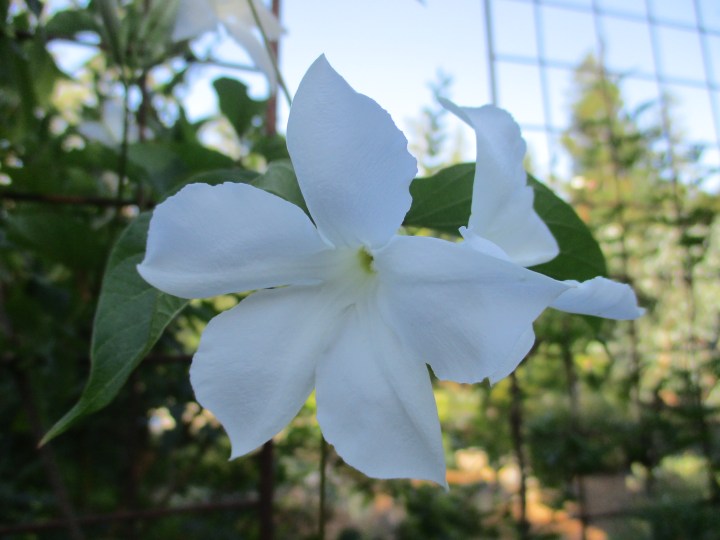
3. Chilean jasmine, Mandevilla laxa, is a mildly fragrant mandevilla. The fragrance is barely perceptible here. I am impressed anyway. I do not expect any fragrance at all from a mandevilla.P90907++

4. Star jasmine, Trachelospermum jasminoides, is much more fragrant, especially in abundance. I know it is common, but I like it anyway, as much for the foliage as for the fragrant bloom.P90907+++

5. Rose, Rosa spp., seems to be the all too common floribunda cultivar, ‘Iceberg’. It is grafted together with what seems to be ‘Burgundy Iceberg’, onto standards (rose trees). 2-in-1 = tacky!P90907++++

6. Oleander, Nerium oleander, to many, is even tackier. I really like it. Besides, it does so well without irrigation in the rustic or unrefined landscapes. It might be the cultivar, ‘Sister Agnes’.P90907+++++

This is the link for Six on Saturday, for anyone else who would like to participate:

https://thepropagatorblog.wordpress.com/2017/09/18/six-on-saturday-a-participant-guide/