The Other Rhodies

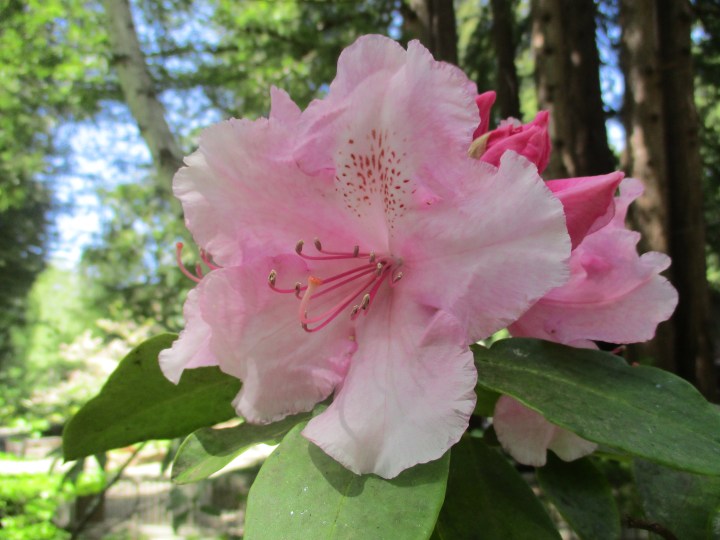
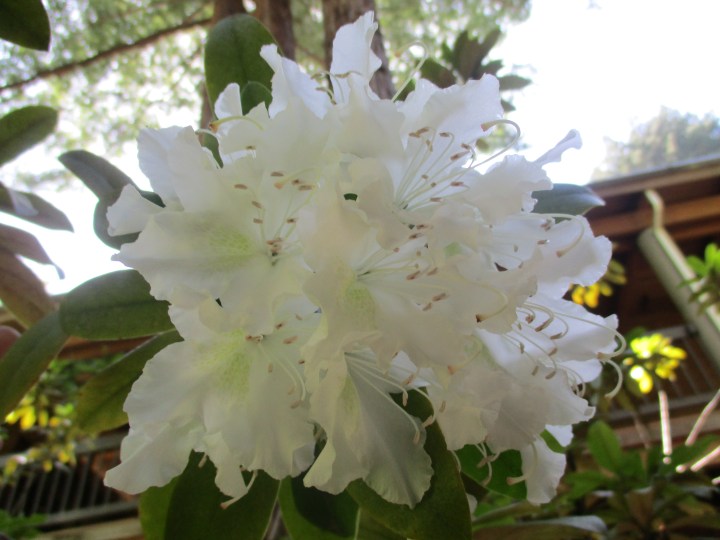
P90504KThere are countless species and cultivars of rhododendrons. Some have been in cultivation for centuries. Their big bold blooms are spectacular against a backdrop of their dark evergreen foliage. They prefer shelters spots, and some are happy to bloom in places that are too cool and too shaded for other flowers to bloom so well. They are so impressive that no one notices that they lack fragrance.

There is certainly a lot of variety among rhododendrons. Some are low mounding shrubs, while other can grow as small trees with open branch structure. Flowers can be white, pink, red, purple, blue or maybe even yellow or orange. Most flowers have some sort of pattern within the main color, but some are solid colors. Nonetheless, regardless of all the variety, we think that we can recognize a rhododendron when we see one.

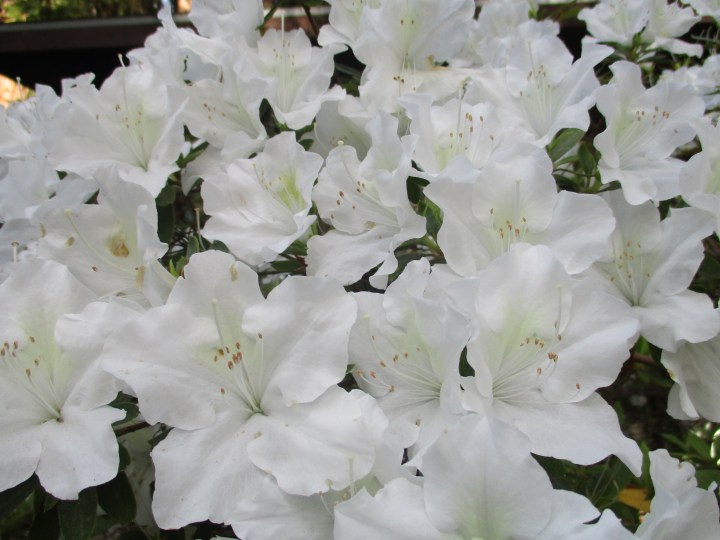
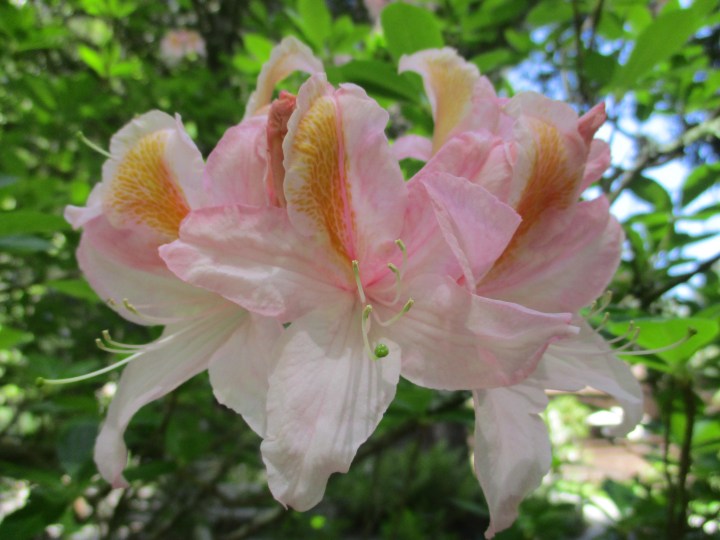
Then there is Rhododendron occidentale, the Western azalea. The flowers are sort of recognizable as either big azalea flowers or lean rhododendron flowers, but are quite distinct from what we think of as familiar rhododendron flowers. The color range is very different too, with more white, marked with yellow, pink or orange. Even more surprising is that the bloom is quite sweetly fragrant!

Foliage is also very different from what is expected from a rhododendron. Not only is it deciduous, but if well exposed, it can actually develop soft yellow, orange or brownish red color in autumn. Individual leaves are rather narrow and papery.

We have only a few Rhododendron occidentale at work. They are not as tolerant of the partial shade from the redwoods as the more familiar rhododendrons are. However, they do happen to be blooming exceptionally well this year, while the bloom of the more familiar rhododendrons is less impressive than it has been in many years.

Six on Saturday: Rhody!!

P71014

This is not really about Rhody, the terrier whom I work for. I just threw that extra picture in because, if you know who Rhody is, you were expecting to see his picture after reading the title. The six pictures below are really just rhododendrons that were blooming last week.

Last year was the best bloom of rhododendrons and azaleas in many years here. Those who have known them for many years can not remember a more spectacular bloom, with so many of different cultivars of the rhododendrons blooming so profusely in the same season.

The bloom this year is unusually sparse. No one can explain it. They have good years and bad years, just like anything else in the garden. Fortunately, even in their bad years, the flowers that bloom are spectacular.

1. Of the six this week, this is my least favorite. It is a vary pale pink, but not pale enough to be white. There are not many florets on the trusses.P90504

2. I refer to this one as ‘Taurus’; but I really do not know what it is. ‘Taurus’ is very susceptible to thrip. This one sustains only minor damage from thrip, while a few others nearby are are seriously damaged.P90504+

3. This one may not look much better than #1, but the color is pinker, and the trusses are impressively big with more florets when it is in full bloom. It grows as a tree nearly twenty feet tall.P90504++

4. I refer to this one as ‘Anah Kruschke’, but like for #2 above and #5 below, I am not sure about its identity. ‘Anah Kruschke’ should not be damaged by thrip as badly as this one is. I think my colleague grew this one.P90504+++

5. Of the three here that I have names for, this is the one that is most certainly not what I like to think it is. ‘Helene Schiffner’, which happens to be one of my favorites, is not blushed with yellow.P90504++++

6. I believe that my esteemed colleague grew this one as well as #4. I remember delivering a significant order of rhododendrons here years ago, at about the same time this and #4 were installed.P90504+++++

This is the link for Six on Saturday, for anyone else who would like to participate:

https://thepropagatorblog.wordpress.com/2017/09/18/six-on-saturday-a-participant-guide/

Horridculture – Bad Seed

P80317+California poppies are like no other wildflower. They are so perfectly bright orange, and look almost synthetically uniform in profusion, as if painted onto coastal plains and hillsides. They may be a bit more yellowish in some regions, or a bit deeper orange in others, but they are always bright and strikingly uniform.
Genetic variation is naturally very rare. I can remember hiking with my Pa up to the (lesser known) Portola Monument in the hills behind Montara, and finding a few pale white poppies, and even fewer pale purple poppies. It was like finding four leaf clovers! Genetic variants among California poppies are not quite as rare as four leaf clovers are, but finding a few of both white and purple was really strange. I never found a pink one though.
Nowadays, poppies can bloom in all sorts of shades and hues or orange, yellow, red, pink and soft purple, as well as creamy white. Some bloom with fluffy double flowers. Of course, all this variety is not natural. California poppies were bred to do this.
The potential problem with such breeding is that California poppy is naturally very prolific with seed. Any of these weirdly bred varieties could escape into the wild and interbreed with wild poppies, causing them to be more variable, and interfere with the ecosystem.
The problem is not just with California poppies. Many plants get bred extensively enough to interfere with how they behave in the wild if they happen to escape cultivation.
Fortunately for California poppies, the weird new varieties do not really get very far in the wild. The are not true-to-type, so revert back to their original bright orange in just a few generations, even without outside influence. If pollinators do not recognize their unfamiliar color and form, they are less likely to get pollinated to continue to tamper with the ecology. In fact, wild California poppies still have the advantage in that regard.
This yellow California poppy with an orange center is a second generation seedling, and is already halfway between the original yellow variety, and the wild orange.

Redwoods Are So Tall . . .

P90428Redwoods are SO TALL!
How tall are they?
They are so tall that you can see for yourself if you look in this direction . . . from anywhere in North America.
They are so tall that if you need firewood, I can aim one in your direction as I cut it down.
They are so tall that while they drop foliar debris on the Ford and Chevrolet parked below, they also drop foliar debris on Mercury and Saturn in their respective orbits.
They are so tall that while other trees collect kites and Frisbees, they collect airplanes and satellites.
They are so tall that only a few of their seed survive. Most burn up in the atmosphere on their way down.
They are SO BIG too!
How big are they?
They are so big that some have tunnels cut through them so cars don’t run out of gasoline while driving around.
Okay enough of that for now.
Most of the biggest redwoods here were harvested, leaving only stumps to remind us of how big they were. The few trees that were big enough for harvest a century ago, but were not harvested when those around them were, probably exhibited some sort of defect that made their lumber undesirable.
The tree in this picture happens to be one of the few that is big enough now to suggest that it was likely big enough for harvest when those around it were harvested. The trunk is more that six feet wide. Yet, except for the severe lean, no obvious defects were observed. (The vertical edge of the doorway to the left was included in the picture for comparison with the lean of the tree.)
The tree started to lean only recently. If it had taken several years to develop this lean, the top several feet of the trunk would be curved upward, as it would have continued to grow vertically away from gravity while the trunk below it moved. If it moved suddenly but only once several years ago, there would be a kink near the top of the otherwise leaning trunk, from which, subsequent growth would be vertical.
This tree instead leans with a straight trunk from bottom to top, which means that it grew vertically, and then moved into this diagonal position too recently for new vertical growth to develop. Lateral branches are also diagonal, as they maintained their position perpendicular to the trunk. Although redwoods rarely destabilize, this one really seems as if it is about to fall.
Is this destabilization relative to some sort of deficiency that prevented the tree from getting harvested a century ago? I really should investigate.

Mellow Yellow

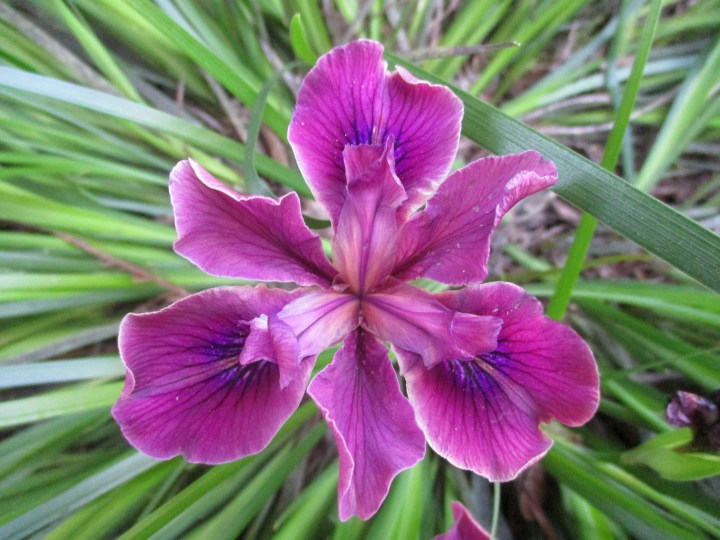
P90427KThis picture of a yellow Pacific Coast iris probably should have been incorporated into the Six on Saturday post earlier today. I omitted it because I was not so impressed with how the color showed up. It is really more yellow than it looks. In this picture, it looks more like a discolored version of the white Pacific Coast iris. This sort of variation, that might have been normal for old fashioned photography, is not expected of digital imagery.
It sort of reminds me of how some insects and other pollinators see flowers so differently with infrared or ultraviolet. Are infrared or ultraviolet faded in digital imagery as well? It would make sense, since there is no need for normal cameras to record colors that we can not see. Nor is there need for computer monitors to display such invisible colors. Ironically, modern technology can modify color to make that which in invisible to us visible.
Modern technology is always improving the quality of stored data, and the presentation of such stored data. Perhaps there really are ways to take pictures that record infrared and ultraviolet, although I can not imagine why there would be a use for such technology. Video is good about recording and presenting motion. Audio records and presents sound. Regardless, none of it is good enough to keep us from actually enjoying our real gardens.
Pacific Coast iris blooms in all sorts of weirdly bright colors now. Modern technology has certainly had its way with them as well. The flowers are bigger and bolder than they naturally were. The foliage is greener and fluffier. Yet, to me, the best are still those that grow wild and bloom on the coast of San Mateo County, with unassuming flowers in subdued shades of greyish blue, like faded denim.

Six on Saturday: Above And Below


Flowers are almost everywhere this time of year. Even some of the lawns are blooming with English daisy. Warm season annuals are starting to bloom nicely while a few cool season annuals that have not yet been replaced are still going. Although those that were established before this spring finished a while ago, a herd of daffodils that got planted very late last winter are just now finishing bloom. New flowers start bloom as old flowers fade.

I got these pictures of some of the more perishable blooms while I could, so some are already outdated. #1 was actually already fading before last Saturday, but I had other pictures to show at the time. #2 lasted only a few days because it is still recovering from getting relocated in the warmth of last spring, after it had already foliated. Of these only #3 and some of 4, 5 and 6 are in good bloom now, but they do happen to be quite spectacular.

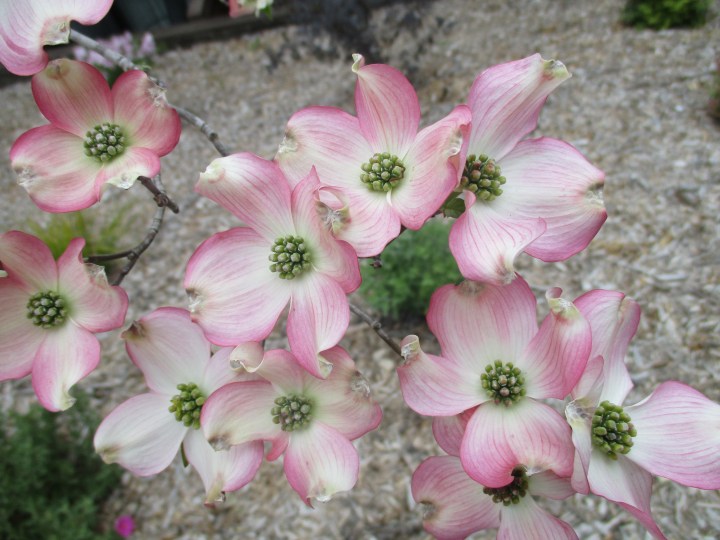
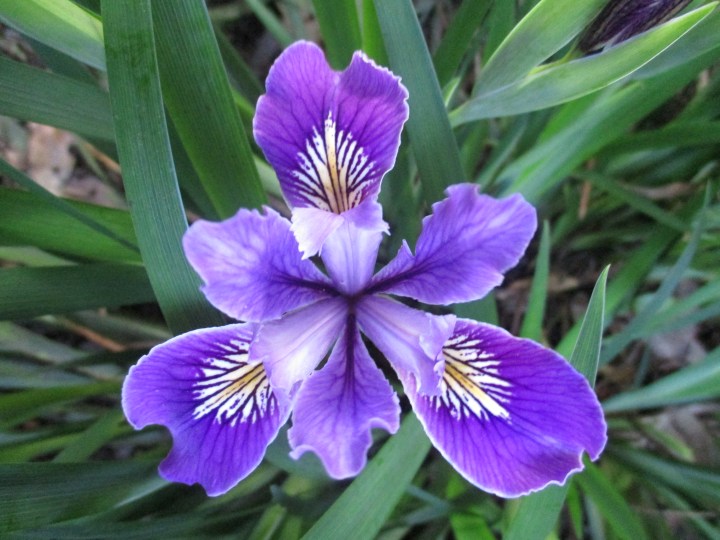
Flowering cherry, star magnolia and flowering dogwood are small or mid sized trees that are above the low Pacific Coast iris below; hence ‘Above and Below’. (However, this particular star magnolia is only about four feet tall so far.) I can only identify the cultivar of the ‘Kwanzan’ flowering cherry. The rest are identified only by species.

Incidentally, there is far more above all of this that is not seen in these pictures. Almost all of the ‘biomass’ here is suspended by the grand but remarkably blandly blooming redwoods.

1. Prunus serrulata ‘Kwanzan’ – ‘Kwanzan’ flowering cherryP90427

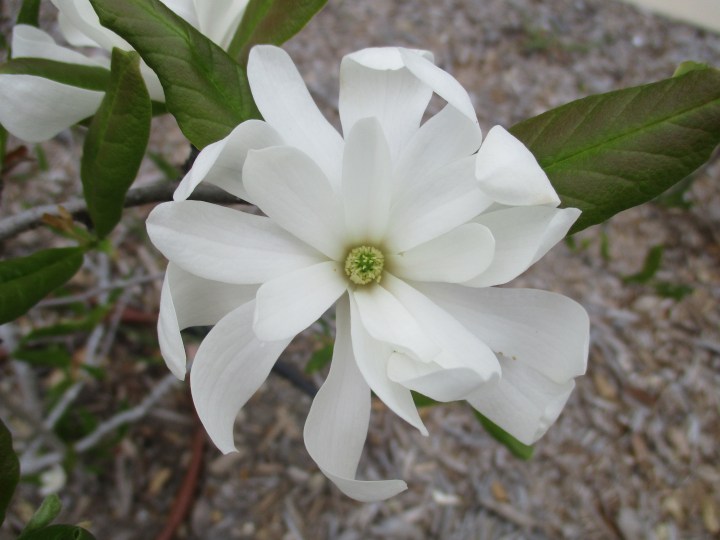
2. Magnolia stellata – star magnoliaP90427+

3. Cornus florida – flowering dogwoodP90427++

4 + 5 + 6 Iris douglasiana – Pacific Coast irisP90427+++P90427++++P90427+++++

This is the link for Six on Saturday, for anyone else who would like to participate:

https://thepropagatorblog.wordpress.com/2017/09/18/six-on-saturday-a-participant-guide/

Horridculture – That’s Just Swale

P90424Building and environmental codes are so ridiculous. So much of what I would want in my home is now illegal. So much modern technology that I do not want is now required. Fireplaces and wood stoves are not allowed. Overly elaborate electrical systems to serve every room are necessary. I would prefer a technologically simple home comparable to those built more than a century ago, but am prohibited by law from ever constructing one.
The area outside of a home is no easier to work with. Dead trees inhabited by the wrong sorts of woodpeckers can not be cut down. Excavation can be prohibited if a particular beetle happens to be in the way. Even some of the increasingly combustible trees and overgrown vegetation have more rights on my land than I do. Now, I am a horticulturist; so I know more about vegetation management than the treehuggers formulating these laws.
Even some of the weather has more rights than people do. In some municipalities, rain that falls onto a property has the right to percolate into the soil. Rain water that drains from roofs and pavement must be provided with ‘swales’ or basins where it can do so. It can not be evicted into old drainage systems that drain into local creeks and rivers. However, such rain water must not be detained in tanks for use in the landscape through summer.
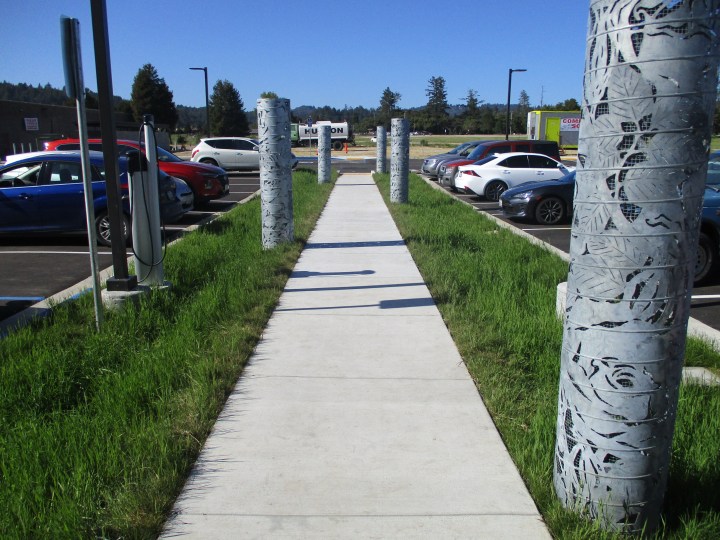
The picture above shows part of a new landscape in the middle of a new parking lot at a newly constructed building. It looks simple for a reason. It is a pair of swales. The meadow grasses conceal a pair of surprisingly deep ditches on either side of the central walkway. Rain water drains here to percolate into the ground. The soil below the walkway might have been replaced with coarse gravel to promote drainage into that area as well.
Do not park a car at the curb and try to step from the curb into a swale to get to the walkway! You could get hurt. As I mentioned, that grass is concealing ditches that are deeper than they look. It is safer to walk through the parking lot to a large paved patio like area that is out of view behind where the picture was taken from. The other option is to walk away from the building to the far end of the walkway, but really, who would do that?
Why is the walkway even there? I really don’t know. There are no curbs on it, so anyone in a wheelchair who feels so compelled to go to the far end to use it could get seriously hurt by tumbling off the edge while trying to get out of way of someone going the opposite direction! The swales are snares for walkers and baby buggies too. Perhaps the walkway is merely bait. What are the surveillance cameras really for? What sick entertainment!

Banana Slug

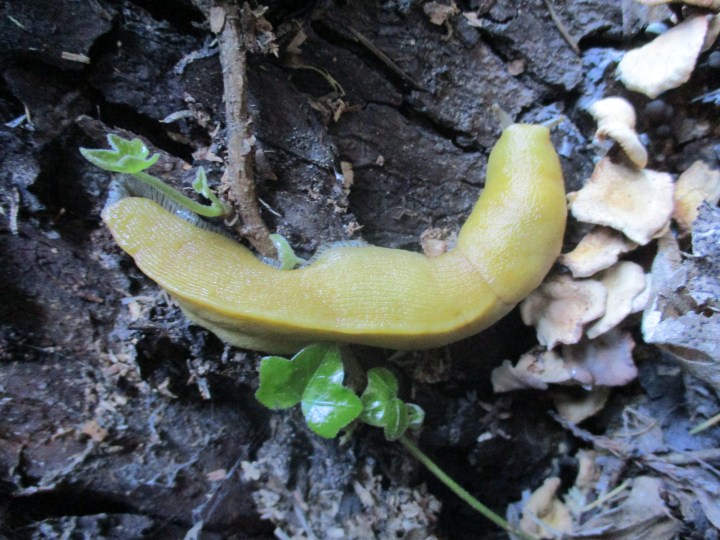
P90421They are not as dangerous as they look. Really. If they were, just one could do more damage than an entire herd of average slugs. The fortunate truth is that banana slugs consume only decaying plant parts and fungus. Yes, they literally cruise about the garden eating bits of decomposing debris that we may not want there anyway, and converting it into a very nutritious and nitrogen rich ‘fertilizer’. They are actually beneficial to home gardening.
Of course, this does not necessarily mean that we ‘want’ them in our gardens. They really do look scary. This one is only about four inches long, but larger ones can get nearly twice as long! Some rats are not that big! Their bright yellow color, which is typically brighter yellow than this one is, is an expression of defiance. They only stay out of the way because they prefer damp and shady situations. Otherwise, they do not care if we see them.
Contrary to popular belief, they do not really taste like chicken. They taste more like the blandest of escargot. If not purged with corn meal and partly deslimed with vinegar, they can taste much worse. Even if the myth about the slime on their undersides containing more vitamin C than a bucket of oranges is true, it does not justify licking them. It is more degrading to you than it is to them; and no one needs that much vitamin C anyway!
As revolting as they are, they are not completely disdainful. It is fun to point them out to friends who have never seen them before, but only after they have gotten close enough to be startled, and jump away as if being chased by something that can actually move . . . quickly. Banana slug races are also fun.

If Mushrooms Could Fly

P90420K

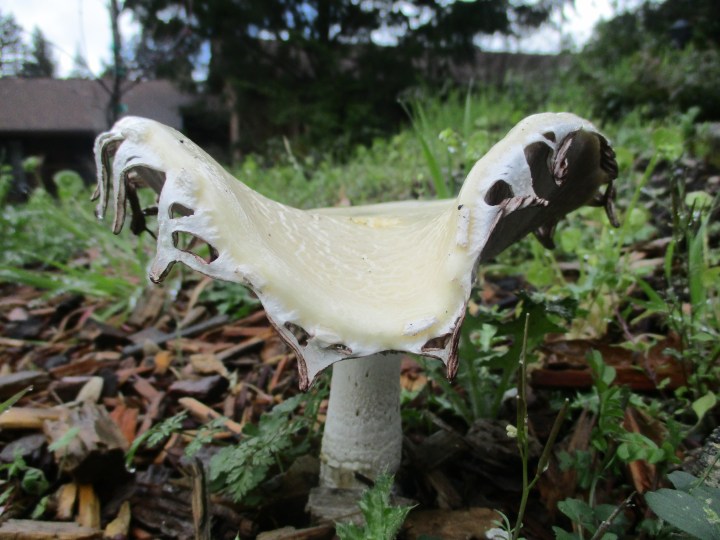
If mushrooms could fly, they might look like this. Doesn’t it look like it is ready for take off? Maybe it looks like it is dressed up as a ghost for Halloween. I thought it looks something like the flying nun. Regardless of what it looks like, it was so weird that I took its picture.

I can not explain why it is in this weird position. It appeared just as the weather was warming up, and most of the earlier mushrooms were already gone or deteriorating. Perhaps the upper surface dried out a bit in the sunlight, and tightened up on the lower surface that remained more hydrated. Since I did not go back after getting this picture, I do not know what it did afterward, or how long it lasted. Perhaps it really did fly away!

This mushroom was just a few yards from where I got the picture of those associated with oak root rot fungus, Armillaria mellea,which many of us know as honey fungus. https://tonytomeo.com/2018/12/02/the-humongous-fungus-among-us/ Those mushrooms grew and deteriorated back in December. The other five types of mushrooms that I got pictures of to post along with a later picture of the oak root rot fungus mushrooms for a ‘Six on Saturday’ post were found just a few more yards away in another direction. https://tonytomeo.com/2018/12/29/six-on-saturday-shrooms/ They did their thing later in December, but still a few months ago.

There are always some sort of mushrooms out and about in riparian environments closer to the creeks and streams. They are just not as abundant now as they were during the rainy weather late in winter. Those out in drier and warmer spots that do not get watered regularly do not often develop so late into spring. They seem to know how to exploit the favorable weather.

Six on Saturday: Azaleas


As the flowering cherry trees fade, the azaleas get their turn. Like the flowering cherry trees, the azaleas are not as spectacular as they were last year. I know it is relevant to the weather, although I do not know what the weather did to inhibit so much bloom with so many of the early spring bloomers. I know there was a lot of rain, but that should not have been a major problem. There was not much chill, but there should have been enough.

I do not know if this will be the most subdued bloom ever witnessed here, but the limited color might be more apparent because the azaleas and rhododendrons were more spectacular last year than they had ever been. According to their bud set, the rhododendrons will be even less impressive than the azaleas. The dogwoods might have had the potential to be as spectacular as last year, but some were disadvantaged by structural pruning.

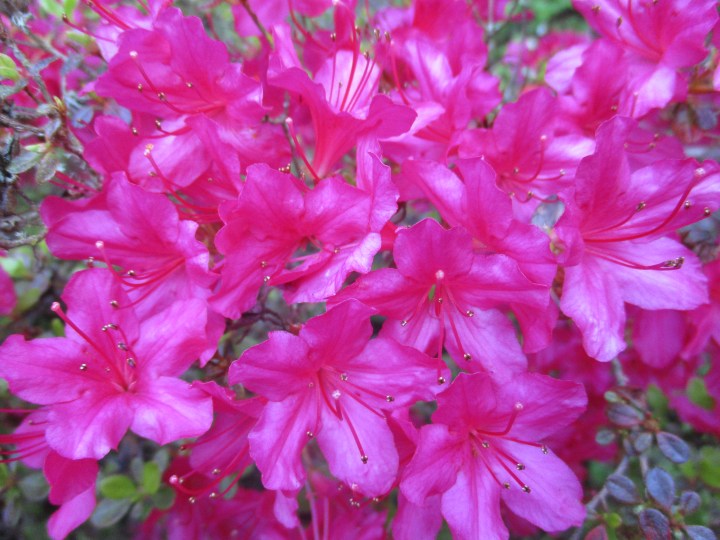
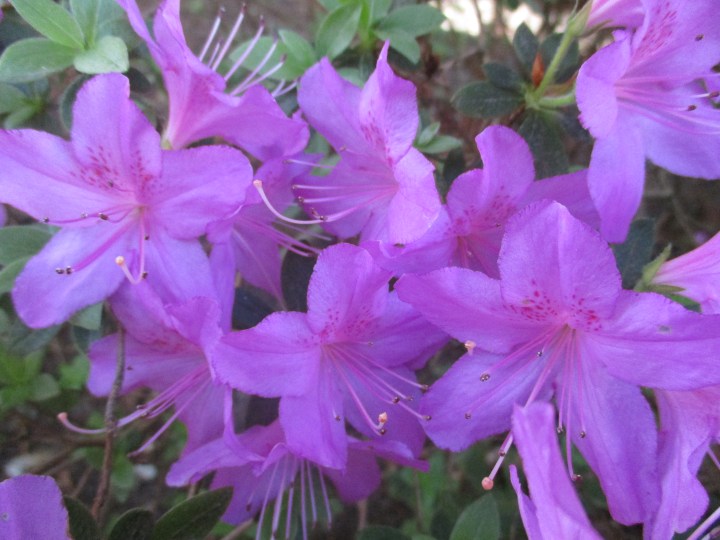
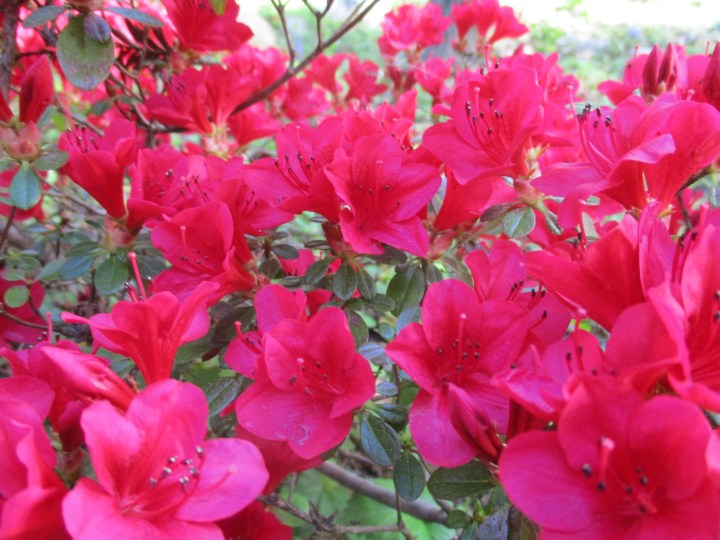
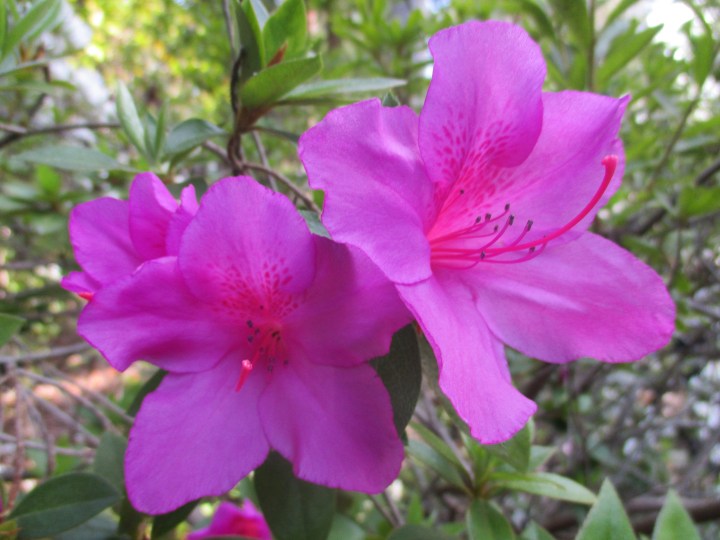
These six azaleas were the best of what was blooming here this year. The pictures were taken about a week ago. I should know the names of all the cultivars, but I don’t. They do not look the same in landscape as they do on the farm where they grow. I could guess on a few. The only one that there is no mistake about is #4, which is ‘Coral Bells’. Color is a bit off in this picture. #5 looks like ‘Hino Crimson’, but without bronzed new foliage.

Rhododendrons are coming along slowly but surely. They will not be ready for next week. Fortunately, as wimpy as our bloom is this spring, there is plenty to get more pictures of for next week.

1.P90420

2.P90420+

3.P90420++

4.P90420+++

5.P90420++++

6.P90420+++++

This is the link for Six on Saturday, for anyone else who would like to participate:

https://thepropagatorblog.wordpress.com/2017/09/18/six-on-saturday-a-participant-guide/