Gladiolus papilio (from the author of Tangly Cottage Gardening Journal)

p90127https://tonytomeo.com/2018/11/10/six-on-saturday-tangly-cottage-gardening-journal/

This link is to the original post to ‘Six on Saturday’ that was about the four dozen or so Gladiolus papilio bulbs that the author of Tangly Cottage Gardening Journal sent to me at the end of last October.

I tried to not get too eager about these new bulbs. I sort of watched their site shortly after planting them, just to make sure they were safe. Once they were planted, nothing else was done there. There was a bit of frost just to let them know what time of year it is. The rain has been soaking the ground for them.

More recently, I noticed that some of the spring bulbs, particularly narcissus, are blooming elsewhere. Daffodils with bigger flowers are just about to bloom. Even though I know that the summer bulbs bloom a season later, I also know that, their foliage starts to develop quite some time before bloom. They are not as fast as spring bulbs, so their foliage may appear months before ultimate bloom in summer. Again, I was trying to not get too excited.

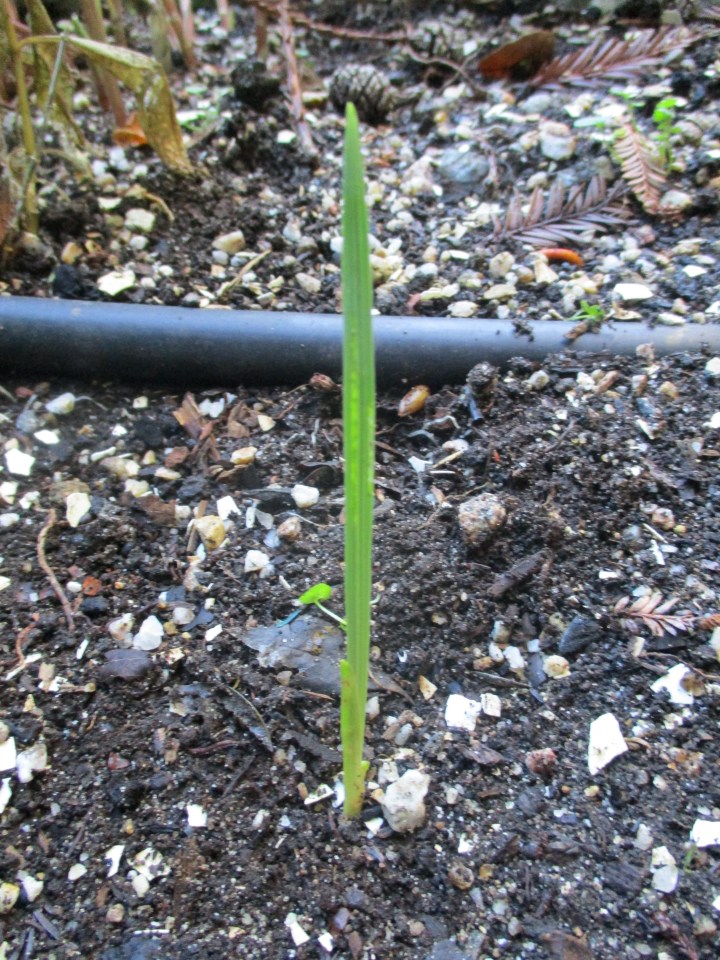
Then on Friday, I needed to remove some licorice plant from the opposite end of the same big bed that the Gladiolus papilio is in. I did not go out of my way, but hey, while there, I went over to just make sure there were no problems where the the bulbs are at. I really did not expect to find these two shoots. They are emerging from bulbs at opposite ends of the row of the five groups of bulbs described in the earlier article. They look like small shoots of common gladiola, like those that emerge from the tiny cormlets that develop next to larger corms, which is exactly what I was expecting them to look like.p90127+

Pseudodendron falsifolia

p90126kLatin and the other languages used to designate botanical names can make the mundane seem compelling, and the unpleasant sound appealing. ‘Nasturtium’ certainly sounds better than ‘nose twister’, which refers to the reaction to the unpleasant fragrance of the flowers. Horticultural professionals can use such language to our advantage, and for more than designating real genera and specie. ‘Necrodendron’ certainly sounds more interesting than ‘dead tree’, and is less likely to offend tree huggers.
‘Pseudodendron’ is a euphemism for ‘fake tree’. Brent, my colleague in Southern California, sometimes points them out in interiorscapes, or worse, in real exterior landscapes. We sometimes analyze them as if they are real. We both are amused to see fake bananas or fake pineapples, or both, hanging from fake cocoanut palms. Sometimes, someone who overhears our conversation feels compelled to inform us that the pseudodendrons that we are so intrigued by are fake. Sometimes, someone asks about growing them in their own gardens.
Of course, hassling Brent about his artificial turf never gets old. It is installed outside of his office to demonstrate how practical it is for clients who are considering it for their landscapes. It really does look great though. Brent probably gives it plenty of fertilizer, and waters it well.
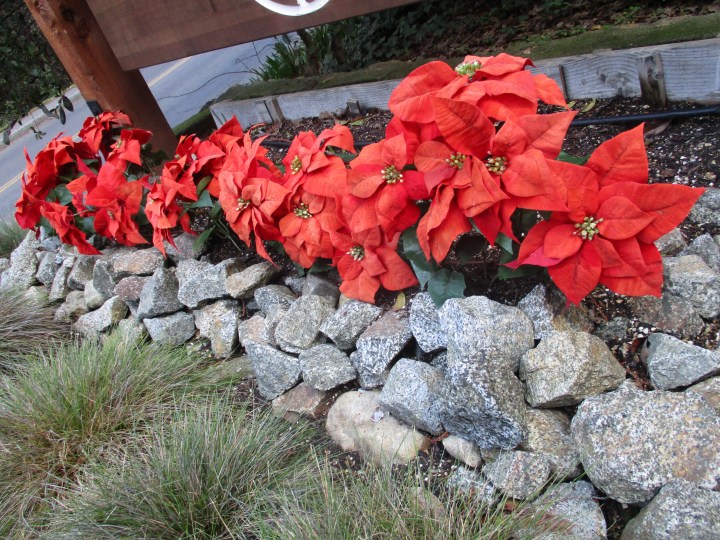
By the time Brent finds out that there is something much worse in one of the landscapes that I work in, it will be gone. Now that it is late January, these fake poinsettias will be removed any day. I will not miss them. Even if they were real, they would still look silly. That is just too much red.
Unfortunately, these poinsettias are perennial. They will be put away until next winter, when they will come out of storage to go back into the same spot in the landscape.

Six on Saturday: Wrath Of Grapes


Racial profiling was not likely the reason I was asked to prune a big overgrown grapevine at work. I just happen to be more proficient with dormant pruning of dago wisteria than my colleagues are. My proficiency is more cultural than racial. I am from the Santa Clara Valley, and sadly, they are not.

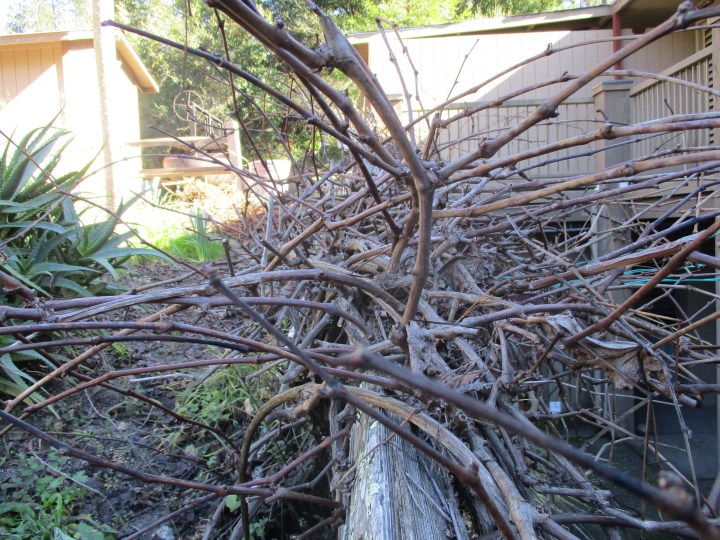
1. Before pruning, the grapevine was a tangled mess on a split rain fence, which is not even visible in this picture. Incidentally, the forsythia that was featured in ‘Six on Saturday’ two seeks ago is located just beyond the upper left margin of the picture.p90126

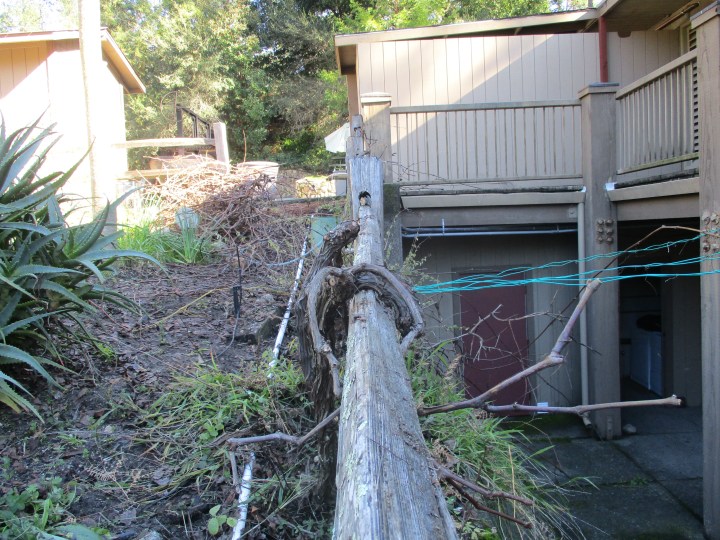
2. After pruning, the top rail of the fence is visible, extending away from where the picture was taken. Some of the debris is still piled to the left in the background. Green wires to the right are there for new vines to climb on. The few remaining unpruned vines are layers (stems that lay on the ground long enough to develop roots of their own) that will be dug and removed. I wanted to prune to just spurs, but there were no new canes on the main trunk. Instead, I left stubs of canes from the previous season, with a few extra buds.p90126+

3. This lineup of what seems to be the usual suspects is really seven well rooted layers (the stems that lay on the ground long enough to develop roots of their own that I mentioned earlier) The smallest one on the left is easy to miss.p90126++

4. Most of the layers are very well rooted. We really do not know what to do with the original grapevine. We certainly do not need seven more! Friends and neighbors will likely find good homes for them.p90126+++

5. The weather was so nice for this project, that the ceanothus nearby started to bloom. There are so many other dormant plants to prune before winter ends!p90126++++

6. Just prior to such nice spring weather, we got eight inches of rain from a series of a few storms. This would have been two thirds of the average annual rainfall of twelve inches in my former neighborhood in town! This bucket of rainwater is nine inches deep because it is flared toward the top, and narrower at the bottom.p90126+++++

This is the link for Six on Saturday, for anyone else who would like to participate:

https://thepropagatorblog.wordpress.com/2017/09/18/six-on-saturday-a-participant-guide/

Horridculture – WEED! (but not a sequel)


Although relevant to the same disdainful weed that I wrote about earlier in https://tonytomeo.com/2018/10/24/horridculture-weed/ this article is about a completely different topic. That is why it is not a sequel. Nor is it a rant. It is instead an explanation of why so many of us choose to not use marijuana. It was written by an admired colleague who has much more experience with such matters than I do, and is therefore much more qualified to write about it. So, for today, I will deviate from standard procedure by refraining from my typical Wednesday rant, and by posting an article written by someone else. In fact, you can ignore the title above. This article below already has one.

p90123

Should the followers of Christ use Cannabis? J.S.Wilkinson 2016

Cannabis seems to keep coming up in conversations people around me are having. Watching the current trends of well-meaning people giving themselves to substances that have been historically questionable brings me to the place where I must share my experience and my research.

Just because the government has made something legal doesn’t make that thing permissible. There’s a lot of examples I could cite … and I’ve been around long enough to know that “all that glitters is not gold”. I’m also one to say “the good is the enemy of the best”. Why settle for something counterfeit when you could have the genuine article?

Classically, the followers of Christ get there cues from the Scriptures, when debating whether or not an action or indulgence is permissible; but as we all know everything is subjective, even the meanings of the Scriptures. And we have seen how something written can be taken out of context and made to fit either side of an argument.

I have worked in one of the most prestigious medical centers in the world (for decades) and I’ve had the good favor to meet some of the top minds in, for example, pain research. I asked the senior research doctor of the “Pain-Clinic” “What do you think of medical marijuana?” He chuckled and said, “There is only one reason why anybody would want to use marijuana. It gets you stoned!” He went on to explain that the current trend of marijuana use in “medicine” was a direct result of the agenda to legalize the drug. He said that cannabis has no analgesic property, and the effect of using it only makes the user “complacent” (as well as stoned) “They no longer care they’re in pain” but the pain is not relieved! This particular Hospital has a strict no cannabis policy. Patients with “Medical Marijuana” cards are not permitted to bring their “Prescription” marijuana into the hospital with them. Psychiatric patients are dropped from treatment if it’s found they are using marijuana, even with a Doctor’s prescription. Here’s my question; if marijuana is so well thought of, why isn’t it universally adopted by the medical community? I’m sure the conspiracy crowd could run for miles with that one…

What do the scriptures say? The English word ‘pharmacy’ is clearly derived from a group of Greek words used to describe pagans (the dark arts) who used potions to encourage hallucinations for contacting the spirit world. The particular word ‘pharmakia’ found in Revelation 9:21, 18:23, 21:8 and 22:15 refers to Sorcerers. Please note: NOT ALL DRUGS ARE BAD! Followers of Christ are admonished not to practice sorcery or witchcraft, so it seems to go without saying that we should not be using drugs that are used in Pagan rituals and in Sorcery.

Let’s take a look at what spiritual practices have historically used marijuana in an entheogenic context – from Wikipedia:

According to the TeenWitch.com website “religious cannabis use occurs or has occurred in many of the world’s largest religions: Ancient Egyptian, Asatru (Norse), Assyrian, Australian (Aboriginal) , Babylonian, Bantu, Brazilian (Tribal), Buddhism, Canaanite, Celtic Druidism, Chinese (various), Dagga, Essenses, Etruscan, Gypsy (including Tarot), Hellinism (Greek), Hermeticism, Hinduism, Hottentot, Kemetic (ancient Egyptian), Mithraism, Persian, Polynesian, Pygmy, Rastafarian, Roman, Shamanic/Tribal religion, Shintoism, Sufi Islam, Tantra, Taoism, Thai, Theraputea, Wicca, Witchcraft, Zoarastrianism, and Zulu.

p90123+

Here’s another great question: Is marijuana OK from a spiritual point of view?

This following quote is from a very astute article I found while researching this subject…

This might sound a bit strange, but the aura quality of marijuana smokers is sticky, fuzzy, and open to entities.”

In this lengthy article from Cosmic Living, the author explains the many deceptions that play out in the minds of marijuana users, especially noting the presence of “entities”

Even the people in New Thought modalities are aware that someone or something is getting access to their souls when they open themselves with marijuana use!

My personal experience:

I first started using cannabis in 1970 at age 13. I began to fall away from my faith in Christ, and began to explore alternate spiritual realities. By the time I was 17 I had been introduced to several modalities including Native American Shamanism. This resulted in some very real and very serious trials of my faith in Christ, and the reality of alternate spiritual dimensions. When I turned 18 I attempted to quit all drug use and follow the way of Christ with a renewed zeal. Trying to do this on my own, without the indwelling presence (of the fullness) of the Holy Spirit proved to be too much for me. When I relapsed I felt so condemned that I proceeded to run long and hard away from God.

When I came to my senses 5 years later, I renewed my relationship with God through Christ. The very night I was to be given the full infilling of the Holy Spirit, I laid my marijuana out on the table before me and prayed; God, if you want me to stop using this, you could make it so it doesn’t affect me anymore (the chicken way out) or you could make it so I hate it and no longer find pleasure in it! I went off to my youth group meeting where the cheerful followers of Christ asked if anyone would like to be “Baptized in the Holy Spirit” I checked in with God and he said “you want that”…

After having the fullness of the Holy Spirit imparted to me, I no longer enjoyed the feeling I got from cannabis, the euphoria was replaced with a sense of dread and loathing. I was painfully aware of how I chose to leave the presence of the Holy Spirit by breathing in the marijuana. It was then that the Holy Spirit revealed to me that I had in fact invited a “familiar spirit” into my reality and Holy Spirit would not share my temple with another god! This happened in 1980, no one I met was teaching on this subject, it seemed to be common sense that followers of Christ don’t use marijuana. Here I am 36 years later, living in a time when even the elect are being deceived. Good friends and family members are at odds with me because I won’t back down.

If you feel that you would like to experience the freedom and fullness of the indwelling Holy Spirit and you’re ready to say goodbye to your cannabis friend, we can help you! J.S.Wilkinson

GreenArt

p90120p90120+It seems that I have been negligent about writing about my colleague Brent Green and some of our crazy adventures in horticulture. I said I would do so when I started writing my articles here way back two Septembers ago. It is easy to get distracted from such topics, particularly since we do such different types of work. Brent is a renowned landscape designer and proprietor of GreenArt Landscape Design in Southern California. I am just a horticulturist and arborist who really should get back to growing horticultural commodities in Northern California. For all of our similarities, there just might be as many differences.

After posting that old video of the Birthday Trees yesterday https://tonytomeo.com/2019/01/19/birthday-trees/, I thought that I should also write more about what Brent does for the urban Forest of Los Angeles, which is probably more interesting than our crazy adventures. I really want to find the old news article about how he busted tree rustlers who were stealing mature Canary Island palms from the embankments of the Santa Monica Freeway, which is pictured above. It is still a sore subject because we know that it continues, and that the trees that were stolen were not returned as promised.

I could write a separate blog about the work that GreenArt does if I were more involved with it. I just do not enjoy design like Brent does. Actually, I am no good at it. I just work with the horticultural aspects of it, and growing material for it. In the future, I will probably be more involved with projects that are not directly affiliated with GreenArt, such as initiatives to maintain and protect trees in public spaces of Los Angeles.

For now I have only this brief and outdated video of the landscaping of Brent’s home, https://www.youtube.com/watch?v=v2IwcuU3KEo .

Birthday Trees

30731

The big wide medians of San Vicente Boulevard in western Los Angeles had been lacking trees since the Red Car Streetcar rails were removed decades earlier. My colleague, Brent Green, had been wanting to add trees to the medians since he was a little kid, and then became intent on doing so after he became a renowned landscape designer in the region.

At about the same time, I was a nurseryman. In my work, it was not uncommon to dispose of a few items that were unsaleable. Sometimes there were entire crops of unsaleable plants; and in 1997, I needed to dispose of a group of coastal redwoods that had very minor kinks in their trunks.

That gave Brent an idea.

He wanted me to bring some of the trees to Los Angeles to plant them in the medians of San Vicente Boulevard just south of the Miracle Mile District. We were sort of skeptical about their ability to adapt to the climate; but were willing to give it a try, and possibly give the trees a second chance. We planned to install thirty coastal redwoods for Brent’s thirtieth birthday on January 18, 1998.

Well, the trees were not happy there, and did not last long. However, they were the first of what became an annual tradition of planting trees on Brent’s birthday, January 18. The number of trees is determined by Brent’s age for the respective year. For example, we planted thirty coastal redwood trees on his thirtieth birthday, and then planted thirty-one manna gum trees, Eucalyptus viminalis, on his thirty-first birthday, and so on.

After a few more years, there was not much space on San Vicente Boulevard, so Brent started planting street trees in the parkstrips of streets that could use more trees. The original trees in San Vicente Boulevard needed to be removed for the installation of the Metro Rail, but they were nice while they lasted.

This short video is about what the tradition has become now that Brent will be planting fifty birthday trees.


Six on Saturday: Rhody


Everyone loves Rhody. Regardless of how interesting I like to believe my articles are, nothing gets as much attention as the few illustrations that are photo bombed by Rhody. There are not many good pictures of Rhody, and it is difficult to get good pictures of him. He is too active, and when I try to get him to be still for the camera, he looks sad. I suppose that part of the problem is that I am not very proficient with taking pictures of him in action, rather than while he is trying to cooperate for a posed picture. These pictures are not exactly horticulturally oriented. Except for a few background bits, the only horticultural subjects are a big California sycamore that does not fit into the picture, a dead box elder that is mostly gone, and an uninteresting lawn.

1. Rhody is an expert of meteorology. He is looking to the gray sky and predicting rain. He will want to get inside before it arrives.p90119

2. Rhody is also an expert of arboriculture. After inspecting this big California sycamore, he concluded that the ‘bark’ is ‘ruff’. He happens to be particularly fond of dogwoods.p90119+

3. Rhody is stumped. He is wondering where all the firewood from this dead box elder went. It is within a protected riparian zone where deteriorating trees were to be cut down and made safe, but otherwise left on site.p90119++

4. Rhody occasionally inspects his big lawns to evaluate their maintenance, and perhaps find sticks or balls left by trespassing dogs.p90119+++

5. Rhody found the maintenance of this lawn to be satisfactory.p90119++++

6. Rhody is finished with his work and is getting ready for the incoming storm.p90119+++++

This is the link for Six on Saturday, for anyone else who would like to participate:

https://thepropagatorblog.wordpress.com/2017/09/18/six-on-saturday-a-participant-guide/

Horridculture – Car Wash

p90116Much of California is chaparral. Much of what is not chaparral is full blown desert. Some coastal climates gets quite a bit of rain; and some climates up in the Sierra Nevada are among the snowiest places in America. Generally though, the most populous and most agriculturally productive parts of California do not get much water to spare.
I certainly do not mean to say that we do not get enough water from rain and snow. We get what the region has always gotten longer than anyone can remember. Those who do not want to live in chaparral or desert need not live in California.
If there seems to be insufficient water for all of us to share, it is merely because there are too many people wanting too much of it, and too many who profit from controlling and selling it to them. Some of us conserve water and landscape accordingly. Others have no problem with vast overly irrigated lawns.
As a horticulturist who grows horticultural commodities, I use what I must for my work. I would prefer others to conserve water in home gardening, but can not complain if they choose not to. If they do not mind paying for excessive consumption of water, that is their prerogative. If rationing becomes necessary, and they do not want to pay fines, their expensive landscapes will be damaged or ruined while mine will survive.
However, it is difficult to not be disgusted with some of the waste I observe in some landscapes. One of the landscape companies that I ‘tried’ to work for years ago regularly watered almost all of their landscapes so excessively that trees succumbed to soil saturation. We then charged significantly to remove the dead or dying trees that we were hired to take care of; hence my ‘Horridculture’ articles on Wednesdays.
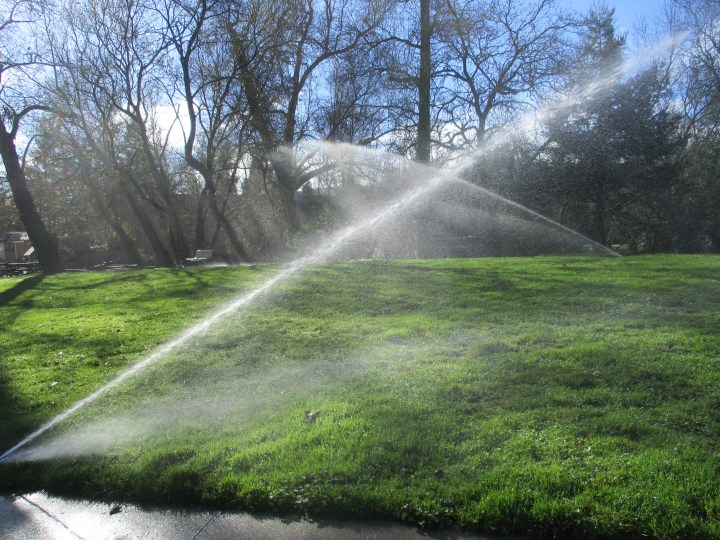
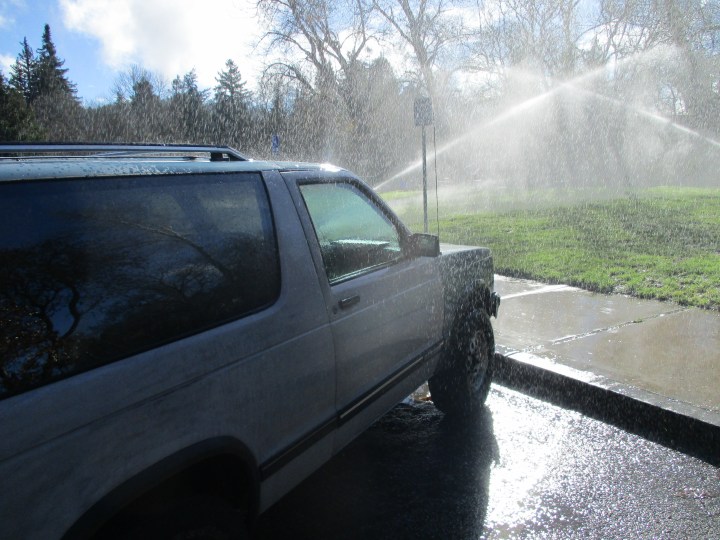
We have been getting quite a bit of rain here recently, and are expecting more rain through the next several days. The cloudy blue sky in the background of these pictures was the most blue sky we had seen in quite a while, and it lasted for only a few hours. The lawn in the park here is too swampy to walk on. Just in case there is a slight possibility that there is a small scrap of it that is not sufficiently swampy, it is getting watered generously.
I know mistakes like this happen, and that those who maintain this particular park are seriously overworked and understaffed. I am annoyed about this anyway. With all the modern technology available, why does the irrigation system not know that it is raining so much? If the irrigation system lacks the sort of technology that allows it to monitor the weather, why has no one told it that it is raining so much? If it can not be contacted by telephone, why does no one who know what the irrigation schedule is stop by to disable the system, or just close valves?! Okay, so I know they are understaffed, so I can not complain about it too much.
Nor should I complain about the parking lot getting watered. I know how easy it is for a sprinkler to get knocked out of adjustment. Besides, the windows are rolled up.
However, I am now a bit more concerned about the weather. Too much rain can cause flooding and mudslides. I already know what the forecast is; and now that the car got washed, the rain could get disastrous!p90116+

The Rose And Fall . . .

p90113Winter is for pruning. Any good native of the Santa Clara Valley knows that. It starts as soon as the first deciduous fruit trees defoliate and continues to the last minute rush to finish before the buds start to swell at the end of winter. It may seem like there would be no last minute rush now that all the orchards are gone, but there is so much in landscapes to prune that prioritizing and scheduling pruning takes a bit of effort. Just like we know that apples and pears can be pruned slightly later than apricots and prunes, in the landscape, we know that sycamores might be delayed until the birches are done. Naturally, I feel compelled to prune the flowering cherries and fosythias, but am almost content to wait until after they finish blooming in early spring. Of course, I cringe as I write this.
Roses are getting pruned now. I first finished a few scrawny hybrid tea roses, including a few ‘tree roses’. They really should be relocated to a sunnier spot, but not this year. Afterward, I did a row of climbing roses that are not exactly climbing the fence that they were planted against. They really should be moved too, but like the others, not this year. I still need to prune a bank covered with modern carpet roses. I am none too keen on them. Actually, I rather dislike them. However, of all the roses, they are the only ones that happen to be in the right situation, and are doing a nice job.
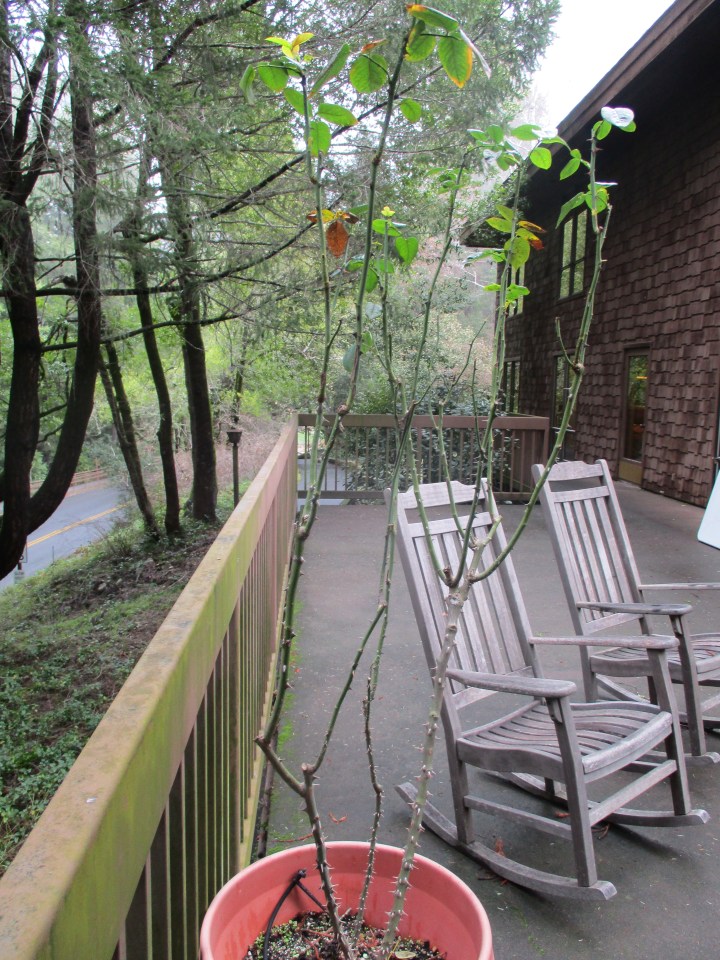
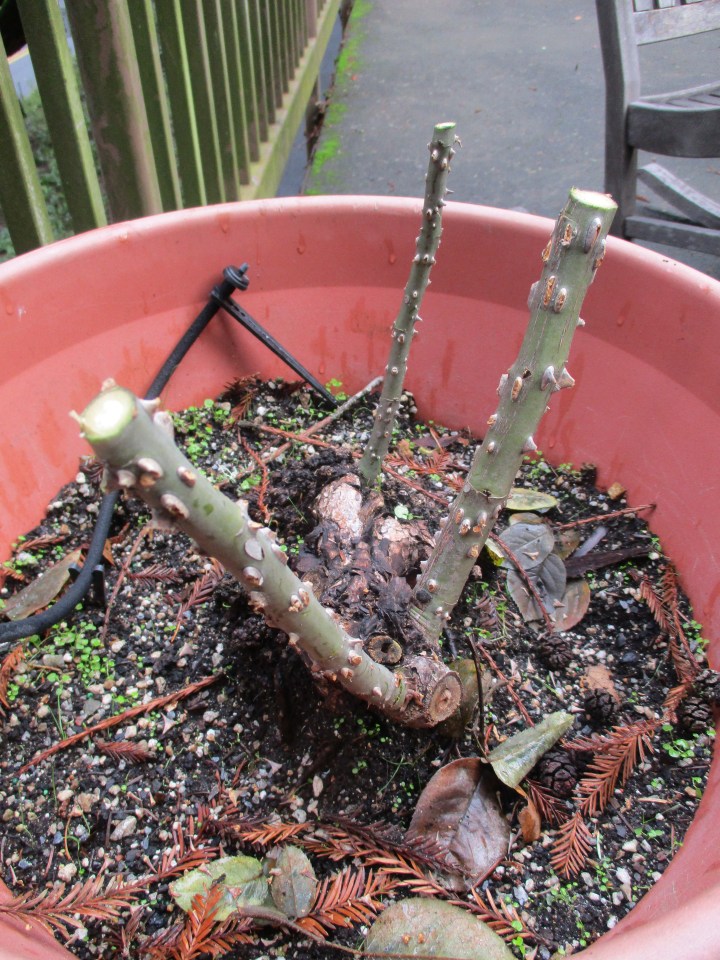
Just before I started with the first batch of hybrid tea roses, I pruned a single potted hybrid tea rose that is all alone on a deck across the street. I wanted to get it done when I thought about it so that I would not forget about it in the process of pruning everything else. It had bothered me for some time because it was so tall. I mean, I could not reach the top of it. The blooms up there were closer to upstairs windows than to anyone wanting to seem them from ground level. The supporting lower canes were bare of foliage, but well armed with nasty thorns. Honestly, I thought that the deck would have been more inviting without it.
Pruning it was rather simple; just three major cuts. Since the rose is where people mingle, I chopped the thorns just so that they are not so sharp. The remaining three canes were older than one year, but did not seem too terribly old. In fact, there was still a bud to cut back to on one of the canes. For the other two, I had to cut back to old petiole scars, expecting that dormant buds are still in there. That was about it.
The problem that I was not aware of is that the rose was left that tall intentionally because a former gardener liked it that way! Now I feel badly. I really thought that it had just been neglected. Like I mentioned, the canes did not seem to be several years old. They must have replaced older canes in just the last few years. Regardless, I can not put it back. In the partial shade there, it will probably grow back as tall within the year. I hope that the former gardener does not find out about it before then. I know that if someone did that to a roses that I had pruned in a specific manner, I would be really angry about it.p90113+

Litter

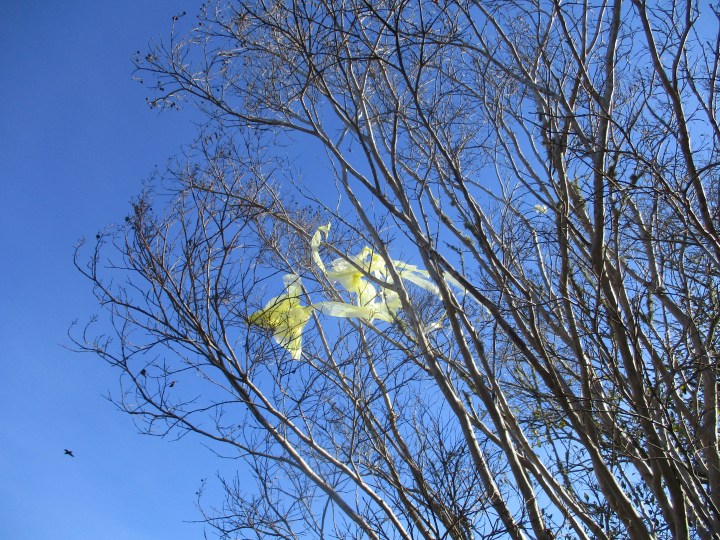
p90112kThose of us who work in public landscapes find litter in the strangest of places. It gets everywhere. It is not necessarily put everywhere. It just has a sneaky way of getting everywhere. By nature, litter blows about and gets washed into creeks and rivers that flow out to the bays and oceans.
Of course, there is much more litter in public spaces with the most traffic, such as city parks, than there is out in remote places where fewer people go, such as hiking trails in state parks. People are not necessarily slobs, and most put their trash into the appropriate receptacles. There just happens to be more litter where people are because that is where most of the trash that becomes litter happens to originate. Most litter that accumulates on the sides of roadways was blown there from the open beds of pickups. Not much is discarded out there intentionally.
One of the projects where I work is designing trash receptacles that wildlife can not get into. Racoons, which some of us know as ‘trash pandas’, are notorious for distributing large volumes of trash into the forest. Squirrels tend to be a bit more selective in taking mostly biodegradable bits of discarded fruit, and by unwrapping their finds before taking them away. Crows are actually worse than squirrels because they will take larger bits of trash merely because they find it to be amusing. Once out of the receptacles designed to contain it, trash gets blown about by the wind. In fact, wind alone can blow trash out of some types of trash receptacles, such as those fancy cylindrical steel mesh receptacles that suspend trash bags within, like those that are so common downtown in many cities. Litter is naturally an unnatural consequence of modern civilized society.