Beard Tongue

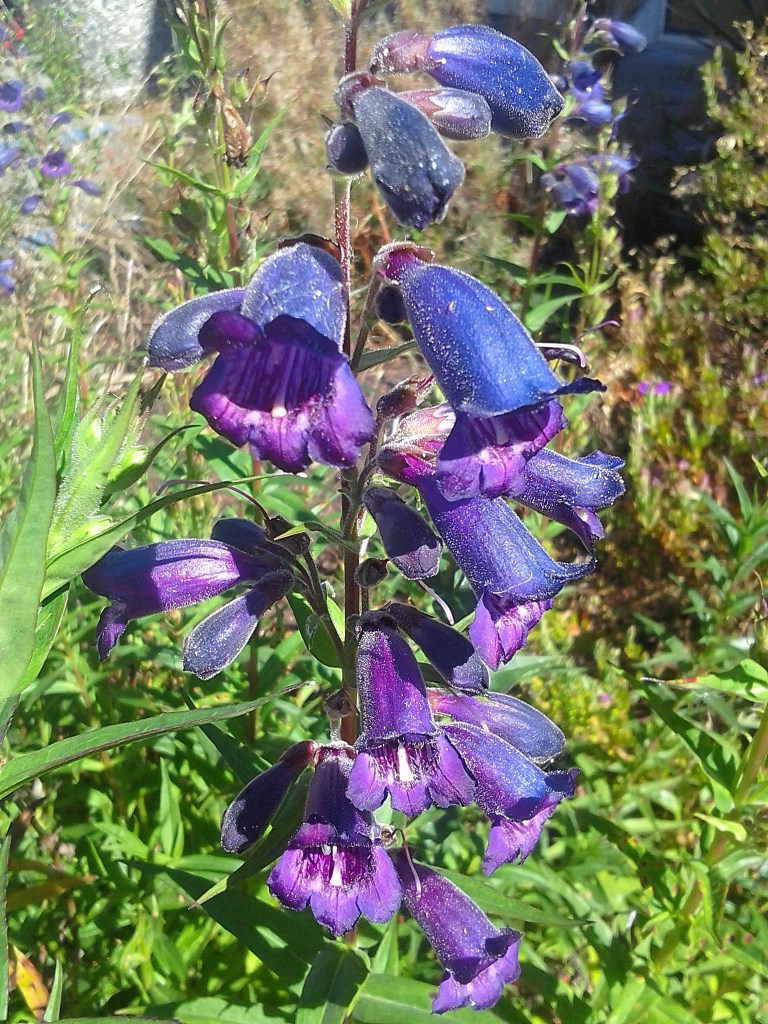
Beard Tongue does purple well.

With such a weird name, beard tongue is probably less commonly known by its common name than by the Latin name of Penstemon. Of the thousands of cultivars (cultivated varieties) that have been developed over the decades, most of those that are popular for home gardens are known as cultivars of Penstemon gloxinioides, even though their actual lineage is generally unknown. In recent years, other species have become more available.

Spikes of red, pink, purple or white flowers stand vertically above the foliage. Yellow flowers are still rather rare. Individual flowers are bisymmetrically tubular, with two conspicuous lips and a fuzzy tongue. Some beard tongue have relatively wide leaves and plump flowers, like really big snapdragons. Others have narrow leaves and thin flowers. Mature plants get only 1 to 2½ feet high and a bit wider, although some of the rare specie can get significantly larger.

Canna

Most cannas have more billowy bloom.

It grows from dormant rhizomes like a few of the popular early spring bulbs do. However, the many garden varieties of Canna are actually late or summer bulbs. They will become available after last frost, at about the time that early bulbs bloom. Also unlike early bulbs that mostly bloom prolifically once, Canna bloom sporadically from late spring until frost.

Canna foliage can be as appealing as the bloom. The big and lush leaves can be green, bronze, striped or irregularly variegated. ‘Australia’ has strikingly dark bronze foliage with red bloom. ‘Tropicana’ is striped green, yellow, bronze red and purplish pink, with orange bloom. ‘Stuttgart’ is irregularly variegated with white, with ribbony peachy orange bloom.

Of course, the bloom can be quite spectacular atop all that foliage too. Flowers might be pink, red, orange, yellow, creamy white, or a spotty combination of two such colors. Most popular cannas bloom with big and floppy flowers. Some have narrower and wispy floral parts. Bigger cannas can get taller than eight feet. All growth dies back after frost though. New growth regenerates fast in spring.

String Of Pearls

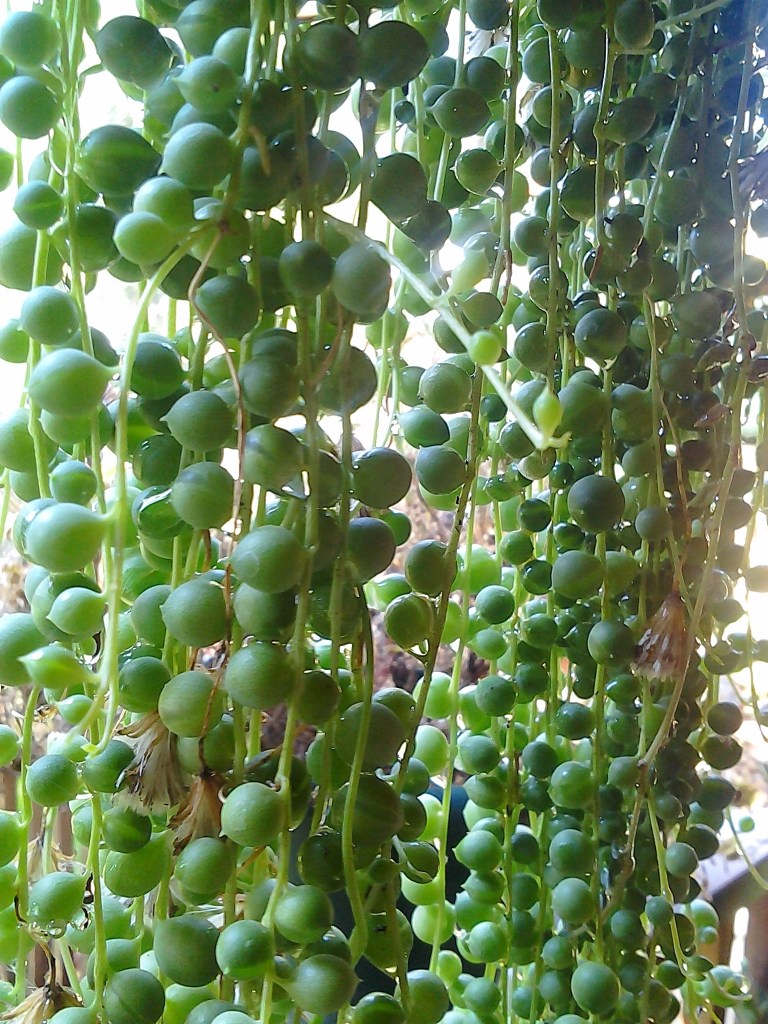
Weird but elegantly pendulous string of pearls likes to hang around. It cascades nicely from hanging pots or tall urns.

It is difficult to see how string of pearls, Senecio rowleyanus, is related to much more colorful daisies and asters. The small, fuzzy and sickly white flowers are not much to look at, and only clutter the elegantly pendulous and oddly succulent foliage. The round leaves are light bluish green, so actually resemble peas more than they resemble pearls. The stems are so very thin and limber that they can only stand a few inches high, but can cascade to three feet!

Although evergreen, stems of outdoor plants can be cut back while dormant through winter to promote fresher growth in spring. The pruning scraps are very easy to propagate as cuttings. Roots are undemanding and sensitive to rot, so should be allowed to get nearly dry between watering. Bright ambient light without too much direct sun exposure is best. Incidentally, all parts of Senecio rowleyanus are toxic.

Pansy

Violas are smaller versions of pansies.

This is one of the more familiar of winter annuals. Yet, pansy, Viola X wittrockiana, is not just one species. It is a diverse group of hybrids of a few species, and includes viola and Johnny-jump-up. Generally, viola and Johnny-jump-up have smaller and simpler flowers. Pansy generates relatively larger and more colorful flowers, with more intricate patterns.

The most recognizable feature of popular pansy is the distinctive floral patterns that look like floral faces. Individual flowers may display a few distinct colors within such patterns. Alternatively, flowers may be a single color. The color range includes white, blue, purple, yellow, orange, rusty red and black. Big flowers can be as wide as two and a half inches. 

Locally, pansy is a winter annual. The best bloom begins about now. If the coolest winter weather inhibits bloom, it is only temporary. Bloom is likely to resume before a lapse gets obvious. Although pansy is a summer annuals in other climates, it does not perform well in the locally arid climate during warm weather. Plants might get six inches tall and wide.

Cyclamen

Autumn is not far behind cyclamen.

The advantage of cyclamen, Cyclamen persicum, is nonconformity. Bloom begins in autumn when there are not many other flowers to provide color, and continues until spring. Cyclamen then defoliate and go dormant through summer while most other plants enjoy the warm weather. Even their red, pink, white, purple or salmon flowers are inside out, with petals flared back. The flowers can stand as high as six inches, just above the somewhat rubbery foliage. The rounded leaves are mostly dark green with silvery or gray marbling

If used as annuals for one season, cyclamen are uniform enough for bedding. However, if later overplanted with warm season annuals and allowed to stay through summer dormancy, regeneration the following season is variable, with larger and smaller plants, and some that do not survive. As perennials, cyclamen therefore work best in mixed plantings, where variety is not a problem. Cyclamen should be planted with their tubers about halfway above the soil level, and should not be mulched. Soil should be rich and drain well.

New Zealand Flax

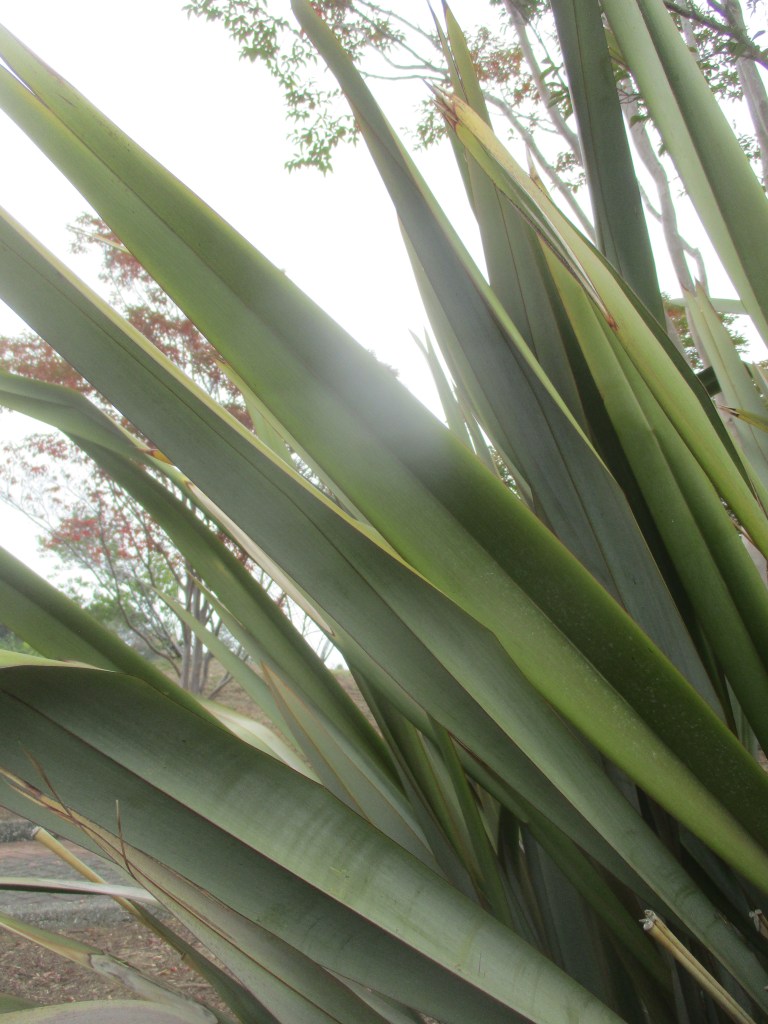
New Zealand flax provides bold texture.

Simple old fashioned New Zealand flax, Phormium tenax, has been popular on the West Coast for as long as anyone can remember. Big specimens are prominent in old pictures of Victorian era gardens. The upright and olive drab foliage gets as high as ten feet, and as broad as fifteen feet. Bronzed and variegated cultivars stay somewhat more compact.

Modern cultivars of New Zealand flax might be Phormium colensoi, or hybrids of the two species. They are generally even more compact, with more colorful foliage. Foliage may be olive green, greenish yellow, brownish bronze, rich reddish bronze or striped with like colors. Some bronze sorts are striped with tan or pink. ‘Yellow Wave’ has floppier foliage. 

New Zealand flax is a tough evergreen perennial. Its long and narrow leaves can be too fibrous to cut without scissors. These leaves grow as tall as they do from clumping basal rhizomes. Interestingly rigid floral stalks stand slightly higher than the foliage, with yellow or red bloom. After bloom, these floral stalks can be a delightful and bold dried cut flower, and work well with pampas grass bloom.

Japanese Aralia

The bold foliage of Japanese aralia is quite striking, whether kept low and dense, or suspended on taller lanky stems.

It may not grow too rapidly, but Japanese aralia eventually gets nearly eight feet high and wide, and commands a bold presence. The deeply and symmetrically lobed leaves can get as broad as a foot and a half, on long petioles (stalks). The foliage of ‘Vairegata’ emerges with a yellow border that turns pale white. ‘Moseri’ stays quite compact.

Plants grown for their foliage can be maintained by cutting the oldest stems to the ground as they begin to deteriorate, so that newer stems can replace them. Alternatively, lower growth can be pruned away as it develops to elevate the canopy and expose interior stems. However, individual stems do not last indefinitely, and will eventually need to be replaced by any convenient watersprouts.

Barberry

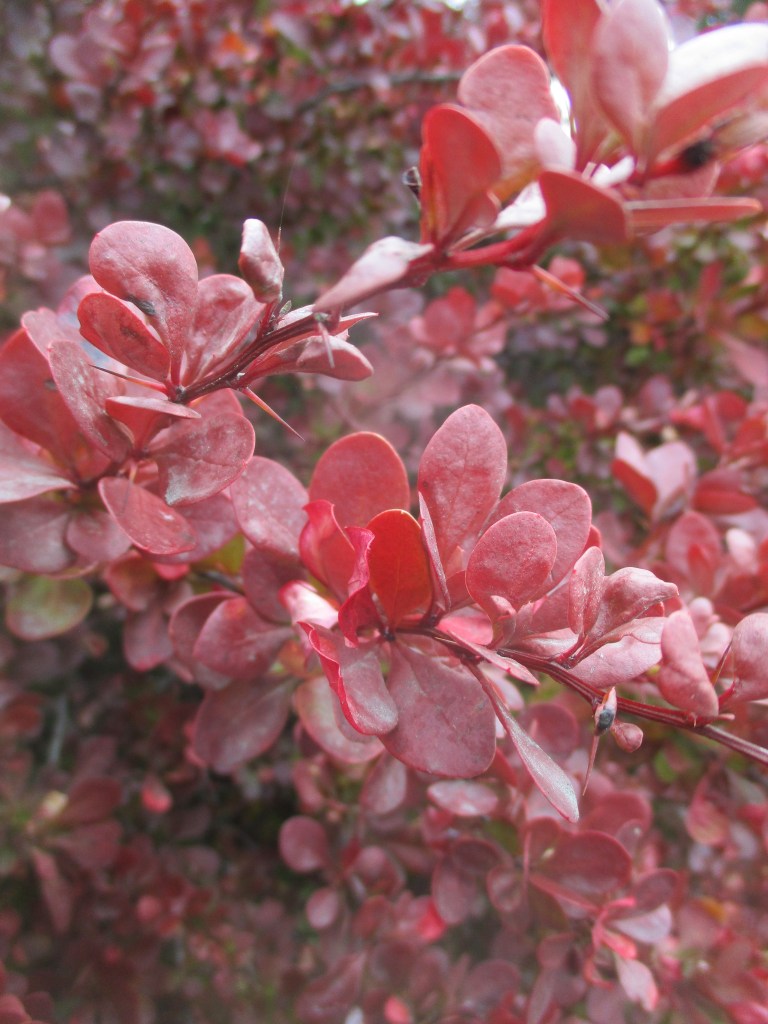
Delicate foliage hides sharp barberry thorns.

It certainly looks innocent enough. The modern cultivars of barberry, Berberis thunbergii, barely get taller and wider than six feet. Densely dwarf cultivars might not get much taller and wider than only two feet. Columnar sorts are quite narrow with mostly vertical stems. Even the old fashioned types get less than ten feet tall. Barberry is not exactly imposing.

However, like an angry chihuahua, it has a nasty bite. Its finely textured foliage obscures thin but very sharp spines. These spines are numerous enough to be visually appealing while the thin stems are bare through winter. Where necessary, they are sharp enough to inhibit encroachment. Unfortunately, these spines are annoying to handle while pruning.

Most popular cultivars of barberry have richly reddish or almost purplish foliage. Few are variegated with white. Some have bright yellowish chartreuse foliage. Formerly common green barberry is now rare. The small and neat leaves are obovate, and may seem to be circular. They turn vivid reddish orange through autumn, prior to defoliation during winter. Tiny red berries are rare.

Giant Chain Fern

Giant chain fern is remarkably resilient.

On the West Coast between British Columbia and Mexico, the largest native fern might be the giant chain fern, Woodwardia fimbriata. In sheltered and damp coastal forests, it can get taller than six feet, although it is typically about three feet tall and wide in home gardens. The lightly colored and almost yellowish green fronds generally stand upright and flare outward from the center. The foliage is doubly lobed and lacy, but quite substantial. The thick rhizomes spread rather slowly. Established plants are remarkably resilient. They can tolerate almost full sun exposure if watered enough. Those in partial shade can tolerate lapses of watering. However, they do not recover too readily from relocation or division.

Boston Ivy

Boston ivy gets colorful before autumn.

It is the ‘ivy’ of ivy league schools. Nonetheless, Boston ivy, Parthenocissus tricuspidata, is neither an ivy, nor indigenous to Boston. It is from eastern Asia, and is related to grape vines. It is related to Virginia creeper too, which is actually native to Boston, Virginia and the eastern half of North America. It has become popular locally for freeway sound walls. 

Boston ivy is an aggressive clinging vine that can climb to the top of a ten story building. Unfortunately, there are a few problems with that. It ruins wooden or painted surfaces, so can only climb concrete or masonry. It climbs over windows if it gets the chance. Thicket growth is difficult to remove if it is too high to reach. On rare occasion, mice can nest in it. 

Otherwise, Boston ivy works well on freeways. Although deciduous, its vines discourage graffiti. Even while bare, its texture helps to muffle sound. Its exquisite autumn foliar color might begin to develop as early as late summer, and lingers until frost. Boston ivy is quite resilient to neglect. Shabby plants generate fresh new growth after major winter pruning.