Winter Daphne

00311
Simple daphne flowers produce complex fragrance.

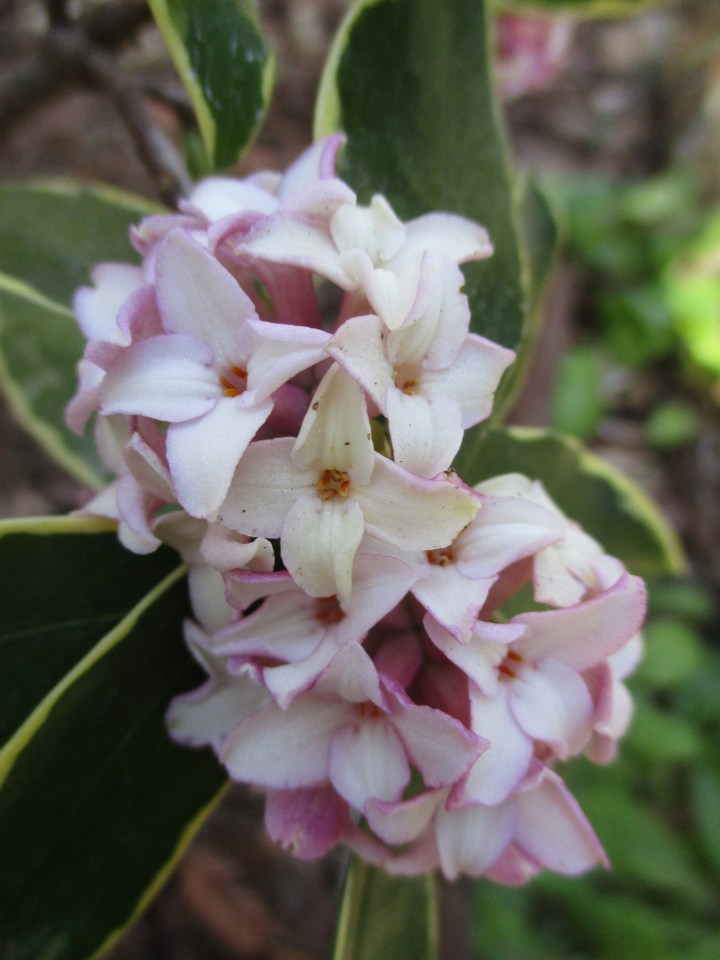
While winter weather is still cool and damp, winter daphne, Daphne odora, provides an alluringly fresh fragrance of spring. It is easy to dismiss the abundant but rather small domed trusses of tiny pastel pink flowers as the source of their formidable fragrance. Like so many fragrant blooms, daphne bloom is visually demure. Nevertheless, blooming stems are delightful with other cut flowers.

‘Aureomarginata’ is the most popular cultivar of daphne, and is the only cultivar available in many regions. The handsomely glossy evergreen foliage is variegated with yellowy white or light yellow margins. Mature plants get about two feet tall and about twice as wide, with a delightfully tame hemispherical form. They may get slightly taller with slightly less refined form where partially shaded.

Daphne prefers rich and loose soil, and with sufficient organic matter, will tolerate rather sandy soil. Partial shade might inhibit bloom somewhat, but is otherwise not a problem. Proper placement is important. Established daphne recover slowly from transplant. It is also important to be aware that even the healthiest of plants may live for only five years, and rarely live for more than ten years.

Barrel Cactus

50225
Barrel cactus spines are serious business!

‘Echino’ translates to ‘spiny’; so the genus name of barrel cactus, Echinocactus grusonii, means ‘spiny cactus’. Duh! The nearly spherical and furrowed (ribbed) plants are completely covered with stout and dangerously sharp spines. The most popular variety, known as golden barrel cactus, has pale amber yellow spines. Another variety has white spines. Tan or ruddy spines are rare.

Growth is quite slow. It takes many years for plants to get to three feet tall. Only plants that are quite mature bloom in spring or early summer with bright yellow or orange flowers that develop in a circle, like a halo around the top of the plant. Pink or red flowers are rare. Old plants typically develop a few pups (side-shoots), which may likewise take many years to bloom.

Like most cacti, barrel cactus wants a warm and very sunny location, and very well drained soil. If they do not get watered too much, they can stay potted for many years. However, because they are so nasty, they are not too welcome on porches or patios where most potted plants live. Because they are so heavy and difficult to handle, they are not as portable as they should be.

Sword Fern

00304
Sword fern looks like Boston fern.

This is not the native Western sword fern of forested and riparian regions here on the West Coast. This sword fern, Nephrolepis cordifolia, is native to Northeastern Australia, Southeastern Asia and Hawaii. It is naturalized in many regions beyond its natural range, and is considered an invasive exotic species in some regions. Its resiliency and reliability are appreciated in local gardens.

If it resembles the popular houseplant, Boston fern, it is because this sword fern is of the same genus. It just happens to prefer to be out in a garden rather than inside a home. Much or even most of the light green foliage stands more upright, rather than cascading from pots or elevated planters. Foliage of mature plants can get almost three feet high, with an even broader horizontal reach.

In fact, sword fern is notorious for sneaking around the garden and spreading wider than just a few feet. It is not particularly aggressive about. It creeps slowly but steadily until someone eventually notices that it has gotten a bit too prolific. Their abundant runners are wiry and strangely hairy, and produce small round tubers. Foliage can be yellowish if not watered enough in sunny situations.

Cymbidium Orchid

50218
Cymbidiums are the most familiar orchids.

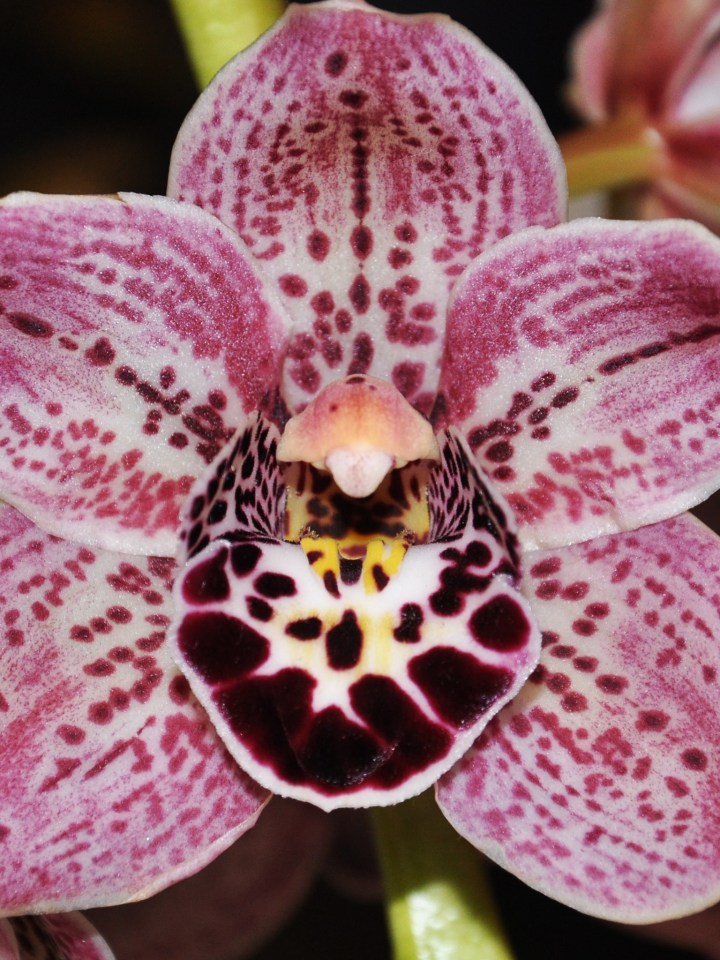
Of all the many and varied orchids, cymbidium orchids are the most popular because they are the easiest to grow. They are naturally terrestrial, so can be grown in the ground if the media (soil) is coarse and rich enough. (epiphytic orchids that naturally grow in crotches of trees want coarse bark in well drained pots.) They are also more tolerant of cool weather than tropical orchids are.

Plants with slightly yellowish leaves tend to bloom better. If the foliage is too dark green, it may not be getting enough sunlight. Regular application of fertilizer may promote bloom, although some plants do not seem to be too demanding. Watering may need to be as frequent as every three days through summer.

The arching flower stalks that begin to appear over winter may bloom for two months. They can be three feet tall, so stand well above the strap shaped leaves that get about two feet tall. Each stalk has many waxy flowers that can be two or three inches wide, in almost any color but blue. Most flowers are pastel hues of pink, lavender, yellow, orange, chartreuse, tan or white, and are intricately spotted and blotched.

Silk Tassel

00226
Pendulous blooms hang like delicate icicles.

With so many exotic species to enjoy in our gardens, it is easy to miss what might be growing wild just beyond. Silk tassel, Garrya elliptica, is endemic to coastal slopes within thirty miles of the ocean, between San Luis Obispo and Newport in Oregon. Yet, it seems to be more popular abroad than it is here at home. It is more adaptable to refined landscapes than most other natives are.

Silk tassel is more tolerant to supplemental irrigation than most other species from the same region are. It actually prefers to be irrigated at least occasionally through summer, particularly in drier and warmer climates. However, as a native, it is resilient to lapses of irrigation too. If necessary for form or confinement, awkward and obtrusive stems can be selectively pruned out after bloom.

Long and elegantly pendulous catkins of tiny pale grayish white flowers bloom late in winter or early in spring. After bloom, dried catkins linger prettily into summer. Garden varieties are male, with longer blooms. ‘James Roof’ can produce catkins nearly a foot long. Female plants in the wild bloom with shorter catkins. Glossy evergreen leaves are two to three inches long with wavy margins.

Ornamental Pepper

50211
Colorful but not flavorful ornamental pepper.

The red, orange, yellow, purple, white or almost black fruit of ornamental pepper that naturally develops in summer can be seen at any time of year because the plants are grown in artificial greenhouse environments. The peppers are usually small and narrow, and stand upright above their glossy rich green foliage. Some are narrower. Others are a plumper. Technically, the fruit is edible, but it is not as flavorful as peppers grown for culinary purposes.

Because the plants are sensitive to frost, they are more often grown as houseplants than out in the garden. In the garden, they need shelter to survive as perennials. As houseplants, they need warm and sunny exposure in order to bloom and develop fruit. They should be watered regularly, but only as their potting soil is starting to get dry.

50211thumb
Look but do not bother tasting.

Redtwig Dogwood

00219
Colorful bark for the wintry landscape.

Most dogwoods are popular for spectacular white or pink spring bloom prior to foliation. Redtwig dogwood, Cornus sericea, is an odd one though. It is a ‘dog’wood that is appropriately grown for colorful twig ‘bark’. It blooms later than other dogwoods, and after foliation. The one to two inch wide trusses of tiny pale white flowers lack the flashy bracts that make other dogwoods so colorful.

Another difference is that, unlike more familiar dogwoods, redtwig dogwood naturally grows as a shrubby riparian thicket rather than as a small tree. Long limber branches can grow to more than fifteen feet high only by leaning into other trees or shrubbery. In home gardens, they typically get coppiced or pollarded just before foliating in spring, to develop twiggy growth for color next winter.

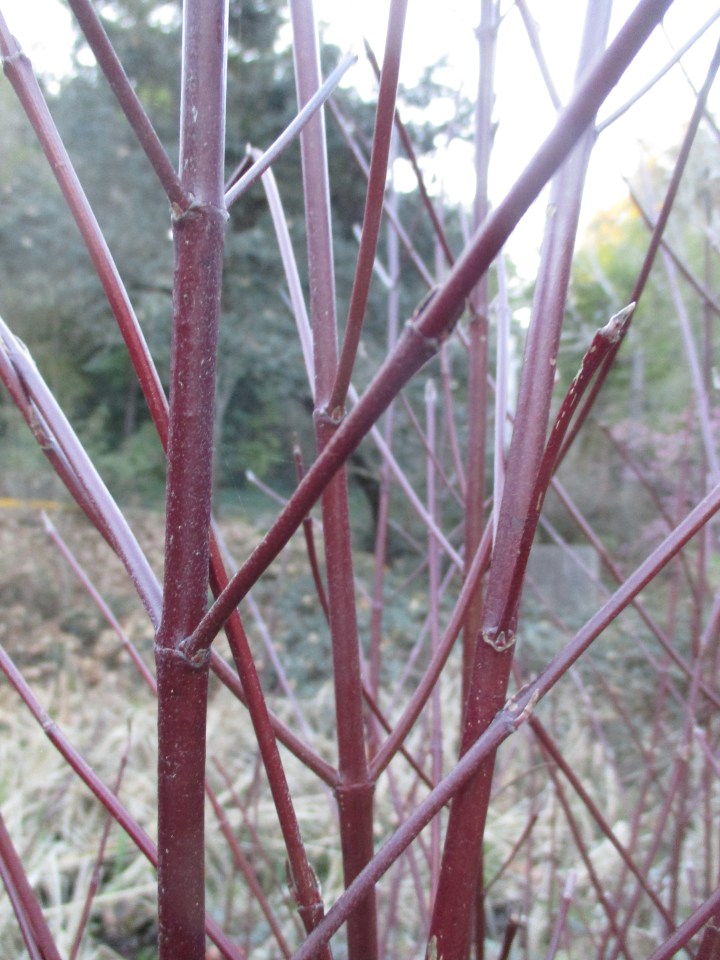
After a bit of autumn chill and defoliation, young stems of well exposed wild redtwig dogwood are a delightful glossy ruddy brown. Twigs of garden varieties are richer cinnamon red, rusty orange, soft yellow, orange blushed pale yellow, or yellowish green. Color is subdued by shade. Some cultivars have variegated foliage. Autumnal foliar color is more impressive in more severe climates.

Orange Clock Vine

50204
It is time for orange flowers.

Since it rarely gets cold enough here to freeze the foliage and stems, clock vine, Thunbergia gregorii, provides very orange flowers throughout the year, and will bloom more profusely in summer. It is very similar to the more traditional black-eyed Susan vine, but the flowers lack the prominent black throats. Relative to most vines, orange clock vines is rather docile. The wiry vines are happy to climb to the height of first floor eaves, but do not go much farther. Without support, the vines grow as small scale ground cover.

New plants prefer full sun exposure, even if they later choose to spread into partial shade as they grow. Shade inhibits bloom. Once established, orange clock vine does not need much water, and can actually survive in abandoned landscapes. Overgrown or neglected vines can get weedy in spots, especially if not regularly watered. Fortunately, they are easily renovated by severe pruning at the end of winter. Even if pruned almost to the ground, vigorous vines regenerate very efficiently.

California Sycamore

00212
California sycamore is a stately native.

California sycamore, Platanus racemosa, is a riparian species that wants to be a chaparral species. It seems to passively mingle with valley oaks and coast live oaks in chaparral regions. Yet, it stays close to rivers, creeks, arroyos, or low spots where water drains from winter rain. California sycamore does not follow waterways far up into forests though, as if it dislikes the deeper shade.

In urban situations, California sycamore is best for large scale landscapes, such as parks or medians of broad boulevards. It is complaisant enough for smaller landscapes, and tends to disperse roots too deeply to damage pavement. However, it grows so fast and so very big. Mature trees get to a hundred feet tall. Massive trunks are picturesquely irregular, with mottled tan and gray bark.

All the deciduous foliage generated by such large trees is generous with shade for summer, but stingy with color for autumn. Defoliation starts early and continues late, so is messy for a long time. Foliar tomentum (fuzz) is irritating to the skin, and much worse if inhaled. Anthracnose often deprives trees of their first phase of foliage in early spring. Although harmless, it makes another mess.

Weeping Bottlebrush

50128
Weeping bottlebrush blooms whenever it likes.

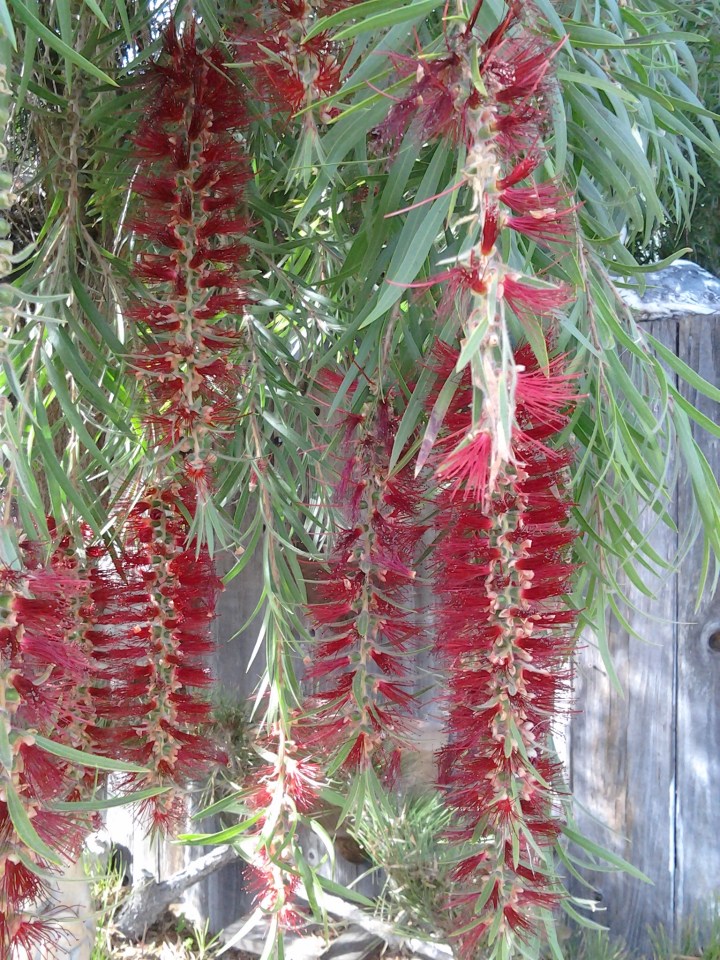
It is no wonder that it takes many years to get to fifteen feet tall, and may never get more than twenty feet tall. Weeping bottlebrush, Callistemon viminalis, may grow less than a foot a year, but seems to hang downward two feet. Because the stems are sculptural, and the bark has an appealingly rough texture, most weeping bottlebrush trees are grown with multiple trunks. The brick red bottlebrush flowers that bloom sporadically at any time of the year are more abundant early in summer. Established plants bloom more colorfully with a bit of water, but can probably survive quite a while without it. The evergreen leaves are narrow and mostly less than three inches long. Weeping bottlebrush needs good sun exposure.