Redtwig Dogwood

00219
Colorful bark for the wintry landscape.

Most dogwoods are popular for spectacular white or pink spring bloom prior to foliation. Redtwig dogwood, Cornus sericea, is an odd one though. It is a ‘dog’wood that is appropriately grown for colorful twig ‘bark’. It blooms later than other dogwoods, and after foliation. The one to two inch wide trusses of tiny pale white flowers lack the flashy bracts that make other dogwoods so colorful.

Another difference is that, unlike more familiar dogwoods, redtwig dogwood naturally grows as a shrubby riparian thicket rather than as a small tree. Long limber branches can grow to more than fifteen feet high only by leaning into other trees or shrubbery. In home gardens, they typically get coppiced or pollarded just before foliating in spring, to develop twiggy growth for color next winter.

After a bit of autumn chill and defoliation, young stems of well exposed wild redtwig dogwood are a delightful glossy ruddy brown. Twigs of garden varieties are richer cinnamon red, rusty orange, soft yellow, orange blushed pale yellow, or yellowish green. Color is subdued by shade. Some cultivars have variegated foliage. Autumnal foliar color is more impressive in more severe climates.

Orange Clock Vine

50204
It is time for orange flowers.

Since it rarely gets cold enough here to freeze the foliage and stems, clock vine, Thunbergia gregorii, provides very orange flowers throughout the year, and will bloom more profusely in summer. It is very similar to the more traditional black-eyed Susan vine, but the flowers lack the prominent black throats. Relative to most vines, orange clock vines is rather docile. The wiry vines are happy to climb to the height of first floor eaves, but do not go much farther. Without support, the vines grow as small scale ground cover.

New plants prefer full sun exposure, even if they later choose to spread into partial shade as they grow. Shade inhibits bloom. Once established, orange clock vine does not need much water, and can actually survive in abandoned landscapes. Overgrown or neglected vines can get weedy in spots, especially if not regularly watered. Fortunately, they are easily renovated by severe pruning at the end of winter. Even if pruned almost to the ground, vigorous vines regenerate very efficiently.

California Sycamore

00212
California sycamore is a stately native.

California sycamore, Platanus racemosa, is a riparian species that wants to be a chaparral species. It seems to passively mingle with valley oaks and coast live oaks in chaparral regions. Yet, it stays close to rivers, creeks, arroyos, or low spots where water drains from winter rain. California sycamore does not follow waterways far up into forests though, as if it dislikes the deeper shade.

In urban situations, California sycamore is best for large scale landscapes, such as parks or medians of broad boulevards. It is complaisant enough for smaller landscapes, and tends to disperse roots too deeply to damage pavement. However, it grows so fast and so very big. Mature trees get to a hundred feet tall. Massive trunks are picturesquely irregular, with mottled tan and gray bark.

All the deciduous foliage generated by such large trees is generous with shade for summer, but stingy with color for autumn. Defoliation starts early and continues late, so is messy for a long time. Foliar tomentum (fuzz) is irritating to the skin, and much worse if inhaled. Anthracnose often deprives trees of their first phase of foliage in early spring. Although harmless, it makes another mess.

Weeping Bottlebrush

50128
Weeping bottlebrush blooms whenever it likes.

It is no wonder that it takes many years to get to fifteen feet tall, and may never get more than twenty feet tall. Weeping bottlebrush, Callistemon viminalis, may grow less than a foot a year, but seems to hang downward two feet. Because the stems are sculptural, and the bark has an appealingly rough texture, most weeping bottlebrush trees are grown with multiple trunks. The brick red bottlebrush flowers that bloom sporadically at any time of the year are more abundant early in summer. Established plants bloom more colorfully with a bit of water, but can probably survive quite a while without it. The evergreen leaves are narrow and mostly less than three inches long. Weeping bottlebrush needs good sun exposure.

Canna

00205
Cannas are just dormant rhizomes now.

It is difficult to document the lineages of the countless modern garden varieties that have been hybridized from ten species of Canna. Straight species that are popularly grown within their native ranges are rare here. Some species are grown for their thick edible rhizomes. Many are grown for edible foliage. Some are employed to absorb toxins from contaminated riparian environments.

Garden varieties that are popular here are grown merely for their aesthetic appeal. The lushly big leaves are typically rich green, but might be bronzed, dark purplish bronze, or striped with yellow, bronze, creamy white or peachy pink. Large varieties get taller than eight feet. Compact types stay less than three feet tall. All foliage dies to the ground after frost, and grows back fast in spring.

The flashiest parts of canna flowers are actually very specialized stamens known as staminodes, which mostly obscure the very subdued petals and sepals. Red, orange, yellow, pink, salmon or very pale yellowish white bloom may be spotted or blotched. Flowers might be thin and wispy, or rather floppy and lush. Canna are popularly known as canna lilies, but are not at all related to lilies.

Black Mondo Grass

50121
The foliage really is this dark.

The deeply colored foliage of black mondo grass, Ophiopogon planiscapus ‘Nigrescens’, is about as convincingly ‘black’ as foliage can get. It is darker than bronze New Zealand flax, purple leaf plum or bronze coral bells. Only purple beech or chocolate coleus are comparable. The foliage is dark enough to contrast very well against lightly colored planters or gray concrete, so works well in urns or mixed perennials, and bordering walkways. If it gets enough sunlight, black mondo grass makes a nice small scale ground cover under Japanese maples.

Mature plants stand only about half a foot tall, and spread slowly. The happiest plants can get nearly twice as tall. The softly cascading leaves are only about a quarter inch wide. Small spikes of tiny pink flowers that sometimes bloom in summer would contrast nicely against the dark foliage, but are rarely seen above the foliage. Black mondo grass prefers rather rich soil and somewhat regular watering. However, as they disperse roots, older plants do not seem to mind too much if they briefly get a bit dry.

Orange

00129
Not all oranges are this orange.

Most of us know what oranges are. The color is, of course, orange. They are very juicy and sweet. Cultivars that are most popular for eating fresh, particularly ‘navel’ oranges, are easy to peel and separate into segments. Those that are best for juicing, such as ‘Valencia’, are a bit smaller with thinner rind, so are a bit sloppier to peel and separate. Such ‘sweet’ oranges are Citrus sinensis.

Richly tangy blood oranges are of the same species, but have blushed or deep red pulp and juice. ‘Sanguinelli’, although rare here, is nonetheless the most popular of the blood oranges, and is a traditional citrus component of sangria. The juicy fruit is compact, with tightly fitting thin skin, comparable to that of ‘Valencia’. Rarer ‘Moro’ produces plumper fruit that is easy to peel and eat fresh.

Sour and bitter oranges, which are very rare here, are mostly Citrus auranticum. Sour oranges, such as ‘Seville’, are used for marmalades and confections. Bitter oranges are used for flavorings and fragrances, such as ‘Bergamot’ for Earl Grey tea. Both bitter and sour oranges were less rare a century ago, when some were appreciated for alluringly fragrant bloom and handsome foliage.

Polka Dot Plant

50114
Polka dot plant is mostly pink.

Of all the tender perennials, polka dot plant, Hypoestes phyllostachya, is one of the lesser likely to survive winter outside, even if sheltered from the cold. Yet, it is actually becoming more popular as a warm season folliage plant for pots of small mixed perennials. It is a delightful small houseplant, either alone or as an understory plant to larger houseplants like ficus. As an understory plant, It is easier to work with if grown separately in small pots that can get nestled into moss on top of the soil of the larger plants. If it has a problem, it can easily be replaced or removed.

The foliage typically has so many pink spots that less than half of the foliar surface area is green. Some have white or darker reddish pink spots. The bloom is not as interesting as the foliage, and is not often seen. Roots like rich and evenly moist potting soil. The biggest plants are not much more than a foot high. Most stay less than half as tall. New plants are easy to propagate from cuttings. When things get warmer in spring, plants that have more stems than foliage can be cut back to regenerate.

Pear

00122
Properly pruned peartrees produce pears prolifically.

Ancestral species of modern pears grow wild from western Europe and northern Africa to eastern Asia. Long before they were domesticated and developed in China about three thousand years ago, their fruit was eaten by indigenous people. Farther west, dozens of cultivars were developed and popularized in ancient Roman societies. There are now more than three thousand cultivars.

Most pears that are popular in America are descendants of European pear, Pyrus communis. Asian pears, which are mostly descendants of Pyrus X bretschneideri and Pyrus pyrifolia, became a fad in the 1980s, and are still somewhat popular, particularly in California. Asian pears are generally rounder and firmer than the familiar ‘pear shaped’ European pears that soften as they ripen.

There are too many cultivars of pear for all to conform to similar characteristics. All that are grown for fruit are deciduous, and almost all have potential to exhibit remarkable foliar color in autumn. Abundant clusters of small white flowers bloom in spring. Floral fragrance of some cultivars might be unappealing. Semi-dwarf trees can get more than fifteen feet tall, so should be pruned lower.

Pears can be shades of yellow, green, red or brown, and might be blushed or russeted. They can be canned, dried, juiced, or eaten fresh.

Hobbit’s Pipe

50107
Jade plant has some weird cultivars.

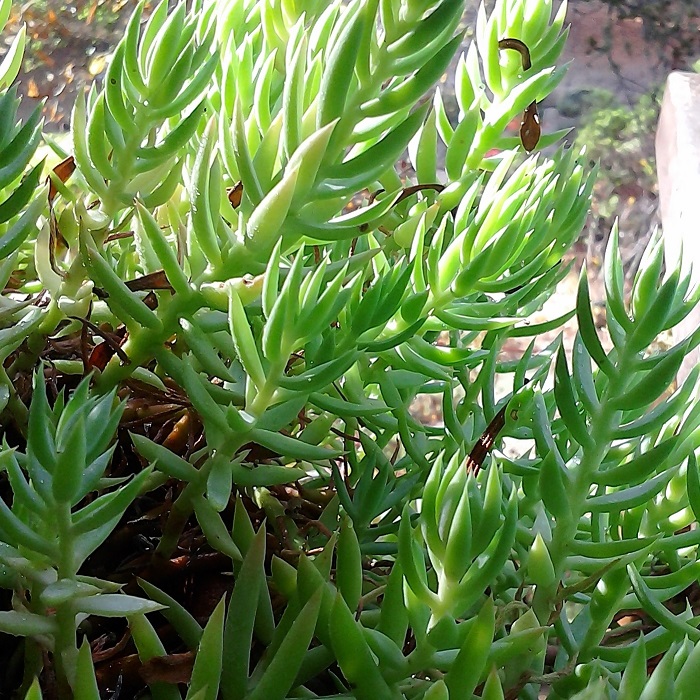
Good old fashioned jade plant has a few interesting cultivars (cultivated varieties) that exhibit variations of color, texture and form. Hobbit’s pipe, Crassula ovata ‘Hobbit’, is similar to classic jade plant in form and color. It is only slightly lighter green, and only a bit shorter. The succulent stems are just as plump and gray. The small and round-topped clusters of pale pink or white flowers that bloom sporadically are just as unimpressive. What is unique about hobbit’s pipe is the weirdly tubular foliage. Each leaf is rolled into a cylinder, with a hollow tip.

Mature plants do not often get much more than two feet tall and broad, although they have the potential to get twice as large. Because they are more sensitive to frost than other jade plants, hobbit’s pipe should be grown in sheltered spots, or pots that can be moved to sheltered spots through the coldest part of winter. Foliage that is too exposed during the warmest weather of summer can get roasted. Hobbit’s pipe can tolerate a slight bit of shade, so can be happy as a houseplant.