 What is it about Australian plants that makes them bloom in winter? Perhaps they think they are still in Australia where it is summer. Whatever the deal is, Geraldton waxflower, Chamaelaucium uncinatum, provides a scattering of small white, pale pink or lavender pink flowers from now until spring. It is no mistake that their bloom resembles that of New Zealand tea tree. They are related.
Geraldton waxflower is pretty serious about drought tolerance. It can rot and fall over it stays too damp for too long. It likes a warm exposure and well drained soil. It is normal for the tiny evergreen leaves to be somewhat sparse. Unfortunately, it is also normal for healthy specimens in ideal situations to die out within ten years or so. Mature plants can get a bit more than six feet tall and wide.
 Relative to other pines and evergreens that are commonly grown as living Christmas trees, the uncommon and even rare Austrian pine, Pinus nigra, would be a better option. If it gets planted too close to the home, as Christmas trees often do, it does not get big enough to cause major problems. Although much bigger in the wild, local trees may take decades to reach second story eaves.
 Pictures are probably prettier than the real thing. Australian fuchsia, Correa pulchella, really does bloom with pendulous soft pink flowers through winter when not much else is blooming. However, the flowers are quite small, and the color is rather hazy. The real appeal of Australian fuchsia is that it is so undemanding, and once established, only needs watering a few times through summer.
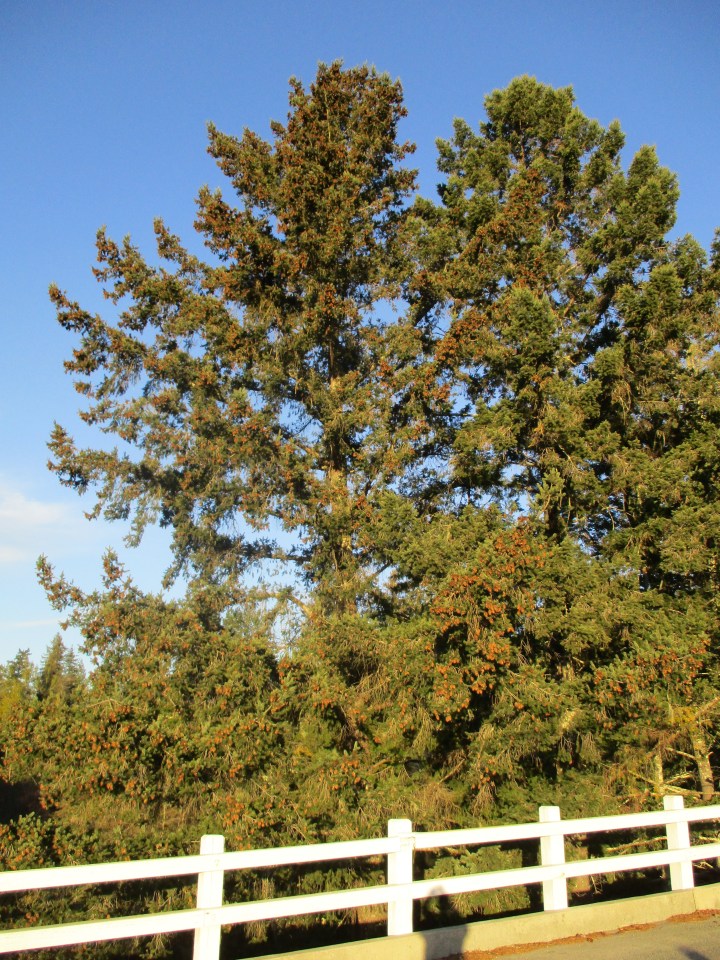 Even those of us who live nowhere near its natural range live closer to Douglas fir, Pseudotsuga menziesii, than we realize. Most of our homes are constructed from Douglas fir lumber. Although very uncommon in landscaped gardens, Douglas fir is the most popular Christmas tree here. Trees introduced for timber have naturalized in parts of Europe, Argentina, Chile and New Zealand.
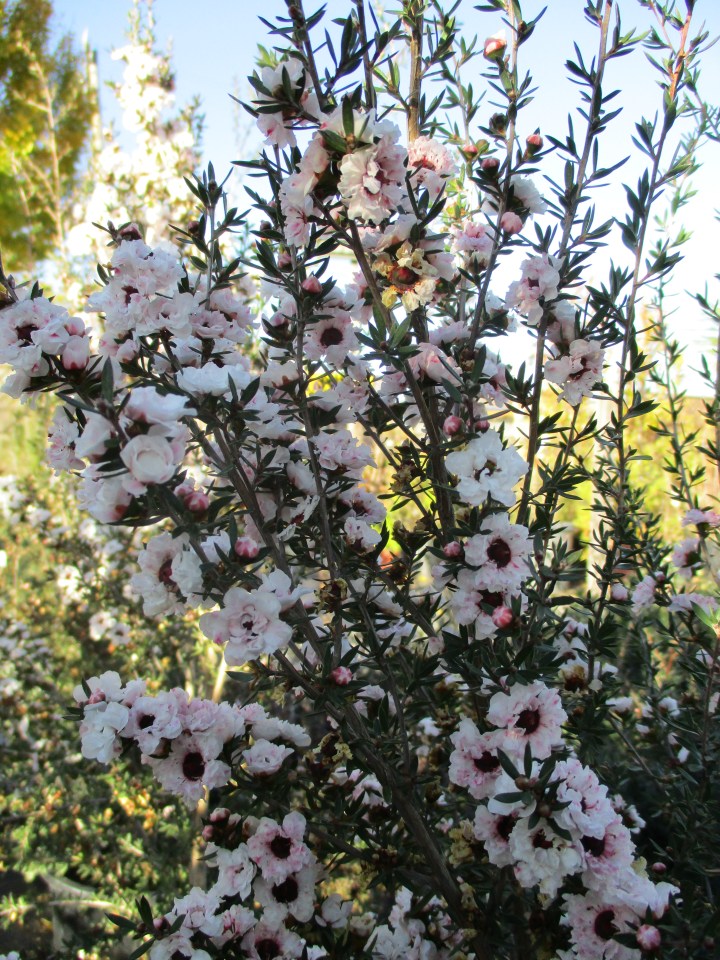 With such an odd variety of flowers blooming out of season, it should be no surprise that New Zealand tea tree, Leptospermum scoparium, decided to join the party. It starts blooming in phases in spring, and continues into autumn, so is not too terribly out of season. Besides, some varieties are known for spontaneous bloom phases at any time of year. Bloom can be pink, white or red.
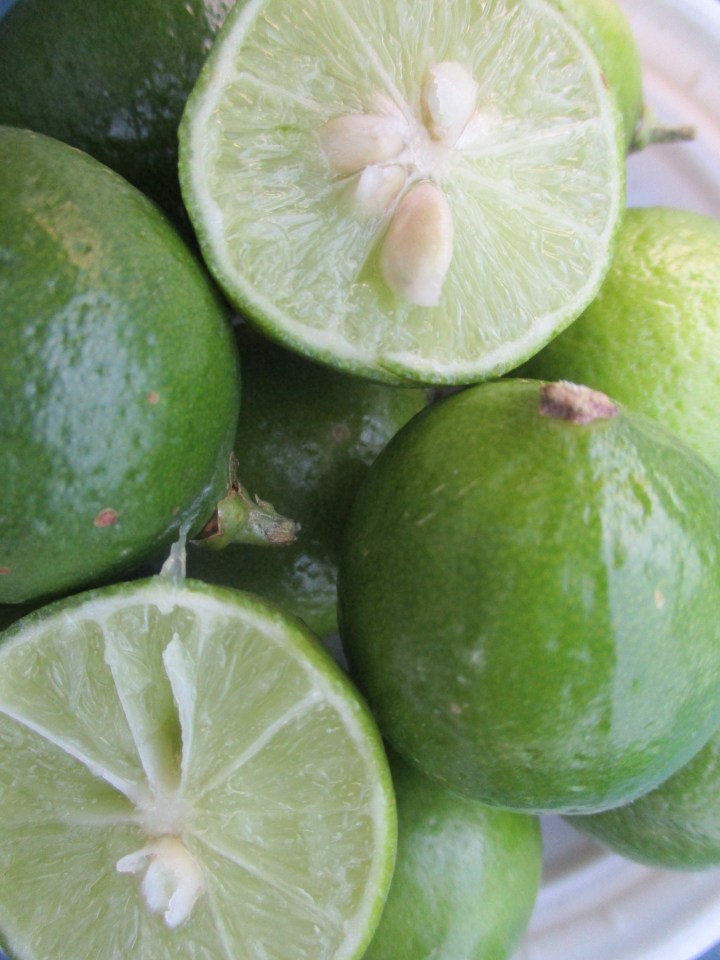 Those who can grow Mexican lime, Citrus aurantifolia, get to brag to their friends who can not, even if they are only a few miles away in slightly cooler spots. It really is marginal here. If it gets too cool in winter, it can defoliate. Frost can damage or kill the stems. Because it stays smaller than other citrus, Mexican lime happens to do well in large pots that can be moved to shelter for winter.
 Okay, so this is not really the time of year that they should be blooming. Torch lily, Kniphofia uvaria, should bloom in the middle of summer. However, without watering, naturalized plants bloom when the weather prompts them to. Some wait out the warm and dry summer weather to bloom as soon as they get dampened by the first rains. Others bloom in spring, before things get too dry.
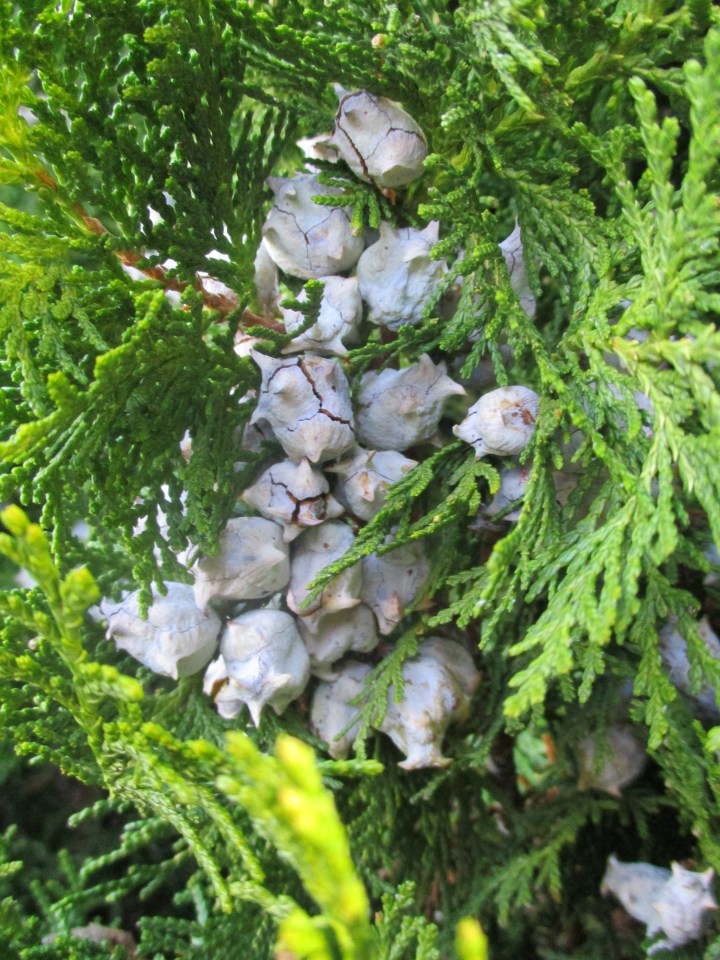 These pale blue . . . whatever they are, were just too cool to pass up without a picture. Technically, they are the ‘cones’ of dwarf golden arborvitae, Platycladus orientalis (formerly Thuja orientalis) ‘Aurea Nana’. They do not look much like cones. They are only about three quarters of an inch long, and are rarely as profuse as they are here. They are less appealing as they dry and turn brown.
 It is about time that someone reintroduced this technique! Blue Princess holly is now available together in the same pot as its male pollinator, Blue Prince holly (Ilex x meserveae ‘Blue Princess’ and ‘Blue Prince’). With careful pruning to prevent one from crowding out the other, both can coexist and provide profuse, bright red berries every winter, indefinitely. As the plants grow, their main trunks will eventually graft together.
 The Latin name is easy to confuse with the sacred flowers of an aquatic perennial from tropical regions of Asia, or a funny looking British sport coupe. Lotus berthelotii is a diminutive terrestrial perennial known as parrot’s beak. It gets only about a foot high, and spreads to only two or three feet wide. It cascades nicely from hanging pots, and is actually rarely planted out in the garden.
 Tony Tomeo