Oh my! This recycled article is difficult to revisit. These flowering crabapples are in even worse condition after three years of abuse. Meanwhile, the so-called ‘gardeners’ who so dutifully destroy them have not bothered to remove or even prune a feral glossy privet that grew among them and is now dominating.

 From the same landscape that, last autumn, was so dutifully deprived of its elegantly cascading rosemary and soon to be fiery autumn color of Boston ivy, https://tonytomeo.com/2017/11/05/serously/ , I procured these disturbing images of what results from of a serious disdain for flowering crabapple bloom. These trees were mentioned earlier in that article, but without such images. Similar victims were discussed last spring, https://tonytomeo.com/2018/03/07/the-good-the-bad-and-theyre-both-ugly/ and about a year agohttps://tonytomeo.com/2017/12/06/sculpture/ .
The landscape where these trees live was actually rather well designed, and for a few years, had been well maintained. Seriously! The flowering crabapples were likely selected because they would not get tall enough to encroach into the utility easement above. There were pruned as much as necessary to prevent them from developing into a nasty thicket like young flowering crabapples typically do, but without significantly compromising the spectacular bloom. They really were spectacular!
About six years ago, a…
View original post 326 more words
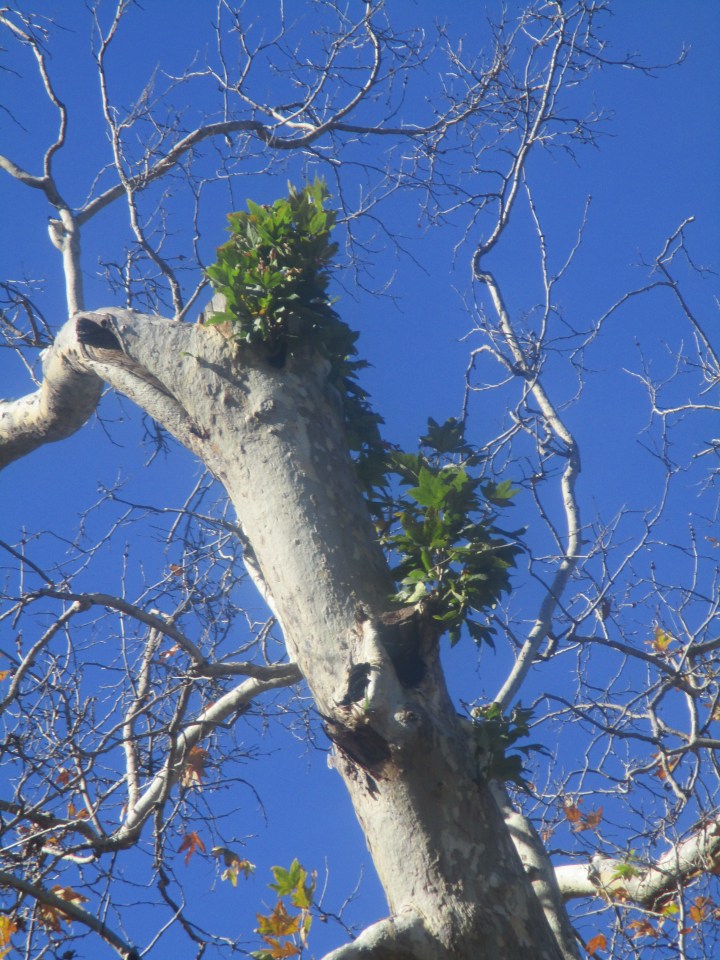 The tufts of small branches that so often develop where limbs were pruned from the trunks of a coast live oaks are sometimes referred to as ‘tumbleweeds’. They are about the same size as an average tumbleweed. By the time the get any larger, most of the smaller stems have subordinated and died out, leaving only a few more defined dominant stems, which will continue the process until even fewer or a single new branch dominates. Such tumbleweeds, as well as stems that originated from such growth, are weakly attached to the main trunks. They often get pruned off for the same reason that the limbs that were there before got pruned off, or because they are expected to be weakly attached. If they remain long enough, they can of course develop into new limbs.
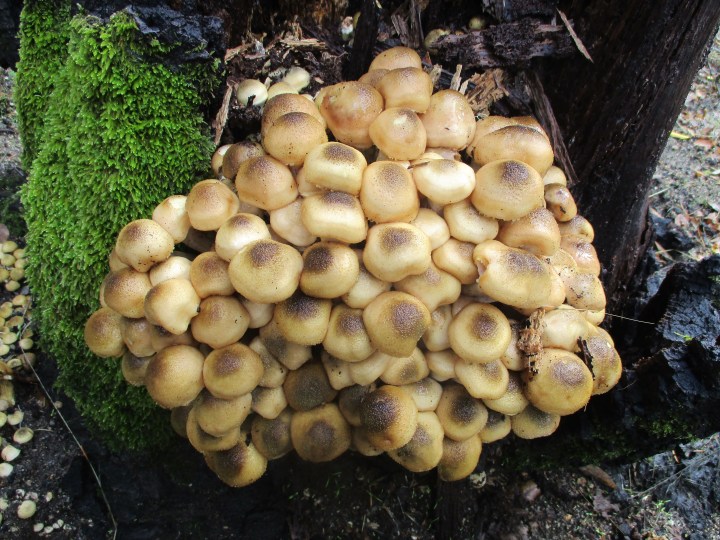 Is this Armillaria mellea, the dreaded oak root rot fungus? I really do not know. All the elements are here. The stump is that of a coast live oak. Bellow the stump there are the remains of roots. Those necrotic roots are undoubtedly decomposing as a result of rot. That rot is undoubtedly associated with this fungus. Furthermore, it fits the description of oak root rot fungus. The toasted spots were probably caused by weathering as the mushrooms started to develop while the weather was still warm and dry.
 This is a recycled picture that still annoys me. There was another that I did not want to use because it happens to be from a landscape that I sometimes work in.
 It is certainly not my favorite small tree. Actually, in most situations, I rather dislike it, which is why I sometimes accidentally spell it without the first ‘e’. It is a cop out; a micro tree that too often ends up where a larger and more respectable tree would be more appropriate. They are not shade trees. They are not not big enough for freeway landscapes or to be street trees on wide boulevards. They are not immune to diseases and insect infestations; and they commonly drop honeydew from aphid or scale infestation, and lose their bloom to powdery mildew. They are not ‘low-maintenance’, and really should be pruned more than they are, but will get you in trouble with the neighbors if you prune them as aggressively as they should be pruned.
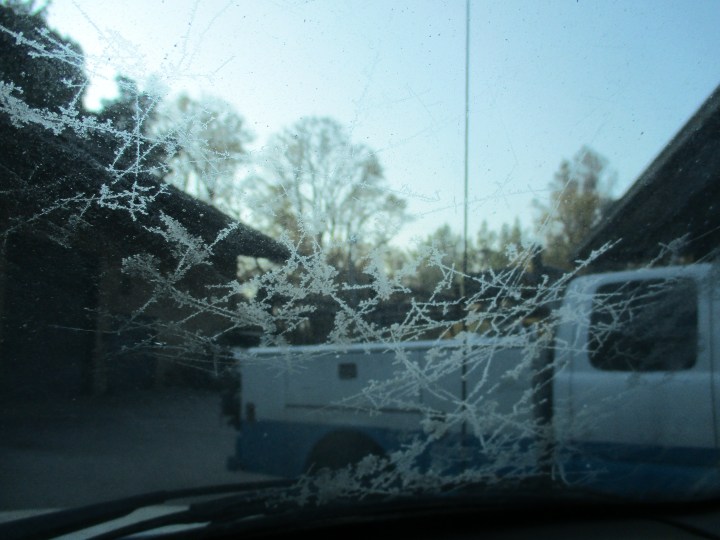 We do not get much frost here. This picture of the view through the windshield of one of the work vehicles was taken more than a week ago, while the humidity and the temperatures were still quite low. The sparse and angular pattern of the frost on the windshield is a result of the minimal humidity. There will be more frost later in winter, although there will not be nearly as much as most other climates get.
 For those who do not remember what ‘rain’ is, it is, it is those odd drops of water that fall so mysteriously from the sky in other regions. We get it here too, just very rarely, and almost exclusively within a limited season centered around winter. Rain tends to be affiliated with storms. The last storm moved through here last spring.
 One never knows what strange artifacts might be found out in public landscapes. It is amusing enough to find items discarded or simply misplaced long ago by former occupants of a home out in a private home garden. Public landscapes are even more interesting, since they collect debris and artifacts from many more people. Some landscapes have been doing so for a long time.
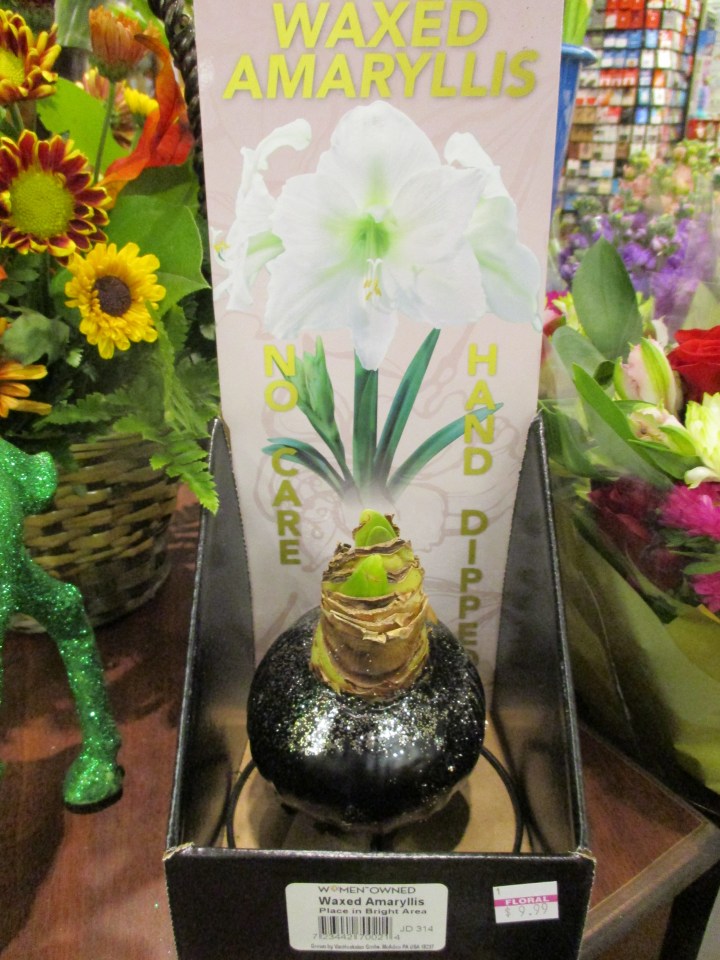 Two others have already written about this far more proficiently than I would have:
 Tony Tomeo